Rural Development
Class 11 Economics · Indian Economic Development · Chapter 5
163 members in the CBSE community
View all









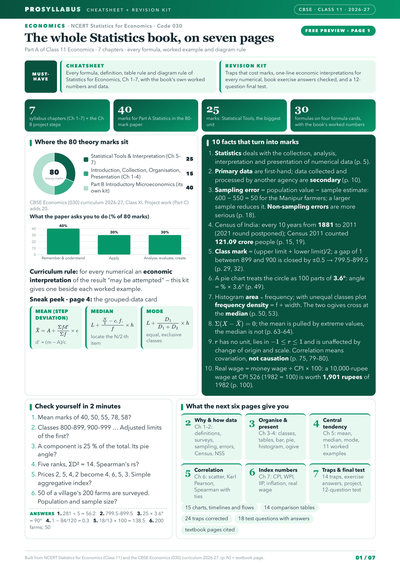
CBSE Class 11 · Economics
Mean to Index Numbers: Unit 3, 25 marks- Marks booster + cheatsheet: key concepts in 2 lines each, common traps
- 15 marks: Ch 1–4, data to diagrams
- 7 chapters: every formula, worked numbers
- Common mistakes, corrected
- Book exercise answers included
- Part C project route
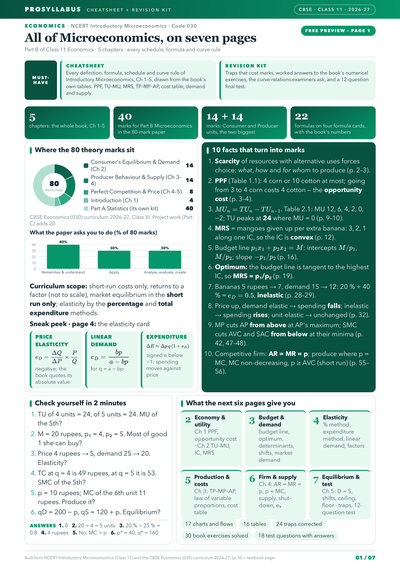
CBSE Class 11 · Economics
Consumer Behaviour: Unit 5, 14 marks- Marks booster + cheatsheet: key concepts in 2 lines each, common traps
- 14 marks: Production and Costs, Unit 6
- 8 marks: Market Equilibrium, Unit 7
- Common traps, corrected
- PPF, TU–MU, MRS and cost table drawn
- Demand and supply schedules from the book
Summary
Since more than two-thirds of India's people depend on agriculture and a large part of rural India remains poor, rural development — the all-round growth of village economies — is central to the nation's progress. It covers developing human resources (literacy, especially female literacy, and health), land reforms, productive resources, rural infrastructure such as electricity, irrigation, credit, marketing and roads, and measures to remove poverty. Agriculture growth decelerated after 1991, partly because public investment fell. Rural credit is vital: at independence moneylenders exploited farmers through high interest and debt traps, so India adopted social banking and a multi-agency approach in 1969, set up NABARD as the apex body in 1982, and built a network of commercial banks, regional rural banks, cooperatives and land development banks, supported by self-help groups that promote thrift and micro-credit. Agricultural marketing — assembling, storing, grading and distributing produce — is improved through regulation of markets, better infrastructure, cooperative marketing, and policy instruments like minimum support prices, buffer stocks held by the Food Corporation of India and the public distribution system, along with channels such as Apni Mandi and Rythu Bazars and the e-NAM portal. Diversification of crops and of livelihoods into allied activities — animal husbandry, fisheries and horticulture — and into non-farm work spreads risk and raises incomes; Operation Flood greatly expanded milk output. Organic farming offers an eco-friendly, sustainable alternative that avoids costly chemical inputs, though its early yields are lower.