Comparative Development Experiences of India and its Neighbours
Class 11 Economics · Indian Economic Development · Chapter 8
163 members in the CBSE community
View all











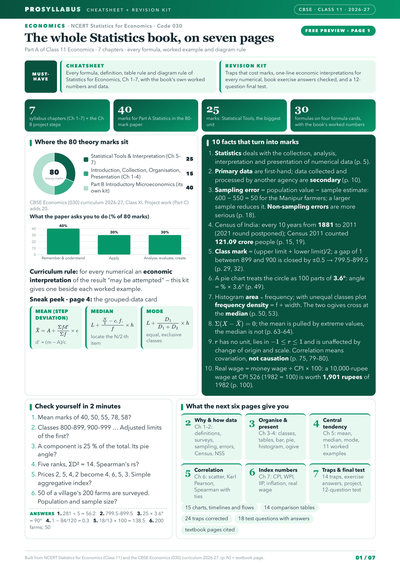
CBSE Class 11 · Economics
Mean to Index Numbers: Unit 3, 25 marks- Marks booster + cheatsheet: key concepts in 2 lines each, common traps
- 15 marks: Ch 1–4, data to diagrams
- 7 chapters: every formula, worked numbers
- Common mistakes, corrected
- Book exercise answers included
- Part C project route
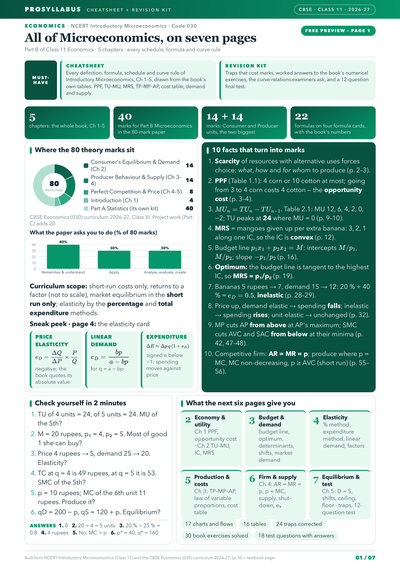
CBSE Class 11 · Economics
Consumer Behaviour: Unit 5, 14 marks- Marks booster + cheatsheet: key concepts in 2 lines each, common traps
- 14 marks: Production and Costs, Unit 6
- 8 marks: Market Equilibrium, Unit 7
- Common traps, corrected
- PPF, TU–MU, MRS and cost table drawn
- Demand and supply schedules from the book
Summary
In a globalising world, neighbouring developing countries study one another's development to understand their own strengths and weaknesses while sharing limited economic space in world markets. This chapter compares India with its neighbours China and Pakistan. All three set out at about the same time (India and Pakistan became independent in 1947 and the People's Republic of China was established in 1949) and all adopted planning, large public sectors and rising public expenditure, with similar growth rates until the 1980s. China, under one-party rule, brought all sectors under government control, launched the Great Leap Forward in 1958 with communes and backyard industries and the Cultural Revolution, then from 1978 introduced reforms in phases, dividing commune land among households, allowing township-and-village and private enterprises, using dual pricing and special economic zones. Pakistan followed a mixed economy with import substitution, a mechanised Green Revolution and nationalisation, then shifted in the late 1970s and 1980s towards denationalisation, helped by remittances, reforming in 1988. On demographic indicators, population growth is highest in Pakistan and lowest in China, aided by its earlier one-child norm. China leads on GDP, growth and most human-development indicators; its growth is driven by manufacturing and services while India's is driven mainly by services. Reforms came on China's own initiative in 1978 but were forced on India and Pakistan during crises; China's success owes much to early investment in health, education and land reform, while liberty indicators remain a concern there.