Employment: Growth, Informalisation and Other Issues
Class 11 Economics · Indian Economic Development · Chapter 6
163 members in the CBSE community
View all











CBSE Class 11 · Economics
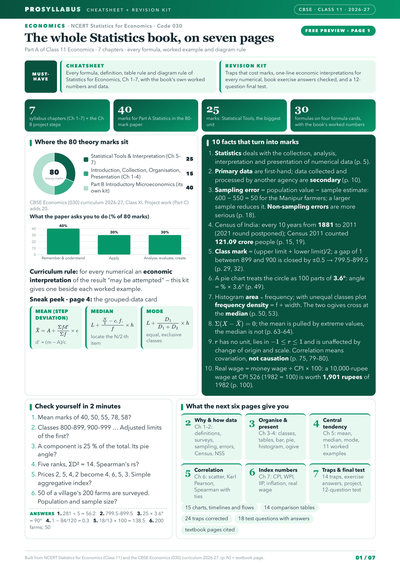
Mean to Index Numbers: Unit 3, 25 marks- Marks booster + cheatsheet: key concepts in 2 lines each, common traps
- 15 marks: Ch 1–4, data to diagrams
- 7 chapters: every formula, worked numbers
- Common mistakes, corrected
- Book exercise answers included
- Part C project route
CBSE Class 11 · Economics
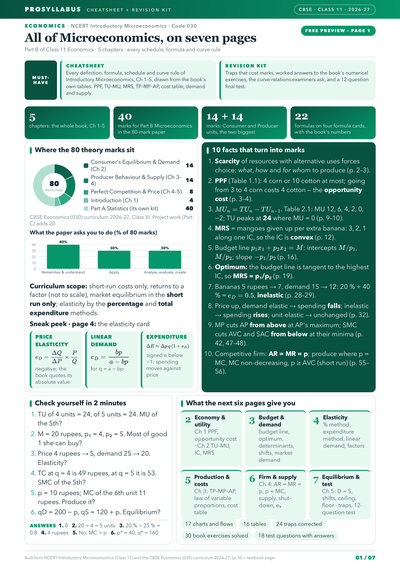
Consumer Behaviour: Unit 5, 14 marks- Marks booster + cheatsheet: key concepts in 2 lines each, common traps
- 14 marks: Production and Costs, Unit 6
- 8 marks: Market Equilibrium, Unit 7
- Common traps, corrected
- PPF, TU–MU, MRS and cost table drawn
- Demand and supply schedules from the book
Summary
A worker is anyone engaged in an economic activity, including the self-employed and those who help main workers. India's workforce was about 545 million in 2022–23, of whom roughly two-thirds were rural and about three-quarters were men; the worker-population ratio is higher in rural than urban areas and much higher for men than for women. Workers fall into three categories — the self-employed, who form the largest group, casual wage labourers, and regular salaried employees. By industry, the workforce is split across the primary, secondary and service sectors, with the primary (mainly agriculture) sector still employing the largest share, especially of women. Although the economy grew steadily after 1950, employment grew slowly, a pattern called jobless growth, and there has been growing casualisation as workers shift from regular salaried and self-employment to casual wage work, increasing their vulnerability. The workforce is also divided into a formal (organised) sector, the public sector plus private firms employing ten or more workers with job security and benefits, and a much larger informal (unorganised) sector that lacks such protection; nearly nine in ten workers are informal. Unemployment takes three forms: open, disguised (where more people work than are needed, as on family farms) and seasonal. The National Statistical Office, the Census and the Periodic Labour Force Survey provide employment data. The government generates employment directly and indirectly and through schemes such as MGNREGA (2005), guaranteeing a hundred days of wage employment to rural households.