
Checked 2 October 2026. Low to medium. DM has held at 21 questions in six of the seven official papers and in the 2027 pattern. Our type counts cover 2018-2024 only, because XLRI has not published the 2025 or 2026 papers.
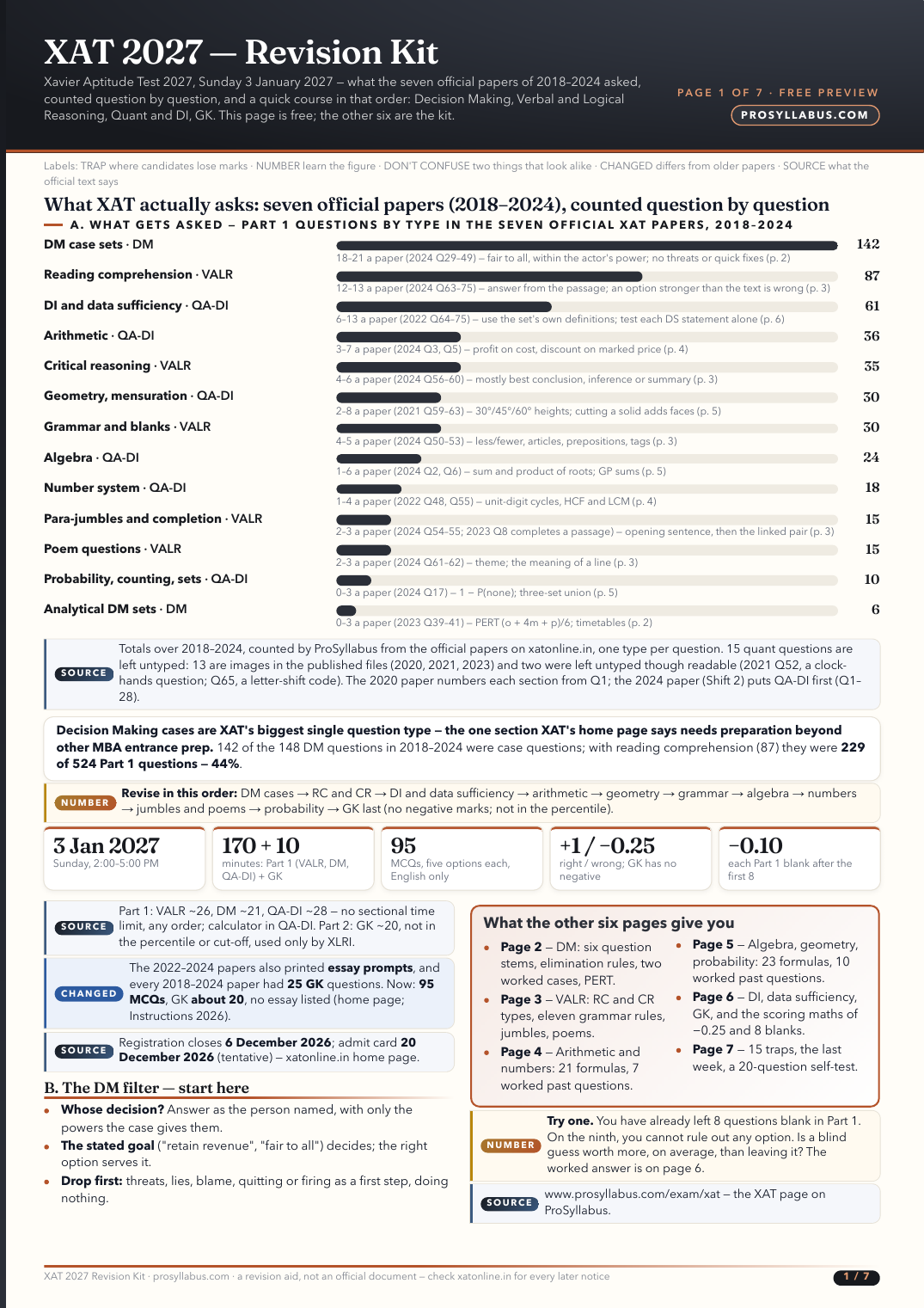
Decision Making is about 21 of the 75 Part 1 questions in XAT 2027, and it is the section XLRI itself singles out: its home page says "No extra preparation required – aligned with other MBA/PGDM entrance prep, except for the decision-making section". Across the seven official papers from 2018 to 2024 there were 148 DM questions. We read every one of them: 142 were case-lets, short situations from work, business, public life or family asking what someone should do or which fact bears on a choice, and only 6 were rule-based analytical sets. This guide sets out what XLRI says the section tests, how the questions are built, where to find each of them in the official PDFs, and how much of your 170 minutes they can take. ProSyllabus is an independent study site. It is not part of XLRI Jamshedpur, which conducts XAT for the Xavier Association of Management Institutes (XAMI), nor of any institute that uses XAT scores. Official notices and institute pages govern the exam and admission rules; the reading and revision methods here are ours.
Pattern: XAT home page. Counts: our question-by-question reading of the official papers on xatonline.in.
What XLRI says Decision Making tests
There is no detailed DM syllabus. The official material describes the section in a sentence or two, and the three descriptions below are all there is.
| Official source | What it says DM covers |
|---|---|
| XAT home page and overview | Scenarios from personal and professional life; critical thinking, problem-solving and prioritisation |
| XAT mock-test page | Ethical dilemmas through decision-making scenarios |
| XAT home page, preparation note | No extra preparation required beyond other MBA entrances, except for the decision-making section |
Read together, the official lines point to judgement in situations, not to a body of knowledge. That matches what the papers contain: there is nothing to memorise, but there is a recognisable way the questions are built, and it can be practised.
Case-lets and analytical sets, year by year
Our classification of the official papers. An analytical set is a group of questions solved from rules and numbers (a timetable, activity times); every other DM question is counted as a case-let.
The analytical sets are rare and short. In 2018, questions 39 to 41 were built on a train timetable: the minimum time to deliver parcels and return, and which train to take. In 2023, questions 39 to 41 were built on activity times in the style of a project-scheduling (PERT) problem: an expected preparation time, a waiting time to announce, and the most variable activity. In the other five papers every DM question was a case-let.
Where each DM question is in the official papers
If you want to work through the real questions, these are the question numbers. The 2020 paper numbers each section from 1, so its DM questions are DM 1 to 21; the 2024 paper put DM second, after QA&DI.
| Paper | DM questions | Case-lets | Analytical set |
|---|---|---|---|
| XAT 2018 | 27-47 (21) | 27-38, 42-47 | 39-41 (train timetable) |
| XAT 2019 | 27-47 (21) | 27-47 | None |
| XAT 2020 | DM 1-21 (21) | DM 1-21 | None |
| XAT 2021 | 27-47 (21) | 27-47 | None |
| XAT 2022 | 27-47 (21) | 27-47 | None |
| XAT 2023 | 27-48 (22) | 27-38, 42-48 | 39-41 (activity times) |
| XAT 2024 | 29-49 (21) | 29-49 | None |
The 2019 file on xatonline.in is a scanned copy, and in our text of it the questions show four options rather than five; check the PDF itself if you work from it. XLRI publishes no answer keys for any of these papers, so any key you find is someone else's reading.
What the case-lets ask
A DM case-let is usually a paragraph or two about a person in a role (a manager, a school principal, a shop owner, a minister, a doctor, a student) facing a situation with more than one reasonable response, followed by two to four questions. We grouped the 142 case-let questions by what the question stem asks. This is our rough grouping by the wording of each stem, not an XLRI category, and some questions could sit in two groups.
| 2018 | 2019 | 2020 | 2021 | 2022 | 2023 | 2024 | What the stem asks | Total |
|---|---|---|---|---|---|---|---|---|
| 10 | 10 | 11 | 8 | 15 | 11 | 9 | The best action, response, decision or course of action | 74 |
| 4 | 5 | 6 | 12 | 1 | 3 | 11 | Which fact, argument, reason or piece of information supports, weakens or justifies a choice | 42 |
| 1 | 4 | 4 | 1 | 2 | 2 | 1 | Rank or order several actions, facts or steps | 15 |
| 3 | 2 | 0 | 0 | 3 | 3 | 0 | The least useful, least likely, most error-prone, or the exception | 11 |
About half the case-let questions ask for the best action. Most of the rest are closer to critical reasoning than to judgement: they ask which fact would strengthen, weaken or justify a decision, and the answer turns on logic rather than on values. The 2021 and 2024 papers leaned heavily that way, with 12 and 11 such questions. A smaller group asks you to put actions or facts in order, and a few are negatively worded, asking for the least useful or least likely option or the exception.
A handful of questions are hard to place. Our notes flag 2019 questions 37 and 38, 2020 DM questions 9, 20 and 21, and 2022 questions 27, 31 and 41 as borderline between groups. That does not change the overall picture.
The situations the case-lets are set in
The settings range widely: running a small business (a shop, a food stall, a franchise, a bakery), managing people inside a company (recruitment, promotion, complaints, a colleague who behaves badly), public administration and policy (a minister, a king in a fable-like setting, a housing authority), education (a school principal, a dean, a professor grading a team assignment), and social questions such as workplace harassment, hiring visually impaired staff, or a community food centre. Several cases ask you to balance fairness to one person against the rules that apply to everyone, or a short-term gain against a relationship or reputation.
How to read a DM question
What follows is our method, not XLRI guidance. First classify the stem: best action, evidence that strengthens or weakens a choice, ranking, or a reverse question such as least useful or except. On a best-action question, identify who decides, their authority and the stated budget, deadline or policy; compare only actions feasible for that person. On an evidence question, test the proposed conclusion against the new fact the stem supplies. On a reverse stem, an option that breaks a constraint may be the answer rather than one to eliminate. Only after identifying the stem should you compare the options. Do not carry a best-action elimination rule into every other question type.
Under the current five-option XAT format, a wrong Part 1 answer costs 0.25. If you truly narrow five options to four equally likely choices, a random answer has a small positive expected mark (+0.0625) before the skip penalty; that arithmetic is not a guarantee of accuracy or a reason to guess blindly. Older official files may show a different option count, including the 2019 scan noted above. Our four-option drills below are deliberately simplified reasoning exercises, so do not transfer their guessing odds to the exam.
Five error patterns to record after a DM case
A percentage correct tells you little about what to change. Our count above codes stem wording into four review lanes: best action, evidence about a decision, ordering, and reverse or exception wording. Name that stem family first. The five error labels below are uncoded editorial heuristics, not measured frequencies in the 148 questions and not XLRI categories. Role and constraint labels chiefly help with best-action stems; they do not automatically eliminate options on least/except or evidence stems. Keep the year and question number so that you can return to the official PDF rather than an unexplained coaching key.
| Error label | What happened | Repair |
|---|---|---|
| Role or authority leap | You picked an action the named decision maker cannot take, or imposed a penalty before checking facts | Write the decision maker, their authority and the next lawful or feasible step in one line |
| Broken case constraint | A persuasive option violates the stated budget, time, policy, relationship or information limit | Underline every explicit constraint; cross out options that fail one before weighing softer benefits |
| Stem-direction slip | You answered best action when asked for a weakening fact, or selected the strongest when asked for least useful | Mark the verb and any NOT, EXCEPT, LEAST or MOST before reading options |
| Unstated assumption in an action answer | You supplied a motive, authority or rule that the action stem did not give | Separate case evidence from your assumption. If the stem instead asks which new fact, if true, helps a decision, evaluate that supplied fact on its merits |
| Too much time on one case | You reread a paragraph without identifying a new fact, leaving easier Part 1 questions unseen | Mark the unresolved pair, move on within your chosen section budget, return if time remains |
For a best-action role error, the repair is not to memorise a universal “ethical” answer. In one case a manager may be able to suspend a process; in another, only an external authority can do so. The same surface option changes quality when the actor changes. Ask whether the action follows from this case's facts and is proportionate. If the stem instead asks for the least appropriate act, the overreaching option may be precisely what you should select. In a “which additional information, if true” stem, new facts are the object of evaluation; they are not forbidden merely because they were absent from the original case.
For an evidence question, first write the claim being tested. “This discount will bring new buyers” predicts a change in new-buyer behaviour. A fact about present buyers receiving the discount may weaken that claim, even if the discount remains affordable. A budget fact instead tests feasibility. These are different questions, and mixing them creates a tempting wrong option. A strengthening fact has to make the proposed conclusion more likely; a weakening fact has to make it less likely. Mere relevance to the setting is insufficient. This small causal check is why some DM stems resemble critical reasoning in VA&LR.
Four original DM decision drills
These are our own short teaching cases, not past XAT questions or an official answer key. For each, name the decision maker, underline the constraint and read the direction word in the stem before selecting an option. The feedback diagnoses a reasoning habit; actual XAT case-lets can have more subtle facts and five options.
Your selections stay on this page; this tool does not store a score or predict an XAT percentile.
The four drills deliberately use short cases, so they are a diagnosis of method rather than a measure of XAT readiness. After trying them, take one complete case-let from a verified official paper and time the reading plus all its associated questions together. Write down whether your first error came from identifying the actor, tracking a constraint, interpreting the stem or rejecting an option. Revisit the same case after two days without looking at an unofficial answer key; explain why each rejected option fails. If two options remain defensible, note the exact missing fact rather than inventing a universal DM rule.
Turn a past-paper case into an error repair
Use an official paper from the linked archive; these checkboxes are a private browser-only review aid.
0 of 6 done
Ticks are saved only in this browser on this device.
From free case method to compact revision
The case atlas and drills here are free. The separate XAT 2027 revision kit condenses Decision Making, VA&LR, QA&DI, GK and marking rules for a later review. See its first-page preview and current price before deciding. The kit is a ProSyllabus aid, not an XLRI publication, and its purchase is separate from quiz or membership access.
Preview the XAT revision kitA pacing budget for DM
XAT gives no sectional time limit, so DM takes as much of the 170 minutes as you let it. As a starting point only, our arithmetic: if Part 1 time were shared in proportion to question counts, DM would get 170 × 21 ÷ 75, about 47.6 minutes, a little over two minutes a question. Case-lets are long to read and short to answer, so reading time dominates.
| Budget (ours) | DM minutes | Per DM question | Left for VA&LR and QA&DI |
|---|---|---|---|
| Proportional share | About 47.6 | About 2.3 minutes | About 122.4 minutes for 54 questions |
| DM faster than average | 40 | About 1.9 minutes | 130 minutes for 54 questions |
| DM slower than average | 55 | About 2.6 minutes | 115 minutes for 54 questions |
Test these on full mocks rather than choosing one in advance. The official mock appears in your application dashboard after you apply, according to the XAT mock-test page. Whatever split you settle on, leave a few minutes at the end of Part 1 so that no question past your 8th blank goes unanswered, since each of those costs 0.10.
What this section is not
DM is not a test of management, law or ethics knowledge: the cases set out the facts you need, and the official descriptions name no subject content. It is also not a personality test: the questions have one keyed answer, even though XLRI does not publish the keys. And it is not the same as the Logical Reasoning part of VA&LR, although the fact-that-weakens questions are close cousins of critical-reasoning items. Candidates who have prepared for CAT will find QA&DI and VA&LR familiar; DM is where XAT is different.
Practise it, don't just read it
ProSyllabus does not yet have a Decision Making quiz. The one live XAT quiz is on reading comprehension inference, which trains the same careful reading of a stem that DM case-lets reward.
One XAT quiz is live on ProSyllabus today: Reading Comprehension Inference Questions Fundamentals, 10 questions. Its questions carry four options where the real XAT paper has five, so treat it as reading practice, not as a mock of the 95-question paper.
How many Decision Making questions are there in XAT 2027?
About 21, out of 75 in Part 1, according to the pattern on xatonline.in.
What does the XAT Decision Making section test?
XLRI describes it as scenarios from personal and professional life testing critical thinking, problem-solving and prioritisation, and its mock page mentions ethical dilemmas. There is no detailed syllabus.
Are XAT DM questions all case-lets?
Nearly. In our count of the seven official papers from 2018 to 2024, 142 of 148 DM questions were case-lets and 6 were rule-based analytical questions, three each in 2018 and 2023.
Is there a sectional time limit for Decision Making?
No. Part 1 has 170 minutes for VA&LR, DM and QA&DI together, with no sectional limits.
Where can I find XAT Decision Making previous year questions?
In the official papers for 2018 to 2024 on xatonline.in. DM is questions 27 to 47 in most years; 2020 numbers DM from 1, 2023 runs to 48, and 2024 has DM at 29 to 49.
Does XAT publish answer keys for Decision Making?
No answer keys are published with the past papers on xatonline.in.
Is there negative marking in XAT Decision Making?
Yes, the Part 1 marking applies: +1, -0.25 for a wrong answer, and -0.10 for each blank after the first 8 in Part 1.
Sources
- official — XAT home page (xatonline.in) — XAT 2027 dates, pattern table (VA&LR 26, DM 21, QA&DI 28, GK 20), marking (+1, -0.25, 0.1 per skip after the 8th), GK outside the percentile, 250+ B-schools, 100+ cities, single slot, new associates and XAMI member
- official — XAT mock-test page — DM "ethical dilemmas through decision-making scenarios"; GK as general awareness; mock link in the dashboard after applying
- official — XAT 2026 Overview (linked as the 2027 overview) — section descriptions, Part 1 and Part 2 marking, skip penalty under Part 1, GK used exclusively by XLRI, PwD 20 minutes per hour
- official — XAT FAQ — admit card 20 Dec 2026 (tentative), result about three weeks after the exam, no sectional time limits, on-screen scientific calculator, final-year dates, work-experience rules, separate XLRI application, BM covers both campuses
- official — Official XAT 2018 question paper
- official — Official XAT 2019 question paper (the published file is a scan)
- official — Official XAT 2020 question paper (each section numbered from 1)
- official — Official XAT 2021 question paper
- official — Official XAT 2022 question paper
- official — Official XAT 2023 question paper
- official — Official XAT 2024 question paper (header: 7 Jan 2024, Shift 2; order QA&DI, DM, VA&LR)
official = a document published by the conducting body. reported = a news or coaching site we could not check against an original. Where sources disagree this page says so rather than picking one.