
Checked 29 September 2026. Module names from IIBF’s JAIIB and CAIIB Rules & Syllabus 2026 (booklets dated February 2026) and the CAIIB Elective booklet dated 12.03.2026. IIBF revises the booklets from time to time; the current-developments cut-off moves every six months.
JAIIB and CAIIB have followed the revised syllabi since the May/June 2023 exams. IIBF announced them in a notice of 30 August 2022, and the current wording is in the JAIIB and CAIIB Rules & Syllabus 2026 booklets. This guide lays out every paper and every module in one place, using IIBF’s own module names. It also shows what has changed since the 2022 notice, because many pages still copy that notice or older material.
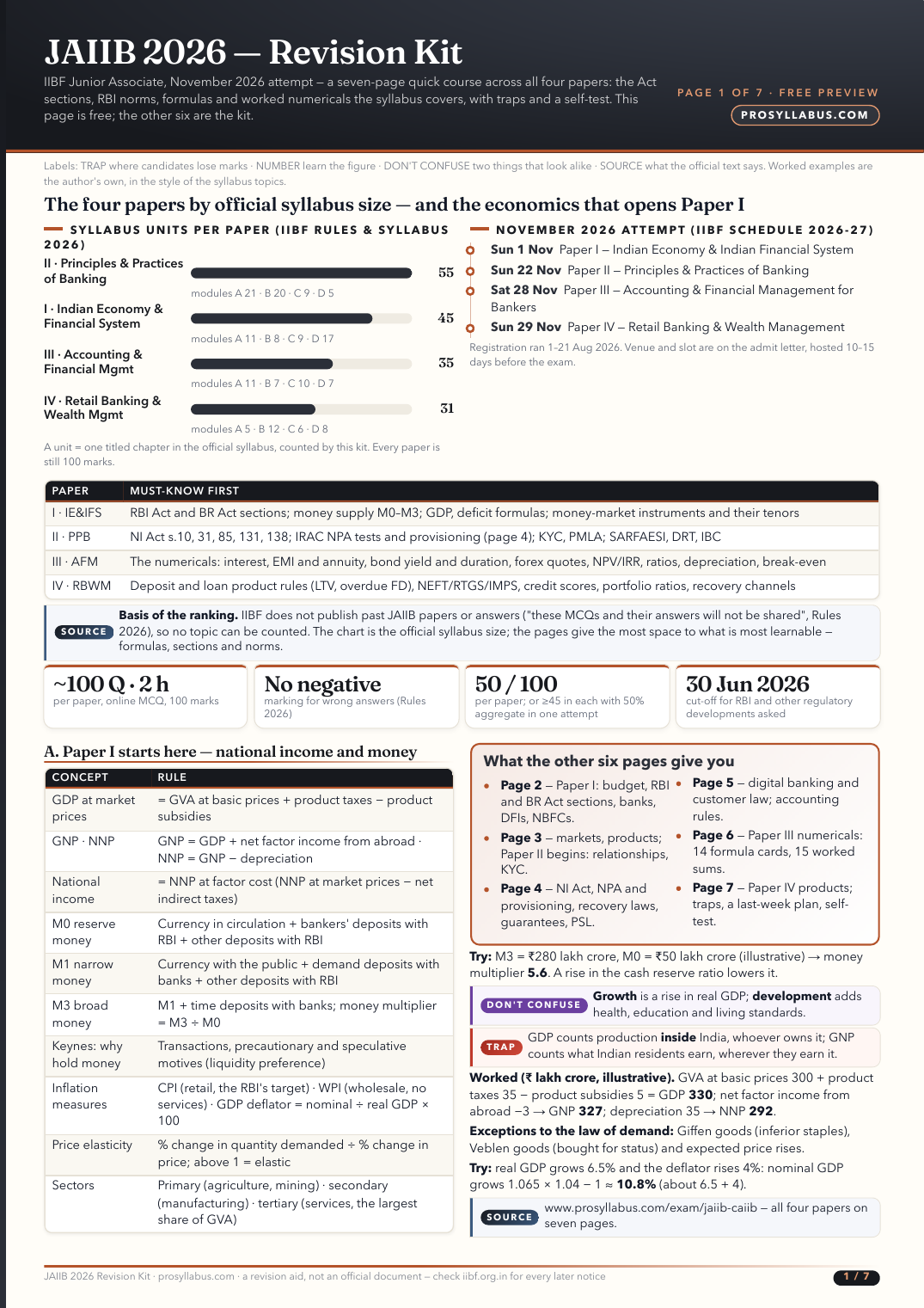
In short: JAIIB is four compulsory papers, each with modules A to D. CAIIB is four compulsory papers, each with modules A to D, plus one elective chosen from five, with four to six modules. Each paper is a separate 2-hour online exam of about 100 questions for 100 marks, with no negative marking.
IIBF JAIIB and CAIIB Rules & Syllabus 2026.
JAIIB: four papers, sixteen modules
| Module | Indian Economy & Indian Financial System | Principles & Practices of Banking | Accounting & Financial Management for Bankers | Retail Banking & Wealth Management |
|---|---|---|---|---|
| A | Indian Economic Architecture | General Banking Operations | Accounting Principles and Processes | Retail Banking |
| B | Economic Concepts Related to Banking | Functions of Banks | Financial Statements and Core Banking Systems | Retail Products and Recovery |
| C | Indian Financial Architecture | Banking Technology | Financial Management | Support Services – Marketing of Banking Services/Products |
| D | Financial Products and Services | Ethics in Banks and Financial Institutions | Taxation and Fundamentals of Costing | Wealth Management |
JAIIB covers the base a working banker needs. Indian Economy & Indian Financial System starts with the structure of the Indian economy and economic concepts, then moves to the financial system, its regulators and markets, and finally financial products and services. Principles & Practices of Banking covers the banker-customer relationship and deposit products, the functions of banks including principles of lending and types of credit facilities, banking technology from core banking to digital channels, and ethics.
Accounting & Financial Management for Bankers carries a large share of calculation-based topics in its syllabus: ratio calculation and interpretation, interest and annuity calculations, yield to maturity and bond duration. IIBF does not publish how many numerical questions each paper has, so we do not rank the papers. It covers accounting principles and standards, including Ind AS, preparing financial statements, financial management, including investment appraisal by discounted and non-discounted cash-flow methods, and taxation (income tax, TDS and GST) with basic costing. Retail Banking & Wealth Management covers retail banking and its products, recovery, marketing and delivery channels, and wealth management products and planning.
The same four papers make up the Diploma in Banking & Finance (DB&F), which is for eligible non-members. IIBF’s credit-transfer page warns that bank and FI employees who are eligible for ordinary membership and JAIIB should take JAIIB, not DB&F. Two of them, IE&IFS and PPB, also form two of the three papers of the Specialist Officers of Banks (SOB) certificate.
CAIIB: four compulsory papers, sixteen modules
| Module | Advanced Bank Management | Bank Financial Management | Advanced Business & Financial Management | Banking Regulations and Business Laws |
|---|---|---|---|---|
| A | Statistics | International Banking | The Management Process | Regulations and Compliance |
| B | Human Resource Management | Risk Management | Advanced Concepts of Financial Management | Important Acts/Laws & Legal Aspects of Banking Operations – Part A |
| C | Credit Management | Treasury Management | Valuation, Mergers & Acquisitions | Important Acts/Laws & Legal Aspects of Banking Operations – Part B |
| D | Compliance in Banks & Corporate Governance | Balance Sheet Management | Emerging Business Solutions | Commercial & Other Laws with reference to Banking Operations |
Advanced Bank Management is a mix. It opens with statistics, which brings numericals, then human resource management, credit management, and compliance and corporate governance. Bank Financial Management covers international banking and foreign exchange, risk management, treasury management, and balance-sheet management, including asset-liability management. Advanced Business & Financial Management covers the management process, advanced financial management, valuation and mergers and acquisitions, and emerging business solutions.
Banking Regulations and Business Laws is the law paper, and its module names are long and easy to mix up. Module A is regulations and compliance. Modules B and C are two parts of “Important Acts/Laws & Legal Aspects of Banking Operations”. Part A starts with the Prevention of Money Laundering Act, 2002, and Part B includes the Reserve Bank Integrated Ombudsman Scheme, 2021. Module D covers commercial and other laws with reference to banking operations. BRBL is also the third SOB paper.
CAIIB questions go beyond recall. The rules list five kinds: knowledge testing, conceptual grasp, analytical and logical exposition, problem solving and case analysis. Papers include case studies and caselets, and IIBF warns that some CAIIB papers may include numerical questions with no options, where the answer has to be typed in. There is no exemption from any CAIIB subject for other qualifications.
The five CAIIB electives
| Elective | Modules | Count |
|---|---|---|
| Rural Banking | A Rural India · B Financing Rural Development · C Priority Sector Financing and Govt. Initiatives · D Problems and Prospects in Rural Banking | 4 |
| Human Resources Management | A Human Resource Management · B Building an HR Strategy · C Motivation, Training and Skill Development · D Personnel Management and Industrial Relations · E Emerging Scenario in HRM | 5 |
| Information Technology & Digital Banking | A Introduction to Information Technology · B Systems and Design · C Banking Technology Applications and Digital Banking · D Information System Security Controls and Audit | 4 |
| Risk Management | A Risk and Risk Management Framework · B Credit Risk · C Market Risk · D Operational Risk · E Basel and RBI Guidelines on Risk Management · F Derivatives and Risk Management | 6 |
| Central Banking | A Rationale and Functions of Central Bank · B Central Banking in India · C Monetary and Credit Policies · D Management of Foreign Exchange Reserves and Constituents of Indian Financial Market · E Regulation, Supervision and Financial Stability · F Non-Banking Financial Companies and Primary Dealers | 6 |
You take one elective, and you can change it in a later attempt. The elective guide in this series compares the five, with IIBF’s figures on which ones candidates choose. Two electives overlap by name with compulsory modules: the HRM elective with ABM Module B, and the Risk Management elective with BFM Module B.
What changed since the 2022 notice
| Item | Before the revision | Aug 2022 notice | 2026 booklets |
|---|---|---|---|
| JAIIB subjects | 3 subjects (IIBF Annual Report 2023-24) | 4 compulsory | 4 compulsory |
| CAIIB subjects | 3 subjects (IIBF Annual Report 2023-24) | 4 compulsory + 1 elective | 4 compulsory + 1 elective |
| PPB Module B | - | Lending Operations of Banks | Functions of Banks |
| RBWM Module A | - | Introduction to Retail Banking | Retail Banking |
| Risk Management elective | - | Overview, Credit Risk, Operational Risk, Market Risk, plus an appendix | 6 modules: adds Basel and RBI Guidelines, and Derivatives and Risk Management |
| Central Banking elective | - | 5 modules | 6 modules: adds Management of Foreign Exchange Reserves and Constituents of Indian Financial Market |
| IT elective Module C | - | Applications in Banking | Banking Technology Applications and Digital Banking |
| Negative marking | - | 25% of the marks of the question | none (deferred by notice of 04.01.2023) |
| Keyed-in numericals | - | possible in some CAIIB subjects | possible in some CAIIB subjects |
The first revised-syllabus exams were in May/June 2023. IIBF’s 2023-24 annual report describes the change as an increase from three subjects to four for JAIIB and DB&F and from three to five for CAIIB, with content coverage “significantly enhanced”. The later module renames are small, but they matter if you are ticking off a syllabus from an old list, and study plans built on the 2022 notice will miss the two added Risk Management modules.
Where other pages get this wrong
In the 2026 booklets, the CAIIB Risk Management and Central Banking electives have six modules each, and PPB Module B is “Functions of Banks”.
Commonly published instead: Module lists copied from IIBF’s August 2022 notice: four content modules for Risk Management, five for Central Banking, and “Lending Operations of Banks” for PPB Module B.
IIBF’s Rules & Syllabus booklets for 2026 are the current text. The 2022 notice introduced the revised syllabi but is not the latest wording of the modules.
Track your modules
JAIIB and CAIIB module tracker
Pick your exam, and for CAIIB your elective. The tracker then shows only your modules and counts progress against them: 16 for JAIIB; for CAIIB, 16 compulsory modules plus your elective’s 4, 5 or 6. Tick a module when you have finished studying it.
0 of 16 done
Module names: IIBF JAIIB and CAIIB Rules & Syllabus 2026. Ticks and your choices are saved only in this browser on this device.
Current affairs: which developments are examined
Each paper can include questions on recent regulatory guidelines and developments. IIBF fixes a cut-off so candidates know what counts. For exams held from March to August, only guidelines and developments up to 31 December of the previous year are used. For exams held from September to February, the cut-off is 30 June. The table in the 2026 booklets still shows the 2025 examples, but the rule itself is clear. For the November 2026 JAIIB and December 2026 CAIIB papers, the cut-off is 30 June 2026 (our application of IIBF’s rule).
Related IIBF courses that share these papers
| Course | Who can take it | Papers | First-attempt fee |
|---|---|---|---|
| JAIIB | Ordinary members of IIBF (employees of member banks and institutions) who have passed class 12; clerical and supervisory staff can be allowed on the manager’s recommendation | IE&IFS, PPB, AFM, RBWM | Rs 4,000 |
| CAIIB | Members who have completed JAIIB or Part 1 of the Associate Examination | ABM, BFM, ABFM, BRBL + one elective | Rs 5,000 |
| Diploma in Banking & Finance (DB&F) | Eligible non-members. Bank/FI employees eligible for ordinary membership and JAIIB should take JAIIB; if they sit DB&F, the result or certificate is liable to cancellation | IE&IFS, PPB, AFM, RBWM (same as JAIIB) | Rs 3,500 |
| Specialist Officers of Banks (SOB) | Members or non-members who have passed class 12 or equivalent and are officers in a specialised cadre in a bank or financial institution | IE&IFS, PPB, BRBL | Rs 3,000 |
| CAIIB Elective (separate certificate) | Those who have completed CAIIB or Part-II of the Associate Examination, with membership subscription not in arrears; one elective at a time | any one of the five electives | Rs 1,100 per attempt |
A DB&F holder who later joins a member bank can convert to JAIIB for Rs 1,000 plus GST, according to IIBF’s credit-transfer page. The most recent credit-transfer window on that page ran until 4 pm on 5 September 2026 and has closed. JAIIB holders can also register with IIBF for the Professional Conversion Route to Associate Chartered Banker by paying a one-time Rs 1,000 plus applicable taxes; IIBF then forwards their details to the Chartered Banker Institute, and the candidate must complete that institute’s formalities. IIBF’s page does not present Rs 1,000 as the full cost of the credential. All fees are plus convenience charges and taxes where IIBF says so.
Study material
IIBF publishes official courseware, one book for each subject, sold through its publishers, and runs contact classes and e-learning. IIBF does not publish past question papers on its public website. Its mock test is a separate paid registration on a Sify-run site linked from IIBF’s menu: Rs 100 plus GST per subject, 100 questions in 120 minutes with no negative marking, one attempt per subject within a three-month login. The module list above, the courseware and the current-affairs cut-off are useful anchors for a plan, but IIBF’s rules warn against treating them as the whole field: the syllabus is “indicative”, the courseware “should not be considered as the only source of information”, and candidates are told to follow IIBF updates, RBI Master Circulars and Master Directions, IIBF Vision and Bank Quest, and the websites of RBI, SEBI, IRDAI and others. Treat any “previous year paper” that claims to be an official IIBF paper with caution.
Which edition of each book is on sale, the flipbooks, the official mock test and IIBF’s contact classes are compared in our books and study material guide; the calculation chapters and how to work them on the permitted calculator are in our numericals guide.
How many papers are there in JAIIB?
Four compulsory papers: Indian Economy & Indian Financial System, Principles & Practices of Banking, Accounting & Financial Management for Bankers, and Retail Banking & Wealth Management. Each has modules A to D.
How many papers are there in CAIIB?
Five: four compulsory papers (Advanced Bank Management, Bank Financial Management, Advanced Business & Financial Management, Banking Regulations and Business Laws) and one elective chosen from five.
What is Module B of JAIIB PPB?
Functions of Banks, in the JAIIB Rules & Syllabus 2026. The 2022 notice called it Lending Operations of Banks.
How many modules do the CAIIB electives have?
Rural Banking 4, HRM 5, IT & Digital Banking 4, Risk Management 6 and Central Banking 6.
What is the current-affairs cut-off for the November/December 2026 exams?
IIBF’s rule sets 30 June as the cut-off for exams held between September and February, so developments up to 30 June 2026 apply.
Does IIBF publish JAIIB or CAIIB previous year papers?
Not on its public website. It provides courseware, contact classes and e-learning, and sells a separate mock test (Rs 100 plus GST per subject, one attempt) on a Sify-run site.
More in this series
- JAIIB and CAIIB pass rate by year (IIBF figures)
- CAIIB elective: which one to choose
- JAIIB and CAIIB increments and PQP: pay calculator
- JAIIB and CAIIB attempts, time limit and pass rules
- JAIIB and CAIIB exam day rules and debarment
- JAIIB and CAIIB numericals on a basic calculator
- JAIIB and CAIIB result, marksheet and certificate
- IIBF membership for JAIIB and the full cost
- Official JAIIB and CAIIB books, mock test and classes
- After CAIIB: Professional Banker, CFP, Chartered Banker
- JAIIB / CAIIB notice board: official updates
Sources
- official — IIBF — JAIIB Rules & Syllabus 2026
- official — IIBF — CAIIB Rules & Syllabus 2026
- official — IIBF — CAIIB Elective (separate certificate exam) Rules & Syllabus (dated 12.03.2026)
- official — IIBF — Notice: JAIIB/DB&F/SOB/CAIIB introduction of revised syllabi (30 Aug 2022)
- official — IIBF — Notice of 04.01.2023 deferring negative marking
- official — IIBF — Annual Report 2023-24
- official — IIBF — Diploma in Banking & Finance page
- official — IIBF — DB&F to JAIIB credit transfer page
- official — IIBF — Specialist Officers of Banks page
- official — IIBF — JAIIB to Associate Chartered Banker
- official — IIBF Mock Test site (run by Sify, linked from IIBF’s menu), checked 29 Sep 2026
official = a document published by the conducting body. reported = a news or coaching site we could not check against an original. Where sources disagree this page says so rather than picking one.