
Checked 29 September 2026. Rules from IIBF’s JAIIB and CAIIB Rules & Syllabus 2026. Registration windows from IIBF’s exam pages and homepage notices, checked on 29 September 2026; they change every cycle and IIBF has extended and postponed them in 2026.
JAIIB and CAIIB are not one-sitting exams. IIBF lets you pass paper by paper, keep the papers you pass, and finish within a fixed window. The window is where most confusion lies. Candidates think a sitting they registered for and then missed is free (it is not), that the 45-mark rule works paper by paper (it does not), and that there is negative marking (there is not, since IIBF deferred it in January 2023).
Everything below comes from IIBF’s JAIIB Rules & Syllabus 2026 and CAIIB Rules & Syllabus 2026, which carry the same rules for both exams. The registration dates come from IIBF’s own exam pages and homepage notices, which we checked on 29 September 2026. Where IIBF’s schedule PDF and its live pages disagree, we print both.
IIBF JAIIB and CAIIB Rules & Syllabus 2026; IIBF notice of 04.01.2023.
The time limit: five attempts, three years, counted on application
The rule reads the same for both exams. You get five attempts, within a maximum of three years, whichever is earlier, starting from the date you register for your first attempt. The attempts need not be consecutive. The line that matters most is this: “Attempts will be counted when he/she applies for the exam, irrespective of whether the candidate appears for any examination or not.”
IIBF explains what this means in practice. Exams are held twice a year, so there are six sittings in a three-year window, and you can normally apply for any five of them. If you use all five attempts before three years are up, you must re-enrol. If three years pass before you have used five attempts, you must also re-enrol. Re-enrolling means starting again with no credits: subjects you passed earlier are not carried over.
Two consequences are easy to miss. First, registering and not appearing still uses an attempt, so if you are not going to sit, do not register. Second, one attempt covers the whole sitting. If you register for a sitting and sit two of the four JAIIB papers, that is one attempt, not half of one. Candidates debarred for unfair means also have their attempts counted during the debarment.
| Rule | What IIBF’s 2026 rules say | What it means for you |
|---|---|---|
| Attempts allowed | 5, need not be consecutive | Normally any 5 of the 6 sittings in your window |
| Time limit | 3 years from registration for the first attempt, or 5 attempts, whichever is earlier | The clock starts when you first register, not when you first sit |
| When an attempt is counted | When you apply, whether or not you appear | Registering and then not appearing still uses an attempt. Not registering uses none, but the three-year clock keeps running |
| Credits | Kept for each subject passed until the time limit expires | Pass two papers now, two later, and it still counts |
| Failing the time limit | Re-enrol afresh; no credit for subjects passed earlier | Every paper has to be passed again |
| Debarment | Attempts are counted during the debarment period | The window keeps running |
What leads to a debarment, and how long each one lasts, is set out in our exam-day rules guide.
The two ways to pass
Route one: score 50 out of 100 in a paper and you have passed it. You keep that credit until your time limit ends. Route two: “Candidates securing at least 45 marks in each subject with an aggregate of 50% marks in all subjects of the examination in a single attempt will also be declared as having completed the Examination.”
The words “all subjects” and “in a single attempt” carry the rule. The aggregate route works only when you sit every paper of the exam in the same sitting: four for JAIIB, five for CAIIB including the elective. You also need at least 45 in each and an average of 50 or more across all of them. It is not a paper-by-paper rule. A 47 in one paper, sat on its own in a later attempt, is simply a fail, however well you did in earlier papers.
This makes a real difference to strategy. A candidate who sits all four JAIIB papers and scores 52, 47, 58 and 46 has passed JAIIB, because each is at least 45 and the average is 50.75. A candidate who sat two papers last time and now sits the other two, scoring 47 and 58, has only one more credit. Sitting the full exam in your first attempt keeps the aggregate route open.
Pass-rule checker: did this sitting complete the exam?
Enter the marks you scored in this sitting, out of 100. Leave a box empty for a paper you did not sit because you already hold its credit. The checker applies both IIBF pass routes and shows what carries forward.
Rules: IIBF JAIIB and CAIIB Rules & Syllabus 2026, “Passing criteria” and “Class of pass”. The checker is our reading of those rules. Your result on IIBF’s portal is what counts.
Class of pass: only the first physical attempt counts
| Class | Rule (IIBF 2026) | Condition |
|---|---|---|
| First Class with Distinction | 70% or more in aggregate and 60 or more in each subject | first physical attempt |
| First Class | 60% or more in aggregate and a pass in all subjects | first physical attempt |
| Pass | everyone who completes the exam without meeting the above | also all re-enrolled candidates |
IIBF defines the first physical attempt strictly: you must not have attempted any subject of that exam at any time before, and you must pass all subjects under the passing criteria in that attempt. So a candidate who completes JAIIB over two sittings finishes with a Pass class, whatever their marks. Candidates who re-enrol after exhausting the time limit are awarded a Pass class.
Fees and late fees
| Attempt | JAIIB | CAIIB | Note |
|---|---|---|---|
| 1st | Rs 4,000 | Rs 5,000 | plus convenience charges and taxes |
| 2nd | Rs 1,300 | Rs 1,300 | register separately for every attempt |
| 3rd | Rs 1,300 | Rs 1,300 | |
| 4th | Rs 1,300 | Rs 1,300 | |
| 5th | Rs 1,300 | Rs 1,300 | last attempt in the window |
| Late registration | Rules booklet: +Rs 100 in weeks 2-3; +Rs 200 in week 4 and any extension | same wording; the live window can differ (see below) | fees are not refunded or adjusted |
The rules booklet sets the late fee by the week of registration: the first week at the normal fee, the second and third weeks at Rs 100 more, and the fourth week at Rs 200 more, with any extension beyond four weeks also at Rs 200 more. That is the generic wording, and a given cycle can differ. The December 2026 CAIIB registration, which started late, runs in three windows on IIBF’s CAIIB page: 13-19 September at the normal fee, 20-26 September at Rs 100 more, and 27 September-3 October at Rs 200 more. So the third week of this cycle carries Rs 200, not Rs 100. Follow the live exam page for the fee that applies to you. In 2026 IIBF waived the JAIIB late fee twice “as a special case”: for registrations from 19 to 25 August (homepage notice of 18 August 2026) and from 26 August to 1 September (notice of 25 August 2026). With the window then extended to 6 September, no late-fee slab was charged in the JAIIB November 2026 cycle (our reading of the two notices). The medium, Hindi or English, is fixed at registration and cannot be changed later.
Membership comes first and is paid once: who qualifies, the Rs 1,770 fee and the full cost from joining to CAIIB are in our membership and cost guide.
The 2026-27 sittings, and where the sources disagree
| Sitting | Paper dates (IIBF page) | Registration in schedule PDF (02.02.2026) | Registration on IIBF page and notices (checked 29.09.2026) |
|---|---|---|---|
| JAIIB November 2026 | 01 Nov IE&IFS · 22 Nov PPB · 28 Nov AFM · 29 Nov RBWM | 01-21 Aug 2026 | 12 Aug-01 Sep 2026 on the page; extended to 6 Sep by notice of 01-09-2026; now closed |
| CAIIB December 2026 | 06 Dec ABM · 12 Dec BFM · 13 Dec ABFM · 20 Dec BRBL · 27 Dec elective | 01-21 Sep 2026 | 13-19 Sep, 20-26 Sep (+Rs 100), 27 Sep-03 Oct 2026 (+Rs 200); open on 29 Sep |
| CAIIB Elective (separate exam), December 2026 | 27 Dec | 01-21 Sep 2026 | same windows as CAIIB, to 03 Oct 2026 |
Why the two sources differ: IIBF’s schedule PDF of 2 February 2026 set the CAIIB December registration at 1 to 21 September. On 1 September 2026 an IIBF homepage notice said that CAIIB and Elective registration, “scheduled from 01-09-2026”, had been postponed for technical reasons. A notice of 13 September 2026 said registration was live. When we checked IIBF’s CAIIB page on 29 September 2026, it showed the last window, with the Rs 200 late fee, running from 27 September to 3 October 2026, with the Apply link active. Testbook’s CAIIB page (reported) prints 1 October as the closing date. IIBF’s own page is the one to follow. Check it again before paying, because IIBF has already changed these dates twice this cycle.
Where other pages get this wrong
CAIIB December 2026 registration did not close on 21 September. IIBF’s CAIIB page, checked on 29 September 2026, shows the last window running to 3 October 2026.
Commonly published instead: The 1-21 September window from IIBF’s February schedule PDF, and a 1 October closing date on a coaching site.
IIBF postponed the start of registration (notice of 01-09-2026) and opened it on 13 September (notice of 13-09-2026). The windows on IIBF’s CAIIB and Elective pages were set after that and are later than the PDF.
Exam pattern and the negative-marking question
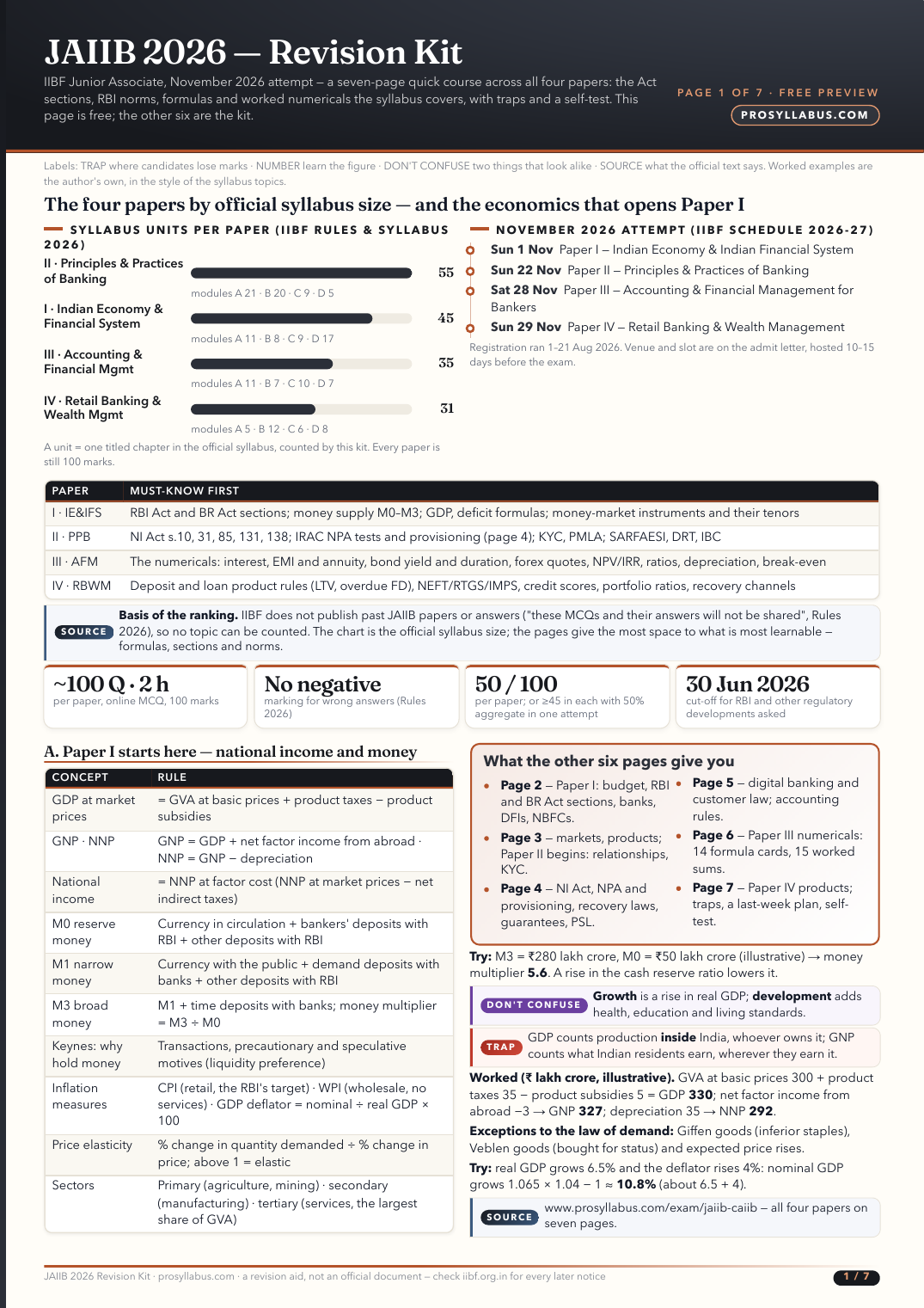
Each JAIIB and CAIIB paper is an online test of about 100 multiple-choice questions for 100 marks, lasting 2 hours. IIBF says it may vary the number of questions. CAIIB papers include case studies and caselets. The CAIIB rules add that some papers may include numerical questions with no options, where you type in the answer, so you cannot pick one at random. Both booklets say: “There will be no negative marking for wrong answers.”
The confusion comes from IIBF’s own history. Its notice of 30 August 2022, announcing the revised syllabi, listed negative marking at 25% of the marks for each question. On 4 January 2023, before the first revised-syllabus exam, IIBF deferred it “for the time being”, citing the larger number of subjects and the changes to the pattern. The 2026 rules say there is no negative marking. So on every multiple-choice question, answer rather than leave it blank.
Questions on recent developments follow a fixed cut-off. For exams held between March and August, IIBF uses regulatory guidelines and developments up to 31 December of the previous year. For exams held between September and February, the cut-off is 30 June. Applying that rule, the November 2026 JAIIB and December 2026 CAIIB papers use developments up to 30 June 2026. That is our application of the rule; the table in the 2026 booklet still shows the 2025 examples.
Planning the window: a worked example
Say you registered for your first JAIIB attempt for the November 2026 sitting. Your three-year clock runs from that registration. You then have up to five attempts, normally chosen from November 2026, May 2027, November 2027, May 2028, November 2028 and May 2029, if IIBF keeps its twice-a-year pattern. IIBF has not yet published dates beyond January 2027, and the exact end of the window depends on your registration date. What is certain is that each sitting you register for uses one of your five attempts, whether you sit it or not.
One plan follows directly from the rules: sit every paper in your first attempt, which keeps both the aggregate route and the chance of a class open, then spend the next attempt only on the papers still below 50. IIBF’s Annual Report 2025-26 gives pass rates of 15.63% for JAIIB and 14.03% for CAIIB, measured on candidates who appeared, so it is sensible to budget for more than one sitting. You cannot budget for six: the rules allow five.
How many attempts are allowed for JAIIB and CAIIB?
Five attempts within three years, whichever runs out first, counted from registration for your first attempt. The attempts need not be consecutive.
Does an attempt count if I register but do not appear?
Yes. IIBF’s 2026 rules say attempts are counted when you apply, whether or not you appear.
What are the passing marks for JAIIB and CAIIB?
50 out of 100 in each paper. Alternatively, at least 45 in each paper with a 50% aggregate across all papers of the exam, in a single attempt.
Can I use the 45-mark rule if I pass some papers in an earlier attempt?
No. The aggregate route requires all subjects of the exam in a single attempt. A paper sat on its own needs 50.
Is there negative marking in JAIIB and CAIIB?
No. IIBF deferred negative marking by a notice dated 4 January 2023, and the 2026 rules say there is no negative marking for wrong answers.
What is the last date for CAIIB December 2026 registration?
IIBF’s CAIIB page, checked on 29 September 2026, shows 3 October 2026 as the end of the last window, with a Rs 200 late fee. The February schedule PDF’s 21 September date was replaced after IIBF postponed the start of registration.
What happens if I do not finish within three years?
You must re-enrol afresh, and you lose the credits for papers you passed earlier.
More in this series
- JAIIB and CAIIB pass rate by year (IIBF figures)
- CAIIB elective: which one to choose
- JAIIB and CAIIB increments and PQP: pay calculator
- JAIIB and CAIIB syllabus: every paper and module
- JAIIB and CAIIB exam day rules and debarment
- JAIIB and CAIIB numericals on a basic calculator
- JAIIB and CAIIB result, marksheet and certificate
- IIBF membership for JAIIB and the full cost
- Official JAIIB and CAIIB books, mock test and classes
- After CAIIB: Professional Banker, CFP, Chartered Banker
- JAIIB / CAIIB notice board: official updates
Sources
- official — IIBF — JAIIB Rules & Syllabus 2026
- official — IIBF — CAIIB Rules & Syllabus 2026
- official — IIBF — Notice of 04.01.2023 deferring negative marking
- official — IIBF — Notice: JAIIB/DB&F/SOB/CAIIB introduction of revised syllabi (30 Aug 2022)
- official — IIBF — JAIIB page (exam dates, registration, fees)
- official — IIBF — CAIIB page (exam dates, registration, fees)
- official — IIBF — CAIIB Elective examination page
- official — IIBF — Homepage notices (12-08, 18-08, 25-08, 01-09, 11-09 and 13-09-2026)
- official — IIBF — Examination schedule 2026-27 (dated 02.02.2026)
- official — IIBF — Annual Report 2025-26
- reported — Testbook — CAIIB exam page (registration dates as printed there)
official = a document published by the conducting body. reported = a news or coaching site we could not check against an original. Where sources disagree this page says so rather than picking one.