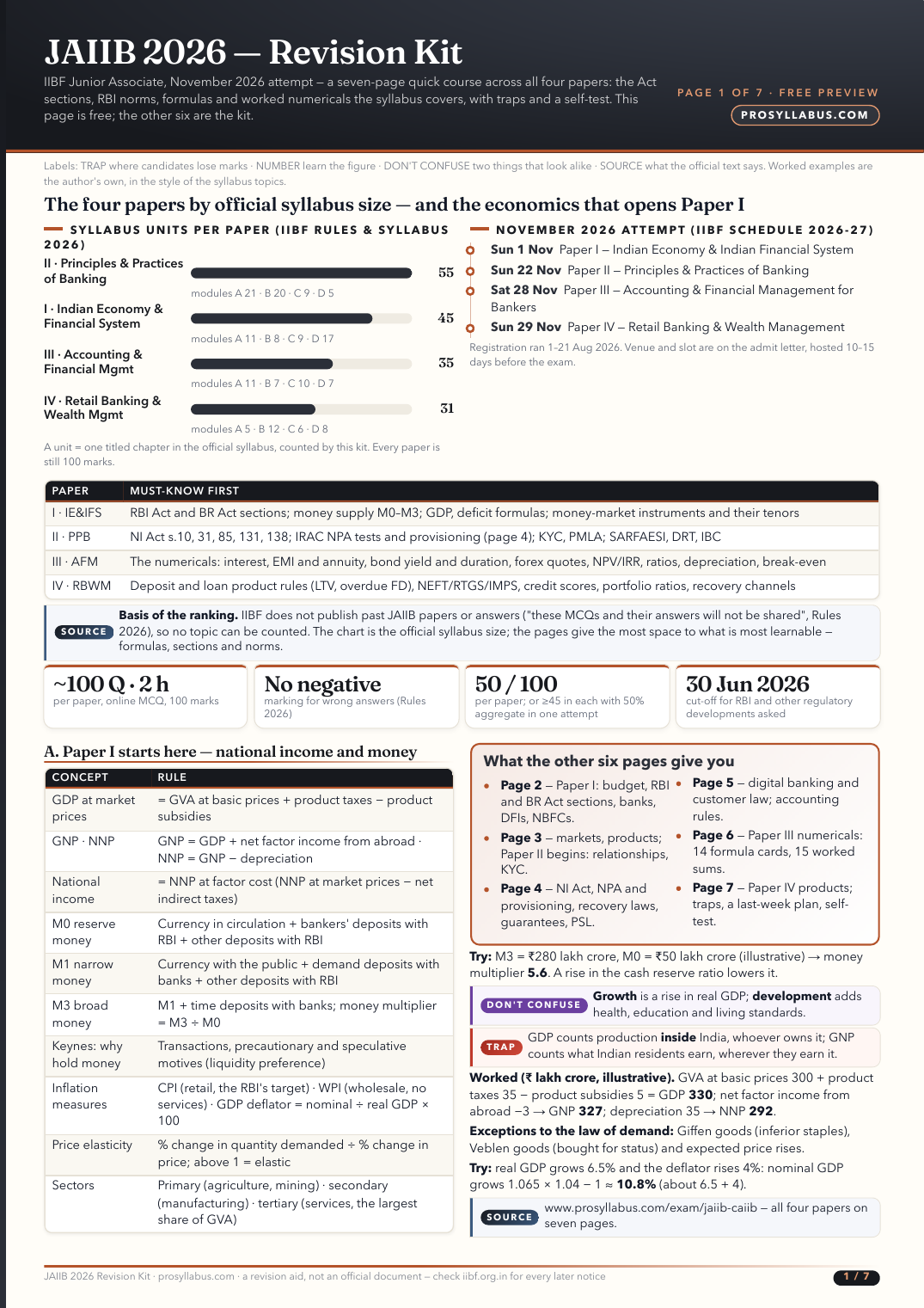
Checked 30 September 2026. Chapter headings from IIBF’s JAIIB and CAIIB Rules & Syllabus 2026; calculator rule from the same booklets. Worked examples and key paths are ours and do not change with the syllabus. IIBF publishes no count of numerical questions per paper. Freshness check on 30 September 2026: IIBF’s homepage, JAIIB page and CAIIB page were re-opened and no JAIIB or CAIIB notice newer than 13 September 2026 was found.
JAIIB and CAIIB set a clear trap for anyone who learnt finance on a spreadsheet. The 2026 rules allow only a basic calculator: “up to 8 functions i.e. (Addition, Subtraction, Multiplication, Division, Percentage, Sq.-root, Tax+ and Tax -), 12 digits”, and state that a scientific calculator is not allowed. Yet the syllabus asks for annuities, bond yields, compound growth, depreciation, break-even, standard deviation and regression. There is no power key, no log key and no ex key on the permitted calculator.
CAIIB adds a second reason to be fluent. Its 2026 rules say some papers may include numerical questions with no options, where the answer is keyed in, so working backwards from the options is not always possible. This guide maps every calculation chapter in the 2026 syllabus, then shows how each kind of sum is done with eight functions. The exam-day side of the calculator rule is in our exam-day rules guide; the full module list is in the syllabus module map.
IIBF JAIIB and CAIIB Rules & Syllabus 2026.
Which chapters are calculation chapters
IIBF publishes no weightage by chapter and no count of numerical questions per paper. What it does publish is the chapter list, and several headings say plainly that they involve computation. The table below quotes or paraphrases those headings from the 2026 booklets. It is our selection of the chapters that need a calculator, not an IIBF list.
| Paper and module | Calculation chapters (2026 syllabus) |
|---|---|
| JAIIB AFM, Module A: Accounting Principles and Processes | Bank Reconciliation Statement; Trial Balance and Rectification of Errors; Depreciation (straight line, written-down value, units of production, sum of the years’ digits, sinking fund) |
| JAIIB AFM, Module B: Financial Statements and Core Banking Systems | Balance Sheet Equation (“Computation of Balance Sheet Equation”); Preparation of Final Accounts; Cash Flow and Funds Flow |
| JAIIB AFM, Module C: Financial Management | Ratio Analysis; Interest and Annuities (simple and compound interest, future and present value of an ordinary annuity and an annuity due, repayment of a debt); Calculation of YTM (bond value, current yield, YTM, duration, price volatility); Forex Arithmetic (direct and indirect quotes, forward rates); Capital Structure and Cost of Capital (WACC); Capital Investment Decisions (discounted and non-discounted cash-flow methods); Working Capital Management |
| JAIIB AFM, Module D: Taxation and Fundamentals of Costing | Standard Costing and variance analysis; Marginal Costing (break-even, cost-volume-profit, P/V ratio, margin of safety); Budgets and Budgetary Control |
| JAIIB IE&IFS | National income computation; bond valuation and theorems |
| JAIIB PPB | “Computation of Gross Advances, Gross NPA, Net Advances”; assessment of working capital and term loans |
| CAIIB ABM, Module A: Statistics | Sampling; central tendency and dispersion, skewness, kurtosis; correlation and regression (standard error of estimate); time series; probability; estimation; linear programming; simulation |
| CAIIB BFM and ABFM | Module heads on international banking and forex, risk management, treasury and balance sheet management (BFM); capital investment decisions, valuation and mergers (ABFM). Check the booklet chapter by chapter |
Two things follow from the table. JAIIB’s numerical load sits mostly in one paper, Accounting and Financial Management for Bankers, and within it in Modules C and D. CAIIB’s load is spread across Advanced Bank Management (statistics), Bank Financial Management and Advanced Business and Financial Management. A candidate who is weak in arithmetic should budget the most practice time for those papers, not spread it evenly.
What eight functions can and cannot do
| Key | What it gives you | What it cannot do alone |
|---|---|---|
| Add, subtract, multiply, divide | Every sum in the syllabus, if you break it into steps | Nothing is out of reach, but long chains are slow |
| Percentage | Mark-ups, discounts, percentage change | Behaviour differs by brand; test yours before the exam |
| Square root | Standard deviation, and the square root, fourth root and eighth root of any number by pressing it once, twice or three times | Cube roots and fifth roots |
| Tax+ and Tax- | Adding or removing a preset tax rate | Rarely useful in these papers |
| Not on the list: power, log, e^x | Nothing; the calculator does not have them | Powers must be built by multiplying; logs are not needed if you work this way |
The rule does not mention memory keys, so we do not say whether a model with memory buttons is allowed; choose a plain model whose keys match IIBF’s list. On many basic calculators, pressing multiply and then the equals key repeatedly keeps multiplying by the same number, which is a quick way to build powers. That behaviour varies by brand, so test your own calculator weeks before the exam, not in the hall.
Powers by repeated squaring
Compound interest, annuity factors, EMIs and bond prices all need a number like (1 + r) raised to a power. Without a power key, the fastest route is to square repeatedly. Squaring three times gives the eighth power; then multiply together the powers you need. For (1.08) to the eighth power, square 1.08 to get 1.1664, square that to get 1.36048896, square again to get about 1.850930. That is three presses of multiply-equals instead of seven multiplications.
| Step | Result | Power reached |
|---|---|---|
| 1.08 squared | 1.1664 | 2 |
| square again | 1.36048896 | 4 |
| square again | 1.850930 (rounded) | 8 |
| 1.01 squared, squared, squared | 1.0201, 1.04060401, 1.082857 (rounded) | 2, 4, 8 |
| 1.01 to the 8th times 1.01 to the 4th | 1.126825 (rounded) | 12 |
To reach a power that is not a power of two, write it as a sum of powers of two and multiply those together. Twelve is eight plus four, so (1.01) to the twelfth is the eighth power times the fourth power. Sixty, a five-year monthly loan, is 32 + 16 + 8 + 4, which means five squarings and three multiplications. Write each intermediate result on the rough sheet as working, and keep six or more decimal places until the last step.
Annuities, loans and EMIs: worked examples
| Example (our arithmetic) | Formula | Answer | Key point |
|---|---|---|---|
| Future value, ordinary annuity: Rs 10,000 a year, 8%, 5 years | A × ((1+r)^n − 1) ÷ r | Rs 58,666.01 | (1.08)^5 = 1.4693281, from the 4th power times 1.08 |
| Present value, ordinary annuity: same figures | A × (1 − 1 ÷ (1+r)^n) ÷ r | Rs 39,927.10 | 1 ÷ 1.4693281 = 0.6805832 |
| Annuity due (payments at the start): future value | ordinary FV × (1+r) | Rs 63,359.29 | one extra multiplication |
| Annuity due: present value | ordinary PV × (1+r) | Rs 43,121.27 | one extra multiplication |
| EMI: Rs 1,00,000 at 12% a year for 12 months | P × r × (1+r)^n ÷ ((1+r)^n − 1), r = 1% a month | Rs 8,884.88 a month; interest Rs 6,618.55 in total | (1.01)^12 = 1.1268250 |
The 2026 AFM syllabus names all four annuity values separately: the future value and present value of an ordinary annuity, and the same two for an annuity due. The only difference is timing. An ordinary annuity pays at the end of each period, an annuity due at the start, so the annuity-due answers are the ordinary ones multiplied once more by (1 + r). Learn that one relationship and you have four formulas for the price of two.
Bond yield to maturity without trial and error
The exact yield to maturity of a bond is the rate that makes the present value of its coupons and redemption equal to its price, and it has no closed formula; it is found by trial and error. In a timed multiple-choice paper, most textbooks use an approximation: the annual coupon plus the yearly share of the discount or premium, divided by the average of face value and price. For a Rs 1,000 bond with an 8% coupon, priced at Rs 950 with 5 years left, that gives (80 + 50 ÷ 5) ÷ 975, about 9.231% (our arithmetic). The current yield, coupon divided by price, is 8.421%. If the options are close together, test the nearest two in the bond-price formula.
Depreciation, break-even and ratios
| Example (our arithmetic) | Working | Answer |
|---|---|---|
| Straight line: cost Rs 1,00,000, scrap Rs 10,000, life 5 years | (1,00,000 − 10,000) ÷ 5 | Rs 18,000 a year |
| Written-down value at 20%: same asset | multiply the opening value by 0.8 each year | Rs 20,000, Rs 16,000, Rs 12,800 in years 1-3; Rs 51,200 left after year 3 |
| Break-even: fixed cost Rs 2,00,000, price Rs 50, variable cost Rs 30 | contribution Rs 20; P/V ratio 20 ÷ 50 | 10,000 units, or Rs 5,00,000 of sales; P/V ratio 40% |
| Margin of safety at 16,000 units sold | (16,000 − 10,000) ÷ 16,000 | 6,000 units, 37.5% of sales |
Written-down value is the one method where repeated multiplication is the whole method: the asset’s value after n years is the cost times (1 − rate) to the power n. Straight line is one subtraction and one division. Break-even and margin of safety, from Module D’s marginal costing chapter, need nothing more than a subtraction and a division each, which is why they are among the most reliable marks in the paper once the definitions are clear.
Statistics with a square-root key
CAIIB’s Advanced Bank Management paper opens with a statistics module: central tendency and dispersion, correlation and regression, time series, probability, estimation, linear programming and simulation. The square-root key does most of the heavy lifting. For the numbers 4, 8, 6, 5 and 7, the mean is 6, the squared deviations add up to 10, the population standard deviation is the square root of 10 ÷ 5, about 1.4142, and the sample standard deviation is the square root of 10 ÷ 4, about 1.5811 (our arithmetic). Know which one the question means.
The geometric mean, used for average growth rates, needs an nth root. With two growth factors, that is one press of the square-root key: growth of 10% and then 20% gives factors 1.10 and 1.20, whose product is 1.32 and whose square root is about 1.1489, an average of about 14.89% a year (our arithmetic). With four factors, press the square-root key twice; with eight, three times. Three or five factors cannot be done this way, and such questions are usually set so the options can be tested by multiplying.
The rough sheet and what you may write on it
Everything above assumes working on the rough sheet, which is what it is for. But IIBF’s unfair-means policy of 1 November 2025 lists as misconduct “Noting down exam questions and/or options in rough sheet, and/ or formula /hints etc. on Admit letter or on any other material”, and a 15-month debarment applies to noting questions or options. Our reading: keep the rough sheet to your own working, never copy a question or its options onto it, write nothing on the admit letter, and learn the formulas so you do not need to write them out as a list. The full debarment table is in our exam-day guide.
Try it: the calculator path for your own figures
Numericals worked the basic-calculator way
Pick a calculation and enter the figures. The answer comes with the key sequence that gets it on an 8-function calculator: powers by repeated squaring and multiplying, roots by the square-root key. The formulas are standard finance and statistics, not IIBF text.
Worked examples and key paths are ours. Check every exam answer against the options, and round only at the end.
Which calculator is allowed in JAIIB and CAIIB?
A battery-operated portable calculator with up to 8 functions (add, subtract, multiply, divide, percentage, square root, Tax+ and Tax-) and 12 digits. A scientific calculator is not allowed.
Which JAIIB paper has the most numericals?
IIBF publishes no count, but the 2026 syllabus puts most calculation chapters in Accounting and Financial Management for Bankers (AFM): annuities, YTM, forex arithmetic, cost of capital, depreciation, costing and ratios.
How do I calculate compound interest without a power key?
Square repeatedly. (1 + r) squared three times gives the 8th power; multiply the powers you need together, e.g. the 8th power times the 4th power for the 12th. Keep six decimal places until the end.
Does CAIIB have questions without options?
The CAIIB Rules & Syllabus 2026 says some papers may include numerical questions with no options, where the answer has to be keyed in.
How is YTM calculated in the exam?
Exact YTM needs trial and error. The usual approximation is (annual coupon + (face value − price) ÷ years) ÷ ((face value + price) ÷ 2). For an 8% Rs 1,000 bond priced at Rs 950 with 5 years left, that is about 9.23%.
Can I write formulas on the rough sheet?
IIBF’s unfair-means policy lists noting questions, options, formulas or hints on the admit letter or other material as misconduct. The wording is not clear about formulas on the rough sheet, so use it only for working and never copy questions or options onto it.
More in this series
- JAIIB and CAIIB pass rate by year (IIBF figures)
- CAIIB elective: which one to choose
- JAIIB and CAIIB increments and PQP: pay calculator
- JAIIB and CAIIB attempts, time limit and pass rules
- JAIIB and CAIIB syllabus: every paper and module
- JAIIB and CAIIB exam day rules and debarment
- JAIIB and CAIIB result, marksheet and certificate
- IIBF membership for JAIIB and the full cost
- Official JAIIB and CAIIB books, mock test and classes
- After CAIIB: Professional Banker, CFP, Chartered Banker
- JAIIB / CAIIB notice board: official updates
Sources
- official — IIBF — JAIIB Rules & Syllabus 2026
- official — IIBF — CAIIB Rules & Syllabus 2026
- official — IIBF — Rules and policy on malpractice / unfair means, centre-based exams (1 Nov 2025)
- official — IIBF — Details of debarment period for unfair practices (effective 1 Nov 2025)
official = a document published by the conducting body. reported = a news or coaching site we could not check against an original. Where sources disagree this page says so rather than picking one.