Checked 29 September 2026. From the CRP RRBs-XV notification (clauses D, E, F, G), compared with the XIV (2025) and XIII (2024) notifications and the XIV prelims information handout. IBPS “reserves the right to modify the structure (including duration)”.
The Office Assistant (Multipurpose) exam in CRP RRBs-XV has two objective, online stages: a Preliminary of 80 questions and a Mains of 200 questions. Both are now sectionally timed — each test has its own clock — which is a change IBPS made in 2025. And the Mains does not give one mark per question in every test: Reasoning and Numerical Ability carry more, Computer Knowledge less. Those two facts change how you should practise, and this guide lays them out from IBPS’s own tables.
CRP RRBs-XV notification, clauses D, E and G.
Where other pages get this wrong
The figures 40/40 and 50/20/40/40/50 in the RRB Office Assistant pattern are MAXIMUM marks per test.
Commonly published instead: Pattern tables headed “Minimum Marks” listing 40 and 40 for the Prelims and 50, 20, 40, 40 and 50 for the Mains (Embibe’s Office Assistant cut-off page).
The notification’s column is “Maximum Marks”. The CRP RRBs-XV notification does not print any numeric minimum: it requires candidates to secure “minimum cut-off marks” in the Prelims tests and “a minimum score in each test” of the Mains, without stating the figures.
Preliminary: 80 questions, two clocks
| Test | Questions | Maximum marks | Time |
|---|---|---|---|
| Reasoning | 40 | 40 | 25 minutes |
| Numerical Ability | 40 | 40 | 20 minutes |
| Total | 80 | 80 | 45 minutes |
CRP RRBs-XV notification, clause D, Preliminary Examination (objective), Office Assistants (Multipurpose).
There is no English test in the Office Assistant Preliminary — a difference from the IBPS Clerk Preliminary, which has one. Candidates must “qualify in both the tests by securing minimum cut-off marks”, and then an “adequate number of candidates in each category, depending upon requirements” is shortlisted for the Mains. A strong Numerical score does not rescue a weak Reasoning score if Reasoning falls below its own minimum.
The 2025 Preliminary information handout (the closest one available; the 2026 handout had not been released on 29 September 2026) says each question has five options, that the tests are “separately timed”, and that you should expect to be at the venue for about 110 minutes. Its sample questions give the flavour of each test: word rearrangement, direction and position ordering, ranking in a row and letter-position puzzles in Reasoning; profit and cost, divisibility, decimal multiplication, simplification and fraction products in Numerical Ability. It also warns that the actual paper may contain “questions of a higher difficulty level”.
Mains: 200 questions, five tests, uneven marks
| Test | Questions | Maximum marks | Time | Marks per question (ours) |
|---|---|---|---|---|
| Reasoning | 40 | 50 | 30 minutes | 1.25 |
| Computer Knowledge | 40 | 20 | 15 minutes | 0.5 |
| General Awareness | 40 | 40 | 15 minutes | 1 |
| English Language OR Hindi Language | 40 | 40 | 30 minutes | 1 |
| Numerical Ability | 40 | 50 | 30 minutes | 1.25 |
| Total | 200 | 200 | 120 minutes | — |
CRP RRBs-XV notification, clause D, Main Examination (objective), Office Assistants. “Candidates can opt either 4 a or 4 b” — English or Hindi. Marks per question are our division, assuming equal marks within a test.
Read the marks column before you plan your hours. (The per-question column is ours: IBPS prints marks per test, and dividing assumes every question within a test carries equal marks, which the notification does not state.) Reasoning and Numerical Ability are 100 of the 200 Mains marks. General Awareness is 40 marks in only 15 minutes. Computer Knowledge is 40 questions for just 20 marks. The language test is your choice — English or Hindi, 40 marks either way — and it is the only test whose medium is fixed by the choice itself. For the other tests, the notification lists the “version of tests (medium of examination)” available in each State/UT — English and Hindi everywhere, plus one or more regional languages in 20 of them — and you pick one of your State’s options in the online application (see the State-choice guide in this series).
Maximum marks ÷ minutes, from the notification’s Mains table. General Awareness is the densest test: recall, not calculation.
Sectional timing: new in 2025, and still here
Until CRP RRBs-XIII (2024) the Office Assistant exam ran on a composite clock: 45 minutes for the whole Preliminary and 2 hours for the whole Mains, to divide between tests as you liked. CRP RRBs-XIV (2025) split both into separately timed tests, and CRP RRBs-XV (2026) keeps the split. Guides and mock series written before 2025 may still train you to “bank” time from one test and spend it on another. That is no longer possible.
| Cycle | Prelims timing | Mains timing | Source |
|---|---|---|---|
| XIII (2024) | Composite 45 minutes | Composite 2 hours | Notification revised 26.06.2024 |
| XIV (2025) | Reasoning 25 + Numerical 20 minutes | 30 / 15 / 15 / 30 / 30 minutes | Notification 2025; prelims handout |
| XV (2026) | Reasoning 25 + Numerical 20 minutes | 30 / 15 / 15 / 30 / 30 minutes | Notification 01.09.2026 |
Question counts and maximum marks are the same in all three cycles; only the clock changed.
What the split means in seconds (our arithmetic from the tables): Prelims Reasoning gives you 37.5 seconds a question and Prelims Numerical only 30. In the Mains, Reasoning, Numerical and the language test give 45 seconds a question, while General Awareness and Computer Knowledge give 22.5. The two 15-minute Mains tests are the fastest part of the whole process — recognition speed matters there more than anywhere else.
What a wrong answer costs
Clause E applies to every stage: “one fourth or 0.25 of the marks assigned to that question will be deducted as penalty”. A blank costs nothing. Because Mains questions are not all worth one mark, the penalty is not the same size everywhere.
| Stage and test | Marks per question (ours) | Penalty per wrong (ours) | Seconds per question (ours) |
|---|---|---|---|
| Prelims — Reasoning / Numerical | 1 | 0.25 | 37.5 / 30 |
| Mains — Reasoning | 1.25 | 0.3125 | 45 |
| Mains — Numerical Ability | 1.25 | 0.3125 | 45 |
| Mains — General Awareness | 1 | 0.25 | 22.5 |
| Mains — English or Hindi | 1 | 0.25 | 45 |
| Mains — Computer Knowledge | 0.5 | 0.125 | 22.5 |
Penalty rule: notification clause E. Per-question figures assume equal marks within a test (IBPS prints only per-test marks).
With five options, a blind guess is right one time in five. Our arithmetic: on a one-mark question the expected value of a blind guess is 0.2 × 1 − 0.8 × 0.25 = 0, so it gains nothing on average and only adds risk. Rule out even one option and the odds become one in four, and the expected value turns positive (0.25 − 0.75 × 0.25 = +0.0625 on a one-mark question). The same logic holds on the 1.25 and 0.5 mark questions, because the penalty is always a quarter of the question’s own marks.
Net score with the quarter-mark penalty
Enter right and wrong answers per test. Blanks cost nothing. Each wrong answer loses a quarter of that question’s marks. This is only an illustrative pre-normalisation estimate, and it assumes equal marks for every question in a test (our assumption). If an examination is held in more than one session, IBPS equates corrected scores by the equi-percentile method, so the official score may differ.
Prelims (80 marks)
Mains (200 marks)
Notification CRP RRBs-XV clause D (structure) and clause E (penalty: “one fourth or 0.25 of the marks assigned to that question”). Marks per question are our arithmetic, assuming every question in a test carries equal marks (IBPS prints marks per test, not per question). Qualifying needs a minimum in every test; the CRP RRBs-XV notification does not print those numbers.
How the scores become a result
Cut-off: for Office Assistants “each candidate will be required to obtain a minimum score in each test of Online Main examination”, and then candidates are shortlisted “depending on the number of vacancies available in each state”. The notification adds that merely passing individual tests may not be enough. Normalisation: where a test runs in several sessions, IBPS equates scores across them with an equi-percentile method and reports scores to two decimals. Merit: final selection is on Mains marks only — the Preliminary is a gate, not a score you keep. Tie: the older candidate ranks higher.
| Rule | What the notification says | Clause |
|---|---|---|
| Prelims qualifying | Minimum cut-off in both tests; adequate number per category shortlisted | D |
| Mains qualifying | Minimum score in each Mains test; shortlisting by State vacancies | F |
| Normalisation | Equi-percentile across sessions; two decimals | G |
| Final merit | Mains marks only; no interview for Office Assistants | G, K |
| Tie-break | Older candidate placed higher | K |
| Compensatory time | Twenty minutes per hour of examination “or otherwise advised”, for candidates eligible under IBPS’s scribe and disability guidelines who registered for it when applying | B.III |
What IBPS does not publish
There is no official topic-wise syllabus for the Office Assistant exam. The notification names the tests; the information handout adds a handful of illustrative questions. Every “RRB Clerk syllabus” list you meet online — number series, syllogism, data interpretation, banking awareness — is somebody’s reading of past papers, and IBPS does not release the question papers either. Treat those lists as a reasonable guide to question types, not as a promise of what will appear.
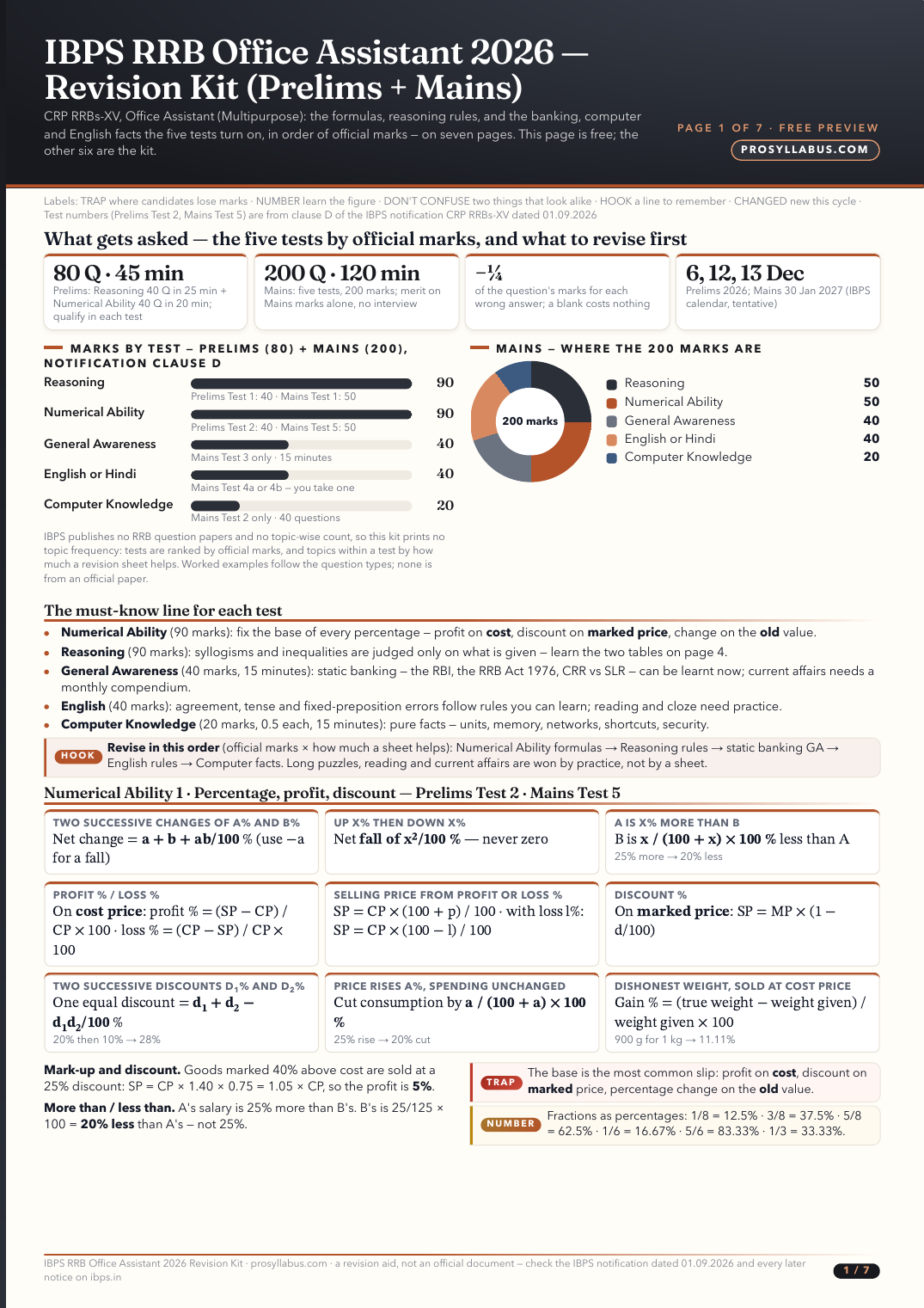
If you want the whole pattern, the formulas and the rules the five tests turn on in one place, ProSyllabus has a seven-page IBPS RRB Office Assistant 2026 revision kit, arranged in order of official marks; its first page is free to read.
Is the IBPS RRB Office Assistant Prelims sectionally timed in 2026?
Yes. Reasoning has 25 minutes and Numerical Ability 20 minutes, as in 2025. Until 2024 the 45 minutes were composite.
Is there English in the RRB Clerk Prelims?
No. The Office Assistant Preliminary has only Reasoning and Numerical Ability, 40 questions each.
How many marks is each Mains Reasoning question worth?
IBPS prints only per-test marks: 50 for 40 questions. If every question in the test carries equal marks — our assumption, not stated by IBPS — that is 1.25 each.
What is the negative marking in RRB Office Assistant?
A quarter of the marks of the question for each wrong answer, at every stage. A blank costs nothing.
Can I take Hindi instead of English in the RRB Clerk Mains?
Yes. Test 4 is English Language or Hindi Language, 40 questions for 40 marks either way.
Is there an interview for RRB Office Assistant?
No. Selection is on Mains marks and the vacancies reported by the RRB of your State.
Do Prelims marks count in the final merit?
No. Final merit is on Mains marks only.
How many options does each RRB Clerk question have?
Five, according to the 2025 Preliminary information handout.
Does IBPS publish an official RRB Office Assistant syllabus?
No topic-wise syllabus is published — only test names and sample questions.
How long is the RRB Office Assistant Mains?
120 minutes for 200 questions, in five separately timed tests.
Is the RRB Clerk Mains score normalised?
Yes, where there are several sessions: IBPS uses an equi-percentile method and reports scores to two decimals.
Sources
- official — IBPS — Detailed Notification CRP RRBs-XV (Officers and Office Assistants), dated 01.09.2026
- official — IBPS — CRP RRBs-XIV notification, updated vacancies as on 27.09.2025
- official — IBPS — CRP RRBs-XIV Office Assistant Preliminary Information Handout (2025)
- official — IBPS — CRP RRBs-XIII notification (revised 26.06.2024)
- reported — Embibe — IBPS RRB Office Assistant cut-off (see correction)
official = a document published by the conducting body. reported = a news or coaching site we could not check against an original. Where sources disagree this page says so rather than picking one.