How to Tell Wild Animals
Class 10 English · First Flight – Poems · Chapter 4
Visual story
Watch as storyTap a card to open it full-screen — swipe through like a story.
158 members in the CBSE community
View all













CBSE Class 10 · English
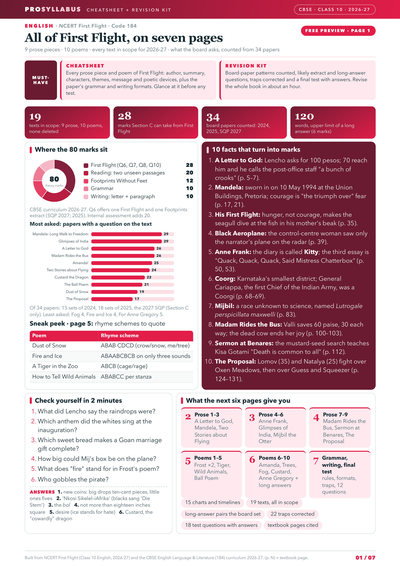
First Flight: what 34 board papers asked- Marks booster + cheatsheet: key concepts in 2 lines each, common traps
- 9 prose pieces, each summarised
- 10 poems with their poetic devices
- Common traps to avoid
- Long-answer pairs the board has set
- 10 marks each: grammar and writing formats
CBSE Class 10 · English
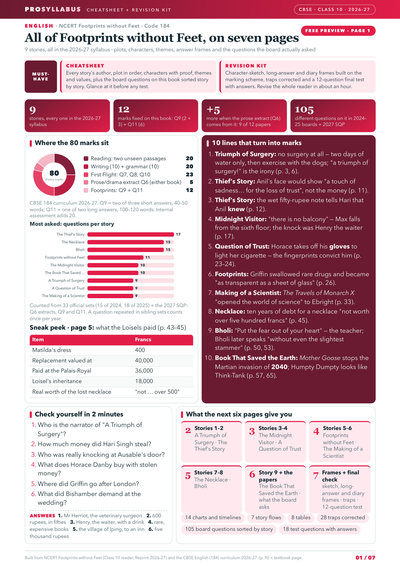
105 board questions, counted story by story- Marks booster + cheatsheet: key concepts in 2 lines each, common traps
- 9 stories: plot, characters, themes
- Character-sketch frames
- Common traps to avoid
- Diary-entry and long-answer frames
- Values in all 9 stories
CBSE Class 10 · English
Both English readers: what the board asked- 34 board papers counted for First Flight
- 105 board questions on Footprints, by story
- 9 prose pieces and 10 poems summarised
- 9 Footprints stories: plot, characters, themes
- 10 + 10 marks: Section B grammar and writing
- Traps + 12-question test in both kits
CBSE Class 10 · All available subjectsTrending
All 12 Class 10 kits: where board marks sit- Maths: 20 marks in Algebra, the biggest unit
- Science: 25 marks each in Units I and II
- English: what 34 board papers asked
- Geography: all 79 CBSE map items, by location
- Economics: all 20 marks, with 18 traps
- 12 kits, one per subject or book
The story in short
Carolyn Wells’s poem is a humorous and witty piece that pretends to teach readers how to identify various wild animals — but in a comically dangerous way. With light, playful rhyme, the speaker describes how you can recognise an Asian Lion if it roars at you while it eats you, a Bengal Tiger by the black stripes on its yellow body as it pounces, a leopard by its spots as it keeps leaping on you, and a bear by the way it hugs you very tightly. The poem also jokes about telling a crocodile from a hyena by whether it weeps while eating, and a chameleon by its ability to change colour and seem to vanish. The humour lies in the absurd idea that one would be identifying these creatures while being attacked. The poem entertains while showing the poet’s clever use of wit, rhyme and exaggeration.
The story in 5 beats
- 1The poet jokes that an Asian Lion is known when it roars while killing and eating you.
- 2She says a Bengal Tiger is easy to know by its yellow body with black stripes as it attacks.
- 3A leopard is recognised by its spotted body and repeated leaps after you if you cry for help.
- 4A bear is known when it gives a crushing hug, and a hyena and a crocodile are compared humorously.
- 5At the end, the poet describes the chameleon as a small creature that changes colour and seems to disappear.