Checked 2 October 2026. The 2023 Haryana Finance Department instructions and HIPA Ordinary Branch Part II syllabus were checked against the scanned official PDFs. Always check the latest HIPA notice for session-specific dates and any amendments. The separate 2020 criteria are a dated question blueprint, not a promise of identical future question positions.
The Haryana Finance Department instructions and Part I syllabus and HIPA Part II Ordinary Branch syllabus specify nine papers: five in Part I worth 600 marks, then four in Part II worth another 600. This page maps each official subject to its allowed material and first practical revision task. It covers Ordinary Branch; HIPA also lists a separate Local Audit Department branch. If you came for question PDFs and measured recurrence, use the 55-paper atlas instead. Here the central question is what you must study and how to allocate your hours.
Official 2023 syllabus structure. Part II requires passing Part I under the Finance Department regulations.
| Part | Official paper | Marks | Exam-hall material | Practical component |
|---|---|---|---|---|
| I | Précis & Drafting | 100 | Without books | Language / drafting |
| I | Commercial Book Keeping | 100 | Without books | At least 50% |
| I | Civil Services Rules | 150 | With prescribed books | At least 50% |
| I | Audit & Financial Regulation | 150 | With prescribed books | At least 50% |
| I | Local Rules & PWD Accounts | 100 | With prescribed books | At least 50% |
| II | Budget & Treasury Rules | 150 | With prescribed books | At least 50% |
| II | Company Law & Allied Acts | 150 | With permitted bare Acts | Act application |
| II | Advanced Accountancy | 150 | Without books | No percentage stated |
| II | Cost Accounts & Financial Management | 150 | Without books | No percentage stated |
Bars show official marks grouped by subject families. They are not a prediction of relative difficulty or time to master.
Do not mistake the 2020 detailed paper criteria for the current syllabus. That older Treasuries document describes exact Q1/Q2 formats, including pay fixation and budget forms. The 2023 Finance Department Part I syllabus explicitly states at least 50% practical questions for Book Keeping, Civil Services Rules, Audit and Local Rules; the Part II syllabus says so for Budget and Treasury Rules. The current syllabus does not state a practical percentage for Advanced Accountancy or Cost Accounts, even though the older 2020 criteria contains substantial practical allocations for them. The later syllabus names topics, permitted books and three-hour papers, but does not restate every old question slot. Use the older blueprint as a practice checklist and the newer syllabus as the boundary on content and materials.
Which rule decides whether you pass?
Under the 2023 regulations, the usual pass route requires at least 45% in each subject and 50% aggregate in each Part. A score of at least 60% in one subject carries an exemption from reappearing in that subject. Passing Part I is a prerequisite to sitting Part II. The regulations also limit attempts: six across both Parts, no more than four for Part I, subject to the stated exceptions. A candidate below 20% aggregate is debarred for two chances; the official wording is chances, not years. A narrow grandfathered pass threshold applies to candidates who had already passed Part I and applied for Part II in 2021; do not apply that exception to a new applicant.
| Rule | Usual threshold | What to check |
|---|---|---|
| Individual subject minimum | 45% | Each paper independently; a strong total cannot rescue a below-threshold paper |
| Part aggregate minimum | 50% | Add the five Part I papers or four Part II papers separately |
| Subject exemption | 60% | Exemption from reappearing in that subject under the regulations |
| Part II entry | Pass Part I | Do not plan a Part II sitting before Part I is cleared |
For a case with individual scores and carried exemptions, use the separate pass and exemption guide. Its decision logic belongs there; the allocator below only helps you distribute study time. Before paying an application fee, check the official notice and your department's eligibility certification.
Part I and Part II topic-by-topic: current scope with an older question blueprint
The table immediately below transcribes the topic families from the 2023 Finance Department and HIPA Ordinary Branch syllabus scans. It is a navigation summary: use the linked PDFs for exact chapter exclusions, amendments and allowed-book conditions. The separate cards after it reproduce the earlier 2020 Treasuries question-setting blueprint. A “compulsory Q1” in one of those cards describes that historical criteria document; it is a timed-practice idea, not a guaranteed position in a future paper.
| Part / paper | Current official scope | 2020 card below |
|---|---|---|
| I · Précis & Drafting | English and Hindi letter writing, grammar, précis, translation both ways, administrative terminology | Sample language tasks and marks |
| I · Commercial Book Keeping | Trial balance, final accounts, error correction, depreciation and reserves, bills and cheques, account current, self-balancing ledger, capital/revenue, income/expenditure, manufacturing/cost accounts, double-account system | Example balance-sheet and theory split |
| I · Civil Services Rules | Haryana Civil Services Rules 2016: General, Pay with Revised Pay and ACP, Allowances, Leave, GPF, Pension, Conduct, and Punishment & Appeal, as amended | Old Punjab-rule pay-fixation pattern; update every reference |
| I · Audit & Financial Regulation | Introduction to Indian Government Accounts and Audit, Government Accounting Rules 1990, major/minor heads, PFR Volume I specified chapters; salary-bill preparation | Older pay-bill and classification question layout |
| I · Local Rules & PWD Accounts | Departmental Financial Rules for PWD and Forest, Haryana PWD Code, Account Code Volume III, Haryana Civil Services TA Rules, with named chapter limits | Older cash-book, contractor-bill and TA-bill layout |
| II · Budget & Treasury Rules | Punjab Budget Manual, Treasury Rules and Subsidiary Treasury Rules, Punjab Financial Rules Volume II specified appendices; constitutional budget/finance provisions | Older BM-32, BM-2 and reappropriation layout |
| II · Company Law & Allied Acts | Companies Act 2013 plus Contract, Gratuity, Minimum Wages, Payment of Wages, Workmen Compensation, EPF, Maternity Benefit and Rights of Persons with Disabilities Acts, with amendments | Old seven-Act question scheme; the current list has nine Acts |
| II · Advanced Accountancy | Advanced Part I bookkeeping, joint-stock and government-company final accounts, hire-purchase accounts, branch and departmental accounts | Older compulsory account formats |
| II · Cost Accounts & Financial Management | Elements and control of cost, job/batch costing, cost-financial reconciliation, financial management, working capital, finance arrangements, cash/fund flow, inventory control | Older cash-flow and cost-sheet question layout |
The 2023 Civil Services Rules scope expressly names the Haryana 2016 volumes. The 2020 pay-fixation card cites an older Punjab-rule format and should never be used as the authority for a current rule number. The 2023 Company Law list names nine Acts, including the Companies Act 2013; the 2020 card describes a seven-Act question scheme from an older regime. For Audit, Local Rules and Budget, chapter exclusions matter as much as broad book titles, so open the official PDF before buying or tabbing a volume.
Part I — five papers, 600 marks
Paper 1: Précis & Drafting (English and Hindi) — 100 marks, without books
- English: drafting an official letter, circular or D.O. letter (25); active/passive voice, 5 of 6 (10); direct/indirect speech, 5 of 6 (10); administrative terms into Hindi, 10 of 12 (10); punctuation (5); Hindi sentences into English (5).
- Hindi: précis of a roughly 300-word passage into 100 words (25); Hindi administrative terms into English, 10 of 12 (10).
The official criteria call this paper "English & Hindi"; most coaching material calls it Précis & Drafting. Same paper.
Paper 2: Commercial Book Keeping (Elementary) — 100 marks, without books
- Q1, compulsory: a balance sheet with 6-7 adjustments (30).
- Two of three practical questions (20): bank reconciliation or correction of errors; depreciation account or cost statement; average due date or account current.
- Three of four theory questions (45): trial balance disagreement, errors not disclosed by the trial balance, cash books, subsidiary books and journal, depreciation methods, bill of exchange versus promissory note.
- Definitions of commercial terms, 5 of 7-8 (5).
Paper 3: Civil Services Rules — 150 marks, with books
- Q1, compulsory (30): a pay fixation case under a named rule.
- Three of four practical questions (45): stoppage of increments, qualifying service for increment, subsistence allowance, leave account, joining time, pension and leave salary contribution, pensionary benefits including commutation, DCRG and family pension, and GPF interest.
- Five of six theory questions, 15 each (75): no more than two from any one volume of the rules.
This is the paper most affected by the rules change: every volume it tests now lives in the Haryana Civil Services Rules 2016. See our HCSR 2016 guide for the nine volumes and their official PDFs.
Paper 4: Audit and Accounts (Audit & Financial Regulation) — 150 marks, with books
- Q1, compulsory, 4 × 10 (40): a pay bill; classification of charges and deductions with the treasury pay order; annual salary income for TDS; an income tax computation.
- Q2, compulsory (15): eligibility for a loan or advance, or interest on an advance and its classification, or a State-Centre settlement classification.
- Q3, compulsory (20): classify 10 of 12 transactions down to minor head, with at least two each from revenue, capital, loans and suspense, and debt.
- Five of seven theory questions, 15 each (75): drawn from An Introduction to Indian Government Audit & Accounts, the Government Accounting Rules 1990 and PFR Vol I, with no more than three per book.
Paper 5: Local Rules & Public Works Accounts — 100 marks, with books
- Q1, compulsory (20): a cash book — ten entries each side, opening and closing balance, cash verification.
- Q2, compulsory (20): a contractor’s bill, works ledger or contractor’s ledger.
- Q3, compulsory (10): a ten-day T.A. bill.
- Five of seven theory questions, 10 each (50): from the DFR, Account Code Vol III and PWD Code, with at least one from the T.A. rules.
Part II — four papers, 600 marks
- Marks booster + cheatsheet: most-asked concepts in 2 lines each, common traps
- Most asked question types, counted
- 15-mark pension calculation, worked
- 400 closed-book marks: the formula sheet
- Pay fixation, suspension and penalty rules
- Traps that cost marks, listed
Paper 1: Budget & Treasury Rules — 150 marks, with books
- Q1, compulsory (15): an excess and surrender statement on form BM-32, 15 primary units.
- Q2, compulsory (30): a budget estimate on form BM-2 with up to 10 object codes (20), plus an explanatory memorandum (10).
- Q3, compulsory (30): a reappropriation statement with up to 20 object codes.
- Five of seven theory questions, 15 each (75): three from the Budget Manual, three from the Treasury Rules and STR, and at least one from PFR Vol II (Appendix 6, destruction of records; Appendix 9, stamps).
HIPA’s 2023 books list excludes parts of these books from the exam hall — for example Budget Manual appendices B, C, D, E and K. See the books guide for the full exclusions.
Paper 2: Company Law & Allied Acts — 150 marks, with bare Acts
- Six of seven questions, equal marks, one from each Act.
- HIPA’s 2023 list of permitted bare Acts: Companies Act 2013, Indian Contract Act, Payment of Gratuity Act, Payment of Wages Act, Minimum Wages Act, Workmen’s Compensation Act, EPF Act, Maternity Benefit Act 1961 and the Rights of Persons with Disabilities Act 2016.
- The 2020 criteria list only seven Acts and still name the Companies Act 1956 — the HIPA list is the more recent of the two.
Paper 3: Advanced Accountancy — 150 marks, without books
- Q1, compulsory (40): final accounts of a joint stock or government company, at B.Com level.
- Q2, compulsory (15): hire purchase. Q3, compulsory (20): branch or departmental accounts.
- Five of seven theory questions (75): accounting concepts, statements and books, depreciation, sinking and reserve funds, bills and promissory notes, account current and average due date, self-balancing ledgers, manufacturing accounts, the double account system and terminology.
Paper 4: Cost Accounts & Financial Management — 150 marks, without books
- Q1, compulsory (30): a cash flow statement.
- Q2 (20): a cost sheet, contract, job or batch costing statement. Q3 (15): cost-financial reconciliation or an inventory statement (FIFO/LIFO). Q4 (10): inventory levels and EOQ, economic batch size, depreciation or working capital.
- Five of seven theory questions (75): elements of cost, job and batch costing, financial management, sales budgeting, working capital, arranging finance, inventory control and cash flow.
The study decision each paper creates
| Part / paper | Open or closed? | First revision output |
|---|---|---|
| I: Précis & Drafting | Without books | Write one official letter and one précis to a timer |
| I: Commercial Book Keeping | Without books | Construct trial balance, final accounts and adjustments |
| I: Civil Services Rules | With prescribed books | Build a 2016-rule index; solve pay, pension and leave cases |
| I: Audit & Financial Regulation | With prescribed books | Prepare a salary bill and classify accounting heads |
| I: Local Rules & PWD Accounts | With prescribed books | Make blank cash-book, contractor-bill and TA-bill templates |
| II: Budget & Treasury Rules | With prescribed books | Practise BM-2, BM-32 and reappropriation outputs |
| II: Company Law & Allied Acts | With permitted bare Acts | Index each named Act by issue and section |
| II: Advanced Accountancy | Without books | Rebuild company final accounts and branch accounts |
| II: Cost Accounts & Financial Management | Without books | Rebuild cash-flow, cost-sheet and reconciliation templates |
For a with-books subject, build a source index, then solve scenarios with the relevant volume open. Your target skill is finding the current rule, applying it to dates and figures, and writing a supported conclusion in three hours. For a without-books accounting subject, reconstruct a blank statement skeleton from memory, work a fresh numerical problem, and check the final totals and intermediate steps. For the language paper, practise writing to time; a rulebook tab cannot compensate for a slow précis or unclear official letter.
Part I is more than an accounting warm-up. Précis and Drafting carries 100 marks and a separate minimum; it deserves a weekly writing session even if numerical errors feel more urgent. Book Keeping is the closed-book base for Part II Advanced Accountancy. Civil Services Rules covers multiple 2016 volumes, so an index by event—appointment, pay change, leave, pension, disciplinary action—is more useful than a flat list of book titles. Audit and Local Rules require a different output: pay bills, accounting classification, cash book, contractor and travel forms.
Part II changes the balance of work. Budget and Treasury is an open-book rules paper with practical budget formats. Company Law allows the named bare Acts, so practise locating and applying an Act rather than memorising obsolete section references from old questions. Advanced Accountancy and Cost Accounts are closed-book three-hour papers: timed production of financial statements, branch or hire-purchase accounts, cost sheets, cash-flow and reconciliation gives you a more measurable target than passive rereading.
Build a weekly plan from the papers you actually need to clear
The official marks are a reasonable starting weight, but your mistakes should change the schedule. Choose only your current Part in the tool. A paper marked “repeated mistakes” receives double the weight of a paper marked “needs practice,” before marks are applied. Set aside a small common review block for rule amendments and an error log. The calculated allocations are approximate and should not override a forthcoming timetable or a paper in which you are close to the 45% floor.
Make a paper-by-paper weekly study allocation
Choose only the Part you are preparing for, enter your total weekly hours, and mark repeated mistakes. The tool weights each selected subject by official marks × your weakness level. This is a transparent personal planner, not official subject weightage, pass probability or an exam schedule.
On AMP, use the official-mark table above as a static fallback. Your choices stay in this browser session only.
A practical 20-hour Part I example might start with two hours of Précis and Drafting, three of Book Keeping, five of Civil Services Rules, five of Audit, three of Local Rules, and two of cross-paper error review. Those hours are an illustration, not a prescribed distribution. If your CSR answers are already secure but bookkeeping trial balances fail, move time from CSR to bookkeeping. If you have a carried subject exemption, remove that paper from the immediate sitting plan and confirm the exemption on the official record.
| Week action | Output to save |
|---|---|
| 1. Scope | Your current Part, nine-paper matrix, allowed-book list and weakest three topics |
| 2. Solve | A timed calculation or written answer for each current-Part paper |
| 3. Diagnose | Error log with paper, topic, rule edition, mistake type and next attempt date |
| 4. Retest | Same format from a different official paper, attempted without the old solution |
Track the official topic families
Tick a family only when you have solved at least one representative task. This is a local study record, not an official completion certificate.
0 of 9 done
Ticks are saved only in this browser on this device.
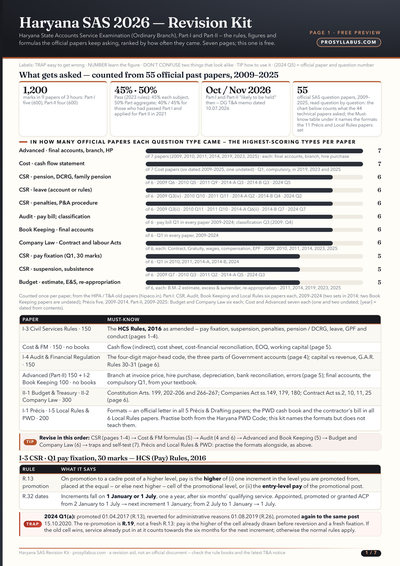
HARYANA SAS REVISION KIT
Use this free syllabus to decide what to cover. The separate seven-page English or Hindi kit condenses recurring formats, service-rule traps, formulas and a final-week self-test. It is based on the audited past-paper set described in our paper atlas.
Read the 55-paper atlas · Preview the kit and see its current price
Independent ProSyllabus product; no HIPA endorsement. Kit purchase is separate from any quiz or membership entitlement.
Common syllabus traps when you use old papers
Old question papers can point to Punjab Civil Services Rules, older pay rules or the Companies Act 1956. Their question method can be worth practising, but the current answer must be checked against the later book or Act named by the 2023 syllabus. The 2020 question criteria also contain detailed allocations that the 2023 syllabus does not repeat. In your notes, mark each statement as “current syllabus topic,” “current permitted material,” or “2020 example pattern.” That simple source tag prevents an attractive historical Q1 format from turning into a false 2026 promise.
The “with books” label does not mean any reference material is allowed. The official Part I and Part II PDFs list chapters, volumes and exclusions; the examination notice can add session-specific conditions. Bring only the material permitted for that sitting, and check whether a volume must be clean or can contain annotations. For the bare-Acts paper, distinguish a permitted bare Act from an explanatory guide. If HIPA changes its list, update your practice copies before you go to the hall.
When a subject feels too broad, look at the official-paper atlas and its denominator table for the formats we observed, then return here to check that every practice task falls inside the current syllabus. The books guide provides direct rule-book sources. The revision kit is a compact last-week aid; it does not replace the official source PDFs or practice through a full paper.
Frequently asked questions
How many papers are in the Haryana SAS Ordinary Branch syllabus?
There are five papers in Part I worth 600 marks and four in Part II worth 600, for nine papers and 1,200 marks across both Parts. Each subject paper lasts three hours in the official syllabus.
Can I sit Haryana SAS Part II without passing Part I?
The 2023 Finance Department regulations say candidates who have not passed Part I are not eligible to appear in Part II.
Are all Haryana SAS papers open-book?
No. Précis, Book Keeping, Advanced Accountancy and Cost Accounts are without books. Four rule/account papers permit prescribed books, while Company Law permits the listed bare Acts.
What are the usual pass marks and exemption marks?
The usual 2023 rule is at least 45% in each subject and 50% aggregate in each Part; at least 60% in a subject exempts the candidate from reappearing in it. A narrow transitional exception applies to certain 2021 Part II applicants.
Is the 2020 compulsory-question pattern guaranteed for a new exam?
No. It is a detailed older official criteria document and useful practice blueprint. The later 2023 syllabus supplies the current topic, marks and material scope; check the latest notice for the sitting.
Is the seven-page revision kit part of membership?
The kit is a separate digital product in English and Hindi. Its offer page shows the current price and preview; this guide does not promise a membership entitlement.
Sources
- official — Haryana Finance Department instructions and Part I syllabus (2023)
- official — HIPA Ordinary Branch Part II syllabus
- official — Haryana Treasuries criteria for SAS-I and SAS-II paper structure (2020)
- official — HIPA examination page and old-paper folders
official = a document published by the conducting body. reported = a news or coaching site we could not check against an original. Where sources disagree this page says so rather than picking one.