
Checked 23 September 2026. The paper structure has been stable for years. The rule books it cites have changed (HCSR 2016, Companies Act 2013) — check HIPA’s current syllabus PDF for the edition in force.
Where other pages get this wrong
Half of most SAS papers is compulsory practical work — pay fixation, pay bills, budget forms, final accounts — not rule-quoting.
Commonly published instead: Most syllabus pages list the rule books and stop there, which leaves candidates revising theory for papers where 75 of 150 marks are computation.
The Treasuries & Accounts Department’s criteria for the SAS papers fix a practical-to-theory split of 75 / 75 in every 150-mark paper except Company Law, and 50 / 50 in Book Keeping and Local Rules. In the with-books papers, the theory questions are also capped per book. That structure, more than the book list, decides how you should prepare.
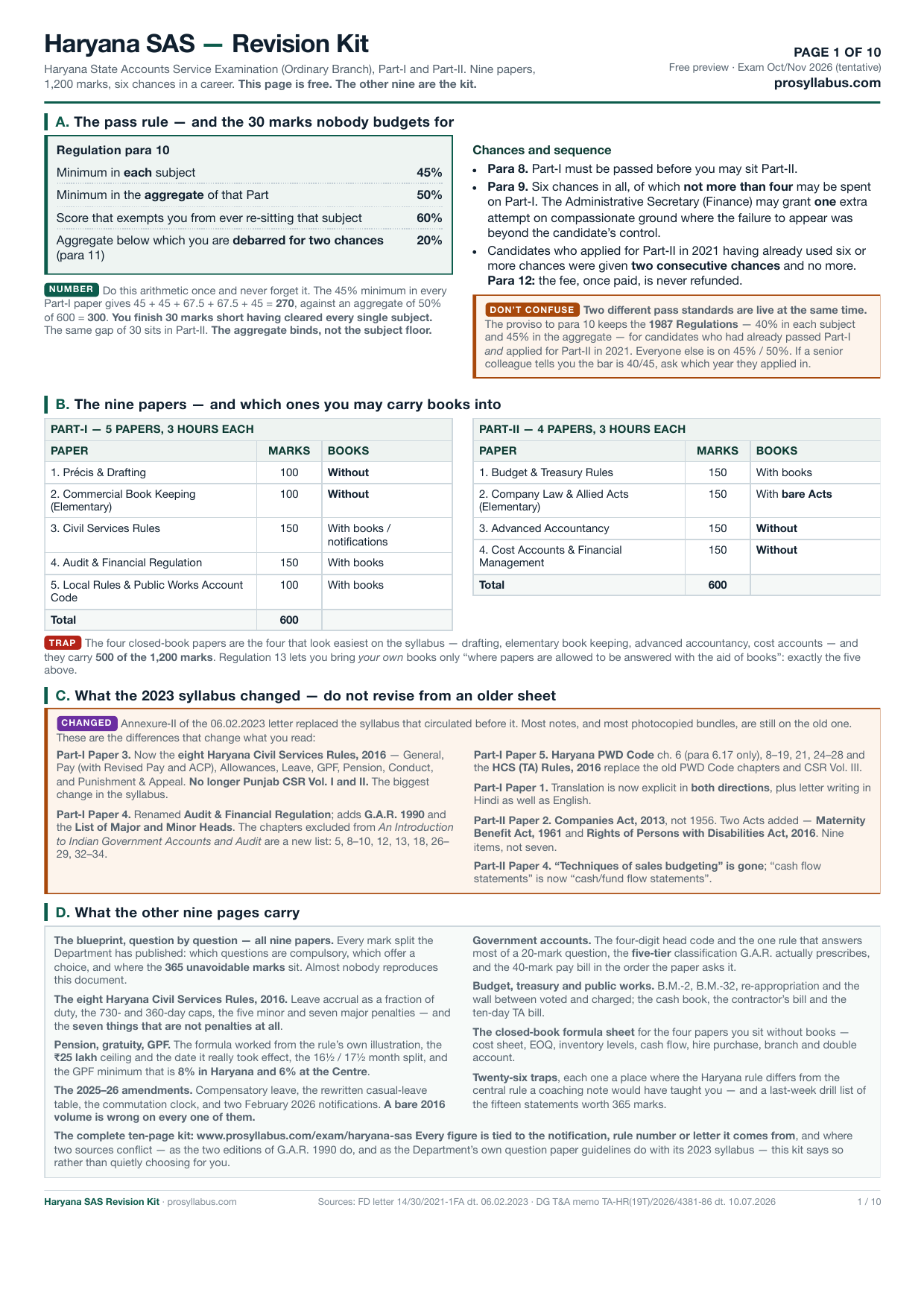
The Haryana State Accounts Subordinate Service (HSAS, or simply SAS) examination has two parts. Part I is five papers worth 600 marks; Part II is four papers worth 600 marks. You must clear Part I before you can sit Part II. Every paper is three hours. Four papers are open-book on the rules, one allows bare Acts, and four are written without books.
| Part | Paper | Marks | Time | Books | Practical / theory |
|---|---|---|---|---|---|
| I | Précis & Drafting (English & Hindi) | 100 | 3 hours | Without books | Language paper — no split |
| I | Commercial Book Keeping (Elementary) | 100 | 3 hours | Without books | 50 / 50 |
| I | Civil Services Rules | 150 | 3 hours | With books | 75 / 75 |
| I | Audit and Accounts (Audit & Financial Regulation) | 150 | 3 hours | With books | 75 / 75 |
| I | Local Rules & Public Works Accounts | 100 | 3 hours | With books | 50 / 50 |
| II | Budget & Treasury Rules | 150 | 3 hours | With books | 75 / 75 |
| II | Company Law & Allied Acts | 150 | 3 hours | With bare Acts | No split — one question per Act |
| II | Advanced Accountancy | 150 | 3 hours | Without books | 75 / 75 |
| II | Cost Accounts & Financial Management | 150 | 3 hours | Without books | 75 / 75 |
Read this before using any SAS syllabus — including this one
- The question-by-question structure below comes from the Treasuries criteria document posted in November 2020. It is the most detailed official statement of how each paper is set.
- Its rule references are older than the rules now in force. It cites the Punjab CSR volumes, the Revised Pay Rules 2008 and the ACP Rules 2008; the Haryana Civil Services Rules 2016 replaced the Punjab CSR from 19 July 2016, with Revised Pay and ACP Rules of 2016.
- For Company Law it lists the Companies Act 1956. HIPA’s own 2023 SAS-II books list names the Companies Act 2013 and adds two Acts.
- So: trust the structure, and take the current rule book for each topic from HIPA’s syllabus PDF and books-allowed list.
HIPA’s current SAS-I and SAS-II syllabus PDFs are scanned images. We link them in the sources below rather than transcribe a document we could not read in full.
Part I — five papers, 600 marks
Paper 1: Précis & Drafting (English and Hindi) — 100 marks, without books
- English: drafting an official letter, circular or D.O. letter (25); active/passive voice, 5 of 6 (10); direct/indirect speech, 5 of 6 (10); administrative terms into Hindi, 10 of 12 (10); punctuation (5); Hindi sentences into English (5).
- Hindi: précis of a roughly 300-word passage into 100 words (25); Hindi administrative terms into English, 10 of 12 (10).
The official criteria call this paper "English & Hindi"; most coaching material calls it Précis & Drafting. Same paper.
Paper 2: Commercial Book Keeping (Elementary) — 100 marks, without books
- Q1, compulsory: a balance sheet with 6-7 adjustments (30).
- Two of three practical questions (20): bank reconciliation or correction of errors; depreciation account or cost statement; average due date or account current.
- Three of four theory questions (45): trial balance disagreement, errors not disclosed by the trial balance, cash books, subsidiary books and journal, depreciation methods, bill of exchange versus promissory note.
- Definitions of commercial terms, 5 of 7-8 (5).
Paper 3: Civil Services Rules — 150 marks, with books
- Q1, compulsory (30): a pay fixation case under a named rule.
- Three of four practical questions (45): stoppage of increments, qualifying service for increment, subsistence allowance, leave account, joining time, pension and leave salary contribution, pensionary benefits including commutation, DCRG and family pension, and GPF interest.
- Five of six theory questions, 15 each (75): no more than two from any one volume of the rules.
This is the paper most affected by the rules change: every volume it tests now lives in the Haryana Civil Services Rules 2016. See our HCSR 2016 guide for the nine volumes and their official PDFs.
Paper 4: Audit and Accounts (Audit & Financial Regulation) — 150 marks, with books
- Q1, compulsory, 4 × 10 (40): a pay bill; classification of charges and deductions with the treasury pay order; annual salary income for TDS; an income tax computation.
- Q2, compulsory (15): eligibility for a loan or advance, or interest on an advance and its classification, or a State-Centre settlement classification.
- Q3, compulsory (20): classify 10 of 12 transactions down to minor head, with at least two each from revenue, capital, loans and suspense, and debt.
- Five of seven theory questions, 15 each (75): drawn from An Introduction to Indian Government Audit & Accounts, the Government Accounting Rules 1990 and PFR Vol I, with no more than three per book.
Paper 5: Local Rules & Public Works Accounts — 100 marks, with books
- Q1, compulsory (20): a cash book — ten entries each side, opening and closing balance, cash verification.
- Q2, compulsory (20): a contractor’s bill, works ledger or contractor’s ledger.
- Q3, compulsory (10): a ten-day T.A. bill.
- Five of seven theory questions, 10 each (50): from the DFR, Account Code Vol III and PWD Code, with at least one from the T.A. rules.
Part II — four papers, 600 marks
Paper 1: Budget & Treasury Rules — 150 marks, with books
- Q1, compulsory (15): an excess and surrender statement on form BM-32, 15 primary units.
- Q2, compulsory (30): a budget estimate on form BM-2 with up to 10 object codes (20), plus an explanatory memorandum (10).
- Q3, compulsory (30): a reappropriation statement with up to 20 object codes.
- Five of seven theory questions, 15 each (75): three from the Budget Manual, three from the Treasury Rules and STR, and at least one from PFR Vol II (Appendix 6, destruction of records; Appendix 9, stamps).
HIPA’s 2023 books list excludes parts of these books from the exam hall — for example Budget Manual appendices B, C, D, E and K. See the books guide for the full exclusions.
Paper 2: Company Law & Allied Acts — 150 marks, with bare Acts
- Six of seven questions, equal marks, one from each Act.
- HIPA’s 2023 list of permitted bare Acts: Companies Act 2013, Indian Contract Act, Payment of Gratuity Act, Payment of Wages Act, Minimum Wages Act, Workmen’s Compensation Act, EPF Act, Maternity Benefit Act 1961 and the Rights of Persons with Disabilities Act 2016.
- The 2020 criteria list only seven Acts and still name the Companies Act 1956 — the HIPA list is the more recent of the two.
Paper 3: Advanced Accountancy — 150 marks, without books
- Q1, compulsory (40): final accounts of a joint stock or government company, at B.Com level.
- Q2, compulsory (15): hire purchase. Q3, compulsory (20): branch or departmental accounts.
- Five of seven theory questions (75): accounting concepts, statements and books, depreciation, sinking and reserve funds, bills and promissory notes, account current and average due date, self-balancing ledgers, manufacturing accounts, the double account system and terminology.
Paper 4: Cost Accounts & Financial Management — 150 marks, without books
- Q1, compulsory (30): a cash flow statement.
- Q2 (20): a cost sheet, contract, job or batch costing statement. Q3 (15): cost-financial reconciliation or an inventory statement (FIFO/LIFO). Q4 (10): inventory levels and EOQ, economic batch size, depreciation or working capital.
- Five of seven theory questions (75): elements of cost, job and batch costing, financial management, sales budgeting, working capital, arranging finance, inventory control and cash flow.
What the structure tells you about preparation
Three things follow directly from how the papers are set
- The compulsory questions are predictable by type. Every Civil Services Rules paper opens with a pay fixation; every Budget paper with BM-32, BM-2 and a reappropriation statement; every Cost paper with a cash flow statement. Practising these formats is the highest-return work in the syllabus.
- Open-book does not mean easy. The theory questions are capped per book precisely so you cannot rely on one volume. You need to find the rule fast — which is a tabbing and indexing skill, not a memory one.
- The no-book papers are B.Com-level accounting. Book Keeping, Advanced Accountancy and Cost Accounts reward candidates with a commerce background and punish those without one. Plan the order in which you take subjects around that.
These are our conclusions from the official structure, not statements from HIPA.
Practise on ProSyllabus
Past SAS-I and SAS-II papers (with the official solutions HIPA released for the practical papers), plus topic-wise practice quizzes for both parts, are on the Haryana SAS exam page. The first quiz in each topic is free.
How many papers are there in the Haryana SAS exam?
Nine. Part I has five papers for 600 marks: Précis and Drafting, Commercial Book Keeping, Civil Services Rules, Audit and Accounts, and Local Rules and Public Works Accounts. Part II has four papers for 600 marks: Budget and Treasury Rules, Company Law and Allied Acts, Advanced Accountancy, and Cost Accounts and Financial Management.
Which SAS papers are with books?
Civil Services Rules, Audit and Accounts, and Local Rules and Public Works Accounts in Part I, and Budget and Treasury Rules in Part II. Company Law is written with bare Acts. Précis and Drafting, Book Keeping, Advanced Accountancy and Cost Accounts are without books.
How long is each SAS paper?
Three hours for every paper in both parts, according to the Treasuries and Accounts Department criteria and HIPA’s 2023 books list.
Is the SAS Part 1 syllabus the same every year?
The paper structure has been stable, but the rule books behind it have changed — the Haryana Civil Services Rules 2016 replaced the Punjab CSR, and the Companies Act 2013 replaced the 1956 Act. Check HIPA’s current syllabus PDF for the editions in force for your cycle.
How much of the SAS exam is practical?
In every 150-mark paper except Company Law, practical questions carry 75 marks and theory 75. In Book Keeping and Local Rules, practical carries 50 of 100. Précis and Drafting is a language paper with no split.
Can I sit Part II before passing Part I?
No. A candidate who has not passed Part I is not eligible to appear in Part II.
Where is the official HSAS syllabus?
On HIPA’s examination page at hipaco.in, which links separate syllabus PDFs for SAS Part-1 and Part-2 (Ordinary Branch), along with the books-allowed lists. The Treasuries and Accounts Department separately publishes the paper-wise criteria document.
Sources
- official — Treasuries & Accounts Dept — Criteria/Guidelines for the paper of SAS Examination Part I & II (posted Nov 2020)
- official — HIPA — SAS Part-1 (Ordinary Branch) syllabus PDF
- official — HIPA — SAS Part-2 (Ordinary Branch) syllabus PDF
- official — HIPA (hipaco.in) — Examination page: syllabus, books allowed, datesheets, roll numbers, past papers
- official — HIPA — Books allowed in SAS-II (OB) 2023 examination
- reported — Finance Dept letter No. 14/30/2021-IFA (16.07.2021), as forwarded by DG Higher Education on 18.08.2021
- official — Finance Dept Haryana — Haryana Civil Services Rules, 2016
official = a Haryana Government or HIPA document. reported = a news or coaching site's transcription, which we could not check against the original. Where sources disagree this page says so rather than picking a winner.
The rest of the Haryana SAS series
- Pass marks, exemption and result calculator — the 45 / 50 / 60 rules
- Previous year question papers — what exists, and which have official solutions
- HSAS 2026 notification — what has been issued, and how to apply
- Eligibility — who can sit SAS, and the direct-recruitment route
- Books list — every rule book, and where to download it free from the government
- Preparation strategy for working employees — with or without coaching
- SAS Related Instructions — the Treasuries circulars page, explained
- Section Officer salary, posting and promotion after SAS
- Haryana Civil Services Rules 2016 — all nine volumes, official PDFs
Every page carries a "checked on" date and stamps each source as official or reported. Spotted something out of date? These pages are rebuilt from one file, so a correction fixes it everywhere at once.