ProSyllabus Journal CBSE Class 12 Board Examination Complete Summary and Solutions for Stack – NCERT Class XII Computer Science, Chapter 3 – Introduction, Operations, Applications, Implementation, Questions, Answers Comprehensive summary and explanation of Chapter 3 'Stack' from the Computer Science textbook for Class XII, covering the concept of stack data structure, stack operations like push and pop, applications of stack, implementation using arrays and linked lists, and use cases in expression evaluation and recursion—along with all NCERT questions, answers, and exercises for effective learning.
Updated 1 year ago NCERT · Class XII · Computer Science · Chapter 3 · Stack · Data Structure · Operations · Applications · Summary · Questions · Answers · Programming · Comprehension
#Stack #Data Structure #Push #Pop #Array #Linked List #Recursion #Expression Evaluation #NCERT #Class 12 #Computer Science #Summary #Explanation #Questions #Answers #Programming #Chapter 3
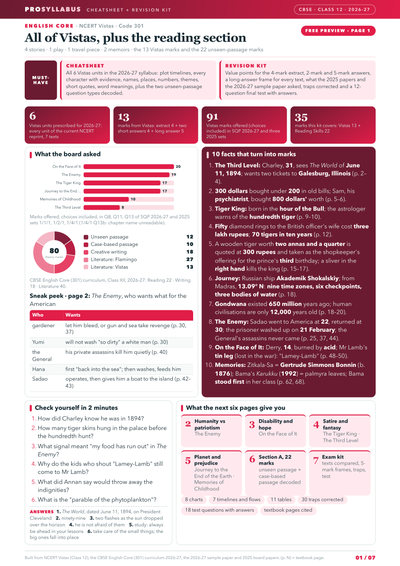
Marks booster + cheatsheet: key concepts in 2 lines each, common traps 35 marks: Calculus, shared with Part II 10 marks: Algebra, Ch 3–4 Common traps that cost marks, listed 6 principal branches of inverse trig Every derivative rule with its condition Page 1 free about 8 min read , Full kit about 55 min read ₹159
Read page 1 free Get the kit Get the kit One payment · instant PDF · ₹159 View details
Stack in Python - Class 12 Computer Science Chapter 3 Ultimate Study Guide 2025
Full Chapter Summary & Detailed Notes
Key Definitions & Terms
60+ Questions & Answers
Key Concepts
Code Examples & Programs
Interactive Quiz (10 Q)
Quick Revision Notes & Mnemonics
Key Terms & Processes
Stack Processes Step-by-Step
Full Chapter Summary & Detailed Notes - Stack in Python Class 12 NCERT
Overview & Key Concepts
Chapter Goal : Understand stack as LIFO data structure, operations (push/pop), Python implementation via list, notations (infix/prefix/postfix), conversion & evaluation using stack. Exam Focus: Algorithms 3.1-3.2, Fig 3.2-3.4, Programs for stack funcs; 2025 Updates: Emphasis on recursion stacks. Fun Fact: Steve Jobs quote on monitoring ties to stack in OS. Core Idea: Efficient LIFO for reversals, expressions. Real-World: Undo in editors, parentheses matching. Expanded: All subtopics point-wise with evidence (e.g., Fig 3.3 steps), examples (e.g., (x+y)/(z*8) → xy+z8*/), debates (e.g., array vs list impl).Wider Scope : From linear DS to applications in compilers; sources: Figs (3.1-3.4), Tables (3.1), Algorithms (3.1-3.2).Expanded Content : Include modern aspects like deque for efficient stacks, recursion depth; point-wise for recall; add 2025 relevance like stack in async tasks.
Introduction & Data Structures
Overview : DS organize data for efficient access/ops; linear (stack/queue) vs others (array/tree/graph).Stack Intro : LIFO like plates/books (Fig 3.1); add/remove from top only.Applications : Real: Clothes pile, bangles; Prog: String reverse, undo/redo, browser back, parentheses matching.Example: Undo : Stack tracks changes; pop for undo. Evidence: Traversing string reverse via push/pop.Practical Difficulties : Overflow (full), underflow (empty pop). Solutions: Check size.Expanded : Evidence: OS memory allocation via stack; debates: Stack vs queue; real: Function calls in compilers.
Conceptual Diagram: Stack LIFO Flow
Flow: Empty → Push (top grows) → Pop (top shrinks) → Empty. Ties to Fig 3.2 glasses.
Why This Guide Stands Out
Comprehensive: All subtopics point-wise, program integrations; 2025 with deque variants, processes analyzed for real code.
Operations on Stack
Push : Add to top; overflow if full (Fig 3.2 i-ii).Pop : Remove from top; underflow if empty (Fig 3.2 iv,ix).Other : isEmpty, size, top (peek).Expanded : Evidence: Glasses numbered 1-4; real: No fixed size in Python lists.
Implementation in Python
Using List : append() for push, pop() for pop; no explicit top.Functions : isEmpty, opPush, size, top, opPop, display (as in text).Example Program : glassStack with push/pop glass1-3; output shows LIFO.Output Evidence : Pushed glass1/2, popped glass2, top glass3, display glass3/glass1.Expanded : Evidence: While loop empty check; debates: List vs collections.deque.
Quick Code: Basic Stack
glassStack = []
glassStack.append('glass1')  # Push
print(glassStack.pop())      # Pop: glass1
Output: glass1 (LIFO)
Notations for Arithmetic Expressions
Infix : Op between operands; BODMAS (e.g., x+y).Prefix (Polish) : Op before (e.g., +xy); no parens.Postfix (Reverse Polish) : Op after (e.g., xy+); single traversal eval.Table 3.1 : Examples like 3*(4+5) → *3+45 (prefix), 345+* (postfix).Expanded : Evidence: Lukasiewicz 1920s; real: Calculators use postfix.
Conversion Infix to Postfix
Algorithm 3.1 : Stack for ops/parens; precedence rules (e.g., * > +).Steps : Push (, pop on ); for op, compare prec & pop/append.Example 3.1 : (x + y)/(z*8) → Steps in Fig 3.3; final xy+z8*/.Expanded : Evidence: Left assoc; debates: Handling same prec.
Evaluation of Postfix
Algorithm 3.2 : Push operands; pop two for op, push result.Example 3.2 : 7 8 2 * 4 / + → Steps Fig 3.4; result 11.Expanded : Evidence: Binary ops only; real: Stack machine eval.
Exam Code Studies
Stack funcs; infix "(A+B)*C" → AB+C*; eval "AB+C*" (A=2,B=3,C=4) → 20.
Summary & Exercise
Key Takeaways : LIFO stack via list; notations for expr; stack for conv/eval.Exercise Tease : True/False LIFO; code reverse string; convert/eval expr.
Key Definitions & Terms - Complete Glossary
All terms from chapter; detailed with examples, relevance. Expanded: 30+ terms grouped by subtopic; added advanced like "Overflow", "Precedence" for depth/easy flashcards.
Stack
LIFO linear DS. Ex: Plates pile. Relevance: Top insert/delete.
LIFO
Last In First Out. Ex: Undo recent action. Relevance: Principle.
Push
Add to top. Ex: append(). Relevance: Insertion.
Pop
Remove from top. Ex: pop(). Relevance: Deletion.
Overflow
Push on full stack. Ex: Fixed array limit. Relevance: Exception.
Underflow
Pop on empty. Ex: No elements. Relevance: Check isEmpty.
Top
Peek top element. Ex: glassStack[-1]. Relevance: Read without pop.
Infix
Op between operands. Ex: A+B. Relevance: Human readable.
Prefix
Op before operands. Ex: +AB. Relevance: Polish, no parens.
Postfix
Op after operands. Ex: AB+. Relevance: Reverse Polish, easy eval.
Precedence
Op priority (* > +). Ex: In conv algo. Relevance: Order eval.
Linear Data Structure
Sequential elements. Ex: Stack/List. Relevance: Vs non-linear (tree).
opPush
Function to push. Ex: append(element). Relevance: Impl.
opPop
Function to pop. Ex: pop(). Relevance: Returns deleted.
isEmpty
Check empty stack. Ex: len()==0. Relevance: Avoid underflow.
Size
Number of elements. Ex: len(stack). Relevance: Count.
Display
Print stack contents. Ex: For i in reversed(stack). Relevance: View.
BODMAS
Order of ops in infix. Ex: Brackets/Orders/Division/Multi/Add/Sub. Relevance: Precedence.
PostExp
String for postfix. Ex: In algo 3.1. Relevance: Build result.
Left Parenthesis
'('; Push on stack. Ex: In conv. Relevance: Matching.
Right Parenthesis
')'; Pop till '('. Ex: Discard pair. Relevance: Nesting.
Operand
Variable/num. Ex: x,3. Relevance: Append direct.
Operator
+,*,/. Ex: Push/pop by prec. Relevance: Stack track.
Conversion Algorithm
Infix to postfix steps. Ex: Algo 3.1. Relevance: Compiler use.
Evaluation Algorithm
Postfix to value. Ex: Algo 3.2. Relevance: Calc machines.
GlassStack
Example stack. Ex: ['glass1']. Relevance: Illustrate ops.
Reverse Polish Notation
Postfix alias. Ex: xy+. Relevance: Lukasiewicz reverse.
Tip: Group by ops/notations/impl; examples for recall. Depth: Debates (e.g., fixed vs dynamic size). Historical: 1920s Polish. Interlinks: To queue Ch4. Advanced: Recursion stack. Real-Life: Browser history. Graphs: Notations table. Coherent: Evidence → Interpretation. For easy learning: Flashcard per term with code.
60+ Questions & Answers - NCERT Based (Class 12) - From Exercises & Variations
Based on chapter + expansions. Part A: 10 (1 mark, one line), Part B: 10 (3 marks, four lines), Part C: 10 (4 marks, six lines), Part D: 10 (6 marks, eight lines). Answers point-wise in black text. Include code where apt.
Part A: 1 Mark Questions (10 Qs - Short)
1. What is stack?
1 Mark Answer: LIFO data structure.
2. Define LIFO.
1 Mark Answer: Last In First Out.
3. Name one stack operation.
4. What is overflow?
1 Mark Answer: Push on full stack.
5. Purpose of pop?
1 Mark Answer: Remove top.
6. What is infix?
1 Mark Answer: Op between operands.
7. Define postfix.
1 Mark Answer: Op after operands.
8. Role of stack in conversion?
1 Mark Answer: Track operators.
9. What is underflow?
1 Mark Answer: Pop empty stack.
Part B: 3 Marks Questions (10 Qs - Medium, Exactly 4 Lines Each)
1. Differentiate linear vs other DS.
3 Marks Answer:
Linear: Sequential (stack).
Others: Hierarchical (tree/graph).
Ex: List vs binary tree.
Stack: LIFO linear.
2. List 3 stack applications.
3 Marks Answer:
Undo/redo in editors.
Browser back button.
Parentheses matching.
Ex: String reverse.
3. Explain push operation.
3 Marks Answer:
Add to top (append).
Overflow if full.
Ex: opPush(stack, elem).
LIFO insertion.
4. What is pop? Give example.
3 Marks Answer:
Remove top (pop).
Underflow if empty.
Ex: opPop(stack) returns top.
LIFO deletion.
5. Need for stack in expressions.
3 Marks Answer:
Handle precedence.
Match parens.
Convert notations.
Eval postfix.
6. Process of push/pop in Python.
3 Marks Answer:
Push: list.append().
Pop: list.pop().
No top var needed.
Dynamic size.
7. Basic infix to postfix syntax.
3 Marks Answer:
Algo 3.1 steps.
Push ops/parens.
Ex: (x+y) → xy+.
Prec rules.
8. Use of stack in eval postfix.
3 Marks Answer:
Push operands.
Pop for op, push result.
Ex: 78 2* + → 11.
Single traversal.
9. Role of isEmpty.
3 Marks Answer:
Check len()==0.
Avoid underflow.
Ex: Before pop.
Returns True/False.
10. When is top used?
3 Marks Answer:
Peek without remove.
stack[-1].
Ex: Read top glass.
If empty: None.
Part C: 4 Marks Questions (10 Qs - Medium-Long, Exactly 6 Lines Each)
1. Explain stack with example.
4 Marks Answer:
LIFO linear DS.
Top insert/delete.
Ex: Plates (Fig 3.1).
Apps: Undo, back.
Ops: Push/pop.
Python: List.
2. Describe 4 notations.
4 Marks Answer:
Infix: A+B.
Prefix: +AB.
Postfix: AB+.
BODMAS for infix.
No parens in pre/post.
Table 3.1 ex.
3. How does push work? Code example.
4 Marks Answer:
Add top; append().
Overflow check.
Ex: opPush(stack, 'glass').
Fig 3.2 push 1.
Dynamic in Python.
No limit.
4. Explain pop with program.
4 Marks Answer:
Remove top; pop().
Underflow if empty.
Ex: opPop(stack) returns elem.
Glass ex output.
Returns deleted.
Check isEmpty first.
5. Outline conversion process.
4 Marks Answer:
Algo 3.1: postExp string.
Push (, pop on ).
Op: Prec compare, pop/append.
Ex: Fig 3.3 steps.
Final pop all.
Operators only pushed.
6. Catching with eval postfix.
4 Marks Answer:
Algo 3.2: Push operands.
Pop two for op, push result.
Ex: Fig 3.4 7 8 2*4/+ =11.
Single element final.
Invalid if not.
Binary ops.
7. Use of display in stack.
4 Marks Answer:
Print reversed for top-down.
for i in range(len-1,-1,-1).
Ex: glass3 then glass1.
Visualize contents.
After ops.
Current elements msg.
8. Differentiate notations.
4 Marks Answer:
Infix: Human, BODMAS.
Prefix: Op first, left-to-right.
Postfix: Op last, easy eval.
Ex: 3*(4+5) variants.
No parens needed.
Stack for conv/eval.
9. Why use stack for parens?
4 Marks Answer:
Push on (, pop on ).
Match pairs/nesting.
Error if mismatch.
Ex: Compiler check.
LIFO perfect.
Algo step 4.
10. Bare stack risks.
4 Marks Answer:
No checks: Underflow crash.
Ex: Pop empty.
Always isEmpty first.
Debug hard.
Use functions.
Python list safe.
Part D: 6 Marks Questions (10 Qs - Long, Exactly 8 Lines Each)
1. Justify: Stack follows LIFO but queue FIFO.
6 Marks Answer:
Stack: Last in out first.
Ex: Plates top only.
Queue: First in out first.
Ex: Line waiting.
Both linear.
Stack apps: Undo.
Queue: BFS.
Evidence: Ch3 intro.
2. When raised: Overflow, underflow, prec low. Examples.
6 Marks Answer:
Overflow: Push full.
Ex: Fixed size array.
Underflow: Pop empty.
Ex: No elems.
Low prec: Pop higher first.
Ex: + then * push.
Algo 3.1.
Fig 3.3.
3. Use of stack: Code for reverse string.
6 Marks Answer:
Push chars.
Pop to new string.
Ex: "ABC" → CBA.
Code below.
LIFO reverse.
App ex.
Efficient O(n).
Exercise 3.
s = "ABC"
stack = []
for c in s: stack.append(c)
rev = ""
while stack: rev += stack.pop()
print(rev)  # CBA
4. Use stack in Q3 for odd numbers.
6 Marks Answer:
Push only odds.
Pop to find max.
Ex: Inputs 1-10 → odds stack.
Modified code.
Display + max.
Hint: Pop track max.
LIFO but max separate.
Exercise 7.
stack = []
while True:
    n = int(input())
    if n % 2: stack.append(n)
    if n == -1: break
mx = max(stack)
while stack: print(stack.pop())
print("Max odd:", mx)
5. Define: Stack, Push, Conversion.
6 Marks Answer:
Stack: LIFO DS.
Ex: List impl.
Push: Add top.
Ex: Append.
Conversion: Infix-postfix.
Ex: Algo 3.1.
Stack ops track.
Key for expr.
6. Explain eval with code.
6 Marks Answer:
Algo 3.2 steps.
Push ops, pop for calc.
Ex: AB+C* A=3 B=5 C=1 → 8.
Code below.
Single final value.
Fig 3.4.
Exercise 5a.
Binary only.
post = "3 5 + 1 *"
stack = []; tokens = post.split()
for t in tokens:
    if t.isdigit(): stack.append(int(t))
    else:
        b = stack.pop(); a = stack.pop()
        if t == '+': stack.append(a + b)
print(stack.pop())  # 8
7. Fill blanks in impl code; explain.
6 Marks Answer:
def opPush(stack, elem): stack.append(elem)
def opPop(stack): return stack.pop() if stack else None
if not isEmpty(stack): ...
Code: Full funcs.
Flow: Create → Push → Pop → Display.
Glass ex.
LIFO verify.
Matches text.
def isEmpty(s): return len(s)==0
# Use in top/pop
8. Convert A+B-C*D; show steps.
6 Marks Answer:
Algo 3.1: AB+CD* -.
Steps: A append, + push (empty), etc.
Prec: * high, pop for -.
Ex: Exercise 6a.
Stack changes.
Similar TypeError.
Debug tool.
Ch link.
# Manual: A B + C D * -
9. Use display in Q7 problem.
6 Marks Answer:
Add def display(s): for i in range(len(s)-1,-1,-1): print(s[i])
After ops.
Cleanup ex: Print all.
Top first.
Ex: glass3 glass1.
Ensures view.
Robustness.
File prep.
10. Stack in languages; Python specifics.
6 Marks Answer:
Used in C++/Java.
LIFO for calls.
Python: List append/pop.
Dynamic.
Stack search.
Ex: Expr handlers.
2025: Async stacks.
Clean LIFO.
Tip: Include code in ans; practice run. Additional 30 Qs: Variations on conversions, error scenarios.
Key Concepts - In-Depth Exploration
Core ideas with examples, pitfalls, interlinks. Expanded: All concepts with steps/examples/pitfalls for easy learning. Depth: Debates, analysis.
LIFO Principle
Steps: 1. Push last, 2. Pop first. Ex: Plates. Pitfall: Confuse with FIFO. Interlink: Queue. Depth: OS calls.
Push Operation
Steps: 1. Append to end, 2. Top updates. Ex: Fig 3.2. Pitfall: Overflow in arrays. Interlink: Impl. Depth: O(1) time.
Pop Operation
Steps: 1. Remove end, 2. Return value. Ex: Glass pop. Pitfall: Underflow. Interlink: isEmpty. Depth: O(1).
Python Implementation
Steps: 1. List(), 2. append/pop. Ex: glassStack. Pitfall: Reverse display. Interlink: Built-ins. Depth: Deque alt.
Infix Notation
Steps: 1. Op between, 2. BODMAS. Ex: A+B*C. Pitfall: Parens needed. Interlink: Conv. Depth: Human-friendly.
Postfix Notation
Steps: 1. Op after, 2. No prec worry. Ex: ABC*+. Pitfall: Read hard. Interlink: Eval. Depth: Stack machine.
Conversion Algo
Steps: 1. Scan left-right, 2. Push ops. Ex: Fig 3.3. Pitfall: Assoc rules. Interlink: Parens. Depth: Compiler.
Evaluation Algo
Steps: 1. Push nums, 2. Pop calc. Ex: Fig 3.4. Pitfall: Invalid expr. Interlink: Binary. Depth: Reverse Polish.
Precedence
Steps: 1. * / high, + - low. Ex: Pop high first. Pitfall: Same prec left assoc. Interlink: Algo 3.1. Depth: BODMAS map.
Parentheses Matching
Steps: 1. Push (, 2. Pop on ). Ex: Nested check. Pitfall: Mismatch error. Interlink: Conv. Depth: Compiler syntax.
isEmpty & Size
Steps: 1. len()==0, 2. len(stack). Ex: Before pop. Pitfall: Forget check. Interlink: Underflow. Depth: O(1).
Top/Peek
Steps: 1. stack[-1], 2. If not empty. Ex: Read top. Pitfall: IndexError. Interlink: Non-destructive. Depth: O(1).
Display Function
Steps: 1. Reverse loop print. Ex: Top first. Pitfall: Wrong order. Interlink: View. Depth: Debug tool.
Overflow/Underflow
Steps: 1. Push full/pop empty. Ex: Exceptions. Pitfall: No check crash. Interlink: Fixed vs dynamic. Depth: Array impl.
Applications
Steps: 1. Reverse via pop. Ex: Undo stack. Pitfall: Memory use. Interlink: Real-life. Depth: Function calls.
Advanced: Recursion Stack
Steps: 1. Calls push frames. Ex: Factorial. Pitfall: Depth limit. Interlink: Ch5. Depth: Sys recursion.
Advanced: Deque impl, prefix eval. Pitfalls: Nested unhandled. Interlinks: To queue Ch4. Real: API stacks. Depth: 14 concepts details. Examples: Real outputs. Graphs: Flow Fig 3.3. Errors: Wrong prec. Tips: Steps evidence; compare tables (notations vs ops).
Code Examples & Programs - From Text with Simple Explanations
Expanded with evidence, analysis; focus on applications. Added variations for practice.
Example 1: Basic Stack Ops (Fig 3.2)
Simple Explanation: LIFO demo.
stack = []
stack.append(1)  # Push 1
stack.append(2)  # Push 2
print(stack.pop())  # Pop 2
Step 1: [1] → [1,2].
Step 2: Pop → 2, [1].
Step 3: LIFO.
Simple Way: Glasses nums.
Example 2: Full Impl Functions
Simple Explanation: Text program.
def isEmpty(s): return len(s)==0
def opPush(s, e): s.append(e)
def opPop(s): return s.pop() if not isEmpty(s) else None
stack = []; opPush(stack, 'glass1'); print(opPop(stack))
Step 1: Define funcs.
Step 2: Push/pop.
Step 3: Output glass1.
Simple Way: Reuse.
Example 3: Display Stack
Simple Explanation: Print top-down.
def display(s):
    for i in range(len(s)-1, -1, -1): print(s[i])
stack = ['glass1', 'glass3']; display(stack)  # glass3 glass1
Step 1: Reverse range.
Step 2: Print each.
Step 3: Top first.
Simple Way: Visualize.
Example 4: Infix to Postfix Manual
Simple Explanation: Algo 3.1 sim.
infix = "(x + y) / z"
# Steps: Parse, stack ops, build postExp = "xy+ z /"
Step 1: Push (, +.
Step 2: ) pop + append.
Step 3: / low prec.
Simple Way: Prec table.
Example 5: Postfix Eval (Fig 3.4)
Simple Explanation: Calc result.
post = "7 8 2 * 4 / +"
stack = []; tokens = post.split()
for t in tokens:
    if t.isdigit(): stack.append(int(t))
    else: b=stack.pop(); a=stack.pop(); stack.append(a + (b * 2 // 4) if t=='*' else ...)  # Simplified
print(stack.pop())  # 11
Step 1: Push 7,8,2.
Step 2: * pop 2*8=16 push.
Step 3: Final + =11.
Simple Way: Operands push.
Example 6: Reverse String (Exercise 3)
Simple Explanation: App (2025 string ops).
def reverse(s):
    stack = []; for c in s: stack.append(c)
    rev = ''; while stack: rev += stack.pop()
    return rev
print(reverse("ABC"))  # CBA
Step 1: Push chars.
Step 2: Pop build rev.
Step 3: LIFO reverse.
Simple Way: Easy traversal.
Tip: Run in shell; troubleshoot (e.g., empty pop). Added for conv, full blocks.
Interactive Quiz - Master Stack
10 MCQs in full sentences; 80%+ goal. Covers LIFO, ops, notations.
Start Quiz
Quick Revision Notes & Mnemonics
Concise, easy-to-learn summaries for all subtopics. Structured in tables for quick scan: Key points, examples, mnemonics. Covers ops, notations, impl. Bold key terms; short phrases for fast reading.
Subtopic
Key Points
Examples
Mnemonics/Tips
Stack Basics LIFO : Last in out (Fig 3.1).Top : Insert/delete end.Linear DS : Sequence.Plates/books.
LIT (LIFO-Insert-Top). Tip: "Last Plate In First Out" – Visualize pile.
Operations (Push/Pop) Push : Append, overflow full.Pop : Remove, underflow empty.Peek/Size : Top/len.Fig 3.2 glasses.
PPUS (Push-Pop-Under-Size). Tip: "Push Up, Pop Down" – Top focus.
Notations (3) Infix : Op between, BODMAS.Prefix : Op before.Postfix : Op after, easy eval.Table 3.1: *3+45.
IPP (In-Pre-Post). Tip: "In Between, Pre First, Post Last" – Op position.
Conversion (Algo 3.1) Steps : Scan, push ops/(, pop prec.Parens : Push (, pop ).Prec : High pop first.Fig 3.3: xy+z8*/.
SPP (Scan-Push-Pop). Tip: "Prec Higher Pops" – Order rule.
Evaluation (Algo 3.2) Steps : Push nums, pop op push result.Final : Single value.Binary : Two pops.Fig 3.4: 11.
PEP (Push-Eval-Pop). Tip: "Numbers Nest, Ops Nestle" – Calc flow.
Impl & Apps List : Append/pop.Apps : Reverse, undo, parens.Funcs : isEmpty, display.glassStack output.
LAR (List-Apps-Reverse). Tip: "Stack Like Plates Always Top" – LIFO daily.
Overall Tip: Use LIT-PPUS-IPP-SPP-PEP for full scan (5 mins). Flashcards: Front (term), Back (points + mnemonic). Print table for wall revision. Covers 100% chapter – easy for exams!
Key Terms & Processes - All Key
Expanded table 30+ rows; quick ref. Added advanced (e.g., Deque, Recursion Depth).
Term/Process Description Example Usage
Stack LIFO linear DS Plates pile Undo LIFO Last In First Out Pop recent Principle Push Add top append(elem) Insert Pop Remove top pop() Delete Overflow Push full Array limit Exception Underflow Pop empty No elems Check Top Peek top stack[-1] Read Infix Op between A+B Human Prefix Op before +AB Polish Postfix Op after AB+ Eval Precedence Op priority * > + Order Linear DS Sequential Stack/list Access opPush Push func append Impl opPop Pop func pop return Impl isEmpty Empty check len()==0 Avoid err Size Element count len(stack) Count Display Print contents Reverse loop View BODMAS Infix order Brackets etc Eval PostExp Postfix string xy+z*/ Build Left Paren '(' push Matching Conv Right Paren ')' pop Discard pair Conv Operand Num/var x,3 Append Operator +/ * Push prec Track Conv Algo Infix-post Algo 3.1 Compiler Eval Algo Post-value Algo 3.2 Calc GlassStack Example ['glass1'] Demo Reverse Polish Postfix alias AB+ History Undo Pop changes Editor App Browser Back Pop history P3→P2 App Parens Match Push/pop ( ) Compiler Syntax Deque Efficient stack collections.deque Advanced Recursion Depth Call stack limit sys.setrecursionlimit Advanced
Tip: Examples memory; sort subtopic. Easy: Table scan. Added 10 rows depth.
Stack Processes Step-by-Step
Step-by-step breakdowns of core processes, structured as full questions followed by detailed answers with steps. Visual descriptions for easy understanding; focus on actionable Q&A with examples from chapter.
Question 1: How does push/pop work in glasses example (Fig 3.2)?
Answer:
Step 1: Empty stack.
Step 2: Push 1 → [1] top=1.
Step 3: Push 2 → [1,2] top=2.
Step 4: Pop → 2 out, top=1.
Step 5: Push 3 → [1,3].
Step 6: LIFO: Last 3 out first.
Visual: Growing/shrinking tower – Bottom fixed, top changes. Example: Num glasses 1-4.
Question 2: What steps in infix to postfix for (x + y)/(z*8) (Ex 3.1)?
Answer:
Step 1: postExp="", stack empty.
Step 2: ( push; x append → "x".
Step 3: + push; y append → "xy".
Step 4: ) pop + append → "xy+".
Step 5: / push (low prec); z append → "xyz+".
Step 6: * pop? No, push; 8 append → "xyz+8"; pop * / append → "xy+z8*/".
Visual: Input scan → Stack ops → String build. Example: Fig 3.3 arrows.
Question 3: How to implement isEmpty/top as in text?
Answer:
Step 1: Def isEmpty: len(s)==0 → True.
Step 2: Call top: If empty print msg, return None.
Step 3: Else: s[len(s)-1] return.
Step 4: Ex: top(['glass3']) → 'glass3'.
Step 5: Avoid pop err.
Step 6: Use in opPop.
Visual: Checkmark – Empty? Msg/Peek. Example: glassStack top.
Question 4: What is the full process of postfix eval 7 8 2 * 4 / + (Ex 3.2)?
Answer:
Step 1: Push 7,8,2 → [7,8,2].
Step 2: * pop 2,8 → 16 push [7,16].
Step 3: Push 4 → [7,16,4].
Step 4: / pop 4,16 → 4 push [7,4].
Step 5: + pop 4,7 → 11 push [11].
Step 6: Pop 11 result.
Visual: Stack grow/shrink – Num push, op calc. Example: Fig 3.4 symbols.
Question 5: How does display enable view in impl program?
Answer:
Step 1: len(s), range(len-1,-1,-1).
Step 2: Print s[i] each.
Step 3: Top first: glass3 then 1.
Step 4: After push/pop.
Step 5: "Current elements" msg.
Step 6: Verify LIFO (Fig 3.2 v).
Visual: Loop down – Reversed print. Example: Output glass3/glass1.
Question 6: Outline steps to reverse string using stack (Exercise 3).
Answer:
Step 1: stack = [], for c in s: push c.
Step 2: rev="", while stack: rev += pop().
Step 3: Ex: "ABC" → push A B C → pop C B A → "CBA".
Step 4: LIFO traversal.
Step 5: O(n) time.
Step 6: App: Reverse order.
Visual: Input chars → Stack → Output rev. Example: Handles any string.
Tip: Treat as FAQ; apply to codes. Easy: Q → Steps + Visual. Full Q&A for exam-like practice.
CBSE Class 12 kits Marks booster + cheatsheet: key concepts in 2 lines each, common traps 35 marks: Calculus, shared with Part II 10 marks: Algebra, Ch 3–4 Common traps that cost marks, listed 6 principal branches of inverse trig Every derivative rule with its condition Page 1 free about 8 min read , Full kit about 55 min read ₹159
Read page 1 free Get the kit Get the kit One payment · instant PDF · ₹159 View details Marks booster + cheatsheet: key concepts in 2 lines each 30 marks: answer frames for आरोह 40 marks outside the book, mapped 15 writers on one timeline Unseen passage question types 12 common mistakes, corrected Page 1 free about 8 min read , Full kit about 55 min read ₹159
Read page 1 free Get the kit Get the kit One payment · instant PDF · ₹159 View details Marks booster + cheatsheet: key concepts in 2 lines each 12 exam traps, listed 22 of 105 marks on offer: CAS overview Most asked item: error values What Q27–34 ask, answer by answer Every Excel function, result checked Page 1 free about 8 min read , Full kit about 55 min read ₹159
Read page 1 free Get the kit Get the kit One payment · instant PDF · ₹159 View details Marks booster + cheatsheet: key concepts in 2 lines each 13 literary terms and devices 9 genres, each defined Writers' dates and works, by page Five ghazals and four nazms covered 10 common mistakes, corrected Page 1 free about 8 min read , Full kit about 55 min read ₹159
Read page 1 free Get the kit Get the kit One payment · instant PDF · ₹159 View details Marks booster + cheatsheet: key concepts in 2 lines each 23 marks in the four papers: Vector Algebra Integral tables with properties P0–P7 3 methods for differential equations 8 marks: Probability, with Bayes' theorem Patterns the board repeats, by chapter Page 1 free about 8 min read , Full kit about 55 min read ₹159
Read page 1 free Get the kit Get the kit One payment · instant PDF · ₹159 View details Marks booster + cheatsheet: key concepts in 2 lines each 9 board questions in one place 22 marks: Section B formats 3 lessons: characters and symbols for each Event order for each lesson, with pages 12 common mistakes Page 1 free about 8 min read , Full kit about 55 min read ₹159
Read page 1 free Get the kit Get the kit One payment · instant PDF · ₹159 View details Marks booster + cheatsheet: key concepts in 2 lines each 20 marks: grammar, 4 × 1 per part Sandhi, samasa, pratyaya from the text Upapada-vibhakti and vachya examples Anvaya and bhavartha answer method Literature intro: epics, prose, champu Page 1 free about 8 min read , Full kit about 55 min read ₹159
Read page 1 free Get the kit Get the kit One payment · instant PDF · ₹159 View details Marks booster + cheatsheet: key concepts in 2 lines each 34 marks in 4 papers: Magnetism, Ch 4–5 33 marks in 4 papers: Induction and AC 26 marks in 4 papers: Current Electricity Every formula with its page number What each 2025 board paper asked Page 1 free about 8 min read , Full kit about 55 min read ₹159
Read page 1 free Get the kit Get the kit One payment · instant PDF · ₹159 View details Marks booster + cheatsheet: key concepts in 2 lines each 38 board marks: prose 4–8 37 board marks: poems 1–5 22 marks: खंड ख, with answer frames 17 writers on one timeline 12 common mistakes, corrected Page 1 free about 8 min read , Full kit about 55 min read ₹159
Read page 1 free Get the kit Get the kit One payment · instant PDF · ₹159 View details Marks booster + cheatsheet: key concepts in 2 lines each 15 marks: grammar from the lessons 6 metres with their gana-sutras 6 figures of speech (अलङ्कार) 20 shlokas of रघुकौत्ससंवादः, upajati metre Literary history in tables, epic to drama Page 1 free about 8 min read , Full kit about 55 min read ₹159
Read page 1 free Get the kit Get the kit One payment · instant PDF · ₹159 View details Marks booster + cheatsheet: key concepts in 2 lines each, common traps 22 marks across four papers: Wave Optics 22 marks: Dual Nature, with 4-mark cases Common traps that cost marks, listed 13 marks each: Atoms and Nuclei 7 marks in all four papers: Semiconductors Page 1 free about 8 min read , Full kit about 55 min read ₹159
Read page 1 free Get the kit Get the kit One payment · instant PDF · ₹159 View details Marks booster + cheatsheet: key concepts in 2 lines each 7 exercise, 3 board answers for lesson 1 5-mark answers in about 100 words Three model 5-mark answers Malwa's rivers and rainfall figures 12 common mistakes, corrected Page 1 free about 8 min read , Full kit about 55 min read ₹159
Read page 1 free Get the kit Get the kit One payment · instant PDF · ₹159 View details Marks booster + cheatsheet: key concepts in 2 lines each Author, genre and summary, lesson by lesson Verse meanings: پرچھائیاں, اپنے گھر کا حال Essay, letter and precis writing Map of the question paper 8 common mistakes Page 1 free about 8 min read , Full kit about 55 min read ₹159
Read page 1 free Get the kit Get the kit One payment · instant PDF · ₹159 View details Marks booster + cheatsheet: key concepts in 2 lines each, common traps 7 marks each: the other four units 37 of 70 theory marks across 5 units Mixed traps, corrected Seven board sums, worked stepwise Every data table, with page numbers Page 1 free about 8 min read , Full kit about 55 min read ₹159
Read page 1 free Get the kit Get the kit One payment · instant PDF · ₹159 View details Marks booster + cheatsheet: key concepts in 2 lines each Chekhov, Basheer and Nirmal Verma introduced کلرک کی موت: 1 sneeze, 5 apologies Event order and characters for each story 3 stories compared in one table Method for writing board answers Page 1 free about 8 min read , Full kit about 55 min read ₹159
Read page 1 free Get the kit Get the kit One payment · instant PDF · ₹159 View details Marks booster + cheatsheet: key concepts in 2 lines each 20 marks: SQL and databases, Unit 3 10 marks: Networks, Unit 2 7 chapters: every output run and checked Stack algorithms and output questions Text, binary and CSV file programs Page 1 free about 8 min read , Full kit about 55 min read ₹159
Read page 1 free Get the kit Get the kit One payment · instant PDF · ₹159 View details Marks booster + cheatsheet: key concepts in 2 lines each, common traps 7 marks in every paper: Biomolecules 6 marks in each 2025 set: Haloalkanes Common traps that cost marks, listed 4–5-mark question every paper: Alcohols Named reactions, reagents, conditions Page 1 free about 8 min read , Full kit about 55 min read ₹159
Read page 1 free Get the kit Get the kit One payment · instant PDF · ₹159 View details Marks booster + cheatsheet: key concepts in 2 lines each, common traps 24 of 92 board marks: Bengal School 20 of 92 board marks: Mughal School Common traps that cost marks, listed 17 of 92 board marks: Rajasthani Schools 11 of 92: modern art, mostly 2-markers Page 1 free about 8 min read , Full kit about 55 min read ₹159
Read page 1 free Get the kit Get the kit One payment · instant PDF · ₹159 View details Marks booster + cheatsheet: key concepts in 2 lines each 30 theory marks, all five units Bhairav, Bageshri, Malkauns in full Jhaptal, Rupak, Dhamar: dugun to chaugun Sangeet Ratnakar and Parijat, by chapter Tuning the tanpura and the sitar Page 1 free about 8 min read , Full kit about 55 min read ₹159
Read page 1 free Get the kit Get the kit One payment · instant PDF · ₹159 View details Marks booster + cheatsheet: key concepts in 2 lines each, common traps 16 marks: Reproduction, Unit VI 12 marks each: Units VIII and IX 10 marks: Ecology, Unit X 13 chapters, with page numbers Common traps, corrected Page 1 free about 8 min read , Full kit about 55 min read ₹159
Read page 1 free Get the kit Get the kit One payment · instant PDF · ₹159 View details Marks booster + cheatsheet: key concepts in 2 lines each, common traps 35 of 140 board marks: SQL functions 20 board marks: networks and the web Common traps, corrected 12 board marks: Matplotlib plots Every statement with its exact output Page 1 free about 8 min read , Full kit about 55 min read ₹159
Read page 1 free Get the kit Get the kit One payment · instant PDF · ₹159 View details Marks booster + cheatsheet: key concepts in 2 lines each 12 exam traps, listed 65 board marks: Admission of a Partner 26 board marks: Dissolution 22 board marks: Retirement/Death Goodwill formulas with the book's figures Page 1 free about 8 min read , Full kit about 55 min read ₹159
Read page 1 free Get the kit Get the kit One payment · instant PDF · ₹159 View details Marks booster + cheatsheet: key concepts in 2 lines each 40 marks: Unit V, rDNA and genomes 30 marks: Unit VI, culture and bioprocess 10 syllabus chapters: every vector, enzyme PCR, blots and DNA fingerprinting Every number tied to its book page Page 1 free about 8 min read , Full kit about 55 min read ₹159
Read page 1 free Get the kit Get the kit One payment · instant PDF · ₹159 View details Marks booster + cheatsheet: key concepts in 2 lines each, common traps 15 marks in every 2025 set: share capital 9 marks in every 2025 set: debentures Common traps that cost marks, listed 6-mark cash flow in every paper 5 marks in every 2025 set: ratios Page 1 free about 8 min read , Full kit about 55 min read ₹159
Read page 1 free Get the kit Get the kit One payment · instant PDF · ₹159 View details Marks booster + cheatsheet: key concepts in 2 lines each Elements of a poem and a story, Unit 1 Feature and article writing, Unit 2 Radio and TV script rules, with marks Steps and types of translation, Unit 3 Levels of editing, Unit 4 Page 1 free about 8 min read , Full kit about 55 min read ₹159
Read page 1 free Get the kit Get the kit One payment · instant PDF · ₹159 View details Marks booster + cheatsheet: most-asked concepts in 2 lines each 8 chapters ranked by what the board asked 31 marks: Organising, a 6-marker every set 30 marks in 4 papers: nature of management 14 principles of Fayol Case cues the board keeps using Page 1 free about 8 min read , Full kit about 55 min read ₹159
Read page 1 free Get the kit Get the kit One payment · instant PDF · ₹159 View details Marks booster + cheatsheet: key concepts in 2 lines each 16 of 60 board marks: taal comparison 12 of 60 board marks: gharanas 13 thekas, from thah to chaugun 6 marks: history of the tabla, Unit 3 4 biographies, with dates Page 1 free about 8 min read , Full kit about 55 min read ₹159
Read page 1 free Get the kit Get the kit One payment · instant PDF · ₹159 View details Marks booster + cheatsheet: key concepts in 2 lines each 15 marks each: Units 9–10 and 11–12 4 Ps of marketing, Unit 11 Consumer Protection Act 2019 tiers, appeals Capital structure with EBIT-EPS examples The three financial decisions, every factor Page 1 free about 8 min read , Full kit about 55 min read ₹159
Read page 1 free Get the kit Get the kit One payment · instant PDF · ₹159 View details Marks booster + cheatsheet: key concepts in 2 lines each 10 marks: National Income Accounting 3 methods for GDP, with identities M1–M4 and credit creation, Ch 3 Every deficit measure of the budget, Ch 5 6 chapters: every formula, board numerical Page 1 free about 8 min read , Full kit about 55 min read ₹159
Read page 1 free Get the kit Get the kit One payment · instant PDF · ₹159 View details Marks booster + cheatsheet: key concepts in 2 lines each, common traps 12 marks: Unit 6, Ch 1–3 8 marks: Unit 8, India-China-Pakistan Every committee, policy and date, by chapter Data tables with the book's own numbers Common traps, corrected Page 1 free about 8 min read , Full kit about 55 min read ₹159
Read page 1 free Get the kit Get the kit One payment · instant PDF · ₹159 View details Marks booster + cheatsheet: key concepts in 2 lines each, common traps 23 of 100 marks: Thinkers, Beliefs, Buildings 22 of 100 board marks: Harappa 20 of 100 marks: Kinship, Caste and Class 8-mark answer: Theme 2 in 3 of 4 papers 5 marks: the Part I map list Page 1 free about 8 min read , Full kit about 55 min read ₹159
Read page 1 free Get the kit Get the kit One payment · instant PDF · ₹159 View details Marks booster + cheatsheet: key concepts in 2 lines each 24 of 100 board marks: Vijayanagara 24 of 100 marks: Mughal village, Theme 8 Q24 from Vijayanagara in every 2025 set 3 of 4 papers: source question on travellers 5 marks: the two map lists Page 1 free about 8 min read , Full kit about 55 min read ₹159
Read page 1 free Get the kit Get the kit One payment · instant PDF · ₹159 View details Marks booster + cheatsheet: key concepts in 2 lines each 1857 and National Movement map items Constituent Assembly committees table Gandhiji 1915–1931: Champaran to Salt March Permanent Settlement and the Fifth Report Bombay Deccan: ryotwari and the 1875 riots Page 1 free about 8 min read , Full kit about 55 min read ₹159
Read page 1 free Get the kit Get the kit One payment · instant PDF · ₹159 View details Marks booster + cheatsheet: key concepts in 2 lines each 17 of 120 marks each: industry, services 15 of 120 marks: Primary Activities 14 of 120 marks: Transport 5 marks: world map work HDI, rail and internet data as charts Page 1 free about 8 min read , Full kit about 55 min read ₹159
Read page 1 free Get the kit Get the kit One payment · instant PDF · ₹159 View details Marks booster + cheatsheet: key concepts in 2 lines each, common traps 20 board marks in 4 papers: Population 14 board marks: Minerals and Energy 13 of the 28 map items asked: minerals 10 marks: Unit III, Ch 3–6 Common traps, corrected Page 1 free about 8 min read , Full kit about 55 min read ₹159
Read page 1 free Get the kit Get the kit One payment · instant PDF · ₹159 View details Marks booster + cheatsheet: key concepts in 2 lines each, common traps 18 marks: Ch 1–3, data and diagrams 7 marks: GIS, Ch 4 Common traps that cost marks, listed 5 marks: file and viva Mean, median and mode, fully worked Page 1 free about 8 min read , Full kit about 55 min read ₹159
Read page 1 free Get the kit Get the kit One payment · instant PDF · ₹159 View details Marks booster + cheatsheet: key concepts in 2 lines each, common traps 22 textbook marks: how each is asked 3 stories: 10 marks in the sample paper Common traps that cost marks, listed 9 poems side by side, with devices 5 essays, each argument set out Page 1 free about 8 min read , Full kit about 55 min read ₹159
Read page 1 free Get the kit Get the kit One payment · instant PDF · ₹159 View details Marks booster + cheatsheet: most-asked concepts in 2 lines each 6-marker in 3 of 4 papers: Security 4-marker in all 4 papers: Environment 6-marker in 3 of 4 papers: centres of power 2 papers asked UN cartoons 7 chapters: dates, treaties, leaders Page 1 free about 8 min read , Full kit about 55 min read ₹159
Read page 1 free Get the kit Get the kit One payment · instant PDF · ₹159 View details Marks booster + cheatsheet: key concepts in 2 lines each 8 marks: Chapter 8, 1989 to 2019 6 marks each: Chapters 1, 4 and 7 State-formation and war timelines Party tables and election results Map clues the board uses Page 1 free about 8 min read , Full kit about 55 min read ₹159
Read page 1 free Get the kit Get the kit One payment · instant PDF · ₹159 View details Marks booster + cheatsheet: key concepts in 2 lines each, common traps 10 marks for each of the four chapters Demography formulas for Ch 2 Sex-ratio and age tables from the book 10 must-know facts with a self-check Common traps, corrected Page 1 free about 8 min read , Full kit about 55 min read ₹159
Read page 1 free Get the kit Get the kit One payment · instant PDF · ₹159 View details Marks booster + cheatsheet: most-asked concepts in 2 lines each 10 marks each: Units 11, 12 and 15 5 marks each: Units 8 and 9 4 processes of cultural change, in a table Land reforms table, Chapter 4 Types of social movements, in one table Page 1 free about 8 min read , Full kit about 55 min read ₹159
Read page 1 free Get the kit Get the kit One payment · instant PDF · ₹159 View details Marks booster + cheatsheet: key concepts in 2 lines each 26 board marks each: Ch 1 and Ch 2 22 of 140 board marks: disorders, Ch 4 20 of 140 board marks: therapies, Ch 5 6-mark questions on Freud, RET and Beck IQ bands and twin correlations from the book Page 1 free about 8 min read , Full kit about 55 min read ₹159
Read page 1 free Get the kit Get the kit One payment · instant PDF · ₹159 View details Marks booster + cheatsheet: key concepts in 2 lines each, common traps 5 poems: Q7 is always one of these 4 writing formats, 18 marks Common traps, corrected 8 prose pieces: events, characters, themes Poetic devices with short quotes Page 1 free about 8 min read , Full kit about 55 min read ₹159
Read page 1 free Get the kit Get the kit One payment · instant PDF · ₹159 View details Marks booster + cheatsheet: key concepts in 2 lines each, common traps 12 marks: unseen passage Q1, decoded 10 marks: case-based passage Q2, decoded Common traps that cost marks, listed Every character, with evidence and quotes 7 texts: plot timelines for each Page 1 free about 8 min read , Full kit about 55 min read ₹159
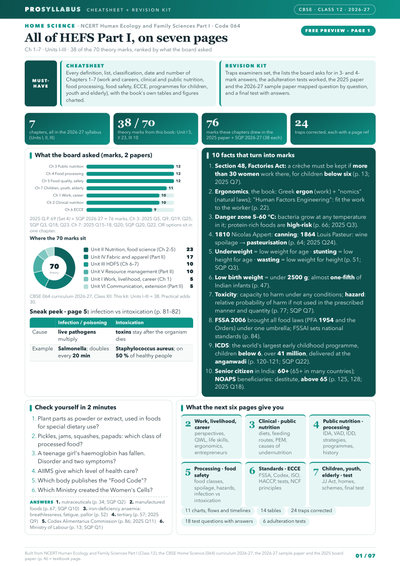
Read page 1 free Get the kit Get the kit One payment · instant PDF · ₹159 View details Marks booster + cheatsheet: key concepts in 2 lines each, common traps 38 of the 70 theory marks: Ch 1–7 10 marks: Unit III, ECCE to elderly Common traps that cost marks, listed 5 marks: Unit I, work and careers 2025 paper and SQP: ranked by what they asked Page 1 free about 8 min read , Full kit about 55 min read ₹159
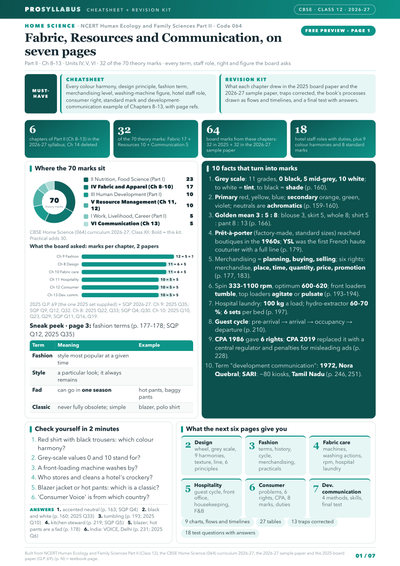
Read page 1 free Get the kit Get the kit One payment · instant PDF · ₹159 View details Marks booster + cheatsheet: key concepts in 2 lines each, common traps 17 marks: Unit IV Fabric and Apparel 10 marks: Unit V Resource Management 2025 board questions mapped to each chapter Every consumer right and standard mark Common traps, corrected Page 1 free about 8 min read , Full kit about 55 min read ₹159
Read page 1 free Get the kit Get the kit One payment · instant PDF · ₹159 View details Get alerts for CBSE Class 12 Board Examination
Dates, results and cutoffs, by email when they are announced. Free.
Google, Apple, or a code to your phone or email. It is saved to your account.
This chapter is part of the CBSE Class 12 Board Examination Board Examination Explore every chapter — summary, notes, extra questions & MCQ quizzes Preparing for CBSE Class 12 Board Examination? Students also sit JEE is set on the Class 11 and 12 Physics, Chemistry and Maths syllabus; students prepare for boards and JEE together.
Tests are played signed in — sign in (free, 10 seconds) so your attempts, rank and XP are saved to you #1
The Last Lesson
Start here
#2
Economics (Class 12) Practice Quiz | CBSE Class 12 Board Examination
#3
#4
Challenges of Nation Building
#5
#6
#7
#8
Human Geography: Nature and Scope
#9
Bricks, Beads and Bones — The Harappan Civilisation
#10
#11
#12
#13
#14
#15
#16
#17
Inverse Trigonometric Functions
#18
#19
#20
Journey to the End of the Earth
#21
#22
#23
#24
#25
#26
#27
#28
#29
The Challenges of Cultural Diversity
#30
Patterns of Social Inequality and Exclusion
#31
Social Institutions: Continuity and Change
#32
The Demographic Structure of the Indian Society
#33
Introducing Indian Society
#34
#35
Security in the Contemporary World
#36
International Trade (India)
#37
Transport and Communication (India)
#38
Tertiary and Quaternary Activities
#39
#40
Kings, Farmers and Towns — Early States and Economies (c. 600 BCE-600 CE)
#41
Theory of Consumer Behaviour
#42
#43
#44
Nature and Significance of Management
#45
Dissolution of Partnership Firm
#46
Accounting for Partnership: Basic Concepts
#47
Three Dimensional Geometry
#48
Continuity and Differentiability
#49
#50
#51
Principles of Inheritance and Variation
#52
#53
#54
#55
#56
#57
Accountancy (Class 12) Practice Quiz | CBSE Class 12 Board Examination
#58
Electrostatic Potential and Capacitance Fundamentals | CBSE Class 12 Board Examination
#59
#60
An Elementary School Classroom in a Slum
#61
#62
Social Influence and Group Processes
#63
Attitude and Social Cognition
#64
#65
#66
#67
Variations in Psychological Attributes
#68
#69
Mass Media and Communications
#70
Globalisation and Social Change
#71
Change and Development in Industrial Society
#72
Change and Development in Rural Society
#73
The Constitution and Social Change
#74
The Market as a Social Institution
#75
Recent Developments in Indian Politics
#76
The Crisis of Democratic Order
#77
Challenges to and Restoration of the Congress System
#78
India's External Relations
#79
Politics of Planned Development
#80
Era of One-party Dominance
#81
Environment and Natural Resources
#82
International Organisations
#83
#84
Contemporary Centres of Power
#85
Geographical Perspective on Selected Issues and Problems
#86
Planning and Sustainable Development in the Indian Context
#87
Mineral and Energy Resources
#88
#89
Land Resources and Agriculture
#90
#91
Population: Distribution, Density, Growth and Composition
#92
#93
#94
The World Population: Distribution, Density and Growth
#95
Framing the Constitution — The Beginning of a New Era
#96
Mahatma Gandhi and the Nationalist Movement — Civil Disobedience and Beyond
#97
Rebels and the Raj — The Revolt of 1857 and its Representations
#98
Colonialism and the Countryside — Exploring Official Archives
#99
Peasants, Zamindars and the State — Agrarian Society and the Mughal Empire (c. sixteenth-seventeenth centuries)
#100
An Imperial Capital: Vijayanagara (c. fourteenth to sixteenth century)
#101
Bhakti-Sufi Traditions — Changes in Religious Beliefs and Devotional Texts (c. eighth to eighteenth century)
#102
Through the Eyes of Travellers — Perceptions of Society (c. tenth to seventeenth century)
#103
Thinkers, Beliefs and Buildings — Cultural Developments (c. 600 BCE-600 CE)
#104
Kinship, Caste and Class — Early Societies (c. 600 BCE-600 CE)
#105
Open Economy Macroeconomics
#106
Government Budget and the Economy
#107
Determination of Income and Employment
#108
National Income Accounting
#109
#110
The Theory of the Firm under Perfect Competition
#111
#112
#113
#114
#115
#116
#117
#118
#119
#120
#121
#122
Analysis of Financial Statements
#123
Financial Statements of a Company
#124
Issue and Redemption of Debentures
#125
Accounting for Share Capital
#126
Reconstitution of a Partnership Firm – Retirement/Death of a Partner
#127
Reconstitution of a Partnership Firm – Admission of a Partner
#128
#129
#130
#131
#132
#133
#134
Application of Derivatives
#135
Biodiversity and its Conservation
#136
#137
Organisms and Populations
#138
Biotechnology and its Applications
#139
Biotechnology: Principles and Processes
#140
Microbes in Human Welfare
#141
#142
#143
Molecular Basis of Inheritance
#144
Sexual Reproduction in Flowering Plants
#145
#146
#147
Aldehydes, Ketones and Carboxylic Acids
#148
Alcohols, Phenols and Ethers
#149
Haloalkanes and Haloarenes
#150
#151
The d- and f-Block Elements
#152
#153
Semiconductor Electronics: Materials, Devices and Simple Circuits
#154
#155
#156
Dual Nature of Radiation and Matter
#157
#158
Ray Optics and Optical Instruments
#159
#160
#161
Electromagnetic Induction
#162
#163
Moving Charges and Magnetism
#164
Electrostatic Potential and Capacitance
#165
Electric Charges and Fields
#166
CBSE Class 12 — Genetics and Evolution
#167
CBSE Class 12 — Matrices and Determinants
#168
CBSE Class 12 — Solutions and Colligative Properties
#169
#170
CBSE Class 12 — Electrostatics and Electric Field
#171
Humanities Subjects Practice Quiz | CBSE Class 12 Board Examination
More on CBSE Class 12 Board Examination20 guides How to Score Good Marks in Class 12 CBSE: Marks Map by Stream CBSE Class 12 Pre-Board Marks: Do They Count, and What to Do If Low Complete Summary and Solutions for Database Concepts – NCERT Class XII Computer Science, Chapter 8 – File Systems, DBMS, Relational Models, Keys, SQL Introduction, Questions, Answers Complete Summary and Solutions for Consumer Education and Protection – NCERT Human Ecology and Family Sciences, Chapter 12 – Study Summary, Explanation, Questions, Answers Complete Summary and Solutions for Supplementary Chemistry Material – NCERT Class XII Chemistry Part I Supplementary Resources – Additional Examples, Problems, and Explanations Complete Summary and Solutions for Project Based Learning – NCERT Class XII Computer Science, Chapter 13 – Project Planning, Implementation, Presentation, Documentation, and Evaluation Complete Summary and Solutions for Querying and SQL Functions – NCERT Class XII Informatics Practices, Chapter 1 – Explanation, Questions, Answers अंतरा भाग 2 – कक्षा 12 के लिए हिंदी (ऐच्छिक) की पाठ्यपुस्तक story खंड – पाठ-16 अंतरा भाग 2 – कक्षा 12 के लिए हिंदी (ऐच्छिक) की पाठ्यपुस्तक काव्य खंड – तुलसीदास: (क) भरत-राम का प्रेम, (ख) पद अंतरा भाग 2 – कक्षा 12 के लिए हिंदी (ऐच्छिक) की पाठ्यपुस्तक story खंड – पाठ-17 अंतरा भाग 2 – कक्षा 12 के लिए हिंदी (ऐच्छिक) की पाठ्यपुस्तक काव्य खंड – मलिक मुहम्मद जायसी: बारहमासा अंतरा भाग 2 – कक्षा 12 के लिए हिंदी (ऐच्छिक) की पाठ्यपुस्तक story खंड – पाठ-15 अंतरा भाग 2 – कक्षा 12 के लिए हिंदी (ऐच्छिक) की पाठ्यपुस्तक काव्य खंड – विष्णु खरे: (क) सत्य, (ख) एक कम अंतरा भाग 2 – कक्षा 12 के लिए हिंदी (ऐच्छिक) की पाठ्यपुस्तक story खंड – पाठ-11 अंतरा भाग 2 – कक्षा 12 हिंदी (ऐच्छिक) काव्य खंड – जयशंकर प्रसाद: (क) देवसेना का गीत, (ख) कार्नेलिया का गीत – संपूर्ण सारांश, व्याख्या, प्रश्न और उत्तर अंतरा भाग 2 – कक्षा 12 के लिए हिंदी (ऐच्छिक) की पाठ्यपुस्तक काव्य खंड – विद्यापति: पद अंतरा भाग 2 – कक्षा 12 के लिए हिंदी (ऐच्छिक) पाठ्यपुस्तक story खंड – पाठ-12 अंतरा भाग 2 – कक्षा 12 के लिए हिंदी (ऐच्छिक) की पाठ्यपुस्तक काव्य खंड – सूर्यकांत त्रिपाठी ‘निराला’: (क) गीत गाने दो मुझे, (ख) सरोज-स्मृति अंतरा भाग 2 – कक्षा 12 के लिए हिंदी (ऐच्छिक) की पाठ्यपुस्तक story खंड – पाठ-10 अंतरा भाग 2 – कक्षा 12 के लिए हिंदी (ऐच्छिक) की पाठ्यपुस्तक काव्य खंड – कुकुआन: दोह Notebook backup + AI Save your notes. Revise with AI. Learn more → Share this article