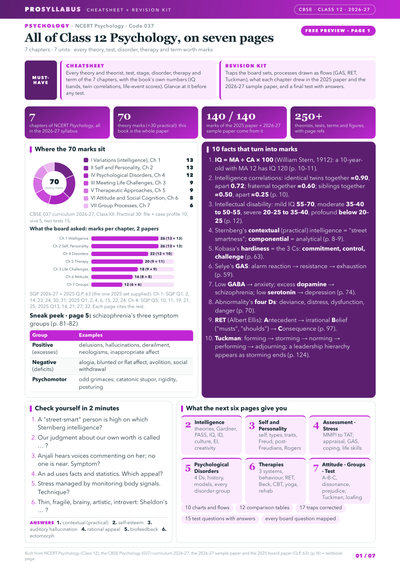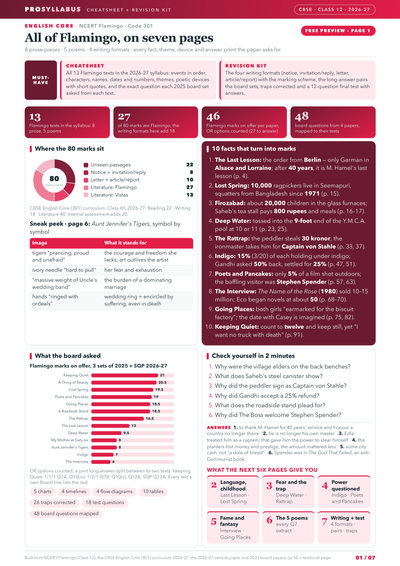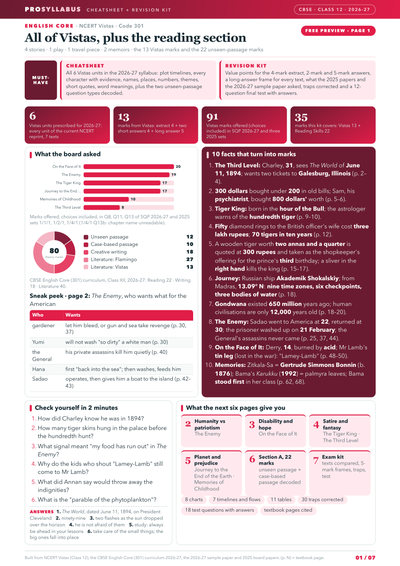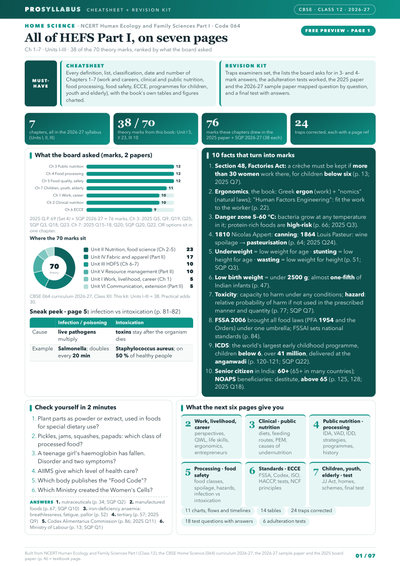
Guides & contents
ProSyllabus JournalCBSE Class 12 Board Examination

How to Score Good Marks in Class 12 CBSE: Marks Map by Stream

Where the 100 marks in each Class 12 subject come from, the units that carry the most in science, commerce and humanities, and a planner that turns your target into theory marks.

Updated 27 seconds agoCBSE Class 12 · Board Exam Preparation · Study Plan
#how to score good marks in class 12#how to score 90 in class 12 cbse#cbse class 12 marks distribution 2026-27#class 12 unit wise weightage#cbse class 12 practical marks#cbse class 12 date sheet 2027#class 12 board exam preparation
Revision kitEvery Part I question from 2025 + the SQP
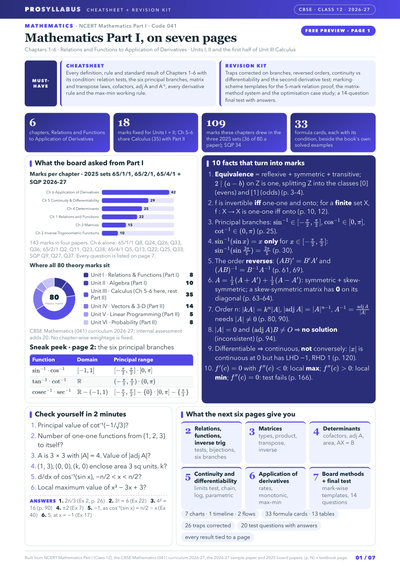
  • Marks booster + cheatsheet: key concepts in 2 lines each, common traps
  • 35 marks: Calculus, shared with Part II
  • 10 marks: Algebra, Ch 3–4
  • Common traps that cost marks, listed
  • 6 principal branches of inverse trig
  • Every derivative rule with its condition
Page 1 free about 8 min read, Full kit about 55 min read
₹159
Read page 1 freeabout 8 minView details
How to Score Good Marks in Class 12 CBSE: Marks Map by Stream

Checked 11 November 2026. Paper dates from CBSE’s 2027 date sheet (06.11.2026); the theory, practical, project and internal-assessment split and the practical windows from CBSE’s circular of 05.11.2026; unit weightage from the 2026-27 subject curricula. Each school sets its own pre-boards and practical dates inside CBSE’s window.

Short answer: good Class 12 marks come from two places, and you can plan both. Every subject is out of 100. In the subjects covered here, the CBSE board paper carries 70 or 80 of them and your school assesses the other 30 or 20 through practicals, a project or internal assessment, with an external examiner in most practical and project subjects. So: secure the school-assessed part first, then spend most of your hours on the units that carry the most marks in each theory paper, practise on CBSE’s 2026-27 sample papers and mark yourself with the marking scheme’s step marks. The Class 12 board exams run from 16 February to 9 April 2027, starting with Physics.

16 Feb 2027
Class 12 boards begin (Physics)
70 + 30 or 80 + 20
board theory + school-assessed marks
1 Jan–13 Feb
practicals and internal assessment (regular schools)
33% + 33%
theory and practical passed separately

CBSE date sheet 06.11.2026; CBSE circular 05.11.2026; Examination Bye-laws 40.1.

Where your 100 marks come from in each subject

CBSE’s circular of 05.11.2026 lists, for every Class 12 subject, the theory marks, the practical, project or internal-assessment marks, and whether the board appoints an external examiner. The subjects covered here use the following marks splits.

SubjectBoard theory paperSchool-assessed partExternal examinerBoard paper (2027)
Physics7030 (practical)YesTue 16 Feb
Chemistry7030 (practical)YesSat 27 Feb
Biology7030 (practical)YesThu 25 Mar
Mathematics8020 (internal assessment)NoTue 9 Mar
Computer Science7030 (practical)YesWed 31 Mar
Informatics Practices7030 (practical)YesWed 31 Mar
Accountancy8020 (project or practical)YesTue 23 Feb
Business Studies8020 (project)YesThu 1 Apr
Economics8020 (project)YesTue 16 Mar
Applied Mathematics8020 (internal assessment)NoTue 9 Mar
History8020 (project)YesSat 27 Mar
Political Science8020 (project)YesFri 19 Mar
Geography7030 (practical)YesThu 25 Feb
Psychology7030 (practical)YesTue 2 Mar
Sociology8020 (project)YesTue 30 Mar
English Core8020 (internal assessment)NoFri 5 Mar
Hindi Core8020 (internal assessment)NoSat 13 Mar

Practical and project marks are not a formality. CBSE’s pass rule for Class 12 needs 33% in each subject, and in a subject with practical work, 33% in the theory and 33% in the practical separately. Practicals, projects and internal assessment for 2027 are held from 1 January to 13 February 2027 in regular schools, and from 9 November to 19 December 2026 in winter-bound schools.

Where other pages get this wrong

CBSE’s Class 12 mark sheet shows marks in each subject, not an overall percentage.

Commonly published instead: “Your CBSE percentage”, as if the board printed one on the mark sheet.

The 2026-27 scheme of studies says the mark sheet cum certificate shows marks in each subject separately and mentions no aggregate score or percentage; a college or institution works out a percentage by its own rules. So “good marks” is decided subject by subject, and each subject is worth planning on its own. The board does replace a failed main subject with a sixth subject, if you took one, as long as Hindi or English stays among the main five.

The marks map by stream

Each subject curriculum for 2026-27 gives a weightage for every unit of the theory paper. The bars below put the largest unit first. Use them to decide the order of revision: a unit worth 35 marks deserves more hours than one worth 5, but no unit is safe to skip, because each paper can ask from all of them.

Science

Science: unit weightage in the theory paper
Largest unitSecondThirdFourthFifthAll other units
Physics (theory 70); largest: Electromagnetic Waves + Optics 18
18
17
16
12
7
Chemistry (theory 70); largest: Electrochemistry 9
9
8
7
7
7
32
Mathematics (theory 80); largest: Calculus 35
35
14
10
8
8
5
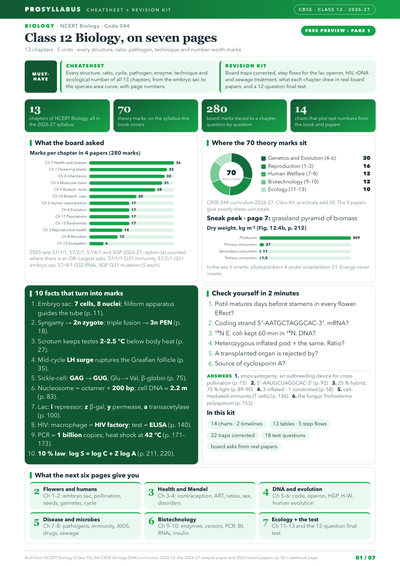
Biology (theory 70); largest: Genetics and Evolution 20
20
16
12
12
10

CBSE subject curricula 2026-27 (Physics, Chemistry, Mathematics, Biology). Physics combines units where its curriculum gives a shared weightage; Electronic Devices has its own 7 marks.

SubjectUnit or partMarksShare of the theory paper (rounded)
Physics (70 theory)Electrostatics + Current Electricity1623%
Magnetic Effects of Current and Magnetism + Electromagnetic Induction and AC1724%
Electromagnetic Waves + Optics1826%
Dual Nature of Radiation and Matter + Atoms and Nuclei1217%
Electronic Devices710%
Chemistry (70 theory)Electrochemistry913%
Aldehydes, Ketones and Carboxylic Acids811%
Solutions710%
Chemical Kinetics710%
d- and f-Block Elements710%
Coordination Compounds710%
Biomolecules710%
Haloalkanes and Haloarenes69%
Alcohols, Phenols and Ethers69%
Amines69%
Biology (70 theory)Genetics and Evolution2029%
Reproduction1623%
Biology and Human Welfare1217%
Biotechnology and its Applications1217%
Ecology and Environment1014%
Mathematics (80 theory)Calculus3544%
Vectors and Three-Dimensional Geometry1418%
Algebra1013%
Relations and Functions810%
Probability810%
Linear Programming56%

In Mathematics, Calculus alone carries 35 of the 80 theory marks. In Physics, Electromagnetic Waves with Optics (18), Magnetism with Electromagnetic Induction and AC (17) and Electrostatics with Current Electricity (16) add up to 51 of 70. In Biology, Genetics and Evolution (20) and Reproduction (16) make up more than half the paper. Chemistry is spread evenly: no chapter carries more than 9 of 70, so it rewards covering every chapter. Kits: Physics Physics Part I · Physics Part II · Chemistry Chemistry Part I · Chemistry Part II · Biology Biology · Mathematics Mathematics Part I · Mathematics Part II.

Commerce

Commerce: unit weightage in the theory paper
Largest unitSecondThirdFourthFifthAll other units
Accountancy (theory 80); largest: Accounting for Partnership Firms 36
36
24
12
8
Business Studies (theory 80); largest: Organising, Staffing, Directing, Controlling 20
20
16
15
15
14
Economics (theory 80); largest: Current Challenges facing Indian Economy 20
20
12
12
10
8
18
Applied Mathematics (theory 80); largest: Calculus 15
15
15
11
10
10
19

CBSE subject curricula 2026-27 (Accountancy, Business Studies, Economics, Applied Mathematics). Business Studies groups chapters per weightage, as its curriculum does.

SubjectUnit or partMarksShare of the theory paper (rounded)
Accountancy (80 theory)Accounting for Partnership Firms3645%
Accounting for Companies2430%
Analysis of Financial Statements (Financial Statement Analysis route)1215%
Cash Flow Statement (Financial Statement Analysis route)810%
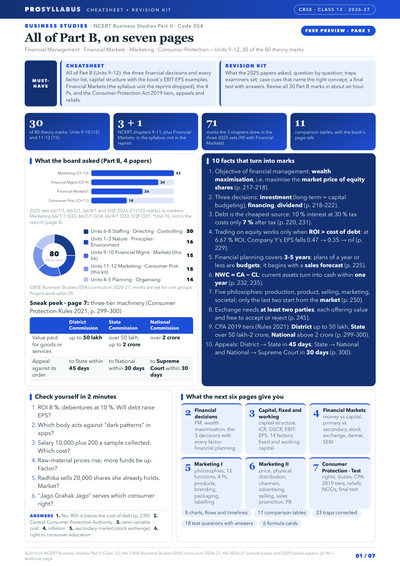
Business Studies (80 theory)Organising, Staffing, Directing, Controlling2025%
Nature and Significance of Management + Principles of Management1620%
Financial Management + Financial Markets1519%
Marketing + Consumer Protection1519%
Business Environment + Planning1418%
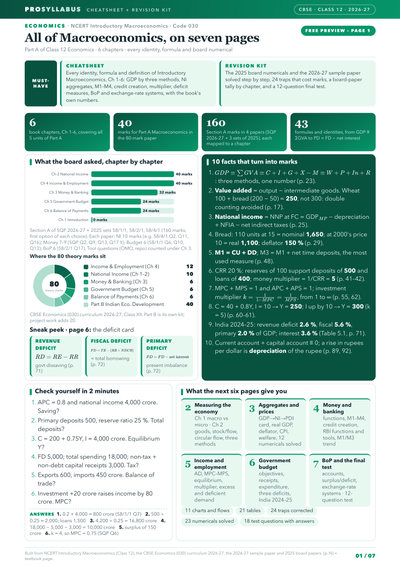
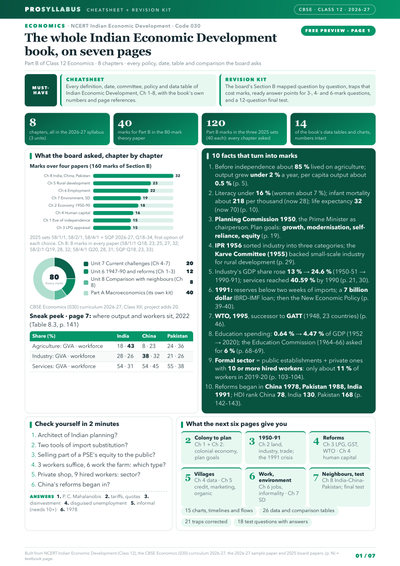
Economics (80 theory)Current Challenges facing Indian Economy2025%
Determination of Income and Employment1215%
Development Experience (1947-90) and Economic Reforms since 19911215%
National Income and Related Aggregates1013%
Development Experience of India: a Comparison with Neighbours810%
Money and Banking68%
Government Budget and the Economy68%
Balance of Payments68%
Applied Mathematics (80 theory)Calculus1519%
Financial Mathematics1519%
Numbers, Quantification and Numerical Applications1114%
Algebra1013%
Probability Distributions1013%
Linear Programming810%
Time-based Data68%
Inferential Statistics56%

In Accountancy, Partnership Firms (36) and Companies (24) together are 60 of the 80 theory marks. In Economics, each book carries 40; the single largest unit is Current Challenges facing Indian Economy (20). Business Studies splits 50 marks for Principles and Functions of Management and 30 for Business Finance and Marketing. In Accountancy, Part B has two routes: Financial Statement Analysis (12 + 8 theory marks, with a 20-mark project) or Computerised Accounting (20 marks, with 20-mark practical work). Mathematics and Applied Mathematics cannot be taken together. Kits: Accountancy Accountancy Part I · Accountancy Part II · Computerised Accounting · Business Studies Business Studies Part I · Business Studies Part II · Economics Macroeconomics · Indian Economic Development.

Humanities

Humanities: unit weightage in the theory paper
Largest unitSecondThirdFourthFifthAll other units
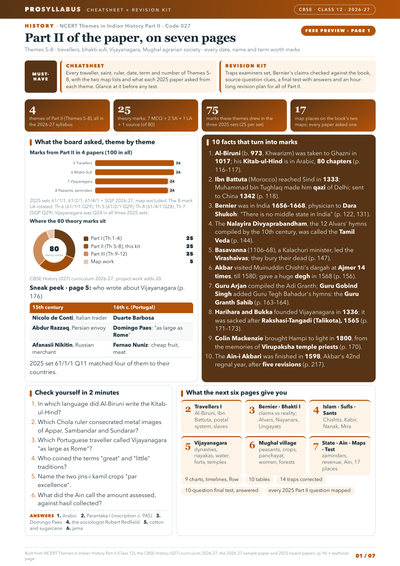
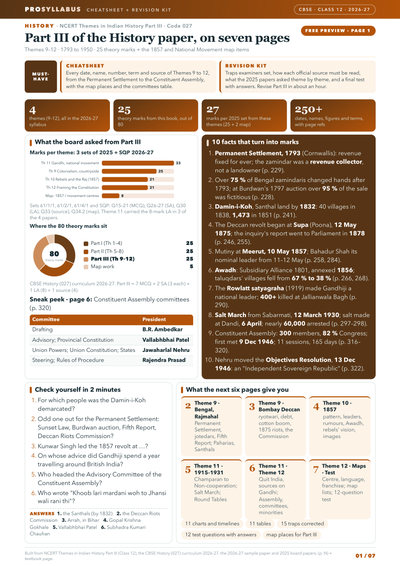
History (theory 80); largest: Themes in Indian History Part I 25
25
25
25
5
Political Science (theory 80); largest: Contemporary World Politics (7 chapters; six carry 6 marks, Globalisation 4) 40
40
40
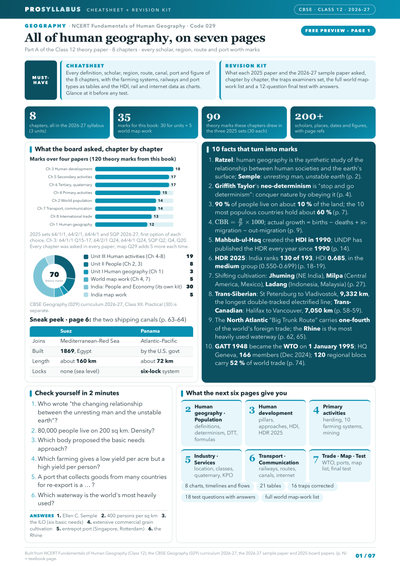
Geography (theory 70); largest: Human activities, transport and trade (world book, ch. 4–8) 19
19
10
8
7
5
21
Psychology (theory 70); largest: Variations in Psychological Attributes 13
13
13
12
9
9
14
Sociology (theory 80); largest: Indian Society (4 evaluated chapters, 10 each) 40
40
40

CBSE subject curricula 2026-27 (History, Political Science, Geography, Psychology, Sociology).

SubjectUnit or partMarksShare of the theory paper (rounded)
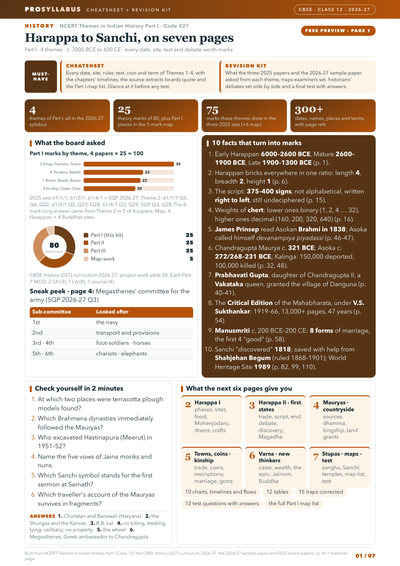
History (80 theory)Themes in Indian History Part I2531%
Themes in Indian History Part II2531%
Themes in Indian History Part III2531%
Map work56%
Political Science (80 theory)Contemporary World Politics (7 chapters; six carry 6 marks, Globalisation 4)4050%
Politics in India since Independence (8 chapters; Recent Developments 8, Planned Development 2)4050%
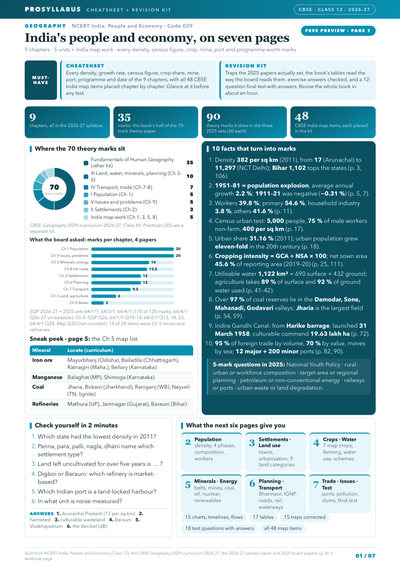
Geography (70 theory)Human activities, transport and trade (world book, ch. 4–8)1927%
Resources and development in India (ch. 3–6)1014%
World population and human development811%
Transport, communication and trade in India710%
Map work (world map)57%
Map work (India map)57%
Population of India57%
Geographical perspective on selected issues (India)57%
Human Geography (nature and scope)34%
Human Settlements (India)34%
Psychology (70 theory)Variations in Psychological Attributes1319%
Self and Personality1319%
Psychological Disorders1217%
Meeting Life Challenges913%
Therapeutic Approaches913%
Attitude and Social Cognition811%
Social Influence and Group Processes69%
Sociology (80 theory)Indian Society (4 evaluated chapters, 10 each)4050%
Social Change and Development in India (5 evaluated chapters: 5 + 5 + 10 + 10 + 10)4050%
English Core (80 theory)Literature: Flamingo and Vistas4050%
Reading skills2228%
Creative writing skills1823%

History gives 25 marks to each of the three Themes in Indian History books and 5 to the map. Geography carries 10 marks of map work, 5 in each book, and its practical is 30 of the 100. In Psychology, the first two units, Variations in Psychological Attributes and Self and Personality, carry 13 each. In English Core, literature from Flamingo and Vistas is 40 of the 80. Kits: History Themes in Indian History I · Themes II · Themes III · Political Science Contemporary World Politics · Politics in India since Independence · Geography Fundamentals of Human Geography · India: People and Economy · Practical Geography Part II · Psychology Psychology · Sociology Indian Society · Social Change and Development in India · English Core Flamingo · Vistas.

Revision kitEvery Part I question from 2025 + the SQP
  • Marks booster + cheatsheet: key concepts in 2 lines each, common traps
  • 35 marks: Calculus, shared with Part II
  • 10 marks: Algebra, Ch 3–4
  • Common traps that cost marks, listed
  • 6 principal branches of inverse trig
  • Every derivative rule with its condition
Page 1 free about 8 min read, Full kit about 55 min read
₹159
Read page 1 freeabout 8 minView details

Your 2027 papers and the gaps between them

All Class 12 papers start at 10:30 am. The table shows an illustrative five-subject combination in each stream and the days between papers (our count from the date sheet). The gaps are fixed, so plan now what goes into each one: a long gap gives the most room to the subject whose paper comes after it, and a short gap needs that subject revised well before the exam period.

StreamPapers in date order (calendar days since the previous paper)Longest gap
Science (PCM)Physics Tue 16 Feb → Chemistry Sat 27 Feb (11 days) → English Core Fri 5 Mar (6 days) → Mathematics Tue 9 Mar (4 days) → Computer Science Wed 31 Mar (22 days)22 days, before Computer Science
Science (PCB)Physics Tue 16 Feb → Chemistry Sat 27 Feb (11 days) → Psychology Tue 2 Mar (3 days) → English Core Fri 5 Mar (3 days) → Biology Thu 25 Mar (20 days)20 days, before Biology
CommerceAccountancy Tue 23 Feb → English Core Fri 5 Mar (10 days) → Mathematics Tue 9 Mar (4 days) → Economics Tue 16 Mar (7 days) → Business Studies Thu 1 Apr (16 days)16 days, before Business Studies
HumanitiesGeography Thu 25 Feb → English Core Fri 5 Mar (8 days) → Political Science Fri 19 Mar (14 days) → History Sat 27 Mar (8 days) → Sociology Tue 30 Mar (3 days)14 days, before Political Science

Your combination may differ: Hindi Core is on 13 March, Physical Education on 18 February, Psychology on 2 March, and Computer Science, Informatics Practices and Information Technology all on 31 March. CBSE says over 40,000 subject combinations were checked so that no two of a student’s papers fall on the same day.

Turn a target into theory marks: a planner

Target-marks planner: what each paper needs from you

Pick your stream, then type a target (out of 100) for each subject you take. The planner subtracts the practical, project or internal marks you expect (change the number if your teacher’s feedback suggests otherwise), shows the marks you need in the board’s theory paper, and ranks your subjects by the gap between that need and your recent theory score, in percentage points. The planner asks for no name and does not save what you type.

Physics
Theory 70 + practical 30 · paper Tue 16 Feb
Chemistry
Theory 70 + practical 30 · paper Sat 27 Feb
Biology
Theory 70 + practical 30 · paper Thu 25 Mar
Mathematics
Theory 80 + internal assessment 20 · paper Tue 9 Mar
Computer Science
Theory 70 + practical 30 · paper Wed 31 Mar
Informatics Practices
Theory 70 + practical 30 · paper Wed 31 Mar
Accountancy
Theory 80 + project or practical 20 · paper Tue 23 Feb
Business Studies
Theory 80 + project 20 · paper Thu 1 Apr
Economics
Theory 80 + project 20 · paper Tue 16 Mar
Applied Mathematics
Theory 80 + internal assessment 20 · paper Tue 9 Mar
History
Theory 80 + project 20 · paper Sat 27 Mar
Political Science
Theory 80 + project 20 · paper Fri 19 Mar
Geography
Theory 70 + practical 30 · paper Thu 25 Feb
Psychology
Theory 70 + practical 30 · paper Tue 2 Mar
Sociology
Theory 80 + project 20 · paper Tue 30 Mar
English Core
Theory 80 + internal assessment 20 · paper Fri 5 Mar
Hindi Core
Theory 80 + internal assessment 20 · paper Sat 13 Mar

Your plan appears here.

Marks splits: CBSE circular of 05.11.2026; Accountancy’s alternative practical route: Class XII Accountancy curriculum 2026-27. Paper dates: CBSE date sheet of 06.11.2026. Unit weightage: CBSE subject curricula 2026-27. The calculation and the order are ours, and a target is a plan, not a prediction: no tool can promise a score.

If the planner cannot run (some readers and saved pages remove it), use this table. It assumes 27 of 30 or 18 of 20 in the school-assessed part; if you expect fewer, the theory paper has to make up the difference. In a subject with practical work, CBSE also needs 33% in theory and 33% in practical separately.

PaperAssumed school-assessed marksTheory needed for 75for 85for 95
70 theory + 30 practical (e.g. Physics, Chemistry, Biology, Geography, Psychology, Computer Science, Informatics Practices)27/3048/70 (68.6%)58/70 (82.9%)68/70 (97.1%)
80 theory + 20 project, practical or internal assessment (e.g. Mathematics, Applied Mathematics, English Core, Hindi Core, Accountancy, Business Studies, Economics, History, Political Science, Sociology)18/2057/80 (71.3%)67/80 (83.8%)77/80 (96.3%)

Two worked examples

Worked example 1: Physics, target 90

  • Expect 28 of 30 in the practical. The theory paper must give 90 − 28 = 62 of 70, which is 88.6%.
  • The three largest weightage groups carry 51 of the 70 theory marks: Electromagnetic Waves and Optics (18), Magnetism, Electromagnetic Induction and AC (17), Electrostatics and Current Electricity (16).
  • If your last test showed 70% in theory, the gap is about 19 points. Revise those three groups first, then Dual Nature with Atoms and Nuclei (12) and Electronic Devices (7), and test yourself on a full sample paper before 16 February.

Our computation from CBSE’s Physics curriculum 2026-27 and circular of 05.11.2026.

Worked example 2: Accountancy, target 85

  • On the Financial Statement Analysis route, expect 18 of 20 in the project (project file 12 and viva, an oral question round, 8, assessed with an external examiner). The theory paper must give 85 − 18 = 67 of 80, which is 83.75%.
  • Partnership Firms carries 36 of the 80 theory marks and Companies 24. A strong grip on those two units covers most of the paper; Analysis of Financial Statements (12) and the Cash Flow Statement (8) complete it.
  • The Accountancy paper is on 23 February, the first paper in the illustrative commerce combination above, so start it early.

Our computation from CBSE’s Accountancy curriculum 2026-27 and circular of 05.11.2026.

Revision kitEvery Part I question from 2025 + the SQP
  • Marks booster + cheatsheet: key concepts in 2 lines each, common traps
  • 35 marks: Calculus, shared with Part II
  • 10 marks: Algebra, Ch 3–4
  • Common traps that cost marks, listed
  • 6 principal branches of inverse trig
  • Every derivative rule with its condition
Page 1 free about 8 min read, Full kit about 55 min read
₹159
Read page 1 freeabout 8 minView details

Eight habits that move Class 12 marks

  1. Bank the school-assessed marks. Finish the practical file, project or internal assessment work before your school’s assessment date, inside CBSE’s window. In most practical and project subjects an external examiner checks it; be ready to explain your own practical or project work in any viva.
  2. Revise by weightage. Use the marks map above to set the order of revision in each subject. Larger units first, but every unit covered.
  3. Work from the NCERT textbook. The 2026-27 curricula for these subjects prescribe NCERT textbooks; your kit, notes and question banks sit beside the textbook, not in place of it.
  4. Expect application questions. The 2026-27 papers are designed around competencies: in Mathematics 20 of 80 marks are for applying and 16 for analysing, evaluating and creating; in Physics 22 and 21 of 70; in Accountancy 24 and 24 of 80. Practise questions you have not seen before, not only textbook exercises.
  5. Mark yourself with the marking scheme. CBSE publishes a marking scheme with each sample paper and for past board papers. Compare your long answers step by step with it to see where marks go.
  6. Write full papers against the clock. Every theory paper for the subjects in this guide is three hours. One timed paper a week from December, more in January, builds the pace.
  7. Recall, don’t reread. Close the book and write what you remember, then check. Try short daily recall of formulas, dates and definitions, then check your answers.
  8. Plan the gaps. The days between your papers are fixed. Decide now what you will revise in each gap, and give weaker subjects extra time before the exam period starts.

For the last month before the boards, our last 30 days strategy guide sets out a day-by-day revision approach; this guide is for the months before that.

If you are a parent

Class 12 is the year your child is becoming an adult. CBSE’s Parenting Calendar for 2026-27 describes the parent’s task in Class 11 and 12 as accompanying rather than directing, and warns that coaching, mock tests and revision can leave a Class 12 student with no life outside preparation. Here is what helps in the months before the boards.

  1. Ask about the plan, not the percentage. “Which subject needs the most work, and when is its paper?” opens a better conversation than a target number. Sit together with the planner above for ten minutes.
  2. Check the school-assessed part. Ask whether practical files and projects are complete and when your child’s school holds its practicals inside CBSE’s window (1 January to 13 February 2027 for regular schools).
  3. Help with one subject, not five. Agree on the subject with the biggest gap and a daily slot for it. The free first page of its Marks Booster kit ends with a short self-check; do it together and let the score decide what to revise.
  4. Protect one non-academic anchor. The Parenting Calendar asks parents to keep one thing such as sport, music or time with friends as a mental-health necessity, not an indulgence. Sleep counts too.
  5. Keep your hopes separate from their result. The calendar asks parents to separate their own identity from their child’s aspirations and results, especially with entrance exams running alongside the boards.

When it is more than marks

  • Watch for withdrawal, changes in sleep or appetite, and a loss of interest in things your child used to enjoy. CBSE’s Parenting Calendar notes that self-harm risk in adolescents peaks in the Class 9–12 years in India, and that asking directly whether a child is thinking of hurting themselves does not plant the idea; it opens the door.
  • Talk to the school counsellor. If your child talks about not wanting to go on, stay with them and seek urgent professional help the same day. Tele-MANAS (14416) is the Government of India’s free 24x7 mental health line. If there is immediate danger, call 112, India’s emergency number.

CBSE Parenting Calendar 2026-27; Ministry of Health and Family Welfare (Tele-MANAS).

Which Marks Booster kit to open first

Each Marks Booster kit is a 7-page PDF for one Class 12 book, built on the 2026-27 curriculum and the NCERT book and used beside the NCERT textbook, not instead of it. It is a revision sheet, not a full course. The first page is free to read on the kit page. If you decide to buy, start with the subject the planner put first.

Board paper Tue 16 Feb 2027

Physics

Physics Part I kit →Physics Part II kit →

Board paper Sat 27 Feb 2027

Chemistry

Chemistry Part I kit →Chemistry Part II kit →

Board paper Thu 25 Mar 2027

Biology

Biology kit →

Board paper Tue 9 Mar 2027

Mathematics

Mathematics Part I kit →Mathematics Part II kit →

Board paper Wed 31 Mar 2027

Computer Science

Computer Science kit →

Board paper Wed 31 Mar 2027

Informatics Practices

Informatics Practices kit →

Board paper Thu 1 Apr 2027

Business Studies

Business Studies Part I kit →Business Studies Part II kit →

Board paper Tue 2 Mar 2027

Psychology

Psychology kit →

Board paper Fri 5 Mar 2027

English Core

Flamingo kit →Vistas kit →

Board paper Sat 13 Mar 2027

Hindi Core

Aroh kit →Vitan kit →

Practise it, don't just read it

After revising a unit, check it. Our Class 12 chapter quizzes are ten questions each: a quick test of recall on the topics they cover. Full sample papers under time show broader progress.

The ProSyllabus CBSE Class 12 library has chapter quizzes for Physics, Chemistry, Biology, Mathematics, English, Accountancy, Business Studies, Economics, History, Political Science, Geography, Sociology and Psychology. You can start free.

Frequently asked questions

How can I score good marks in Class 12 CBSE?

Secure the practical, project or internal-assessment marks your school gives (20 or 30 of each subject’s 100), revise the units that carry the most theory marks first without skipping any, practise on CBSE’s 2026-27 sample papers, and mark your answers with the marking scheme. Plan what you will revise in each gap between papers.

How are Class 12 marks divided between theory and practical?

Each subject is out of 100. Physics, Chemistry, Biology, Geography, Psychology, Computer Science and Informatics Practices are 70 theory + 30 practical. Mathematics, Applied Mathematics, English Core and Hindi Core are 80 + 20 internal assessment. Business Studies, Economics, History, Political Science and Sociology are 80 theory + 20 project. Accountancy is 80 theory + 20 project on the Financial Statement Analysis route, or 80 theory + 20 practical on the Computerised Accounting route. Sources: CBSE circular of 05.11.2026 and the Class XII Accountancy curriculum 2026-27.

When do the CBSE Class 12 board exams start in 2027?

On Tuesday 16 February 2027 with Physics. Chemistry is on 27 February, English on 5 March, Mathematics and Applied Mathematics on 9 March, Economics on 16 March, Biology on 25 March and Business Studies on 1 April; the last Class 12 papers are on 9 April. Every paper starts at 10:30 am.

How many marks do I need in theory to score 90 in Physics?

Subtract the practical marks you expect from 90; worked example 1 shows it with 28 of 30 in the practical. The planner on this page does the same for every subject with your own numbers.

Is there a pass mark for theory and practical separately?

Yes. CBSE’s Examination Bye-laws require 33% in each subject and, in a subject with practical work, 33% in the theory and 33% in the practical separately.

Does the CBSE mark sheet show my overall percentage?

No. The 2026-27 scheme of studies says the board shows marks in each subject separately and no aggregate percentage; a college works out a percentage by its own rules.

Is a Marks Booster kit enough to score well?

No. It is a 7-page revision sheet for one book, meant to be used with the NCERT textbook, sample papers and your teacher’s feedback. Its job is to show what to revise first and to check recall.

Sources

official = a document published by the conducting body. reported = a news or coaching site we could not check against an original. Where sources disagree this page says so rather than picking one.
CBSE Class 12 kits

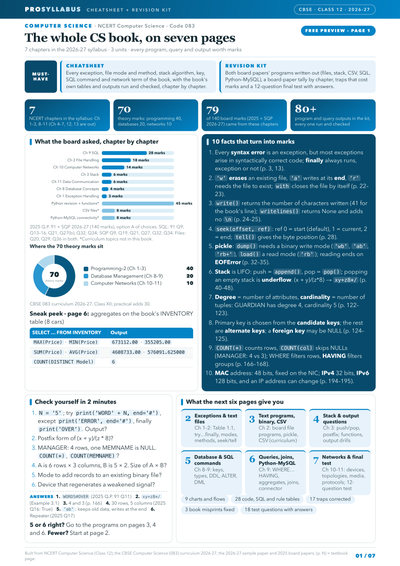
Revision kitEvery Part I question from 2025 + the SQP
  • Marks booster + cheatsheet: key concepts in 2 lines each, common traps
  • 35 marks: Calculus, shared with Part II
  • 10 marks: Algebra, Ch 3–4
  • Common traps that cost marks, listed
  • 6 principal branches of inverse trig
  • Every derivative rule with its condition
Page 1 free about 8 min read, Full kit about 55 min read
₹159
Read page 1 freeabout 8 minView details
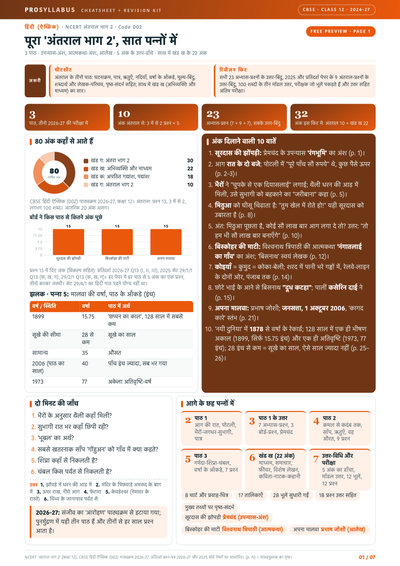
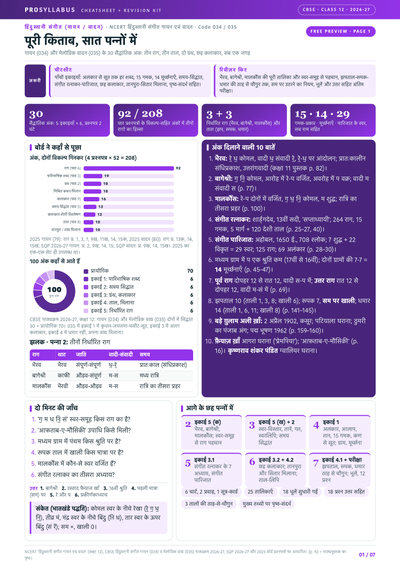
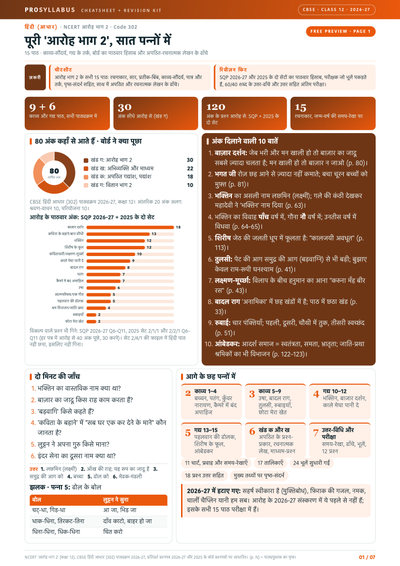
Revision kitAll 15 आरोह lessons, board asks by lesson
  • Marks booster + cheatsheet: key concepts in 2 lines each
  • 30 marks: answer frames for आरोह
  • 40 marks outside the book, mapped
  • 15 writers on one timeline
  • Unseen passage question types
  • 12 common mistakes, corrected
Page 1 free about 8 min read, Full kit about 55 min read
₹159
Read page 1 freeabout 8 minView details
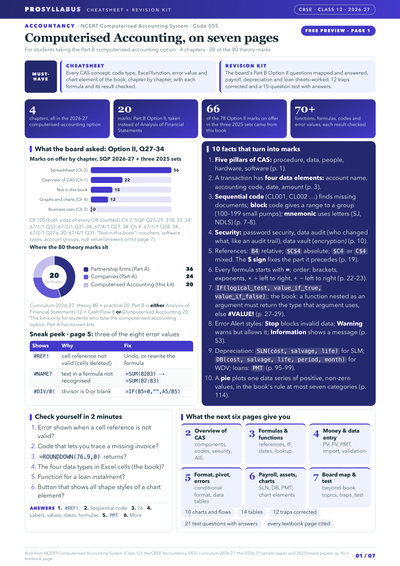
Revision kitSpreadsheet: 56 of 105 Option II marks
  • Marks booster + cheatsheet: key concepts in 2 lines each
  • 12 exam traps, listed
  • 22 of 105 marks on offer: CAS overview
  • Most asked item: error values
  • What Q27–34 ask, answer by answer
  • Every Excel function, result checked
Page 1 free about 8 min read, Full kit about 55 min read
₹159
Read page 1 freeabout 8 minView details
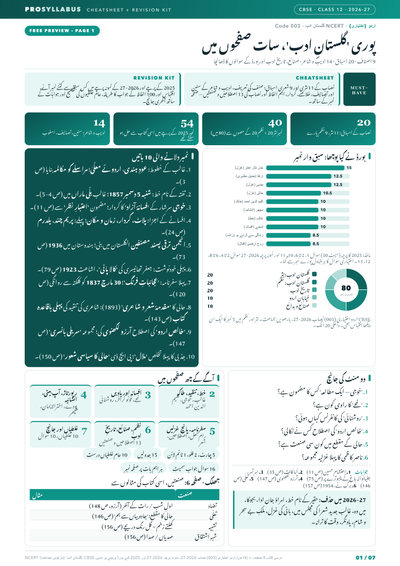
Revision kit20 گلستانِ ادب lessons, 14 writers
  • Marks booster + cheatsheet: key concepts in 2 lines each
  • 13 literary terms and devices
  • 9 genres, each defined
  • Writers' dates and works, by page
  • Five ghazals and four nazms covered
  • 10 common mistakes, corrected
Page 1 free about 8 min read, Full kit about 55 min read
₹159
Read page 1 freeabout 8 minView details
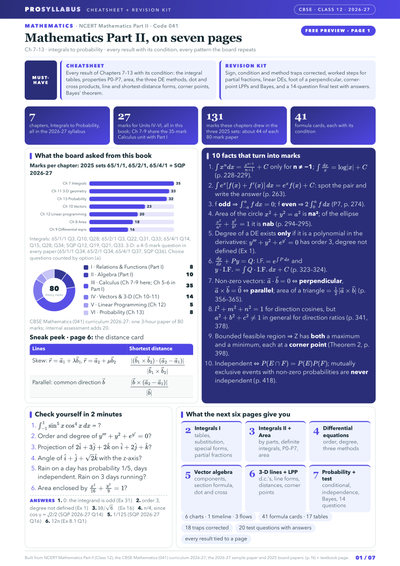
Revision kitIntegrals: 35 marks across the four papers
  • Marks booster + cheatsheet: key concepts in 2 lines each
  • 23 marks in the four papers: Vector Algebra
  • Integral tables with properties P0–P7
  • 3 methods for differential equations
  • 8 marks: Probability, with Bayes' theorem
  • Patterns the board repeats, by chapter
Page 1 free about 8 min read, Full kit about 55 min read
₹159
Read page 1 freeabout 8 minView details
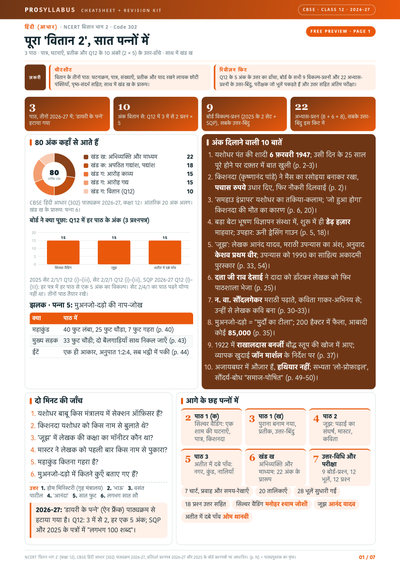
Revision kitवितान: Q12's 10 marks, answer frames
  • Marks booster + cheatsheet: key concepts in 2 lines each
  • 9 board questions in one place
  • 22 marks: Section B formats
  • 3 lessons: characters and symbols for each
  • Event order for each lesson, with pages
  • 12 common mistakes
Page 1 free about 8 min read, Full kit about 55 min read
₹159
Read page 1 freeabout 8 minView details
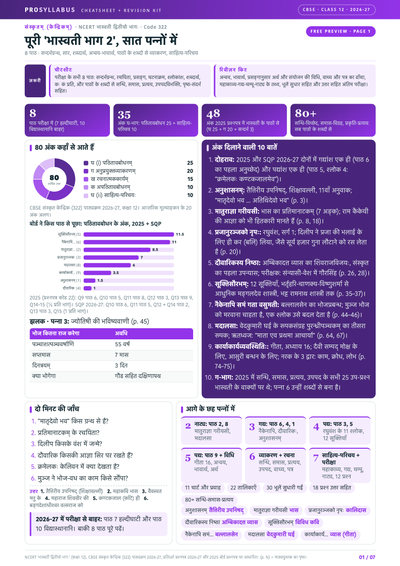
Revision kitAll 8 भास्वती lessons: who says what to whom
  • Marks booster + cheatsheet: key concepts in 2 lines each
  • 20 marks: grammar, 4 × 1 per part
  • Sandhi, samasa, pratyaya from the text
  • Upapada-vibhakti and vachya examples
  • Anvaya and bhavartha answer method
  • Literature intro: epics, prose, champu
Page 1 free about 8 min read, Full kit about 55 min read
₹159
Read page 1 freeabout 8 minView details
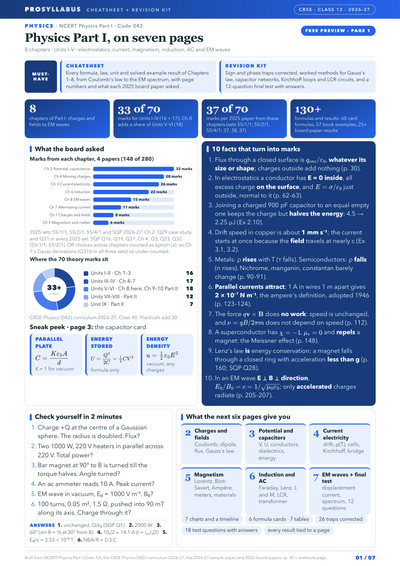
Revision kitCapacitance: 32 marks in 4 papers, most asked
  • Marks booster + cheatsheet: key concepts in 2 lines each
  • 34 marks in 4 papers: Magnetism, Ch 4–5
  • 33 marks in 4 papers: Induction and AC
  • 26 marks in 4 papers: Current Electricity
  • Every formula with its page number
  • What each 2025 board paper asked
Page 1 free about 8 min read, Full kit about 55 min read
₹159
Read page 1 freeabout 8 minView details
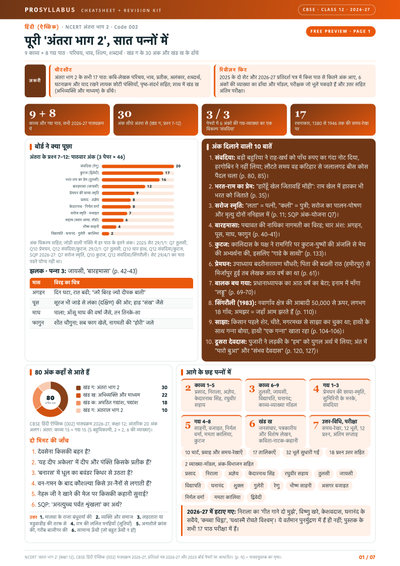
Revision kitAll 17 अंतरा lessons, with board marks
  • Marks booster + cheatsheet: key concepts in 2 lines each
  • 38 board marks: prose 4–8
  • 37 board marks: poems 1–5
  • 22 marks: खंड ख, with answer frames
  • 17 writers on one timeline
  • 12 common mistakes, corrected
Page 1 free about 8 min read, Full kit about 55 min read
₹159
Read page 1 freeabout 8 minView details
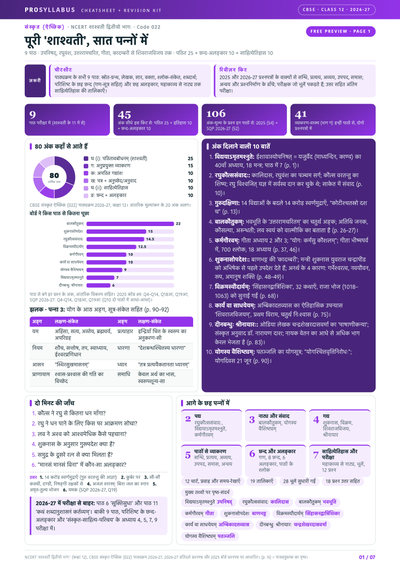
Revision kitशाश्वती: where the 25 + 10 + 10 marks sit
  • Marks booster + cheatsheet: key concepts in 2 lines each
  • 15 marks: grammar from the lessons
  • 6 metres with their gana-sutras
  • 6 figures of speech (अलङ्कार)
  • 20 shlokas of रघुकौत्ससंवादः, upajati metre
  • Literary history in tables, epic to drama
Page 1 free about 8 min read, Full kit about 55 min read
₹159
Read page 1 freeabout 8 minView details
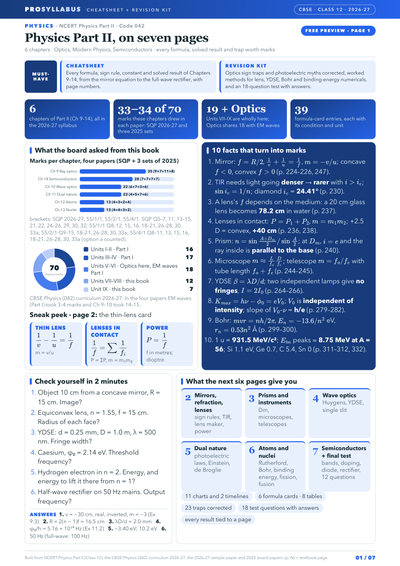
Revision kitRay Optics: 35 marks across four papers
  • Marks booster + cheatsheet: key concepts in 2 lines each, common traps
  • 22 marks across four papers: Wave Optics
  • 22 marks: Dual Nature, with 4-mark cases
  • Common traps that cost marks, listed
  • 13 marks each: Atoms and Nuclei
  • 7 marks in all four papers: Semiconductors
Page 1 free about 8 min read, Full kit about 55 min read
₹159
Read page 1 freeabout 8 minView details
Revision kitAll 3 अंतराल lessons + खंड ख (22 marks)
  • Marks booster + cheatsheet: key concepts in 2 lines each
  • 7 exercise, 3 board answers for lesson 1
  • 5-mark answers in about 100 words
  • Three model 5-mark answers
  • Malwa's rivers and rainfall figures
  • 12 common mistakes, corrected
Page 1 free about 8 min read, Full kit about 55 min read
₹159
Read page 1 freeabout 8 minView details
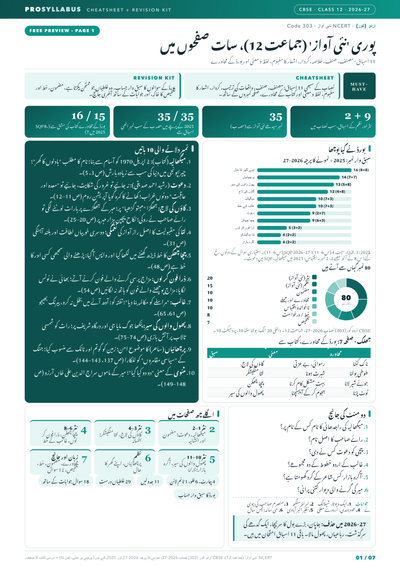
Revision kit11 نئی آواز lessons + the board's idioms
  • Marks booster + cheatsheet: key concepts in 2 lines each
  • Author, genre and summary, lesson by lesson
  • Verse meanings: پرچھائیاں, اپنے گھر کا حال
  • Essay, letter and precis writing
  • Map of the question paper
  • 8 common mistakes
Page 1 free about 8 min read, Full kit about 55 min read
₹159
Read page 1 freeabout 8 minView details
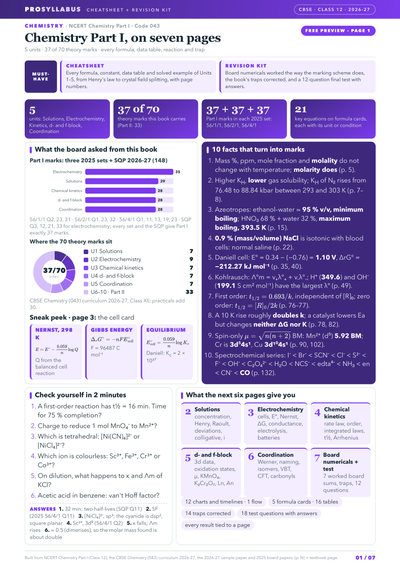
Revision kitElectrochemistry: 9 marks, biggest unit
  • Marks booster + cheatsheet: key concepts in 2 lines each, common traps
  • 7 marks each: the other four units
  • 37 of 70 theory marks across 5 units
  • Mixed traps, corrected
  • Seven board sums, worked stepwise
  • Every data table, with page numbers
Page 1 free about 8 min read, Full kit about 55 min read
₹159
Read page 1 freeabout 8 minView details
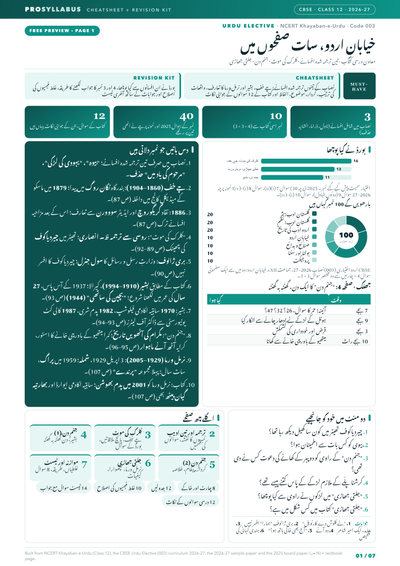
Revision kitThree translated stories, 12 book answers
  • Marks booster + cheatsheet: key concepts in 2 lines each
  • Chekhov, Basheer and Nirmal Verma introduced
  • کلرک کی موت: 1 sneeze, 5 apologies
  • Event order and characters for each story
  • 3 stories compared in one table
  • Method for writing board answers
Page 1 free about 8 min read, Full kit about 55 min read
₹159
Read page 1 freeabout 8 minView details
Revision kitFiles, stack, functions: Unit 1, 40 marks
  • Marks booster + cheatsheet: key concepts in 2 lines each
  • 20 marks: SQL and databases, Unit 3
  • 10 marks: Networks, Unit 2
  • 7 chapters: every output run and checked
  • Stack algorithms and output questions
  • Text, binary and CSV file programs
Page 1 free about 8 min read, Full kit about 55 min read
₹159
Read page 1 freeabout 8 minView details
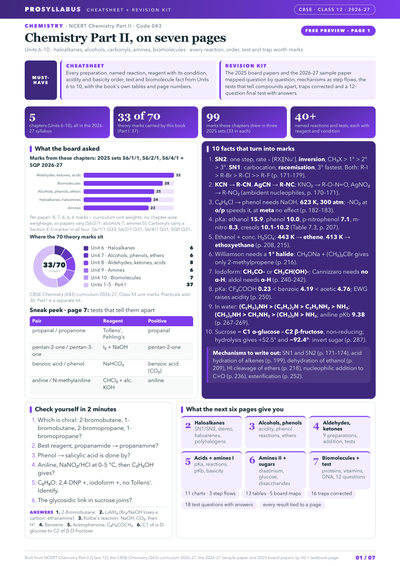
Revision kitUnit 8 carbonyls: 8 marks, biggest unit
  • Marks booster + cheatsheet: key concepts in 2 lines each, common traps
  • 7 marks in every paper: Biomolecules
  • 6 marks in each 2025 set: Haloalkanes
  • Common traps that cost marks, listed
  • 4–5-mark question every paper: Alcohols
  • Named reactions, reagents, conditions
Page 1 free about 8 min read, Full kit about 55 min read
₹159
Read page 1 freeabout 8 minView details
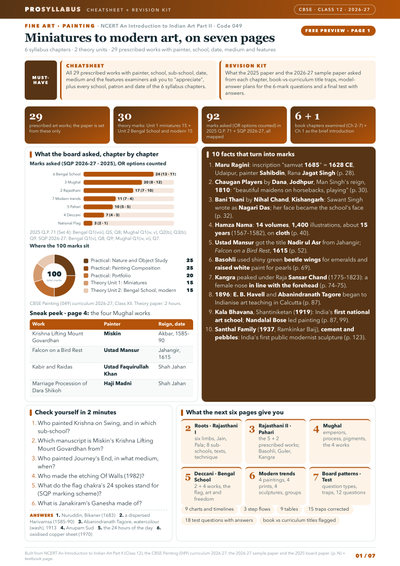
Revision kitAll 29 prescribed works: painter to medium
  • Marks booster + cheatsheet: key concepts in 2 lines each, common traps
  • 24 of 92 board marks: Bengal School
  • 20 of 92 board marks: Mughal School
  • Common traps that cost marks, listed
  • 17 of 92 board marks: Rajasthani Schools
  • 11 of 92: modern art, mostly 2-markers
Page 1 free about 8 min read, Full kit about 55 min read
₹159
Read page 1 freeabout 8 minView details
Revision kit15 gamak, 14 murchhana, three ragas
  • Marks booster + cheatsheet: key concepts in 2 lines each
  • 30 theory marks, all five units
  • Bhairav, Bageshri, Malkauns in full
  • Jhaptal, Rupak, Dhamar: dugun to chaugun
  • Sangeet Ratnakar and Parijat, by chapter
  • Tuning the tanpura and the sitar
Page 1 free about 8 min read, Full kit about 55 min read
₹159
Read page 1 freeabout 8 minView details
Revision kitGenetics + Evolution: Unit VII, 20 marks
  • Marks booster + cheatsheet: key concepts in 2 lines each, common traps
  • 16 marks: Reproduction, Unit VI
  • 12 marks each: Units VIII and IX
  • 10 marks: Ecology, Unit X
  • 13 chapters, with page numbers
  • Common traps, corrected
Page 1 free about 8 min read, Full kit about 55 min read
₹159
Read page 1 freeabout 8 minView details
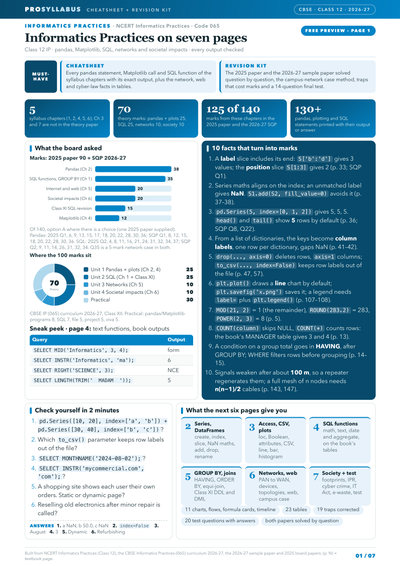
Revision kitPandas: 38 of 140 board marks, mapped
  • Marks booster + cheatsheet: key concepts in 2 lines each, common traps
  • 35 of 140 board marks: SQL functions
  • 20 board marks: networks and the web
  • Common traps, corrected
  • 12 board marks: Matplotlib plots
  • Every statement with its exact output
Page 1 free about 8 min read, Full kit about 55 min read
₹159
Read page 1 freeabout 8 minView details
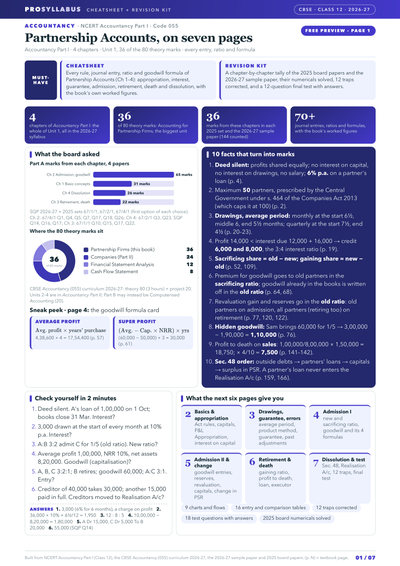
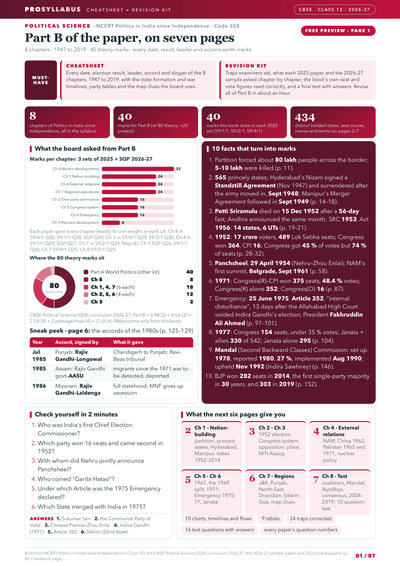
Revision kitPartnership Accounts: 36 of 80 theory marks
  • Marks booster + cheatsheet: key concepts in 2 lines each
  • 12 exam traps, listed
  • 65 board marks: Admission of a Partner
  • 26 board marks: Dissolution
  • 22 board marks: Retirement/Death
  • Goodwill formulas with the book's figures
Page 1 free about 8 min read, Full kit about 55 min read
₹159
Read page 1 freeabout 8 minView details
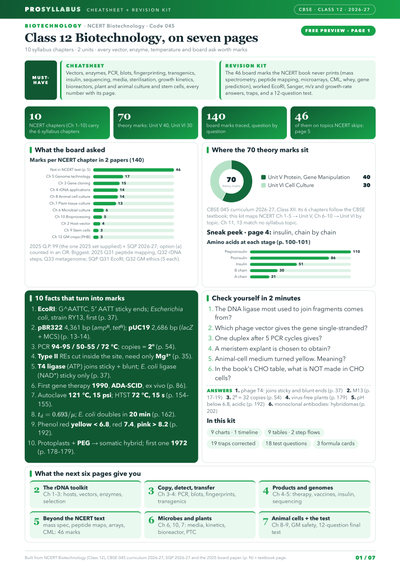
Revision kitBeyond NCERT: 46 of 140 board marks
  • Marks booster + cheatsheet: key concepts in 2 lines each
  • 40 marks: Unit V, rDNA and genomes
  • 30 marks: Unit VI, culture and bioprocess
  • 10 syllabus chapters: every vector, enzyme
  • PCR, blots and DNA fingerprinting
  • Every number tied to its book page
Page 1 free about 8 min read, Full kit about 55 min read
₹159
Read page 1 freeabout 8 minView details
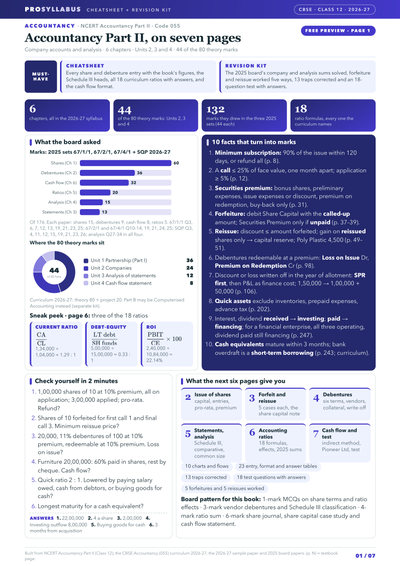
Revision kitAll 18 ratios, with the book's answers
  • Marks booster + cheatsheet: key concepts in 2 lines each, common traps
  • 15 marks in every 2025 set: share capital
  • 9 marks in every 2025 set: debentures
  • Common traps that cost marks, listed
  • 6-mark cash flow in every paper
  • 5 marks in every 2025 set: ratios
Page 1 free about 8 min read, Full kit about 55 min read
₹159
Read page 1 freeabout 8 minView details
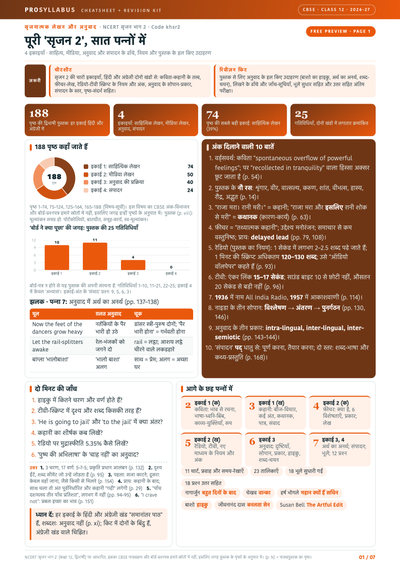
Revision kitसृजन 2: all 4 units, Hindi + English parts
  • Marks booster + cheatsheet: key concepts in 2 lines each
  • Elements of a poem and a story, Unit 1
  • Feature and article writing, Unit 2
  • Radio and TV script rules, with marks
  • Steps and types of translation, Unit 3
  • Levels of editing, Unit 4
Page 1 free about 8 min read, Full kit about 55 min read
₹159
Read page 1 freeabout 8 minView details
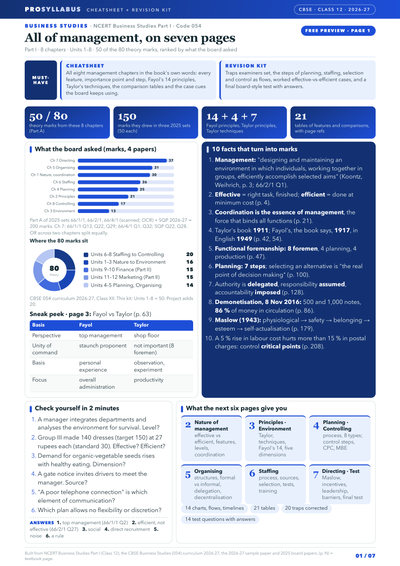
Revision kitDirecting: 37 marks in 4 papers, the most
  • Marks booster + cheatsheet: most-asked concepts in 2 lines each
  • 8 chapters ranked by what the board asked
  • 31 marks: Organising, a 6-marker every set
  • 30 marks in 4 papers: nature of management
  • 14 principles of Fayol
  • Case cues the board keeps using
Page 1 free about 8 min read, Full kit about 55 min read
₹159
Read page 1 freeabout 8 minView details
Revision kitTaal notation: 20 of 60 board marks
  • Marks booster + cheatsheet: key concepts in 2 lines each
  • 16 of 60 board marks: taal comparison
  • 12 of 60 board marks: gharanas
  • 13 thekas, from thah to chaugun
  • 6 marks: history of the tabla, Unit 3
  • 4 biographies, with dates
Page 1 free about 8 min read, Full kit about 55 min read
₹159
Read page 1 freeabout 8 minView details
Revision kitFinancial Markets: 26 marks, not in NCERT
  • Marks booster + cheatsheet: key concepts in 2 lines each
  • 15 marks each: Units 9–10 and 11–12
  • 4 Ps of marketing, Unit 11
  • Consumer Protection Act 2019 tiers, appeals
  • Capital structure with EBIT-EPS examples
  • The three financial decisions, every factor
Page 1 free about 8 min read, Full kit about 55 min read
₹159
Read page 1 freeabout 8 minView details
Revision kitMacro marks by unit: Ch 4 leads with 12
  • Marks booster + cheatsheet: key concepts in 2 lines each
  • 10 marks: National Income Accounting
  • 3 methods for GDP, with identities
  • M1–M4 and credit creation, Ch 3
  • Every deficit measure of the budget, Ch 5
  • 6 chapters: every formula, board numerical
Page 1 free about 8 min read, Full kit about 55 min read
₹159
Read page 1 freeabout 8 minView details
Revision kitUnit 7 (Ch 4–7) carries 20 marks
  • Marks booster + cheatsheet: key concepts in 2 lines each, common traps
  • 12 marks: Unit 6, Ch 1–3
  • 8 marks: Unit 8, India-China-Pakistan
  • Every committee, policy and date, by chapter
  • Data tables with the book's own numbers
  • Common traps, corrected
Page 1 free about 8 min read, Full kit about 55 min read
₹159
Read page 1 freeabout 8 minView details
Revision kitKings, Farmers and Towns: 35 of 100 marks
  • Marks booster + cheatsheet: key concepts in 2 lines each, common traps
  • 23 of 100 marks: Thinkers, Beliefs, Buildings
  • 22 of 100 board marks: Harappa
  • 20 of 100 marks: Kinship, Caste and Class
  • 8-mark answer: Theme 2 in 3 of 4 papers
  • 5 marks: the Part I map list
Page 1 free about 8 min read, Full kit about 55 min read
₹159
Read page 1 freeabout 8 minView details
Revision kitTravellers, Bhakti-Sufi: 26 of 100 each
  • Marks booster + cheatsheet: key concepts in 2 lines each
  • 24 of 100 board marks: Vijayanagara
  • 24 of 100 marks: Mughal village, Theme 8
  • Q24 from Vijayanagara in every 2025 set
  • 3 of 4 papers: source question on travellers
  • 5 marks: the two map lists
Page 1 free about 8 min read, Full kit about 55 min read
₹159
Read page 1 freeabout 8 minView details
Revision kitThemes 9–12: 25 theory marks, 1793 to 1950
  • Marks booster + cheatsheet: key concepts in 2 lines each
  • 1857 and National Movement map items
  • Constituent Assembly committees table
  • Gandhiji 1915–1931: Champaran to Salt March
  • Permanent Settlement and the Fifth Report
  • Bombay Deccan: ryotwari and the 1875 riots
Page 1 free about 8 min read, Full kit about 55 min read
₹159
Read page 1 freeabout 8 minView details
Revision kitHuman Development: 18 of 120 marks asked
  • Marks booster + cheatsheet: key concepts in 2 lines each
  • 17 of 120 marks each: industry, services
  • 15 of 120 marks: Primary Activities
  • 14 of 120 marks: Transport
  • 5 marks: world map work
  • HDI, rail and internet data as charts
Page 1 free about 8 min read, Full kit about 55 min read
₹159
Read page 1 freeabout 8 minView details
Revision kitAll 48 CBSE India map items, by chapter
  • Marks booster + cheatsheet: key concepts in 2 lines each, common traps
  • 20 board marks in 4 papers: Population
  • 14 board marks: Minerals and Energy
  • 13 of the 28 map items asked: minerals
  • 10 marks: Unit III, Ch 3–6
  • Common traps, corrected
Page 1 free about 8 min read, Full kit about 55 min read
₹159
Read page 1 freeabout 8 minView details
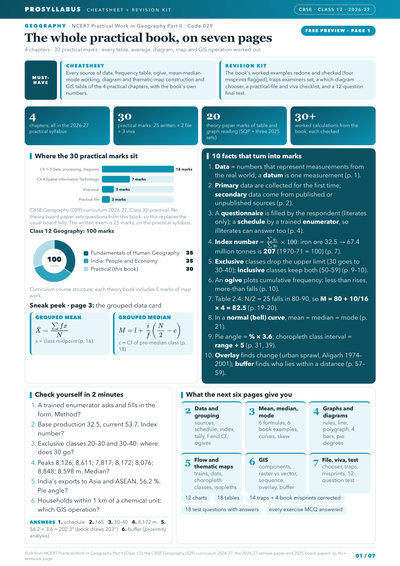
Revision kit30 practical marks: where each one sits
  • Marks booster + cheatsheet: key concepts in 2 lines each, common traps
  • 18 marks: Ch 1–3, data and diagrams
  • 7 marks: GIS, Ch 4
  • Common traps that cost marks, listed
  • 5 marks: file and viva
  • Mean, median and mode, fully worked
Page 1 free about 8 min read, Full kit about 55 min read
₹159
Read page 1 freeabout 8 minView details
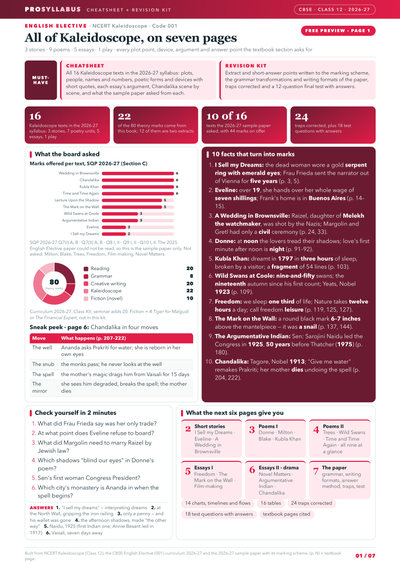
Revision kitAll 16 texts + what the sample paper asked
  • Marks booster + cheatsheet: key concepts in 2 lines each, common traps
  • 22 textbook marks: how each is asked
  • 3 stories: 10 marks in the sample paper
  • Common traps that cost marks, listed
  • 9 poems side by side, with devices
  • 5 essays, each argument set out
Page 1 free about 8 min read, Full kit about 55 min read
₹159
Read page 1 freeabout 8 minView details
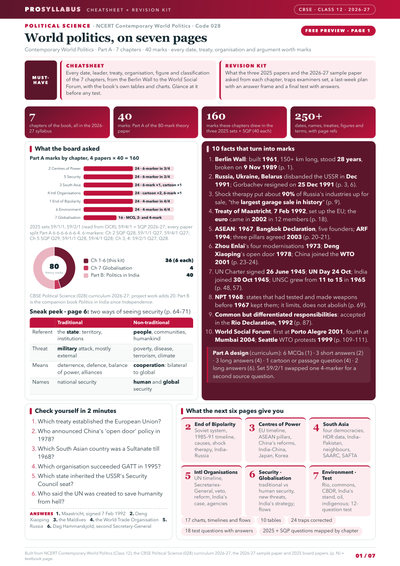
Revision kitEnd of Bipolarity: asked in all 4 papers
  • Marks booster + cheatsheet: most-asked concepts in 2 lines each
  • 6-marker in 3 of 4 papers: Security
  • 4-marker in all 4 papers: Environment
  • 6-marker in 3 of 4 papers: centres of power
  • 2 papers asked UN cartoons
  • 7 chapters: dates, treaties, leaders
Page 1 free about 8 min read, Full kit about 55 min read
₹159
Read page 1 freeabout 8 minView details
Revision kit40 theory marks, split chapter by chapter
  • Marks booster + cheatsheet: key concepts in 2 lines each
  • 8 marks: Chapter 8, 1989 to 2019
  • 6 marks each: Chapters 1, 4 and 7
  • State-formation and war timelines
  • Party tables and election results
  • Map clues the board uses
Page 1 free about 8 min read, Full kit about 55 min read
₹159
Read page 1 freeabout 8 minView details
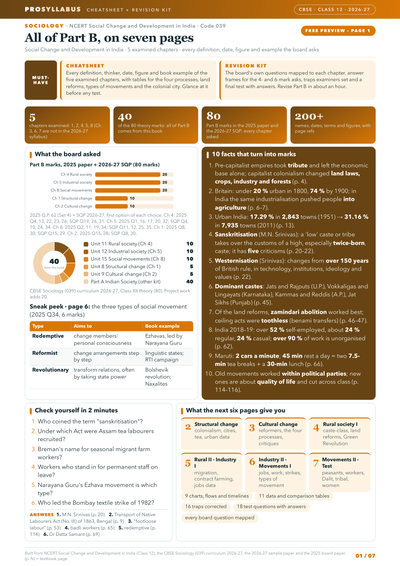
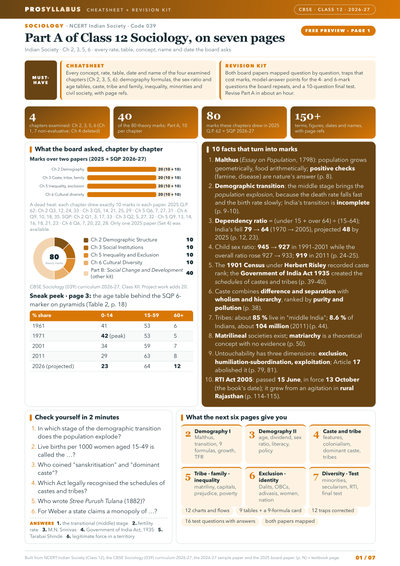
Revision kitCh 2, 3, 5, 6: the four examined chapters
  • Marks booster + cheatsheet: key concepts in 2 lines each, common traps
  • 10 marks for each of the four chapters
  • Demography formulas for Ch 2
  • Sex-ratio and age tables from the book
  • 10 must-know facts with a self-check
  • Common traps, corrected
Page 1 free about 8 min read, Full kit about 55 min read
₹159
Read page 1 freeabout 8 minView details
Revision kitFive examined chapters, 2025 Qs mapped
  • Marks booster + cheatsheet: most-asked concepts in 2 lines each
  • 10 marks each: Units 11, 12 and 15
  • 5 marks each: Units 8 and 9
  • 4 processes of cultural change, in a table
  • Land reforms table, Chapter 4
  • Types of social movements, in one table
Page 1 free about 8 min read, Full kit about 55 min read
₹159
Read page 1 freeabout 8 minView details
Revision kit140 board marks counted, chapter by chapter
  • Marks booster + cheatsheet: key concepts in 2 lines each
  • 26 board marks each: Ch 1 and Ch 2
  • 22 of 140 board marks: disorders, Ch 4
  • 20 of 140 board marks: therapies, Ch 5
  • 6-mark questions on Freud, RET and Beck
  • IQ bands and twin correlations from the book
Page 1 free about 8 min read, Full kit about 55 min read
₹159
Read page 1 freeabout 8 minView details
Revision kitAll 13 Flamingo texts, with what 2025 asked
  • Marks booster + cheatsheet: key concepts in 2 lines each, common traps
  • 5 poems: Q7 is always one of these
  • 4 writing formats, 18 marks
  • Common traps, corrected
  • 8 prose pieces: events, characters, themes
  • Poetic devices with short quotes
Page 1 free about 8 min read, Full kit about 55 min read
₹159
Read page 1 freeabout 8 minView details
Revision kit13 Vistas marks + 22 unseen-passage marks
  • Marks booster + cheatsheet: key concepts in 2 lines each, common traps
  • 12 marks: unseen passage Q1, decoded
  • 10 marks: case-based passage Q2, decoded
  • Common traps that cost marks, listed
  • Every character, with evidence and quotes
  • 7 texts: plot timelines for each
Page 1 free about 8 min read, Full kit about 55 min read
₹159
Read page 1 freeabout 8 minView details
Revision kitUnit II nutrition and food: 23 marks
  • Marks booster + cheatsheet: key concepts in 2 lines each, common traps
  • 38 of the 70 theory marks: Ch 1–7
  • 10 marks: Unit III, ECCE to elderly
  • Common traps that cost marks, listed
  • 5 marks: Unit I, work and careers
  • 2025 paper and SQP: ranked by what they asked
Page 1 free about 8 min read, Full kit about 55 min read
₹159
Read page 1 freeabout 8 minView details
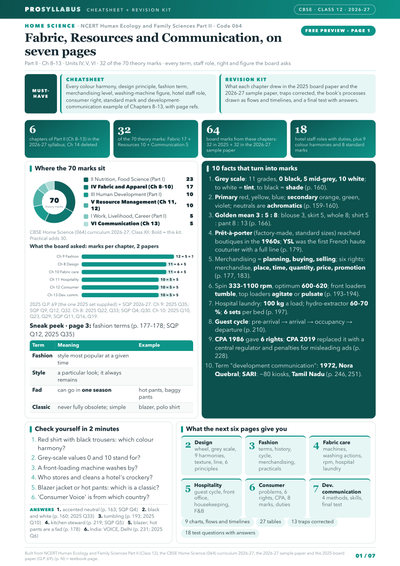
Revision kitCh 8–13: 32 of the 70 theory marks
  • Marks booster + cheatsheet: key concepts in 2 lines each, common traps
  • 17 marks: Unit IV Fabric and Apparel
  • 10 marks: Unit V Resource Management
  • 2025 board questions mapped to each chapter
  • Every consumer right and standard mark
  • Common traps, corrected
Page 1 free about 8 min read, Full kit about 55 min read
₹159
Read page 1 freeabout 8 minView details

Get alerts for CBSE Class 12 Board Examination

Dates, results and cutoffs, by email when they are announced. Free.
Google, Apple, or a code to your phone or email. It is saved to your account.
This chapter is part of the CBSE Class 12 Board Examination Board ExaminationExplore every chapter — summary, notes, extra questions & MCQ quizzes

Topic tests for CBSE Class 12 Board Examination

Short tests, one topic at a time, with every answer explained.

Double-checked questions Real exam pattern 1 free test every month, then ₹9 per test

#1

The Last Lesson

Start here
English 10 Qs · ~10 min

Instant score, answer review and weak-topic diagnosis

#2

Economics (Class 12) Practice Quiz | CBSE Class 12 Board Examination

10 Qs · ~10 min

Instant score, answer review and weak-topic diagnosis

#3

Lost Spring

English 10 Qs · ~10 min

Instant score, answer review and weak-topic diagnosis

#4

Challenges of Nation Building

Political Science 10 Qs · ~10 min

Instant score, answer review and weak-topic diagnosis

#5

Matrices

Maths 10 Qs · ~10 min

Instant score, answer review and weak-topic diagnosis

#6

My Mother at Sixty-six

English 10 Qs · ~10 min

Instant score, answer review and weak-topic diagnosis

#7

Human Geography: Nature and Scope

Geography 10 Qs · ~10 min

Instant score, answer review and weak-topic diagnosis

#8

Bricks, Beads and Bones — The Harappan Civilisation

History 10 Qs · ~10 min

Instant score, answer review and weak-topic diagnosis

#9

Money and Banking

Economics 10 Qs · ~10 min

Instant score, answer review and weak-topic diagnosis

#10

The Enemy

English 10 Qs · ~10 min

Instant score, answer review and weak-topic diagnosis

#11

The Tiger King

English 10 Qs · ~10 min

Instant score, answer review and weak-topic diagnosis

#12

A Thing of Beauty

English 10 Qs · ~10 min

Instant score, answer review and weak-topic diagnosis

#13

Keeping Quiet

English 10 Qs · ~10 min

Instant score, answer review and weak-topic diagnosis

#14

Poets and Pancakes

English 10 Qs · ~10 min

Instant score, answer review and weak-topic diagnosis

#15

The Rattrap

English 10 Qs · ~10 min

Instant score, answer review and weak-topic diagnosis

#16

The End of Bipolarity

Political Science 10 Qs · ~10 min

Instant score, answer review and weak-topic diagnosis

#17

Inverse Trigonometric Functions

Maths 10 Qs · ~10 min

Instant score, answer review and weak-topic diagnosis

#18

Memories of Childhood

English 10 Qs · ~10 min

Instant score, answer review and weak-topic diagnosis

#19

On the Face of It

English 10 Qs · ~10 min

Instant score, answer review and weak-topic diagnosis

#20

Journey to the End of the Earth

English 10 Qs · ~10 min

Instant score, answer review and weak-topic diagnosis

#21

The Third Level

English 10 Qs · ~10 min

Instant score, answer review and weak-topic diagnosis

#22

Aunt Jennifer's Tigers

English 10 Qs · ~10 min

Instant score, answer review and weak-topic diagnosis

#23

Going Places

English 10 Qs · ~10 min

Instant score, answer review and weak-topic diagnosis

#24

Indigo

English 10 Qs · ~10 min

Instant score, answer review and weak-topic diagnosis

#25

Deep Water

English 10 Qs · ~10 min

Instant score, answer review and weak-topic diagnosis

#26

Meeting Life Challenges

Psychology 10 Qs · ~10 min

Instant score, answer review and weak-topic diagnosis

#27

Cultural Change

Sociology 10 Qs · ~10 min

Instant score, answer review and weak-topic diagnosis

#28

Structural Change

Sociology 10 Qs · ~10 min

Instant score, answer review and weak-topic diagnosis

#29

The Challenges of Cultural Diversity

Sociology 10 Qs · ~10 min

Instant score, answer review and weak-topic diagnosis

#30

Patterns of Social Inequality and Exclusion

Sociology 10 Qs · ~10 min

Instant score, answer review and weak-topic diagnosis

#31

Social Institutions: Continuity and Change

Sociology 10 Qs · ~10 min

Instant score, answer review and weak-topic diagnosis

#32

The Demographic Structure of the Indian Society

Sociology 10 Qs · ~10 min

Instant score, answer review and weak-topic diagnosis

#33

Introducing Indian Society

Sociology 10 Qs · ~10 min

Instant score, answer review and weak-topic diagnosis

#34

Regional Aspirations

Political Science 10 Qs · ~10 min

Instant score, answer review and weak-topic diagnosis

#35

Security in the Contemporary World

Political Science 10 Qs · ~10 min

Instant score, answer review and weak-topic diagnosis

#36

International Trade (India)

Geography 10 Qs · ~10 min

Instant score, answer review and weak-topic diagnosis

#37

Transport and Communication (India)

Geography 10 Qs · ~10 min

Instant score, answer review and weak-topic diagnosis

#38

Tertiary and Quaternary Activities

Geography 10 Qs · ~10 min

Instant score, answer review and weak-topic diagnosis

#39

Secondary Activities

Geography 10 Qs · ~10 min

Instant score, answer review and weak-topic diagnosis

#40

Kings, Farmers and Towns — Early States and Economies (c. 600 BCE-600 CE)

History 10 Qs · ~10 min

Instant score, answer review and weak-topic diagnosis

#41

Theory of Consumer Behaviour

Economics 10 Qs · ~10 min

Instant score, answer review and weak-topic diagnosis

#42

Introduction

Economics 10 Qs · ~10 min

Instant score, answer review and weak-topic diagnosis

#43

Staffing

Business Studies 10 Qs · ~10 min

Instant score, answer review and weak-topic diagnosis

#44

Nature and Significance of Management

Business Studies 10 Qs · ~10 min

Instant score, answer review and weak-topic diagnosis

#45

Dissolution of Partnership Firm

Accountancy 10 Qs · ~10 min

Instant score, answer review and weak-topic diagnosis

#46

Accounting for Partnership: Basic Concepts

Accountancy 10 Qs · ~10 min

Instant score, answer review and weak-topic diagnosis

#47

Three Dimensional Geometry

Maths 10 Qs · ~10 min

Instant score, answer review and weak-topic diagnosis

#48

Continuity and Differentiability

Maths 10 Qs · ~10 min

Instant score, answer review and weak-topic diagnosis

#49

Determinants

Maths 10 Qs · ~10 min

Instant score, answer review and weak-topic diagnosis

#50

Relations and Functions

Maths 10 Qs · ~10 min

Instant score, answer review and weak-topic diagnosis

#51

Principles of Inheritance and Variation

Biology 10 Qs · ~10 min

Instant score, answer review and weak-topic diagnosis

#52

Reproductive Health

Biology 10 Qs · ~10 min

Instant score, answer review and weak-topic diagnosis

#53

Human Reproduction

Biology 10 Qs · ~10 min

Instant score, answer review and weak-topic diagnosis

#54

Chemical Kinetics

Chemistry 10 Qs · ~10 min

Instant score, answer review and weak-topic diagnosis

#55

Solutions

Chemistry 10 Qs · ~10 min

Instant score, answer review and weak-topic diagnosis

#56

Principles of Management

Business Studies 10 Qs · ~10 min

Instant score, answer review and weak-topic diagnosis

#57

Accountancy (Class 12) Practice Quiz | CBSE Class 12 Board Examination

10 Qs · ~10 min

Instant score, answer review and weak-topic diagnosis

#58

Electrostatic Potential and Capacitance Fundamentals | CBSE Class 12 Board Examination

10 Qs · ~10 min

Instant score, answer review and weak-topic diagnosis

#59

A Roadside Stand

English 10 Qs · ~10 min

Instant score, answer review and weak-topic diagnosis

#60

An Elementary School Classroom in a Slum

English 10 Qs · ~10 min

Instant score, answer review and weak-topic diagnosis

#61

The Interview

English 10 Qs · ~10 min

Instant score, answer review and weak-topic diagnosis

#62

Social Influence and Group Processes

Psychology 10 Qs · ~10 min

Instant score, answer review and weak-topic diagnosis

#63

Attitude and Social Cognition

Psychology 10 Qs · ~10 min

Instant score, answer review and weak-topic diagnosis

#64

Therapeutic Approaches

Psychology 10 Qs · ~10 min

Instant score, answer review and weak-topic diagnosis

#65

Psychological Disorders

Psychology 10 Qs · ~10 min

Instant score, answer review and weak-topic diagnosis

#66

Self and Personality

Psychology 10 Qs · ~10 min

Instant score, answer review and weak-topic diagnosis

#67

Variations in Psychological Attributes

Psychology 10 Qs · ~10 min

Instant score, answer review and weak-topic diagnosis

#68

Social Movements

Sociology 10 Qs · ~10 min

Instant score, answer review and weak-topic diagnosis

#69

Mass Media and Communications

Sociology 10 Qs · ~10 min

Instant score, answer review and weak-topic diagnosis

#70

Globalisation and Social Change

Sociology 10 Qs · ~10 min

Instant score, answer review and weak-topic diagnosis

#71

Change and Development in Industrial Society

Sociology 10 Qs · ~10 min

Instant score, answer review and weak-topic diagnosis

#72

Change and Development in Rural Society

Sociology 10 Qs · ~10 min

Instant score, answer review and weak-topic diagnosis

#73

The Constitution and Social Change

Sociology 10 Qs · ~10 min

Instant score, answer review and weak-topic diagnosis

#74

The Market as a Social Institution

Sociology 10 Qs · ~10 min

Instant score, answer review and weak-topic diagnosis

#75

Recent Developments in Indian Politics

Political Science 10 Qs · ~10 min

Instant score, answer review and weak-topic diagnosis

#76

The Crisis of Democratic Order

Political Science 10 Qs · ~10 min

Instant score, answer review and weak-topic diagnosis

#77

Challenges to and Restoration of the Congress System

Political Science 10 Qs · ~10 min

Instant score, answer review and weak-topic diagnosis

#78

India's External Relations

Political Science 10 Qs · ~10 min

Instant score, answer review and weak-topic diagnosis

#79

Politics of Planned Development

Political Science 10 Qs · ~10 min

Instant score, answer review and weak-topic diagnosis

#80

Era of One-party Dominance

Political Science 10 Qs · ~10 min

Instant score, answer review and weak-topic diagnosis

#81

Environment and Natural Resources

Political Science 10 Qs · ~10 min

Instant score, answer review and weak-topic diagnosis

#82

International Organisations

Political Science 10 Qs · ~10 min

Instant score, answer review and weak-topic diagnosis

#83

Contemporary South Asia

Political Science 10 Qs · ~10 min

Instant score, answer review and weak-topic diagnosis

#84

Contemporary Centres of Power

Political Science 10 Qs · ~10 min

Instant score, answer review and weak-topic diagnosis

#85

Geographical Perspective on Selected Issues and Problems

Geography 10 Qs · ~10 min

Instant score, answer review and weak-topic diagnosis

#86

Planning and Sustainable Development in the Indian Context

Geography 10 Qs · ~10 min

Instant score, answer review and weak-topic diagnosis

#87

Mineral and Energy Resources

Geography 10 Qs · ~10 min

Instant score, answer review and weak-topic diagnosis

#88

Water Resources

Geography 10 Qs · ~10 min

Instant score, answer review and weak-topic diagnosis

#89

Land Resources and Agriculture

Geography 10 Qs · ~10 min

Instant score, answer review and weak-topic diagnosis

#90

Human Settlements

Geography 10 Qs · ~10 min

Instant score, answer review and weak-topic diagnosis

#91

Population: Distribution, Density, Growth and Composition

Geography 10 Qs · ~10 min

Instant score, answer review and weak-topic diagnosis

#92

Primary Activities

Geography 10 Qs · ~10 min

Instant score, answer review and weak-topic diagnosis

#93

Human Development

Geography 10 Qs · ~10 min

Instant score, answer review and weak-topic diagnosis

#94

The World Population: Distribution, Density and Growth

Geography 10 Qs · ~10 min

Instant score, answer review and weak-topic diagnosis

#95

Framing the Constitution — The Beginning of a New Era

History 10 Qs · ~10 min

Instant score, answer review and weak-topic diagnosis

#96

Mahatma Gandhi and the Nationalist Movement — Civil Disobedience and Beyond

History 10 Qs · ~10 min

Instant score, answer review and weak-topic diagnosis

#97

Rebels and the Raj — The Revolt of 1857 and its Representations

History 10 Qs · ~10 min

Instant score, answer review and weak-topic diagnosis

#98

Colonialism and the Countryside — Exploring Official Archives

History 10 Qs · ~10 min

Instant score, answer review and weak-topic diagnosis

#99

Peasants, Zamindars and the State — Agrarian Society and the Mughal Empire (c. sixteenth-seventeenth centuries)

History 10 Qs · ~10 min

Instant score, answer review and weak-topic diagnosis

#100

An Imperial Capital: Vijayanagara (c. fourteenth to sixteenth century)

History 10 Qs · ~10 min

Instant score, answer review and weak-topic diagnosis

#101

Bhakti-Sufi Traditions — Changes in Religious Beliefs and Devotional Texts (c. eighth to eighteenth century)

History 10 Qs · ~10 min

Instant score, answer review and weak-topic diagnosis

#102

Through the Eyes of Travellers — Perceptions of Society (c. tenth to seventeenth century)

History 10 Qs · ~10 min

Instant score, answer review and weak-topic diagnosis

#103

Thinkers, Beliefs and Buildings — Cultural Developments (c. 600 BCE-600 CE)

History 10 Qs · ~10 min

Instant score, answer review and weak-topic diagnosis

#104

Kinship, Caste and Class — Early Societies (c. 600 BCE-600 CE)

History 10 Qs · ~10 min

Instant score, answer review and weak-topic diagnosis

#105

Open Economy Macroeconomics

Economics 10 Qs · ~10 min

Instant score, answer review and weak-topic diagnosis

#106

Government Budget and the Economy

Economics 10 Qs · ~10 min

Instant score, answer review and weak-topic diagnosis

#107

Determination of Income and Employment

Economics 10 Qs · ~10 min

Instant score, answer review and weak-topic diagnosis

#108

National Income Accounting

Economics 10 Qs · ~10 min

Instant score, answer review and weak-topic diagnosis

#109

Market Equilibrium

Economics 10 Qs · ~10 min

Instant score, answer review and weak-topic diagnosis

#110

The Theory of the Firm under Perfect Competition

Economics 10 Qs · ~10 min

Instant score, answer review and weak-topic diagnosis

#111

Production and Costs

Economics 10 Qs · ~10 min

Instant score, answer review and weak-topic diagnosis

#112

Consumer Protection

Business Studies 10 Qs · ~10 min

Instant score, answer review and weak-topic diagnosis

#113

Marketing

Business Studies 10 Qs · ~10 min

Instant score, answer review and weak-topic diagnosis

#114

Financial Management

Business Studies 10 Qs · ~10 min

Instant score, answer review and weak-topic diagnosis

#115

Controlling

Business Studies 10 Qs · ~10 min

Instant score, answer review and weak-topic diagnosis

#116

Directing

Business Studies 10 Qs · ~10 min

Instant score, answer review and weak-topic diagnosis

#117

Organising

Business Studies 10 Qs · ~10 min

Instant score, answer review and weak-topic diagnosis

#118

Planning

Business Studies 10 Qs · ~10 min

Instant score, answer review and weak-topic diagnosis

#119

Business Environment

Business Studies 10 Qs · ~10 min

Instant score, answer review and weak-topic diagnosis

#120

Cash Flow Statement

Accountancy 10 Qs · ~10 min

Instant score, answer review and weak-topic diagnosis

#121

Accounting Ratios

Accountancy 10 Qs · ~10 min

Instant score, answer review and weak-topic diagnosis

#122

Analysis of Financial Statements

Accountancy 10 Qs · ~10 min

Instant score, answer review and weak-topic diagnosis

#123

Financial Statements of a Company

Accountancy 10 Qs · ~10 min

Instant score, answer review and weak-topic diagnosis

#124

Issue and Redemption of Debentures

Accountancy 10 Qs · ~10 min

Instant score, answer review and weak-topic diagnosis

#125

Accounting for Share Capital

Accountancy 10 Qs · ~10 min

Instant score, answer review and weak-topic diagnosis

#126

Reconstitution of a Partnership Firm – Retirement/Death of a Partner

Accountancy 10 Qs · ~10 min

Instant score, answer review and weak-topic diagnosis

#127

Reconstitution of a Partnership Firm – Admission of a Partner

Accountancy 10 Qs · ~10 min

Instant score, answer review and weak-topic diagnosis

#128

Probability

Maths 10 Qs · ~10 min

Instant score, answer review and weak-topic diagnosis

#129

Linear Programming

Maths 10 Qs · ~10 min

Instant score, answer review and weak-topic diagnosis

#130

Vector Algebra

Maths 10 Qs · ~10 min

Instant score, answer review and weak-topic diagnosis

#131

Differential Equations

Maths 10 Qs · ~10 min

Instant score, answer review and weak-topic diagnosis

#132

Application of Integrals

Maths 10 Qs · ~10 min

Instant score, answer review and weak-topic diagnosis

#133

Integrals

Maths 10 Qs · ~10 min

Instant score, answer review and weak-topic diagnosis

#134

Application of Derivatives

Maths 10 Qs · ~10 min

Instant score, answer review and weak-topic diagnosis

#135

Biodiversity and its Conservation

Biology 10 Qs · ~10 min

Instant score, answer review and weak-topic diagnosis

#136

Ecosystem

Biology 10 Qs · ~10 min

Instant score, answer review and weak-topic diagnosis

#137

Organisms and Populations

Biology 10 Qs · ~10 min

Instant score, answer review and weak-topic diagnosis

#138

Biotechnology and its Applications

Biology 10 Qs · ~10 min

Instant score, answer review and weak-topic diagnosis

#139

Biotechnology: Principles and Processes

Biology 10 Qs · ~10 min

Instant score, answer review and weak-topic diagnosis

#140

Microbes in Human Welfare

Biology 10 Qs · ~10 min

Instant score, answer review and weak-topic diagnosis

#141

Human Health and Disease

Biology 10 Qs · ~10 min

Instant score, answer review and weak-topic diagnosis

#142

Evolution

Biology 10 Qs · ~10 min

Instant score, answer review and weak-topic diagnosis

#143

Molecular Basis of Inheritance

Biology 10 Qs · ~10 min

Instant score, answer review and weak-topic diagnosis

#144

Sexual Reproduction in Flowering Plants

Biology 10 Qs · ~10 min

Instant score, answer review and weak-topic diagnosis

#145

Biomolecules

Chemistry 10 Qs · ~10 min

Instant score, answer review and weak-topic diagnosis

#146

Amines

Chemistry 10 Qs · ~10 min

Instant score, answer review and weak-topic diagnosis

#147

Aldehydes, Ketones and Carboxylic Acids

Chemistry 10 Qs · ~10 min

Instant score, answer review and weak-topic diagnosis

#148

Alcohols, Phenols and Ethers

Chemistry 10 Qs · ~10 min

Instant score, answer review and weak-topic diagnosis

#149

Haloalkanes and Haloarenes

Chemistry 10 Qs · ~10 min

Instant score, answer review and weak-topic diagnosis

#150

Coordination Compounds

Chemistry 10 Qs · ~10 min

Instant score, answer review and weak-topic diagnosis

#151

The d- and f-Block Elements

Chemistry 10 Qs · ~10 min

Instant score, answer review and weak-topic diagnosis

#152

Electrochemistry

Chemistry 10 Qs · ~10 min

Instant score, answer review and weak-topic diagnosis

#153

Semiconductor Electronics: Materials, Devices and Simple Circuits

Physics 10 Qs · ~10 min

Instant score, answer review and weak-topic diagnosis

#154

Nuclei

Physics 10 Qs · ~10 min

Instant score, answer review and weak-topic diagnosis

#155

Atoms

Physics 10 Qs · ~10 min

Instant score, answer review and weak-topic diagnosis

#156

Dual Nature of Radiation and Matter

Physics 10 Qs · ~10 min

Instant score, answer review and weak-topic diagnosis

#157

Wave Optics

Physics 10 Qs · ~10 min

Instant score, answer review and weak-topic diagnosis

#158

Ray Optics and Optical Instruments

Physics 10 Qs · ~10 min

Instant score, answer review and weak-topic diagnosis

#159

Electromagnetic Waves

Physics 10 Qs · ~10 min

Instant score, answer review and weak-topic diagnosis

#160

Alternating Current

Physics 10 Qs · ~10 min

Instant score, answer review and weak-topic diagnosis

#161

Electromagnetic Induction

Physics 10 Qs · ~10 min

Instant score, answer review and weak-topic diagnosis

#162

Magnetism and Matter

Physics 10 Qs · ~10 min

Instant score, answer review and weak-topic diagnosis

#163

Moving Charges and Magnetism

Physics 10 Qs · ~10 min

Instant score, answer review and weak-topic diagnosis

#164

Electrostatic Potential and Capacitance

Physics 10 Qs · ~10 min

Instant score, answer review and weak-topic diagnosis

#165

Electric Charges and Fields

Physics 10 Qs · ~10 min

Instant score, answer review and weak-topic diagnosis

#166

CBSE Class 12 — Genetics and Evolution

10 Qs · ~10 min

Instant score, answer review and weak-topic diagnosis

#167

CBSE Class 12 — Matrices and Determinants

10 Qs · ~10 min

Instant score, answer review and weak-topic diagnosis

#168

CBSE Class 12 — Solutions and Colligative Properties

10 Qs · ~10 min

Instant score, answer review and weak-topic diagnosis

#169

Current Electricity

Physics 10 Qs · ~10 min

Instant score, answer review and weak-topic diagnosis

#170

CBSE Class 12 — Electrostatics and Electric Field

10 Qs · ~10 min

Instant score, answer review and weak-topic diagnosis

#171

Humanities Subjects Practice Quiz | CBSE Class 12 Board Examination

10 Qs · ~10 min

Instant score, answer review and weak-topic diagnosis

More on CBSE Class 12 Board Examination19 guides

CBSE Class 12 Pre-Board Marks: Do They Count, and What to Do If LowComplete Summary and Solutions for Database Concepts – NCERT Class XII Computer Science, Chapter 8 – File Systems, DBMS, Relational Models, Keys, SQL Introduction, Questions, AnswersComplete Summary and Solutions for Consumer Education and Protection – NCERT Human Ecology and Family Sciences, Chapter 12 – Study Summary, Explanation, Questions, AnswersComplete Summary and Solutions for Supplementary Chemistry Material – NCERT Class XII Chemistry Part I Supplementary Resources – Additional Examples, Problems, and ExplanationsComplete Summary and Solutions for Project Based Learning – NCERT Class XII Computer Science, Chapter 13 – Project Planning, Implementation, Presentation, Documentation, and EvaluationComplete Summary and Solutions for Querying and SQL Functions – NCERT Class XII Informatics Practices, Chapter 1 – Explanation, Questions, Answersअंतरा भाग 2 – कक्षा 12 के लिए हिंदी (ऐच्छिक) की पाठ्यपुस्तक story खंड – पाठ-16अंतरा भाग 2 – कक्षा 12 के लिए हिंदी (ऐच्छिक) की पाठ्यपुस्तक काव्य खंड – तुलसीदास: (क) भरत-राम का प्रेम, (ख) पदअंतरा भाग 2 – कक्षा 12 के लिए हिंदी (ऐच्छिक) की पाठ्यपुस्तक story खंड – पाठ-17अंतरा भाग 2 – कक्षा 12 के लिए हिंदी (ऐच्छिक) की पाठ्यपुस्तक काव्य खंड – मलिक मुहम्मद जायसी: बारहमासाअंतरा भाग 2 – कक्षा 12 के लिए हिंदी (ऐच्छिक) की पाठ्यपुस्तक story खंड – पाठ-15अंतरा भाग 2 – कक्षा 12 के लिए हिंदी (ऐच्छिक) की पाठ्यपुस्तक काव्य खंड – विष्णु खरे: (क) सत्य, (ख) एक कमअंतरा भाग 2 – कक्षा 12 के लिए हिंदी (ऐच्छिक) की पाठ्यपुस्तक story खंड – पाठ-11अंतरा भाग 2 – कक्षा 12 हिंदी (ऐच्छिक) काव्य खंड – जयशंकर प्रसाद: (क) देवसेना का गीत, (ख) कार्नेलिया का गीत – संपूर्ण सारांश, व्याख्या, प्रश्न और उत्तरअंतरा भाग 2 – कक्षा 12 के लिए हिंदी (ऐच्छिक) की पाठ्यपुस्तक काव्य खंड – विद्यापति: पदअंतरा भाग 2 – कक्षा 12 के लिए हिंदी (ऐच्छिक) पाठ्यपुस्तक story खंड – पाठ-12अंतरा भाग 2 – कक्षा 12 के लिए हिंदी (ऐच्छिक) की पाठ्यपुस्तक काव्य खंड – सूर्यकांत त्रिपाठी ‘निराला’: (क) गीत गाने दो मुझे, (ख) सरोज-स्मृतिअंतरा भाग 2 – कक्षा 12 के लिए हिंदी (ऐच्छिक) की पाठ्यपुस्तक story खंड – पाठ-10अंतरा भाग 2 – कक्षा 12 के लिए हिंदी (ऐच्छिक) की पाठ्यपुस्तक काव्य खंड – कुकुआन: दोह
Notebook backup + AISave your notes. Revise with AI.Learn more →

Discussion

No discussions yet.

Share this article

Page 1 free about 8 min read, Full kit about 55 min read
Page 1 freeabout 8 min

View details