Sports for All
Class 9 Physical Education · Khel Praveen · Chapter 4
173 members in the CBSE community
View all










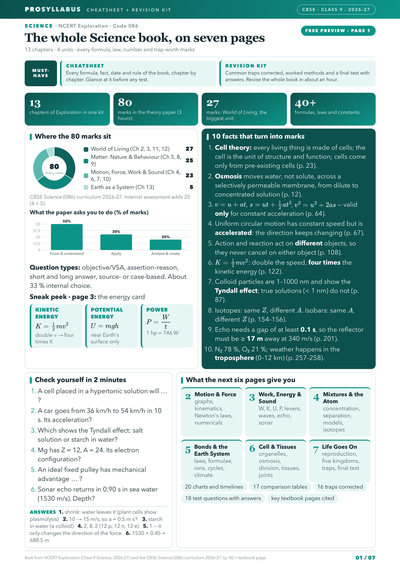
CBSE Class 9 · ScienceTrending
13 chapters, 20 charts, 16 traps corrected- Marks booster + cheatsheet: key concepts in 2 lines each
- 16 exam traps, listed
- 27 marks: Unit I, cells to reproduction
- 25 marks: Unit II, mixtures to bonding
- 23 marks: Unit III, motion to sound
- Formula cards for every law and number
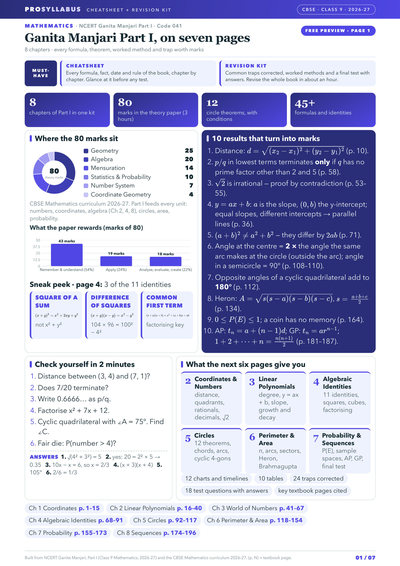
CBSE Class 9 · Mathematics Part I
11 identities + 12 circle theorems, Class 9- Marks booster + cheatsheet: key concepts in 2 lines each, common traps
- 25 marks: Circles, in Unit IV Geometry
- 20 marks: linear polynomials, Unit II Algebra
- Ch 7: probability and its traps
- 14 marks: Mensuration, Heron and Brahmagupta
- 8 chapters of worked numericals
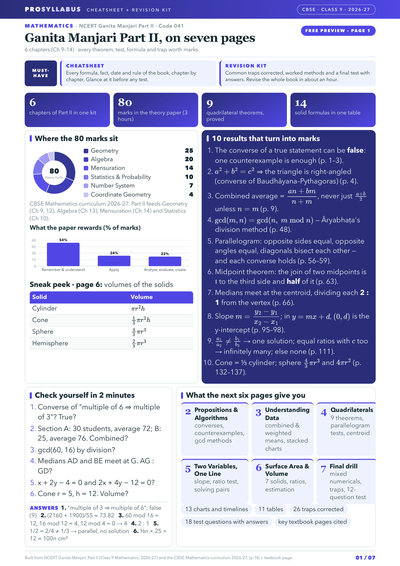
CBSE Class 9 · Mathematics Part II
9 quadrilateral theorems + all 7 solids- Marks booster + cheatsheet: key concepts in 2 lines each, common traps
- 25 marks: Quadrilaterals, Unit IV Geometry
- 20 marks: linear equations in two variables
- Common traps that cost marks, listed
- 14 marks: surface area and volume
- 10 marks: combined and weighted averages
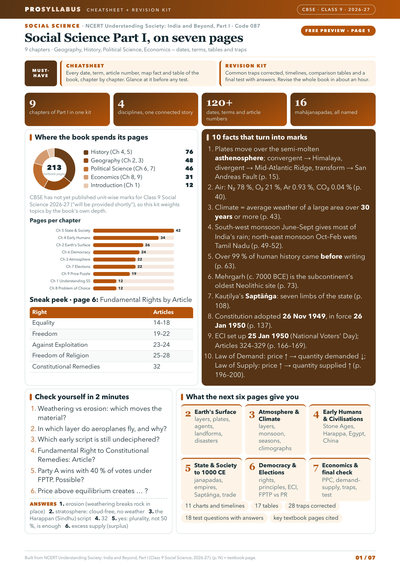
CBSE Class 9 · Social Science
9 chapters: Geography to Economics, dated- Marks booster + cheatsheet: key concepts in 2 lines each, common traps
- Timelines from early humans to 1000 CE
- Article numbers for democracy and elections
- Common traps that cost marks, listed
- Comparison tables built from the book
- Plate tectonics and landforms, Ch 1–2
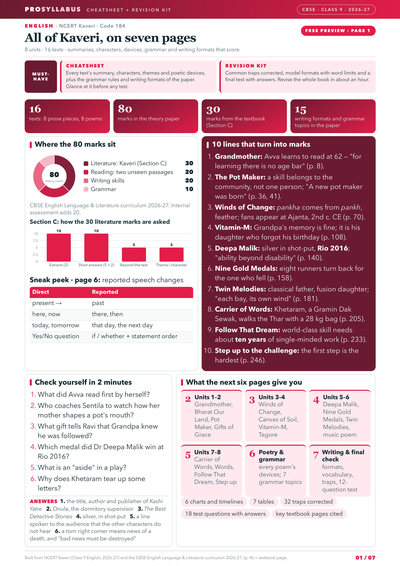
CBSE Class 9 · EnglishTrending
All 16 Kaveri texts + 8 poems in one table- Marks booster + cheatsheet: key concepts in 2 lines each, common traps
- 20 marks: Section B writing formats
- 10 marks: the 7 grammar topics of the paper
- Common traps that cost marks, listed
- 8 units: summaries and characters of each
- Idioms and expressions in one place
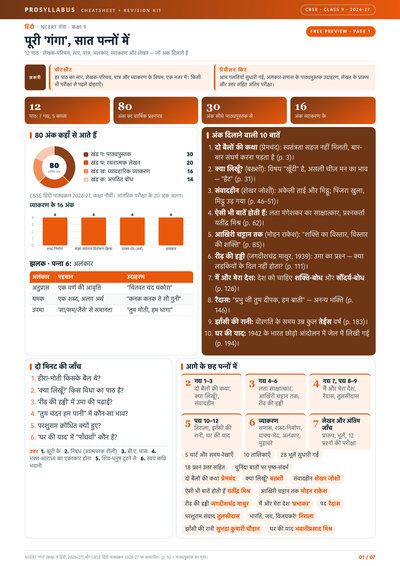
CBSE Class 9 · Hindi
All 12 गंगा lessons, with अलंकार examples- Marks booster + cheatsheet: key concepts in 2 lines each
- 20 अंक: खंड घ रचनात्मक लेखन formats
- समास and उपसर्ग-प्रत्यय rules in one place
- अर्थ के आधार पर वाक्य-भेद, with मुहावरे
- लेखक-परिचय, सार and पात्र for each पाठ
- 12 भूलें students make
Summary
This unit argues that sport is a fundamental human right for everyone, regardless of age, gender, ability or socio-economic background, as stated in global frameworks like the 2015 UNESCO International Charter of Physical Education and the European Sports Charter. It explores how inclusive sport promotes happiness, unity and good health, while also preserving culture through ethnosport — traditional and indigenous games such as Kabaddi, Kho-Kho and Mallakhamb. The unit identifies key dimensions of inclusiveness — gender, disability, socio-economic, cultural/ethnic and age inclusion — and the barriers that block them, such as a lack of facilities, financial constraints, societal attitudes and geography. It then sets out concrete measures: accessible infrastructure (ramps, tactile walkways, wheelchair seating), anti-discrimination policies, grassroots programmes, inclusive coach training, awareness campaigns and scholarships for underprivileged athletes. A major focus is disability and adapted sport: it explains that disability is not inability, introduces the Paralympic Games (held "alongside" the Olympics, with values of courage, determination, inspiration and equality), and presents disability etiquette and the STEP model (adapting Space, Task, Equipment and People) to make activities inclusive. The unit also covers the young athlete — growth, fair play and the risks of early specialisation — women in sport, including menstrual health and the Female Athlete Triad, and healthy ageing, showing that age is just a number.