Physical Education and Well-being
Class 9 Physical Education · Khel Praveen · Chapter 1
173 members in the CBSE community
View all







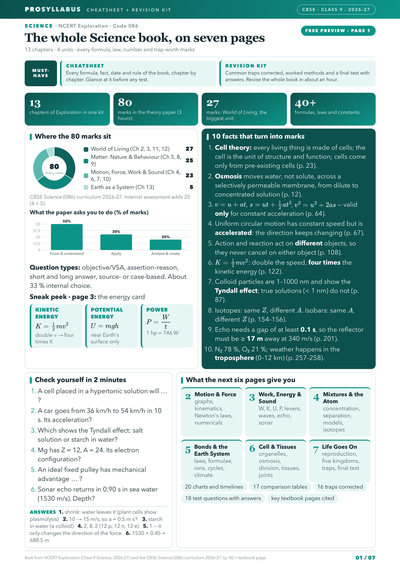
CBSE Class 9 · ScienceTrending
13 chapters, 20 charts, 16 traps corrected- Marks booster + cheatsheet: key concepts in 2 lines each
- 16 exam traps, listed
- 27 marks: Unit I, cells to reproduction
- 25 marks: Unit II, mixtures to bonding
- 23 marks: Unit III, motion to sound
- Formula cards for every law and number
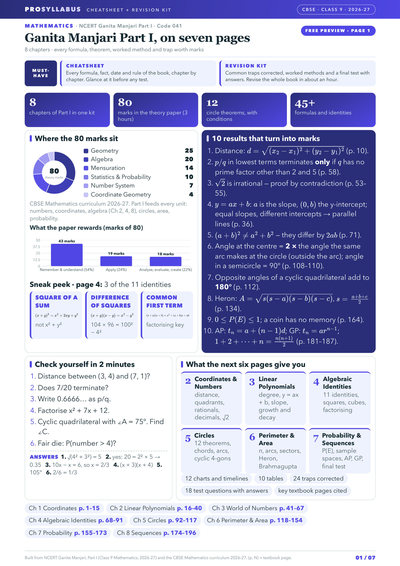
CBSE Class 9 · Mathematics Part I
11 identities + 12 circle theorems, Class 9- Marks booster + cheatsheet: key concepts in 2 lines each, common traps
- 25 marks: Circles, in Unit IV Geometry
- 20 marks: linear polynomials, Unit II Algebra
- Ch 7: probability and its traps
- 14 marks: Mensuration, Heron and Brahmagupta
- 8 chapters of worked numericals
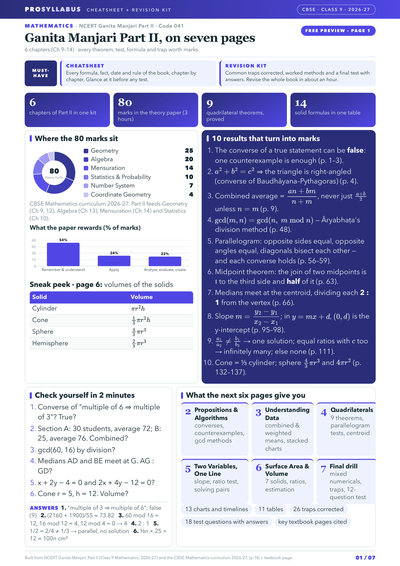
CBSE Class 9 · Mathematics Part II
9 quadrilateral theorems + all 7 solids- Marks booster + cheatsheet: key concepts in 2 lines each, common traps
- 25 marks: Quadrilaterals, Unit IV Geometry
- 20 marks: linear equations in two variables
- Common traps that cost marks, listed
- 14 marks: surface area and volume
- 10 marks: combined and weighted averages
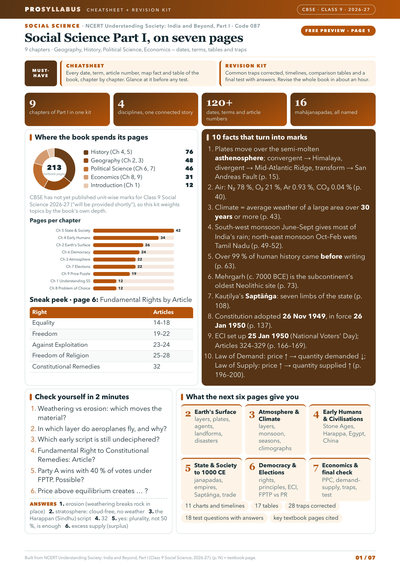
CBSE Class 9 · Social Science
9 chapters: Geography to Economics, dated- Marks booster + cheatsheet: key concepts in 2 lines each, common traps
- Timelines from early humans to 1000 CE
- Article numbers for democracy and elections
- Common traps that cost marks, listed
- Comparison tables built from the book
- Plate tectonics and landforms, Ch 1–2
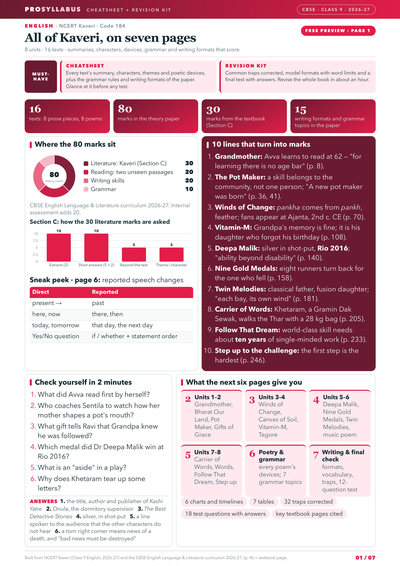
CBSE Class 9 · EnglishTrending
All 16 Kaveri texts + 8 poems in one table- Marks booster + cheatsheet: key concepts in 2 lines each, common traps
- 20 marks: Section B writing formats
- 10 marks: the 7 grammar topics of the paper
- Common traps that cost marks, listed
- 8 units: summaries and characters of each
- Idioms and expressions in one place
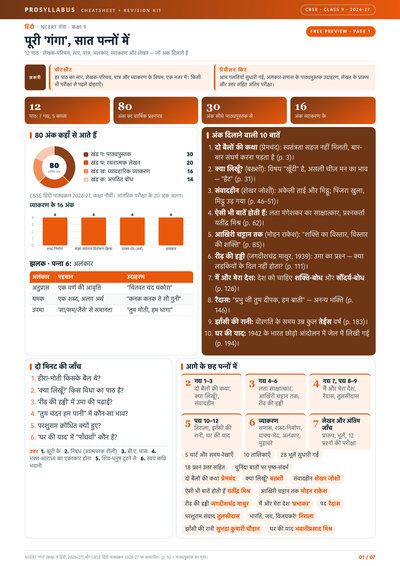
CBSE Class 9 · Hindi
All 12 गंगा lessons, with अलंकार examples- Marks booster + cheatsheet: key concepts in 2 lines each
- 20 अंक: खंड घ रचनात्मक लेखन formats
- समास and उपसर्ग-प्रत्यय rules in one place
- अर्थ के आधार पर वाक्य-भेद, with मुहावरे
- लेखक-परिचय, सार and पात्र for each पाठ
- 12 भूलें students make
Summary
This opening unit presents physical education as far more than a games period — it is education *through* the body, training body and mind together so that movement, discipline and fitness improve the quality of everyday life. Following the National Curriculum Framework for School Education (NCF-SE 2023), the subject is named Physical Education and Well-being because it builds not only physical fitness but also happiness, confidence, emotional balance and mental calmness, while nurturing values such as respect, fairness, honesty and co-operation. Thinkers like Sri Aurobindo and bodies like UNESCO are cited to show that the wider aim is holistic development — shaping character and virtues such as honesty and patience, and preparing students to be socially responsible and emotionally balanced. The unit then explains physical literacy: the ability, confidence and motivation to stay physically active throughout life, just as reading and writing build language literacy. It classifies the building-block movement skills into locomotor skills (running, jumping, hopping), non-locomotor skills (bending, stretching, balancing, used heavily in yoga), and manipulative skills (throwing, catching, kicking, dribbling). Indigenous games and yoga asanas are highlighted as ways to develop these skills while connecting students to India's cultural heritage.