Olympism
Class 9 Physical Education · Khel Praveen · Chapter 3
173 members in the CBSE community
View all











CBSE Class 9 · ScienceTrending
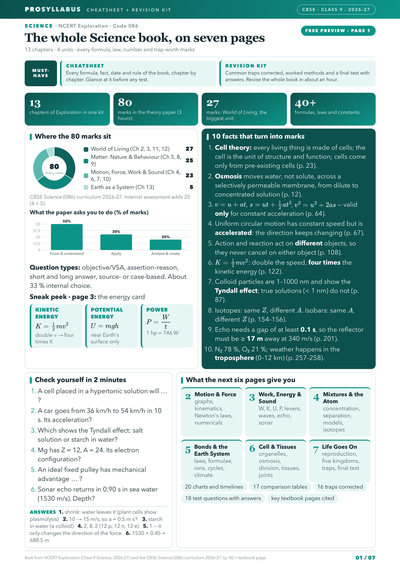
13 chapters, 20 charts, 16 traps corrected- Marks booster + cheatsheet: key concepts in 2 lines each
- 16 exam traps, listed
- 27 marks: Unit I, cells to reproduction
- 25 marks: Unit II, mixtures to bonding
- 23 marks: Unit III, motion to sound
- Formula cards for every law and number
CBSE Class 9 · Mathematics Part I
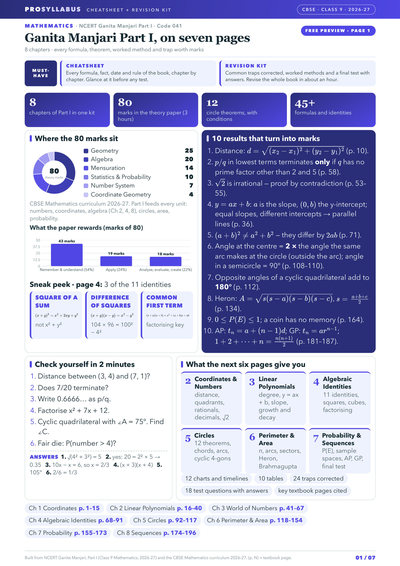
11 identities + 12 circle theorems, Class 9- Marks booster + cheatsheet: key concepts in 2 lines each, common traps
- 25 marks: Circles, in Unit IV Geometry
- 20 marks: linear polynomials, Unit II Algebra
- Ch 7: probability and its traps
- 14 marks: Mensuration, Heron and Brahmagupta
- 8 chapters of worked numericals
CBSE Class 9 · Mathematics Part II
9 quadrilateral theorems + all 7 solids- Marks booster + cheatsheet: key concepts in 2 lines each, common traps
- 25 marks: Quadrilaterals, Unit IV Geometry
- 20 marks: linear equations in two variables
- Common traps that cost marks, listed
- 14 marks: surface area and volume
- 10 marks: combined and weighted averages
CBSE Class 9 · Social Science
9 chapters: Geography to Economics, dated- Marks booster + cheatsheet: key concepts in 2 lines each, common traps
- Timelines from early humans to 1000 CE
- Article numbers for democracy and elections
- Common traps that cost marks, listed
- Comparison tables built from the book
- Plate tectonics and landforms, Ch 1–2
CBSE Class 9 · EnglishTrending
All 16 Kaveri texts + 8 poems in one table- Marks booster + cheatsheet: key concepts in 2 lines each, common traps
- 20 marks: Section B writing formats
- 10 marks: the 7 grammar topics of the paper
- Common traps that cost marks, listed
- 8 units: summaries and characters of each
- Idioms and expressions in one place
CBSE Class 9 · Hindi
All 12 गंगा lessons, with अलंकार examples- Marks booster + cheatsheet: key concepts in 2 lines each
- 20 अंक: खंड घ रचनात्मक लेखन formats
- समास and उपसर्ग-प्रत्यय rules in one place
- अर्थ के आधार पर वाक्य-भेद, with मुहावरे
- लेखक-परिचय, सार and पात्र for each पाठ
- 12 भूलें students make
Summary
This unit explains Olympism — a philosophy of life that blends sport, culture and education to promote peace, unity and personal excellence by balancing body, mind and willpower. Its goal is to put sport at the service of human development, encouraging fair play, friendship and respect across nations. The unit presents three core Olympic values — excellence (giving one's best and always improving), friendship (built on trust, respect and kindness) and respect (for oneself, others and the rules) — together with educational values such as the joy of effort, fair play and the balance of body, mind and will. It traces the Olympic story from the ancient Games at Olympia in Greece (first recorded in 776 BCE, held to honour Zeus, with winners crowned with an olive wreath called the kotinos), through their decline and ban, to the modern revival led by Pierre de Coubertin, whose vision brought the first modern Olympic Games to Athens in 1896. It follows the Games' growth — the inclusion of women, the Winter Olympics, the Paralympics and the Youth Olympics — as steps toward equality and inclusion, and notes India's journey, including the men's hockey golden era. Finally it explains the symbols and identity of the Movement — the five-ringed flag, the motto "Faster, Higher, Stronger — Together", the creed, oath and anthem — that unite athletes worldwide.