Science and Sports
Class 9 Physical Education · Khel Praveen · Chapter 2
173 members in the CBSE community
View all













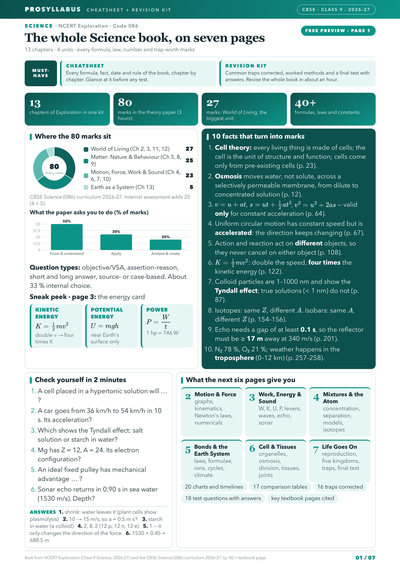
CBSE Class 9 · ScienceTrending
13 chapters, 20 charts, 16 traps corrected- Marks booster + cheatsheet: key concepts in 2 lines each
- 16 exam traps, listed
- 27 marks: Unit I, cells to reproduction
- 25 marks: Unit II, mixtures to bonding
- 23 marks: Unit III, motion to sound
- Formula cards for every law and number
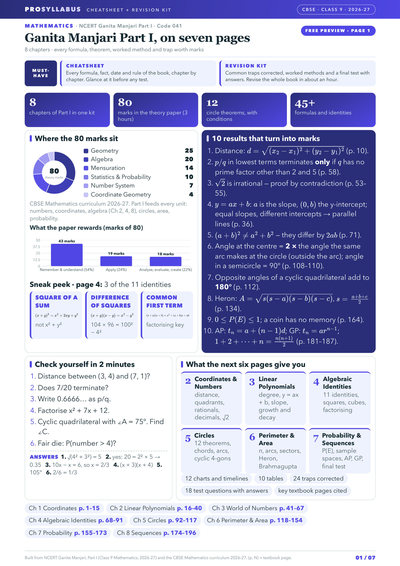
CBSE Class 9 · Mathematics Part I
11 identities + 12 circle theorems, Class 9- Marks booster + cheatsheet: key concepts in 2 lines each, common traps
- 25 marks: Circles, in Unit IV Geometry
- 20 marks: linear polynomials, Unit II Algebra
- Ch 7: probability and its traps
- 14 marks: Mensuration, Heron and Brahmagupta
- 8 chapters of worked numericals
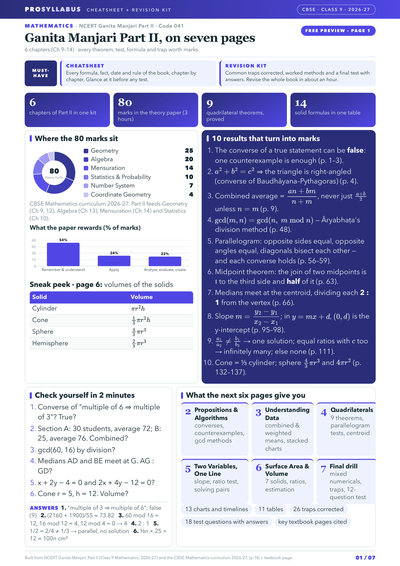
CBSE Class 9 · Mathematics Part II
9 quadrilateral theorems + all 7 solids- Marks booster + cheatsheet: key concepts in 2 lines each, common traps
- 25 marks: Quadrilaterals, Unit IV Geometry
- 20 marks: linear equations in two variables
- Common traps that cost marks, listed
- 14 marks: surface area and volume
- 10 marks: combined and weighted averages
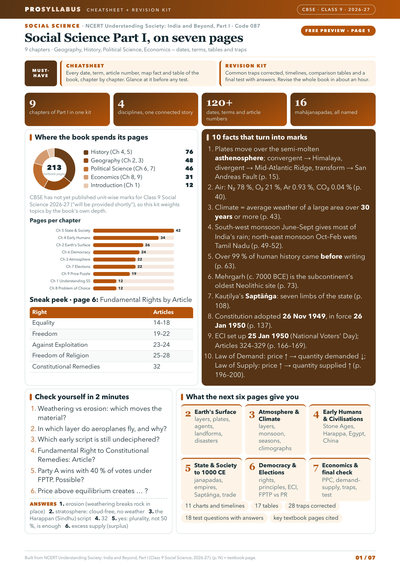
CBSE Class 9 · Social Science
9 chapters: Geography to Economics, dated- Marks booster + cheatsheet: key concepts in 2 lines each, common traps
- Timelines from early humans to 1000 CE
- Article numbers for democracy and elections
- Common traps that cost marks, listed
- Comparison tables built from the book
- Plate tectonics and landforms, Ch 1–2
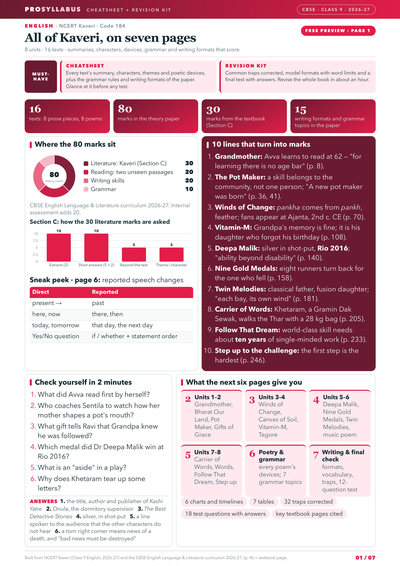
CBSE Class 9 · EnglishTrending
All 16 Kaveri texts + 8 poems in one table- Marks booster + cheatsheet: key concepts in 2 lines each, common traps
- 20 marks: Section B writing formats
- 10 marks: the 7 grammar topics of the paper
- Common traps that cost marks, listed
- 8 units: summaries and characters of each
- Idioms and expressions in one place
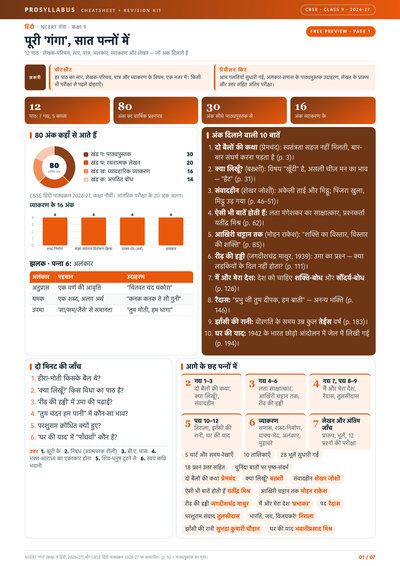
CBSE Class 9 · Hindi
All 12 गंगा lessons, with अलंकार examples- Marks booster + cheatsheet: key concepts in 2 lines each
- 20 अंक: खंड घ रचनात्मक लेखन formats
- समास and उपसर्ग-प्रत्यय rules in one place
- अर्थ के आधार पर वाक्य-भेद, with मुहावरे
- लेखक-परिचय, सार and पात्र for each पाठ
- 12 भूलें students make
Summary
This unit looks at sport through the lens of science, explaining how the human body works during movement and how that knowledge helps us train smarter and stay healthy. It introduces anatomy (the structure of the body) and physiology (how it functions), then surveys the systems that power activity: the skeletal system of bones that gives the body its frame and protects organs; the muscular system that produces force and movement; and joints, which are classified by how much they move (for example, the freely moving ball-and-socket and hinge joints). It explains the cardiovascular system — the heart, blood and vessels that circulate oxygen and nutrients — and the respiratory system, including how breathing supplies oxygen for cellular respiration, the process by which cells release energy from food. The unit also introduces the idea of levers in the body, showing how bones, joints and muscles act together like simple machines to generate strength and power. Students are encouraged to observe their own actions — kicking or throwing a ball — to identify the muscles and joints involved. Finally it compares the short-term and long-term effects of exercise on the body and stresses the importance of proper warm-up, cool-down and breathing, so that training is both effective and safe.