Class 9 › Mathematics › Ganita Manjari Predicting What Comes Next: Exploring Sequences and Progressions Class 9 Mathematics · Ganita Manjari · Chapter 8
Summary Questions & answers Practise this chapter → This chapter studies sequences — ordered lists of numbers whose entries are called terms — and ways to describe them. Familiar examples include natural, odd, triangular and square numbers. A sequence can be given by an explicit rule, which computes the \(n\)th term directly from its position, such as \(t_n = 2n-1\) for the odd numbers; or by a recursive rule, which builds each term from earlier ones, such as the Virahanka-Fibonacci rule \(V_n = V_{n-1} + V_{n-2}\). An arithmetic progression (AP) has a constant common difference \(d\); its \(n\)th term is \(t_n = a + (n-1)d\), and its points lie on a straight line. A geometric progression (GP) has a constant common ratio \(r\); its \(n\)th term is \(t_n = ar^{n-1}\), and its points do not lie on a line. The sum of the first \(n\) natural numbers, first written by Aryabhata, is \(\dfrac{n(n+1)}{2}\), which is also the \(n\)th triangular number. Fractals such as the Sierpinski triangle and square carpet generate geometric progressions in both their counts and areas.
Sequence
An ordered list of numbers, each of which is called a term.
Explicit rule
A formula giving the \(n\)th term directly from its position \(n\), e.g. \(t_n = 2n-1\).
Recursive rule
A rule that defines each term using one or more previous terms.
Arithmetic progression
A sequence with a constant common difference \(d\); \(t_n = a + (n-1)d\).
Geometric progression
A sequence with a constant common ratio \(r\); \(t_n = ar^{n-1}\).
Common difference / ratio
The fixed amount added in an AP, or the fixed factor multiplied in a GP.
Q1 What is the \(n\)th term of the odd-number sequence? Answer Q2 What is an arithmetic progression? Answer Q3 Write the formula for the \(n\)th term of an AP. Answer Q4 Find the \(10\)th term of the AP \(3, 8, 13, 18, \dots\). Answer Q5 What is the formula for the \(n\)th term of a GP? Answer Q6 Is \(1, 3, 9, 27, \dots\) a GP, and what is its common ratio? Answer Q7 What is the sum of the first \(n\) natural numbers? Answer Q8 Compute \(1 + 2 + \dots + 100\). Answer Q9 What is the recursive rule of the Virahanka-Fibonacci sequence? Answer Q10 How does a GP graph differ from an AP graph? Answer Q1 Can you describe the pattern in each of the above sequences? Can you predict the next few numbers in these sequences? Answer Q1 Consider the sequence 1, 4, 7, 10, 13, … Can you predict the next four terms? Can you derive the first 10 terms of the sequence obtained by adding all the terms up to a given term of this sequence? (Hint: The first term is 1. The second term is 1 + 4 = 5, the third term is 1 + 4 + 7 = 12, and so on.) Answer Q1 Can you write \(t_5\), \(t_6\), \(t_7\) and \(t_8\) for the sequence of triangular numbers? Answer Q1 Can you think of any other kinds of sequences? List out five different types of sequences and discuss their properties with your friends. Answer Q1 Why is it useful to have an explicit formula for the \(n^{th}\) term of a sequence? Answer Q1 Using the explicit rule \(u_n = 2n - 1\), find the 53rd term, the 108th term, and the 1170th term of the odd number sequence. Answer Q1 Can you find the rule describing the \(n^{th}\) term of the sequence of square numbers? Here is the sequence of the first ten prime numbers: 2, 3, 5, 7, 11, 13, 17, 19, 23, 29. Do you see any pattern in this sequence? Can you think of a rule that can predict the next few prime numbers? Answer Q1 Consider the expression \(t_n = 3n - 7\). (i) Find its first, second, third, 12th, 18th and 50th terms. Answer Q2 Consider the expression \(t_n = 3n - 7\). (ii) Which term of the sequence is 332? Answer Q3 Consider the expression \(t_n = 3n - 7\). (iii) Is 557 a term of this sequence? Why or why not? Answer Q1 1. Find the first five terms of the sequence in which the \(n^{th}\) term is given by (i) \(t_n = 3n - 4\) for \(n \ge 1\). Answer Q2 1. Find the first five terms of the sequence in which the \(n^{th}\) term is given by (ii) \(t_n = 2 - 5n\) for \(n \ge 1\). Answer Q3 1. Find the first five terms of the sequence in which the \(n^{th}\) term is given by (iii) \(t_n = n^2 - 2n + 3\) for \(n \ge 1\). Answer Q4 2. Find the 10th and 15th terms of the sequence \(t_n = 5n - 3\) for \(n \ge 1\). Answer Q5 3. Determine whether 97 and 172 are terms of the sequence \(t_n = 5n - 3\) for \(n \ge 1\). Answer Q6 4. Which term of the sequence \(t_n = 5n - 3\) for \(n \ge 1\) is 607? Answer Q7 5. A sequence is given by the recursive rule \(t_1 = -5\), \(t_{n+1} = t_n + 3\) for \(n \ge 1\). Find the first five terms of the sequence. Is 52 a term of this sequence? If so, which term is it? Answer Q8 6. Let \(T_1 = 1\), \(T_2 = 2\), \(T_3 = 4\), and \(T_n = T_{n-1} + T_{n-2} + T_{n-3}\) for \(n \ge 4\). Find \(T_4\), \(T_5\), \(T_6\), \(T_7\), and \(T_8\). Answer Q1 Can you predict the number of squares in Stages 5 and 6 of the sequence? In Stages 10, 11 and 12? In Stage 20? At any stage? Answer Q1 Consider all the sequences we have discussed so far in this chapter. Which ones are arithmetic progressions and which ones are not? Can you justify your claim? Answer Q1 Verify that the following sequences are arithmetic progressions and write their \(n^{th}\) terms. What do you observe when you plot the ordered pairs emerging from them? (i) 2, 5, 8, 11, … Answer Q2 Verify that the following sequences are arithmetic progressions and write their \(n^{th}\) terms. What do you observe when you plot the ordered pairs emerging from them? (ii) –5, –1, 3, 7, … Answer Q1 Using the formula \(t_n = a + (n - 1) \times d\), find the \(n^{th}\) term of the following arithmetic progressions. (i) \(\frac{1}{2}, \frac{5}{2}, \frac{9}{2}, \frac{13}{2}, \dots\) Answer Q2 Using the formula \(t_n = a + (n - 1) \times d\), find the \(n^{th}\) term of the following arithmetic progressions. (ii) 1.5, 3.5, 5.5, 7.5, … Answer Q1 Find recursive rules for the APs in the previous exercises. Answer Q1 Can the same approach be used to find the sum of \(1 + 2 + 3 + \dots + 100\)? Answer Q1 Can you use this formula to find \(S_{20}\), \(S_{50}\) or \(S_{1000}\)? Answer Q1 Let us revisit the sequence \(t_n\) of triangular numbers 1, 3, 6, 10, 15, … shown in Fig. 8.1. Note that the \(n^{th}\) term of this sequence is the sum of the first \(n\) natural numbers. Thus \(t_n = \frac{n(n + 1)}{2}\). Can you use this to find the 10th, 17th and 80th triangular numbers? Answer Q1 1. Find the 10th and 26th terms of the AP: 3, 8, 13, 18, …. Answer Q2 2. Which term of the AP : 21, 18, 15, … is – 81? Also, is 0 a term of this AP? Give reasons for your answer. Answer Q3 3. Find the \(n^{th}\) term of the AP: 11, 8, 5, 2 … Write the recursive rule for this AP. Answer Q4 4. An AP consists of 50 terms in which the 3rd term is 12 and the last term is 106. Find the 29th term. (Hint: If ‘a’ is the first term and ‘d’ the common difference, then we arrive at the equations \(a + 2d = 12\) and \(a + 49d = 106\). Solve this pair of linear equations for ‘a’ and ‘d’.) Answer Q5 5. How many 2-digit numbers are divisible by 3? What is the sum of all these 2-digit numbers? Answer Q6 6. Harish started work at an annual salary of ₹5,00,000 and received an increment of ₹20,000 each year. After how many years did his income reach ₹7,00,000? Answer Q7 7. A child arranges marbles in rows so that the first row has 1 marble, the second has 2 marbles, the third has 3, and so on up to 25 rows. How many marbles does the child use in all? Answer Q1 Can you predict the number of squares in Stages 5 and 6 of the pattern? In Stages 10, 11 and 12? In Stage 20? At any stage? How is this different from the growing pattern in Fig. 8.3? Answer Q1 Check whether the following sequences are geometric progressions and find their \(n^{th}\) terms. (i) 2, 10, 50, 250, … Answer Q2 Check whether the following sequences are geometric progressions and find their \(n^{th}\) terms. (ii) \(4, \frac{8}{3}, \frac{16}{9}, \frac{32}{27}, \dots\) Answer Q3 Check whether the following sequences are geometric progressions and find their \(n^{th}\) terms. (iii) \(3, -\frac{3}{2}, \frac{3}{4}, -\frac{3}{8}, \dots\) Answer Q1 Can you find a recursive rule for the formula \(t_n = 3 \times 10^{n-1}\) that generates the geometric progression 3, 30, 300, 3000, … ? Answer Q1 Observe the Sierpiński triangle and try to answer the following questions (a) How many black triangles are there in Stages 0 to 3 of Fig. 8.7? Answer Q2 (b) Can you predict the number of black triangles at Stages 4 and 5? Answer Q3 (c) Can you find a rule for the number of black triangles at the \(n^{th}\) stage? Answer Q4 (d) Suppose the area of the triangle (that is, the black region) in Stage 0 is 1 square unit. What is the area of the black region in Stages 1, 2 and 3? What will be the area of the black region in Stages 4 and 5? Find a rule for the area of the black region at the \(n^{th}\) stage. What happens to this area as \(n\), the number of stages, goes on increasing? Answer Q1 1. Find the 12th term of a GP with common ratio 2, whose 8th term is 192. Answer Q2 2. Find the 10th and \(n^{th}\) terms of the GP: 5, 25, 125, … . Answer Q3 3. A sequence is given by the recursive rule \(t_1 = 2\), \(t_{n+1} = 3t_n - 2\) for \(n \ge 1\). Which term of the sequence is 730? Answer Q4 4. Which term of the GP: 2, 6, 18, … is 4374? Write the explicit formula as well as the recursive formula for the \(n^{th}\) term. Answer Q5 5. A ball is dropped from a height of 80 metres. After hitting the ground, it bounces back to 60% of the height from which it fell. It continues bouncing in this way — each time rising to 60% of the previous height. (i) What height does the ball reach after the 5th bounce? Answer Q6 5. A ball is dropped from a height of 80 metres. After hitting the ground, it bounces back to 60% of the height from which it fell. It continues bouncing in this way — each time rising to 60% of the previous height. (ii) What is the total vertical distance the ball has travelled by the time it hits the ground for the 6th time? Answer Q7 6. Which term of the sequence \(2, 2\sqrt{2}, 4, \dots\) is 128? Answer Q8 7. Fig. 8.12 shows Stages 0 to 3 of the Sierpiński square carpet. Stage 0 of this fractal is a square sheet of paper. To construct Stage 1, each side of the square is trisected and the points of trisection of opposite sides are joined to obtain nine smaller squares. The centre square is then removed and the 8 smaller squares are retained, leaving a square hole in the centre. The same process is repeated on the eight smaller shaded squares to obtain Stage 2 and so on. Look at Fig. 8.12 and try to answer the following questions. (i) How many red squares are there in Stages 0 to 3? Answer Q9 7. Fig. 8.12 shows Stages 0 to 3 of the Sierpiński square carpet. (ii) Can you predict the number of red squares in Stages 4 and 5? Answer Q10 7. Fig. 8.12 shows Stages 0 to 3 of the Sierpiński square carpet. (iii) Can you find a rule for the number of red squares at the \(n^{th}\) stage? Write the explicit formula as well as the recursive formula for the number of red squares at any stage. Answer Q11 7. Fig. 8.12 shows Stages 0 to 3 of the Sierpiński square carpet. (iv) Suppose the area of the square in Stage 0 is 1 square unit. What is the area of the red region in Stages 1, 2 and 3? What will be the area of the red region in Stages 4 and 5? Find the explicit as well as the recursive formula for the area of the red region at the \(n^{th}\) stage. What happens to this area as \(n\), the number of stages, goes on increasing? Answer Q1 1. Find the 31st term of an AP whose 11th term is 38 and 16th term is 73. Answer Q2 2. Determine the AP whose third term is 16 and whose 7th term exceeds the 5th term by 12. Answer Q3 3. How many three-digit numbers are divisible by 7? (Hint: All three-digit numbers divisible by 7 form an AP. Find the smallest and largest such three-digit numbers.) Answer Q4 4. How many multiples of 4 lie between 10 and 250? (Hint: All multiples of 4 form an AP. Find the smallest and largest multiples of 4 between 10 and 250.) Answer Q5 5. Find a GP for which the sum of the first two terms is – 4 and the fifth term is 4 times the third term. Answer Q6 6. Find all possible ways of expressing 100 as the sum of consecutive natural numbers. Answer Q7 7. The number of bacteria in a certain culture doubles every hour. If there were 30 bacteria present in the culture originally, how many bacteria will be present at the end of the 2nd hour, 4th hour and \(n^{th}\) hour? Answer Q8 8. The sum of the 4th and 8th terms of an AP is 24 and the sum of the 6th and 10th terms is 44. Find the first three terms of the AP. Answer Q9 9. Find the smallest value of \(n\) such that the sum of the first \(n\) natural numbers is greater than 1,000. Answer Q10 10. Which term of the GP: 2, 8, 32, … is 131072? Write the explicit formula as well as the recursive formula for the \(n^{th}\) term. Answer Q11 11. The sum of the first three terms of a GP is \(\frac{13}{12}\) and their product is –1. Find the common ratio and the terms. Answer Q12 12. If the 4th, 10th and 16th terms of a GP are \(x\), \(y\) and \(z\) respectively, prove that \(x\), \(y\), \(z\) are in GP. Answer Q13 13. The sum of the first three terms of a geometric progression is 26, and the sum of their squares is 364. Find the terms of the GP. Answer Q14 14. Suppose \(P_1 = 1\), \(P_2 = 2\) and for \(n > 2\), \(P_n = P_1 + P_2 + \dots + P_{n-1} + 1\). Find the values of \(P_1\), \(P_2\), …, \(P_8\). Can you find a simpler recursive formula for \(P_n\)? Can you give an explicit formula? Answer Q15 15. Suppose \(W_1 = 1\), \(W_2 = 2\) and for \(n > 2\), \(W_n = W_1 + W_2 + \dots + W_{n-2} + 2\). Find the values of \(W_1\), \(W_2\), …, \(W_8\). Do you recognise this sequence? Answer
The \(n\)th term of the odd-number sequence \(1, 3, 5, 7, \dots\) is:
A \(n + 1\) B \(2n + 1\) C \(2n - 1\) D \(n^2\)
Flashcards & interactive practice 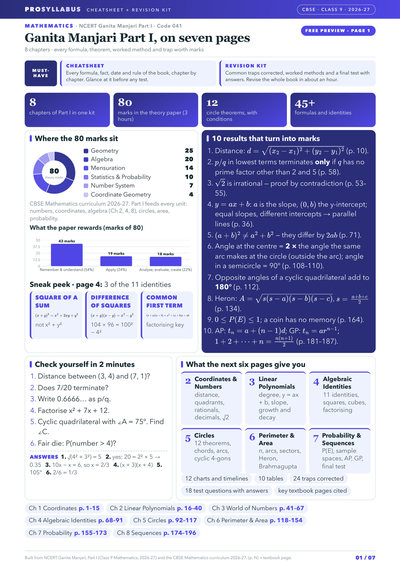
 2
2