Class 9 › Mathematics › Ganita Manjari Exploring Algebraic Identities Class 9 Mathematics · Ganita Manjari · Chapter 4
Practice all → Summary Questions & answers Practise this chapter → View all Page 1 free about 8 min read , Full kit about 55 min read Page 1 free about 8 min read , Full kit about 55 min read
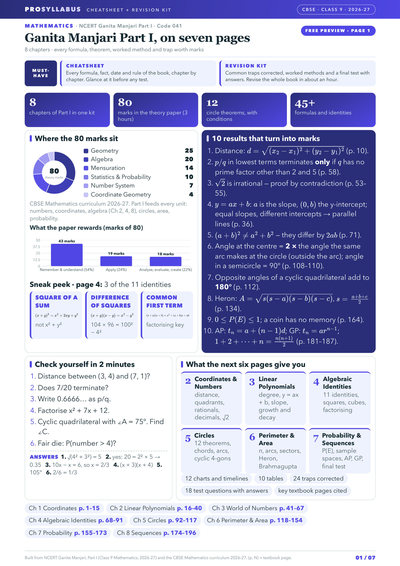
View all 6 amazing Marks Booster kits → This chapter develops algebraic identities — equations true for all values of the variables — and shows how to verify them geometrically with squares, rectangles and cubes, and using algebra tiles. The basic square identities are \((a+b)^2 = a^2 + 2ab + b^2\) and \((a-b)^2 = a^2 - 2ab + b^2\), extended to three terms by \((a+b+c)^2 = a^2+b^2+c^2+2ab+2bc+2ca\). The difference of squares is \(a^2 - b^2 = (a+b)(a-b)\), and the product pattern \((x+a)(x+b)=x^2+(a+b)x+ab\) leads to factorising quadratics by splitting the middle term. Cubic identities include \((a+b)^3 = a^3+3a^2b+3ab^2+b^3\), \((a-b)^3 = a^3-3a^2b+3ab^2-b^3\), the sum and difference of cubes \(a^3 \pm b^3\), and \(a^3+b^3+c^3-3abc=(a+b+c)(a^2+b^2+c^2-ab-bc-ca)\). These identities speed up numerical squaring and cubing, support factorisation, and let us simplify rational algebraic expressions by cancelling common factors.
Identity
An equation that is true for every value of the variables involved.
Equation
A statement that holds only for particular values of the variable, unlike an identity.
Factorisation
Writing an expression as a product of its factors, e.g. \(x^2+4x+4=(x+2)^2\).
Difference of squares
The identity \(a^2 - b^2 = (a+b)(a-b)\).
Splitting the middle term
Factorising \(x^2+px+q\) by finding \(a,b\) with \(a+b=p\) and \(ab=q\).
Algebra tiles
Square and rectangular pieces used to visualise products and factors of expressions.
Q1 What is the difference between an equation and an identity? Answer Q2 Expand \((5x + 2y)^2\). Answer Q3 Factorise \(x^2 + 4x + 4\). Answer Q4 Use an identity to compute \(43^2\). Answer Q5 State the identity for \(a^2 - b^2\). Answer Q6 Factorise \(x^2 + 7x + 12\) by splitting the middle term. Answer Q7 Expand \((a+b)^3\). Answer Q8 What is the factorisation of \(a^3 + b^3\)? Answer Q9 Find \(x^3+y^3+z^3\) if \(x+y+z=10,\ xyz=25,\ x^2+y^2+z^2=38\). Answer Q10 How is a rational algebraic expression simplified? Answer Q1 Try and find other patterns like this one. For example, you could consider 4 consecutive squares and see if you can find a pattern. Answer Q1 1. What can you say about \(a\) and \(b\) if \((a + b)^{2} < a^{2} + b^{2}\)? Answer Q2 2. What can you say about \(a\) and \(b\) if \((a + b)^{2} > a^{2} + b^{2}\)? Answer Q3 3. When will \((a + b)^{2}\) be equal to \(a^{2} + b^{2}\)? Answer Q4 Did you observe that \((a + b)^{2}\) and \(a^{2} + b^{2}\) are both positive? What term will decide which is larger? Use the expansion of \((a + b)^{2}\) to decide. Answer Q1 1. Using the identity \((a + b)^{2} = a^{2} + 2ab + b^{2}\), expand the following: (i) \((7x + 4y)^{2}\) Answer Q2 1. Using the identity \((a + b)^{2} = a^{2} + 2ab + b^{2}\), expand the following: (ii) \(\left(\frac{7}{5}x + \frac{3}{2}y\right)^{2}\) Answer Q3 1. Using the identity \((a + b)^{2} = a^{2} + 2ab + b^{2}\), expand the following: (iii) \((2.5p + 1.5q)^{2}\) Answer Q4 1. Using the identity \((a + b)^{2} = a^{2} + 2ab + b^{2}\), expand the following: (iv) \(\left(\frac{3}{4}s + 8t\right)^{2}\) Answer Q5 1. Using the identity \((a + b)^{2} = a^{2} + 2ab + b^{2}\), expand the following: (v) \(\left(x + \frac{1}{2y}\right)^{2}\) Answer Q6 1. Using the identity \((a + b)^{2} = a^{2} + 2ab + b^{2}\), expand the following: (vi) \(\left(\frac{1}{x} + \frac{1}{y}\right)^{2}\) Answer Q7 2. Using the same identity, find the values of the following: (i) \((64)^{2}\) Answer Q8 2. Using the same identity, find the values of the following: (ii) \((105)^{2}\) Answer Q9 2. Using the same identity, find the values of the following: (iii) \((205)^{2}\) Answer Q1 What if we replace \(b\) by \(-b\) in \((a + b)^{2} = a^{2} + 2ab + b^{2}\)? Answer Q1 1. Factor completely: (i) \(9x^{2} + 24xy + 16y^{2}\) Answer Q2 1. Factor completely: (ii) \(4s^{2} + 20st + 25t^{2}\) Answer Q3 1. Factor completely: (iii) \(49x^{2} + 28xy + 4y^{2}\) Answer Q4 1. Factor completely: (iv) \(64p^{2} + \frac{32}{3}pq + \frac{4}{9}q^{2}\) Answer Q5 1. Factor completely: (v) \(3a^{2} + 4ab + \frac{4}{3}b^{2}\) Answer Q6 1. Factor completely: (vi) \(\frac{9}{5}s^{2} + 6sv + 5v^{2}\) Answer Q7 2. Find the values of the following using the identity \((a - b)^{2} = a^{2} - 2ab + b^{2}\). (i) \((79)^{2}\) Answer Q8 2. Find the values of the following using the identity \((a - b)^{2} = a^{2} - 2ab + b^{2}\). (ii) \((193)^{2}\) Answer Q9 2. Find the values of the following using the identity \((a - b)^{2} = a^{2} - 2ab + b^{2}\). (iii) \((299)^{2}\) Answer Q1 Label the squares and rectangles in Fig. 4.4 so that it represents the identity \((a + b + c)^{2} = a^{2} + b^{2} + c^{2} + 2ab + 2bc + 2ca\). Answer Q1 1. Find the following squares using one of the above identities. Determine which of these identities will make these calculations easier. (i) \(117^{2}\) Answer Q2 1. Find the following squares using one of the above identities. Determine which of these identities will make these calculations easier. (ii) \(78^{2}\) Answer Q3 1. Find the following squares using one of the above identities. Determine which of these identities will make these calculations easier. (iii) \(198^{2}\) Answer Q4 1. Find the following squares using one of the above identities. Determine which of these identities will make these calculations easier. (iv) \(214^{2}\) Answer Q5 1. Find the following squares using one of the above identities. Determine which of these identities will make these calculations easier. (v) \(1104^{2}\) Answer Q6 1. Find the following squares using one of the above identities. Determine which of these identities will make these calculations easier. (vi) \(1120^{2}\) Answer Q7 2. Factor using suitable identities: (i) \(16y^{2} - 24y + 9\) Answer Q8 2. Factor using suitable identities: (ii) \(\frac{9}{4}s^{2} + 6st + 4t^{2}\) Answer Q9 2. Factor using suitable identities: (iii) \(\frac{m^{2}}{9} + \frac{mk}{3} + \frac{k^{2}}{4} + 2mn + 3kn + 9n^{2}\) Answer Q10 2. Factor using suitable identities: (iv) \(\frac{p^{2}}{16} - 2 + \frac{16}{p^{2}}\) Answer Q11 2. Factor using suitable identities: (v) \(9a^{2} + 4b^{2} + c^{2} - 6ab + 6ac - 4bc\) Answer Q12 3. Expand the following using the identity \((a + b + c)^{2} = a^{2} + b^{2} + c^{2} + 2ab + 2bc + 2ca\): (i) \((p + 3q + 7r)^{2}\) Answer Q13 3. Expand the following using the identity \((a + b + c)^{2} = a^{2} + b^{2} + c^{2} + 2ab + 2bc + 2ca\): (ii) \((3x - 2y + 4z)^{2}\) Answer Q14 4. Is this an identity? \((a + b - c)^{2} + (a - b + c)^{2} + (-a + b + c)^{2} = 2(a^{2} + b^{2} + c^{2})\) Answer Q1 1. Try to evaluate the following using a suitable identity: (i) \(35^{2}\) Answer Q2 1. Try to evaluate the following using a suitable identity: (ii) \(65^{2}\) Answer Q3 1. Try to evaluate the following using a suitable identity: (iii) \(85^{2}\) Answer Q4 1. Try to evaluate the following using a suitable identity: (iv) \(105^{2}\) Answer Q5 2. Observe the two rows of figures below. They represent an algebraic identity. Try to identify it. 2b 2c, a+b+c, a+b-c, a-b+c, a-b-c Answer Q1 Suppose \(7x\) is split as \(2x + 5x\); can a similar rectangular arrangement be formed? Consider other possibilities and check. Answer Q1 1. Figure out the product of \(x + 2\) and \(x + 3\) using algebra tiles. Answer Q2 2. Lay out algebra tiles for \(x^{2} + 11x + 30\) in such a way that you will see its factors. Answer Q1 We have seen that \((x + 3)(x + 4) = x^{2} + 7x + 12\). Also \((x + 6)(x + 7) = x^{2} + 13x + 42\). Generalise the pattern to get an expression for \((x + a)(x + b)\). Answer Q2 Now consider the case where we have a rectangle of sidelengths \(2x + 3\) and \(3x + 1\), as shown in Fig. 4.8. What can you say about its area \((2x + 3)(3x + 1)\)? Fill in the blanks with the appropriate expressions to make the equation true. \((px + a)(qx + b) = (\text{_____})x^{2} + (\text{_____})x + \text{_____}\). Also, verify your answer using the distributive property. Answer Q1 1. Fill in the blanks to complete the following identities: (i) \(s^{2} - 11s + 24 = (\text{________})(\text{________})\) Answer Q2 1. Fill in the blanks to complete the following identities: (ii) \((\text{________})(x + 1) = (3x^{2} - 4x - 7)\) Answer Q3 1. Fill in the blanks to complete the following identities: (iii) \(10x^{2} - 11x - 6 = (2x - \text{___})(\text{___} + 2)\) Answer Q4 1. Fill in the blanks to complete the following identities: (iv) \(6x^{2} + 7x + 2 = (\text{____________})(\text{___________})\) Answer Q5 2. Select and use the identity that will help you to find the following products without multiplying directly: (i) \((41)^{2}\) Answer Q6 2. Select and use the identity that will help you to find the following products without multiplying directly: (ii) \((27)^{2}\) Answer Q7 2. Select and use the identity that will help you to find the following products without multiplying directly: (iii) \((23 \times 17)\) Answer Q8 2. Select and use the identity that will help you to find the following products without multiplying directly: (iv) \((135)^{2}\) Answer Q9 2. Select and use the identity that will help you to find the following products without multiplying directly: (v) \((97)^{2}\) Answer Q10 2. Select and use the identity that will help you to find the following products without multiplying directly: (vi) \((18 \times 29)\) Answer Q11 2. Select and use the identity that will help you to find the following products without multiplying directly: (vii) \((34 \times 43)\) Answer Q12 2. Select and use the identity that will help you to find the following products without multiplying directly: (viii) \((205)^{2}\) Answer Q13 3. Factor the following: (i) \(9a^{2} + b^{2} + 4c^{2} - 6ab + 12ac - 4bc\) Answer Q14 3. Factor the following: (ii) \(16s^{2} + 25t^{2} - 40st\) Answer Q15 3. Factor the following: (iii) \(r^{2} - r - 42\) Answer Q16 3. Factor the following: (iv) \(49g^{2} + 14gh + h^{2}\) Answer Q17 3. Factor the following: (v) \(64u^{2} + 121v^{2} + 4w^{2} - 176uv - 32uw + 44vw\) Answer Q1 James: \((a - b)^{2}(a + b) = (a^{2} - 2ab + b^{2})(a + b)\) Reshma: I have a different idea. \((a - b)^{2}(a + b) = (a - b)[(a - b)(a + b)] = (a - b)(a^{2} - b^{2})\) I will find this product to get the answer. According to you, who is correct and why? Try to combine more such identities and find new results. Answer Q1 We already know that \(x^{2} - y^{2} = (x - y)(x + y)\). Further, we have verified that \(x^{3} - y^{3} = (x - y)(x^{2} + xy + y^{2})\). Observe that \(x - y\) is a common factor of \(x^{2} - y^{2}\) and \(x^{3} - y^{3}\). Do you think \(x - y\) is also a factor of \(x^{4} - y^{4}\)? Note that \(x^{4} - y^{4} = (x^{2})^{2} - (y^{2})^{2} = (x^{2} - y^{2})(x^{2} + y^{2})\). Can you see how \(x - y\) is a factor of \(x^{4} - y^{4}\)? How about \(x^{5} - y^{5}\)? Does this also have \(x - y\) as a factor? Answer Q1 Try to simplify the following rational expression: \(\frac{36s^{2} - 12st + 6\cdot2\cdot2t^{2} - 48s^{2}}{t^{2} + 2ts - 48s^{2}} = \frac{\text{___}}{(\text{___})(\text{___})}\) (Hint: Factor \(t^{2} + 2ts - 48s^{2}\) and simplify the rational expressions assuming that \(t^{2} + 2ts - 48s^{2} \neq 0\)). Answer Q1 1. Simplify the following rational expressions assuming that the expressions in the denominators are not equal to zero: (i) \(\frac{3p^{2} - 3pq - 18q^{2}}{p^{2} + 3pq - 10q^{2}}\) Answer Q2 1. Simplify the following rational expressions assuming that the expressions in the denominators are not equal to zero: (ii) \(\frac{n^{3} - 3n^{2}m + 3nm^{2} - m^{3}}{5m^{2} - 10mn + 5n^{2}}\) Answer Q3 1. Simplify the following rational expressions assuming that the expressions in the denominators are not equal to zero: (iii) \(\frac{w^{3} - v^{3} + x^{3} + 3wvx}{w^{2} + v^{2} + x^{2} - 2wv - 2vx + 2wx}\) Answer Q4 1. Simplify the following rational expressions assuming that the expressions in the denominators are not equal to zero: (iv) \(\frac{4y^{2} - 20yz + 25z^{2}}{25z^{2} - 4y^{2}}\) Answer Q5 1. Simplify the following rational expressions assuming that the expressions in the denominators are not equal to zero: (v) \(\frac{(x^{2}+x-6)(x^{2}-7x+12)}{(x^{2}-6x+8)(x^{2}-9)}\) Answer Q6 1. Simplify the following rational expressions assuming that the expressions in the denominators are not equal to zero: (vi) \(\frac{p^{4} - 16}{p^{2} - 4p + 4}\) Answer Q1 1. Use suitable identities to find the following products: (i) \((-3x + 4)^{2}\) Answer Q2 1. Use suitable identities to find the following products: (ii) \((2s + 7)(2s - 7)\) Answer Q3 1. Use suitable identities to find the following products: (iii) \(\left(p^{2} + \frac{1}{2}\right)\left(p^{2} - \frac{1}{2}\right)\) Answer Q4 1. Use suitable identities to find the following products: (iv) \((2n + 7)(2n - 7)\) Answer Q5 1. Use suitable identities to find the following products: (v) \((s - 2t)(s^{2} + 2st + 4t^{2})\) Answer Q6 1. Use suitable identities to find the following products: (vi) \(\left(\frac{1}{2}r - 4\right)^{2}\) Answer Q7 1. Use suitable identities to find the following products: (vii) \((-3m + 4k - l)^{2}\) Answer Q8 1. Use suitable identities to find the following products: (viii) \(\left(x - \frac{1}{3}y\right)^{3}\) Answer Q9 1. Use suitable identities to find the following products: (ix) \(\left(7k - \frac{2}{3}m\right)^{3}\) Answer Q10 2. Find the values using suitable identities: (i) \(17 \times 21\) Answer Q11 2. Find the values using suitable identities: (ii) \(104 \times 96\) Answer Q12 2. Find the values using suitable identities: (iii) \(24 \times 16\) Answer Q13 2. Find the values using suitable identities: (iv) \(147^{3}\) Answer Q14 2. Find the values using suitable identities: (v) \(199^{3}\) Answer Q15 2. Find the values using suitable identities: (vi) \(127^{3}\) Answer Q16 2. Find the values using suitable identities: (vii) \((-107)^{3}\) Answer Q17 2. Find the values using suitable identities: (viii) \((-299)^{3}\) Answer Q18 3. Factor the following algebraic expressions: (i) \(4y^{2} + 1 + \frac{1}{16y^{2}}\) Answer Q19 3. Factor the following algebraic expressions: (ii) \(9m^{2} - \frac{1}{25n^{2}}\) Answer Q20 3. Factor the following algebraic expressions: (iii) \(27b^{3} - \frac{1}{64b^{3}}\) Answer Q21 3. Factor the following algebraic expressions: (iv) \(x^{2} + \frac{5}{6}x + \frac{1}{6}\) Answer Q22 3. Factor the following algebraic expressions: (v) \(27u^{3} - \frac{1}{125} - \frac{27}{5}u^{2} + \frac{9}{25}u\) Answer Q23 3. Factor the following algebraic expressions: (vi) \(64y^{3} + \frac{1}{125}z^{3}\) Answer Q24 3. Factor the following algebraic expressions: (vii) \(p^{3} + 27q^{3} + r^{3} - 9pqr\) Answer Q25 3. Factor the following algebraic expressions: (viii) \(9m^{2} - 12m + 4\) Answer Q26 3. Factor the following algebraic expressions: (ix) \(9x^{3} - \frac{8}{3}y^{3} + \frac{1}{3}z^{3} + 6xyz\) Answer Q27 3. Factor the following algebraic expressions: (x) \(4x^{2} + 9y^{2} + 36z^{2} + 12xy + 36yz + 24zx\) Answer Q28 3. Factor the following algebraic expressions: (xi) \(27u^{3} - \frac{1}{216} - \frac{9}{2}u^{2} + \frac{1}{4}u\) Answer Q29 4. Simplify the following: (i) \(\frac{4x^{2} + 4x + 1}{4x^{2} - 1}\) Note: Assume that the denominators are not equal to 0. Answer Q30 4. Simplify the following: (ii) \(\frac{9\left(3a^{3} - 24b^{3}\right)}{9a^{2} - 36b^{2}}\) Answer Q31 4. Simplify the following: (iii) \(\frac{s^{3} + 125t^{3}}{s^{2} - 2st - 35t^{2}}\) Answer Q32 5. Find possible expressions for the length and breadth of each of the following rectangles whose areas are given by the following expressions in square units. (i) \(25a^{2} - 30ab + 9b^{2}\) Answer Q33 5. Find possible expressions for the length and breadth of each of the following rectangles whose areas are given by the following expressions in square units. (ii) \(36s^{2} - 49t^{2}\) Answer Q34 6. Find possible expressions for the length, breadth, and heights of each of the following cuboids whose volumes are given by the following expressions in cubic units. (i) \(6a^{2} - 24b^{2}\) Answer Q35 6. Find possible expressions for the length, breadth, and heights of each of the following cuboids whose volumes are given by the following expressions in cubic units. (ii) \(3ps^{2} - 15ps + 12p\) Answer Q36 7. The village playground is shaped as a square of side 40 metres. A path of width \(s\) metres is created around the playground for people to walk. Find an expression for the area of the path in terms of \(s\). Answer Q37 8. If a number plus its reciprocal equals \(\frac{10}{3}\), find the number. Answer Q38 9. A rectangular pool has area \(2x^{2} + 7x + 3\) square hastas. If its width is \(2x + 1\) hastas, find its length. Hasta was a unit used to measure length. Answer Q39 10. If both \(x - 2\) and \(x - \frac{1}{2}\) are factors of \(px^{2} + 5x + r\), show that \(p = r\). Answer Q40 11. If \(a + b + c = 5\) and \(ab + bc + ca = 10\), then prove that \(a^{3} + b^{3} + c^{3} - 3abc = -25\). Answer Q41 12. By factoring the expression, check that \(n^{3} - n\) is always divisible by 6 for all natural numbers \(n\). Give reasons. Answer Q42 13. Find the value of (i) \(x^{3} + y^{3} - 12xy + 64\), when \(x + y = -4\) Answer Q43 13. Find the value of (ii) \(x^{3} - 8y^{3} - 36xy - 216\), when \(x = 2y + 6\) Answer
An identity is an equation that is true:
A never B only for one value of the variable C only for positive values D for all values of the variables
Flashcards & interactive practice