CBSE · NCERT syllabus

CBSE Class 7 — Notes, Chapters & Practice Quizzes

Every Class 7 chapter, made friendly — notes with pictures, key words, and a quiz for each chapter.

6 subjects 77 chapters 82 practice quizzes NCERT syllabus
104 quiz attempts so far Dual AI-verified questions 10 quizzes free, then 10 credits
Notice Board
Class 7 students learning

Students preparing for CBSE Class 7 Annual Assessment

View all

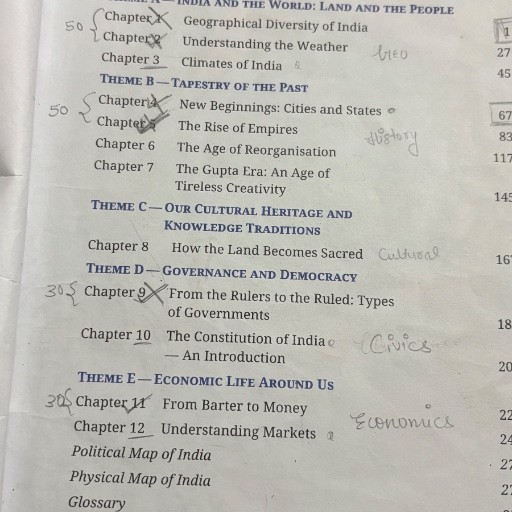
Chapter 4: New Beginnings: Cities and States — Class 7 Social Science

Social Science · 20 chapters
Summary, key terms, important questions and a practice quiz with AI diagnosis for each.

Chapter 4: New Beginnings: Cities and States

Try one from this chapter
What is meant by India's 'Second Urbanisation'?

Summary

This chapter explores India's 'Second Urbanisation'. After the Harappan or Sindhu-Sarasvati civilisation (the 'First Urbanisation') declined in the early 2nd millennium BCE, urban life vanished for about a thousand years. Then, in the 1st millennium BCE, vibrant new cities arose in the Ganga plains and beyond. We know this from archaeological excavations and from late Vedic, Buddhist and Jain literature. As clans settled in territories led by a raja, these became janapadas ('where people have set foot'); by the 8th–7th centuries BCE many merged into larger mahajanapadas, the more common list naming sixteen, from Gandhara in the northwest to Anga in the east. Most capitals were large fortified cities with moats, many still living cities today. The chapter highlights early democratic traditions: each janapada had an assembly (sabha or samiti), and at least two mahajanapadas, Vajji and Malla, were ganas or sanghas — 'early republics' where the assembly chose the ruler. Key innovations included iron metallurgy, which boosted agriculture and weaponry, and the first Indian coins (silver 'punch-marked coins'). The chapter also introduces the varna-jati system of social organisation, noting it was more flexible early on and grew rigid over time, and traces trade routes like the Uttarapatha and Dakshinapatha that knit the Subcontinent together.

First and Second UrbanisationJanapadas and mahajanapadasEarly republics and assembliesIron, coins and tradeThe varna-jati system

Key terms

Second Urbanisation
The new phase of city-building that began in the Ganga plains in the 1st millennium BCE, long after the Harappan First Urbanisation declined.
Janapada
A Sanskrit term meaning 'where people have set foot'; an early territory or small state led by a raja, often associated with a clan.
Mahajanapada
A larger state formed when janapadas merged; sixteen are most often listed, ranging across north and central India.
Gana or sangha
A mahajanapada that was not a monarchy but an 'early republic', where the assembly took decisions and even selected the ruler, as in Vajji and Malla.
Punch-marked coins
India's earliest coins, made of silver with symbols punched onto them, introduced as trade grew.
Varna-jati system
A two-fold system of social organisation: jati, a community tied to an occupation, and varna, the four-fold Vedic categories.

Important questions

The Big Questions

LET'S EXPLORE

LET'S EXPLORE

LET'S EXPLORE

THINK ABOUT IT

Questions and activities

Explore interactively

Key-term flashcards
Flip cards · mark known · keyboard ← → and Space
6 cards
Term1 / 6
Second Urbanisation
Tap to reveal
Meaning1 / 6
The new phase of city-building that began in the Ganga plains in the 1st millennium BCE, long after the Harappan First Urbanisation declined.
Tap to flip back
Tap card to flip

Keyboard: ← → to move · Space to flip

Practice quiz · New Beginnings: Cities and States

Score on this chapter, climb the leaderboard, and get an AI diagnosis of your mistakes.

Dual AI-verified questions Real exam pattern 2 quizzes free, then 10 credits per quiz

#1

New Beginnings: Cities and States

Social Science 10 Qs · ~10 min
5.5/10avg score
10/10best