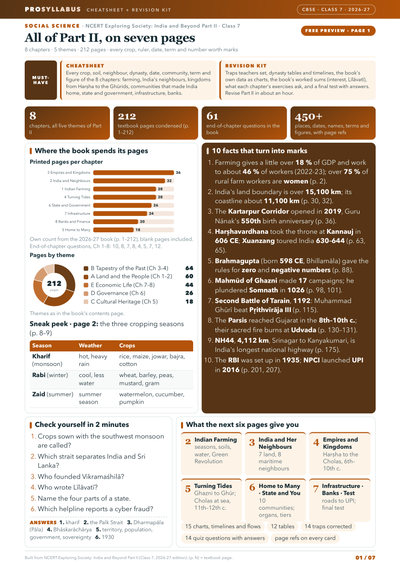
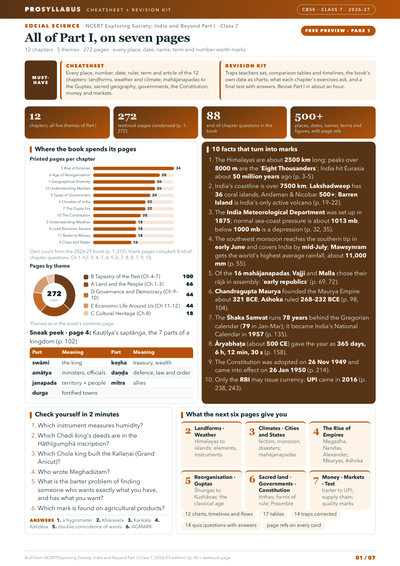
This chapter explores India's relationships with her neighbours, both land-based and maritime. A neighbour is traditionally a country sharing a land border, but India, a maritime nation surrounded by sea on three sides, also has maritime neighbours connected by shared seas. India's land boundary stretches over 15,100 km, while her coastline of about 11,100 km gives her a central place in the Indian Ocean. The chapter surveys India's land neighbours — China (linked by Buddhism but with border tensions and trade imbalance), Pakistan (a complex relationship since the 1947 Partition, with shared heritage like the Kartarpur Corridor), Bangladesh (sharing language and the Sundarbans), Nepal (with an open border and shared faith), Bhutan (the 'Land of the Thunder Dragon', linked by hydropower and Buddhism), Myanmar (India's gateway to Southeast Asia), and Afghanistan (linked by the ancient Uttarapatha route). It then explores maritime neighbours — Sri Lanka, the Maldives, Thailand, Malaysia, Singapore, Indonesia, Iran and Oman — tracing centuries of cultural, religious and commercial exchange, including the spread of Buddhism and Hinduism, place names like Ayutthaya echoing Ayodhya, and monuments like Borobudur and Angkor Wat. The big idea is that being good neighbours is not only about borders but about working together for shared peace, progress and regional cooperation.
Land and maritime neighboursIndia and her land neighboursIndia's maritime neighboursCultural and trade linksRegional cooperation
Key terms
Maritime neighbour
A country connected to another by a shared sea or ocean, even without a direct land border, linked through trade and cultural exchange.
Regionalism
Countries of a region working together to create peace, stability and shared progress, as India does in the Indian Ocean.
Open border
An arrangement, as between India and Nepal, where people can cross without a visa or passport, enabling work, study, trade and family ties.
SAARC
The South Asian Association for Regional Cooperation, formed in 1985 to promote sociocultural and economic progress among member nations.
Suvarnabhumi
The 'golden land' — a name early Indian traders gave to parts of Southeast Asia like Java, Sumatra and Malaya.
Gross National Happiness
A holistic measure of progress developed by Bhutan, including sustainability, good governance and the promotion of culture.
Extra questions & answers
The Big Questions
LET’S EXPLORE
LET’S EXPLORE
LET’S EXPLORE
Questions and activities
Try one from this chapter
Who is a maritime neighbour?
Flashcards & interactive practice
Practice quiz · India and Her Neighbours
Score on this chapter, climb the leaderboard, and get an AI diagnosis of your mistakes.
Double-checked questions Real exam pattern 1 free test every month, then ₹9 per test
#1
India and Her Neighbours
Start here
Social Science 10 Qs · ~10 min
Instant score, answer review and weak-topic diagnosis
Data & insights
Trending in Class 7 this weekThe chapters students are reading most right now