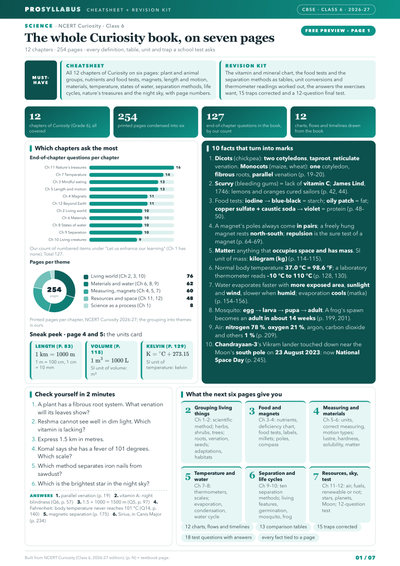
This chapter explains how we measure how hot or cold a body is. It opens with the insight that our sense of touch is unreliable: after dipping one hand in warm water and the other in cold, the same water in a third container feels warm to one hand and cool to the other. Therefore we need a reliable measure of hotness or coldness, called temperature, and a device that measures it, called a thermometer. The chapter describes the clinical thermometer used for body temperature, noting that modern digital thermometers have replaced toxic mercury ones, and even infrared (non-contact) thermometers that measure temperature from a distance, as used during the COVID-19 pandemic. The normal temperature of a healthy human body is taken to be 37.0 °C (98.6 °F), though it varies slightly with age, time of day, and activity, and the human body normally stays between 35 °C and 42 °C. Temperature is measured on three scales: the Celsius scale (degree Celsius, °C), the Fahrenheit scale (degree Fahrenheit, °F), and the Kelvin scale, whose unit, the kelvin (K), is the SI unit of temperature; the conversion is \( T_{K} = T_{C} + 273.15 \). The chapter then introduces the laboratory thermometer, which has a liquid (alcohol or mercury) in a sealed glass tube with a Celsius scale, and explains how to read its range (typically –10 °C to 110 °C) and the value of its smallest division. It teaches the correct way to use it: the bulb must be immersed without touching the bottom or sides, the thermometer held vertically, the reading taken while still immersed and with the eye level with the liquid. A clinical thermometer cannot measure boiling water or ice because these lie outside its range. Air temperature, measured by room and weather thermometers, varies daily and is used for weather forecasts.
Why touch is unreliableTemperature and thermometersClinical thermometers and scalesLaboratory thermometers and correct useAir temperature and weather
Key terms
Temperature
A reliable measure of the hotness or coldness of a body; a hotter body has a higher temperature than a colder one.
Thermometer
A device used to measure temperature; clinical thermometers measure body temperature and laboratory thermometers are used for many other purposes.
Clinical thermometer
A thermometer used to measure human body temperature, usually digital today, replacing the older toxic mercury type.
Laboratory thermometer
A thermometer with a liquid column in a sealed glass tube and a Celsius scale, used to measure temperatures over a wide range, typically –10 °C to 110 °C.
Temperature scales
The Celsius scale (°C), the Fahrenheit scale (°F), and the Kelvin scale (K); the kelvin is the SI unit of temperature.
Normal body temperature
The average body temperature of healthy people, taken to be 37.0 °C (98.6 °F), with the human body normally between 35 °C and 42 °C.
Extra questions & answers
Let us enhance our learning
Try one from this chapter
Why is our sense of touch not a reliable way to judge hotness or coldness?
Flashcards & interactive practice
Practice quiz · Temperature and its Measurement
Score on this chapter, climb the leaderboard, and get an AI diagnosis of your mistakes.
Double-checked questions Real exam pattern 1 free quiz every month, then ₹9 per quiz
#1
Temperature and its Measurement
Start here
Science 10 Qs · ~10 min
Instant score, answer review and weak-topic diagnosis
Data & insights
Trending in Class 6 this weekThe chapters students are reading most right now