Variations in Psychological Attributes
Class 12 Psychology · Psychology · Chapter 1
163 members in the CBSE community
View all








CBSE Class 12 · Psychology
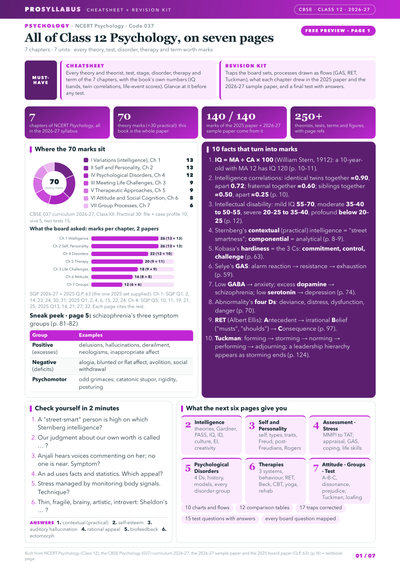
140 board marks counted, chapter by chapter- Marks booster + cheatsheet: key concepts in 2 lines each
- 26 board marks each: Ch 1 and Ch 2
- 22 of 140 board marks: disorders, Ch 4
- 20 of 140 board marks: therapies, Ch 5
- 6-mark questions on Freud, RET and Beck
- IQ bands and twin correlations from the book
Summary
This chapter studies how and why people differ from one another. Individual differences are the distinctive variations in people's characteristics and behaviour; the situationist view stresses that circumstances also shape behaviour. Psychological attributes such as intelligence, aptitude, interest, personality and values are multi-dimensional and are measured through assessment using tests, interviews, case studies, observation and self-report. Intelligence is the global capacity to understand the world, think rationally and use resources effectively. Theories fall into two camps: psychometric approaches (Spearman's g and s factors, Thurstone's primary mental abilities, Guilford's structure-of-intellect) and information-processing approaches (Gardner's eight multiple intelligences, Sternberg's triarchic theory of componential, experiential and contextual intelligence, and the PASS model of planning, attention-arousal and simultaneous-successive processing). Intelligence is a product of the interplay of nature and nurture. IQ, devised by Stern, is mental age divided by chronological age times 100; IQ scores form a bell-shaped normal curve. Those below 70 may have intellectual disability and those above 130 are gifted. Western culture promotes technological intelligence while the Indian tradition emphasises integral intelligence (buddhi). Emotional intelligence is the ability to perceive and regulate emotions. Aptitude is potential for acquiring specific skills, and creativity is the ability to produce novel, useful ideas.