Therapeutic Approaches
Class 12 Psychology · Psychology · Chapter 5
163 members in the CBSE community
View all










CBSE Class 12 · Psychology
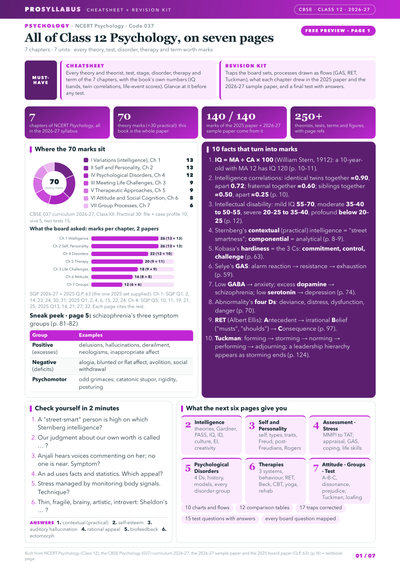
140 board marks counted, chapter by chapter- Marks booster + cheatsheet: key concepts in 2 lines each
- 26 board marks each: Ch 1 and Ch 2
- 22 of 140 board marks: disorders, Ch 4
- 20 of 140 board marks: therapies, Ch 5
- 6-mark questions on Freud, RET and Beck
- IQ bands and twin correlations from the book
Summary
This chapter describes the nature and methods of psychotherapy used to relieve psychological distress. Psychotherapy is a voluntary, confidential relationship between a trained therapist and a client that aims to change maladaptive behaviour, reduce distress and improve adjustment. The therapeutic relationship or alliance, built on trust, empathy and unconditional positive regard, is central to healing. Therapies are classified mainly into psychodynamic, behaviour and existential (humanistic) approaches, differing in their view of the cause of problems, methods and the therapist's role. Behaviour therapy applies learning principles, using techniques such as negative reinforcement, aversive conditioning, token economy, systematic desensitisation (Wolpe) based on reciprocal inhibition, and modelling. Cognitive therapy locates distress in irrational thoughts; Ellis's Rational Emotive Therapy uses ABC analysis to dispute irrational beliefs, and Beck's cognitive therapy challenges dysfunctional schemas and negative automatic thoughts. Cognitive Behaviour Therapy combines these with a bio-psychosocial approach. Humanistic-existential therapies, including Rogers's client-centred therapy, Frankl's logotherapy and Gestalt therapy, foster personal growth and self-actualisation. Factors that contribute to healing include the techniques used, the therapeutic alliance, catharsis and non-specific patient and therapist variables, with ethics like informed consent and confidentiality. Alternative therapies such as yoga and meditation, and rehabilitation of the mentally ill through occupational, social-skills and vocational training, are also discussed.