Meeting Life Challenges
Class 12 Psychology · Psychology · Chapter 3
163 members in the CBSE community
View all








CBSE Class 12 · Psychology
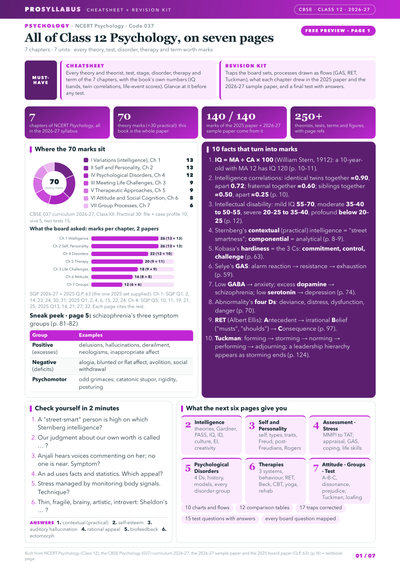
140 board marks counted, chapter by chapter- Marks booster + cheatsheet: key concepts in 2 lines each
- 26 board marks each: Ch 1 and Ch 2
- 22 of 140 board marks: disorders, Ch 4
- 20 of 140 board marks: therapies, Ch 5
- 6-mark questions on Freud, RET and Beck
- IQ bands and twin correlations from the book
Summary
This chapter examines stress as a feature of life and how people cope with it. Stress is the pattern of responses an organism makes to events that disturb its equilibrium; mild stress (eustress) can energise, while excessive stress turns into distress. Lazarus stressed that the impact of an event depends on cognitive appraisal: primary appraisal judges whether the situation is positive, neutral or stressful, and secondary appraisal assesses one's coping resources. Sources and types of stress include physical and environmental, psychological (frustration, conflict, internal and social pressures) and social stress. Stress affects psychological functioning, leading to emotional, physiological, cognitive and behavioural effects, and prolonged stress damages health. Selye's General Adaptation Syndrome describes three stages of the body's response: alarm reaction, resistance and exhaustion. Stress weakens the immune system, and chronic stress can cause burnout. Lifestyle factors influence health. Coping, after Lazarus and Folkman, may be task-oriented (problem-focused), emotion-focused or avoidance-oriented. Stress-management techniques include relaxation, meditation, biofeedback, creative visualisation, cognitive restructuring and exercise. Positive health and well-being are promoted by life skills such as assertiveness, time management, rational thinking, improving relationships, self-care and overcoming unhelpful habits, along with social support, a balanced diet and resilience.