Self and Personality
Class 12 Psychology · Psychology · Chapter 2
163 members in the CBSE community
View all









CBSE Class 12 · Psychology
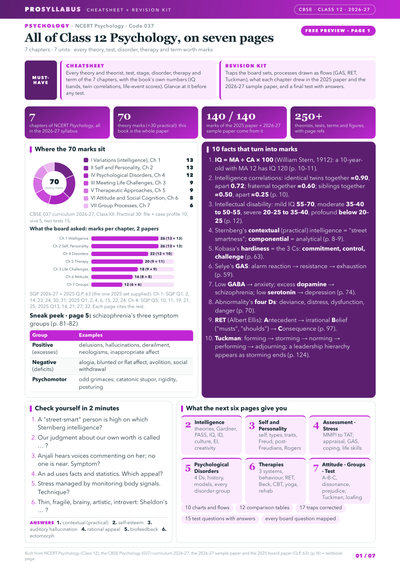
140 board marks counted, chapter by chapter- Marks booster + cheatsheet: key concepts in 2 lines each
- 26 board marks each: Ch 1 and Ch 2
- 22 of 140 board marks: disorders, Ch 4
- 20 of 140 board marks: therapies, Ch 5
- 6-mark questions on Freud, RET and Beck
- IQ bands and twin correlations from the book
Summary
Self and personality describe the characteristic ways we define our existence. The self is the totality of an individual's conscious experiences, ideas and feelings about himself or herself, and can be understood both as subject (knower) and object (known). Kinds of self include personal and social identity, and the self develops through interaction with significant others. Important self-processes are self-esteem (one's overall worth), self-efficacy (Bandura's belief in one's capability) and self-regulation (controlling behaviour, including self-reinforcement). Personality is a relatively stable, organised set of characteristics. Type approaches classify people into categories (Ayurveda's tridosha, Sheldon's body types, Jung's introvert-extravert, Friedman and Rosenman's Type A and Type B). Trait approaches describe building blocks of personality: Allport's cardinal, central and secondary traits, Cattell's source traits, Eysenck's dimensions and the Big Five factors (openness, extraversion, agreeableness, neuroticism, conscientiousness). The psychodynamic approach (Freud) emphasises the unconscious, the id-ego-superego structure, libido, ego defence mechanisms and psychosexual stages; post-Freudians include Jung, Horney, Adler and Erikson. The behavioural, cultural and humanistic (Rogers, Maslow) approaches offer alternatives. Personality is assessed through self-report measures, projective techniques (Rorschach, TAT) and behavioural analysis.