Checked 26 October 2026. The UGC Paper I syllabus and the NTA December 2026 bulletin were re-downloaded and checked on 26 October 2026. Historical topic counts use six public UGC NET Bureau booklets from 2015–2018; NTA does not publish full current Paper I question text publicly. Original examples illustrate methods rather than predict future question frequencies.
In UGC NET Paper I, Logical Reasoning is Unit VI. The official UGC syllabus names categorical propositions, mood and figure, fallacies, the classical square of opposition, Venn diagrams, deduction and induction, analogies, and Indian logic: pramanas, anumana, vyapti and hetvabhasas. A notes page that lists the terms is useful for recall, but the mark is earned when a candidate can decide what follows from a statement. This workshop makes that decision visible with truth relations, counterexamples, a small checker and a repair routine. It is separate from our ten-unit syllabus and historical question-count guide: that page tells you how much was asked; this one teaches a Unit VI method.
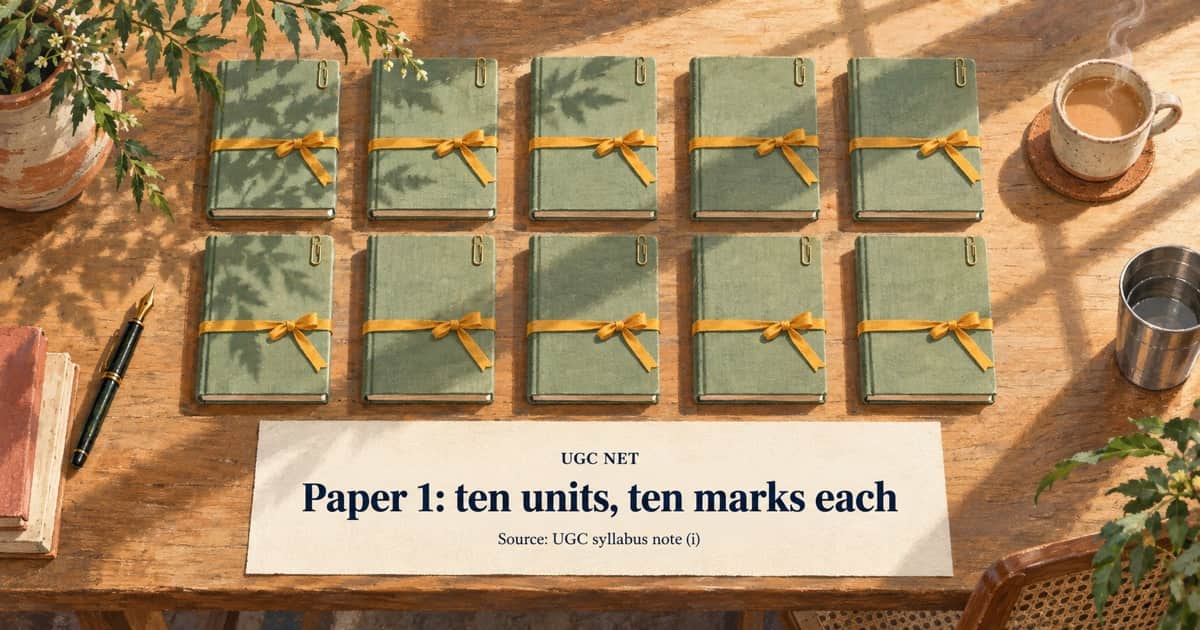
The UGC syllabus gives five two-mark questions per unit. Ten is our count of square items in six official Bureau booklets, not an NTA prediction.
The official boundary: what belongs in Unit VI
The UGC syllabus divides this unit into several linked tasks. Formal logic asks whether a conclusion follows from a form, while informal fallacies ask whether an argument has a reasoning defect despite natural language. The square relates four categorical sentence forms about the same subject and predicate. Venn diagrams test whether premises force a conclusion. Indian logic studies means of knowledge and inference through its own terms. Do not assume that a question on one of these tasks gives the entire unit a larger weight; the syllabus note gives five questions of two marks from each of ten units.
| Official syllabus phrase | Do this in practice |
|---|---|
| Categorical propositions, mood/figure, square | Translate a sentence into A/E/I/O, keep S and P fixed, and test a claimed consequence. |
| Formal/informal fallacies; deduction/induction | Look for a counterexample to necessity; distinguish a probability claim from a proof. |
| Venn diagrams; analogies | Shade empty regions, place an X for an existence claim, and check whether a conclusion is forced. |
| Indian logic, pramanas, anumana, vyapti, hetvabhasas | Name the evidence route, the invariant relation and where an inference can fail. |
NTA’s December 2026 bulletin says Paper I has 50 compulsory questions for 100 marks, Paper II has 100 questions for 200 marks, and both share a three-hour sitting without a break. Each correct response earns two marks and an incorrect response loses none. It provides no separate Unit VI clock or official question-type quota. Any time allocation in this workshop is a personal practice rule, not an NTA instruction. The current bulletin also says to choose the most appropriate option when there is no negative marking.
First translate the sentence: A, E, I or O
A and E are universal propositions; I and O are particular. Quality means affirmative or negative. Keep the same subject class S and predicate class P as you compare them. “All researchers are teachers” and “Some teachers are researchers” change the subject and predicate positions, so they are not simply two corners of one square. “Some” in this logic means at least one, not “some but not all.” That last distinction prevents a common wrong answer.
| Code | Standard form | Quantity / quality | Example |
|---|---|---|---|
| A | All S are P | Universal affirmative | All oak trees in this grove are marked. |
| E | No S are P | Universal negative | No oak trees in this grove are marked. |
| I | Some S are P | Particular affirmative | Some oak trees in this grove are marked. |
| O | Some S are not P | Particular negative | Some oak trees in this grove are not marked. |
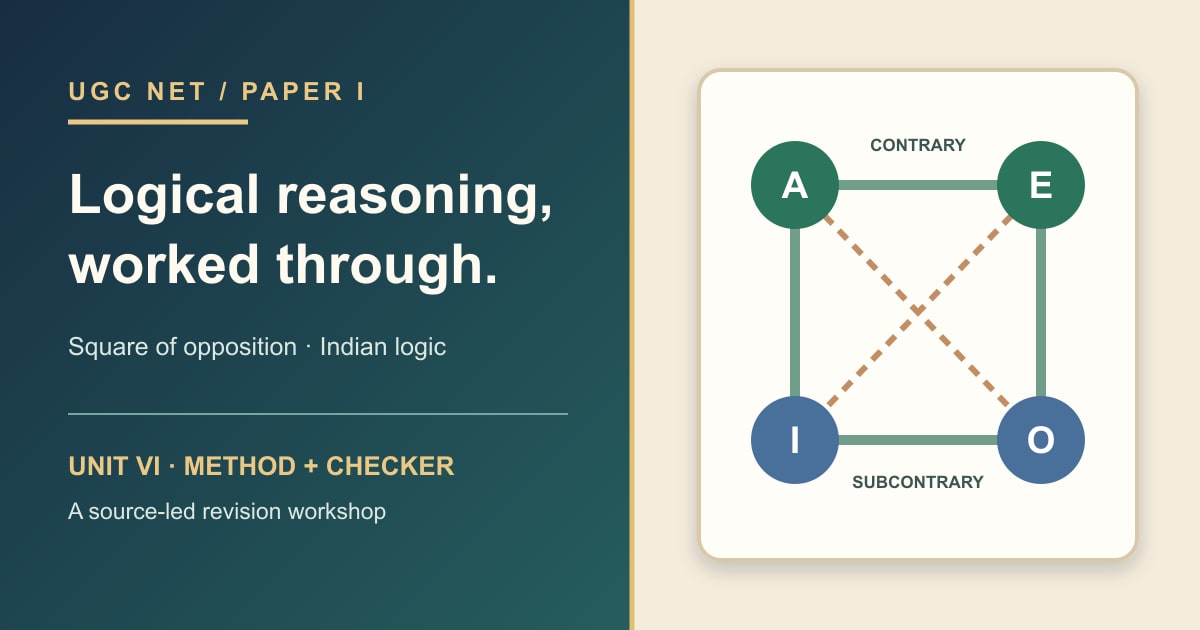
The two diagonal pairs are the easiest to apply: A and O cannot share a truth value, and E and I cannot share a truth value. If “All S are P” is false, “Some S are not P” is true; if it is true, O is false. If “No S are P” is false, “Some S are P” is true. These diagonal relations are contradictions. They do not depend on a separate guess about how common S is.
Three other relations, with the classical assumption stated
A and E are contraries: they cannot both be true if S has at least one member, but they can both be false when some S are P and some are not. I and O are subcontraries: they cannot both be false under that same nonempty assumption, but they can both be true. Subalternation goes from A true to I true, and E true to O true. It also goes from I false to A false, and O false to E false. Do not reverse the truth arrow: “Some S are P” does not prove “All S are P.”
| Given | Forced in classical square | Why |
|---|---|---|
| A true | E false; I true; O false | All S are P, and at least one S exists. |
| A false | O true | A and O contradict; E and I remain unsettled. |
| E true | A false; I false; O true | No S are P, and at least one S exists. |
| E false | I true | E and I contradict. |
| I true | E false | Some S are P; that does not settle A or O. |
| I false | E true; A false; O true | No S are P, then the classical existence assumption gives O. |
| O true | A false | Some S are outside P; E and I may vary. |
| O false | A true; E false; I true | All S are P, with a nonempty S. |
Try the classical-square consequence checker
Fix one proposition as true or false. The tool shows only what follows in the classical square, which assumes the subject class has at least one member. A missing conclusion means its truth cannot be settled from this one premise.
Teaching model for the syllabus phrase “classical square of opposition.” For an empty subject class, modern Boolean interpretation treats universal statements differently. The static table above carries the same results in AMP and print.
Here is a quick self-test. Suppose “No members of this reading group use the library” is false. This is E false, so I is true: at least one member uses it. You cannot infer that every member uses it. If instead “Some members do not use the library” is false, O false makes A true: every member uses it. The two English sentences sound close, yet they force different conclusions. Try both in the checker, then explain the result without looking at the table.
Modern empty classes: a caution for advanced questions
The syllabus specifically says “classical square of opposition.” Traditional relations outside the diagonals assume there is at least one S. Modern Boolean logic does not treat “All S are P” as proving that an S exists: if there are no S, the universal can be true while “Some S are P” is false. If a question explicitly says the subject class may be empty, rely on the diagonal contradictions and read its stated interpretation. Many short notes omit this condition and turn the vertical arrows into unconditional facts. We include it so the diagram does not teach a false universal rule.
From two premises to a valid conclusion
A square question relates one categorical proposition to another. A syllogism adds a second premise. First identify the middle term that appears in both premises but disappears from the conclusion. Then look for a counterexample: can both premises be true while the proposed conclusion is false? If yes, the inference is invalid. A Venn diagram is a disciplined way to draw this test. Shade a region when the premises say it is empty; place an X when they say at least one member exists. Do not add an X for “all” unless existence is given.
| Original case | Verdict | Reason |
|---|---|---|
| All editors are readers. All readers are learners. Therefore all editors are learners. | Valid | The editors circle sits inside readers, which sits inside learners. |
| All editors are readers. Some readers are learners. Therefore some editors are learners. | Invalid | The learners among readers could all be outside the editors circle. |
| No editors are late. Some interns are editors. Therefore some interns are not late. | Valid | The given intern-editor overlap exists and lies outside late. |
| Some editors are readers. Some readers are learners. Therefore some editors are learners. | Invalid | The two “some” groups may be different people. |
The second and fourth examples expose an everyday trap: two premises can each sound supportive while their named people are different. Draw the minimum picture allowed by the premises, then try to place the “some” groups separately. If you can, the conclusion is not forced. This is more reliable than memorising a slogan such as “two particular premises are always wrong” without understanding which inference is being tested.
Deduction, induction and a five-minute counterexample test
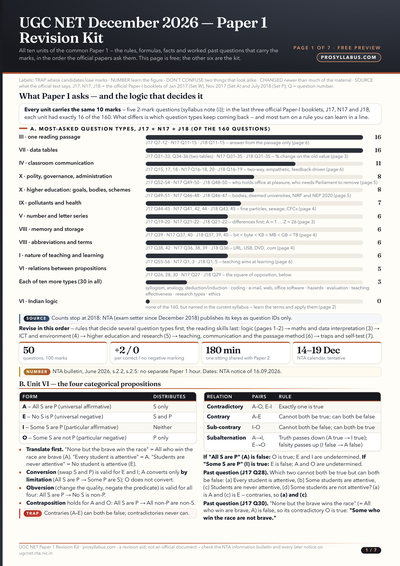
- Marks booster + cheatsheet: key concepts in 2 lines each
- 17 traps UGC NET has tested
- 16 of 160 past questions from every unit
- Logic rules: syllogisms, fallacies, pramanas
- DI formulas, series and codes
- Worked past questions from official papers
A deductive claim promises necessity: if the premises hold, the conclusion must hold. The counterexample test is therefore decisive. An inductive claim offers support without necessity: several observed library users may suggest a pattern, but another group could behave differently. The same passage can contain both. “Every surveyed reader preferred a digital copy” is a fact about the sample; “all readers everywhere prefer digital copies” goes beyond it. In a Paper I question, mark the scope of the evidence before choosing “valid,” “strong” or “probable.”
| Error signature | Symptom | Repair |
|---|---|---|
| Reversed inclusion | All A are B becomes all B are A | Draw a small A circle inside B; leave B-only space visible. |
| Two different “some” groups | One overlap is silently treated as the other | Place separate X marks in different eligible regions. |
| Empty-class assumption | A true is used to prove I true with no subject existence | Ask whether the task says classical or allows an empty S. |
| Induction presented as proof | A sample observation becomes a universal law | State the population and find a possible unobserved case. |
Indian logic: six named means of knowledge
The UGC syllabus names six pramanas: pratyaksha, anumana, upamana, shabda, arthapatti and anupalabdhi. This is the syllabus list for the exam, not a claim that every Indian philosophical school accepts all six. For revision, ask how a claim was obtained. Was the object perceived, inferred through a dependable relation, learned by comparison, reported by a trustworthy speaker, postulated to explain a fact, or known through non-apprehension in appropriate conditions? Keep that route separate from whether the conclusion happens to be true.
| Syllabus term | Study label | Original classroom illustration |
|---|---|---|
| Pratyaksha | Perception | You see a red marker on a clear desk. |
| Anumana | Inference | From a reliable, relevant sign and a known relation, you infer what is not directly seen. |
| Upamana | Comparison | After a description of a plant, you recognise a matching unfamiliar plant. |
| Shabda | Verbal testimony | You learn the library closing time from its authorised notice. |
| Arthapatti | Postulation / implication | A locked room is empty at night but a lamp is found lit each morning; you seek a fact that explains both observations. |
| Anupalabdhi | Non-apprehension | In good light, you look at an otherwise empty table and find that the expected book is absent. |
These illustrations are deliberately simple. They are not official questions and should not be used as complete philosophical definitions. In particular, ordinary “I did not see it” is weak evidence of absence when lighting, access or attention is poor. Similarly, an inference needs a dependable vyapti, the invariable connection named by the syllabus, rather than a coincidental sign. A reported sentence depends on its source. This second check—conditions under which the route works—is what makes the list useful instead of six labels to memorise.
Anumana, vyapti and where an inference breaks
A standard classroom model of anumana runs from a subject through a reason or sign to a conclusion, supported by a general relation. “This hill has fire because it has smoke” is the familiar model, but only if the smoke–fire link is secure and the smoke really belongs to that hill. Our fresh example is a laboratory thermometer: if a calibrated instrument reliably reads above a defined threshold and it is measuring this vessel, an inference about the vessel’s temperature may be warranted. If the instrument belongs to another vessel, the reason is misplaced; if it is faulty, the general connection fails. These are two different failure points.
The syllabus names hetvabhasas, fallacies of inference. Instead of treating every ordinary mistake as one named subtype, first ask three diagnostic questions: Is the sign established in this subject? Is the sign reliably connected to the proposed conclusion? Is a contradictory observation or stronger reason present? These questions do not replace a full classical taxonomy; they stop a candidate from labelling a weak inference “proved” merely because the example resembles a memorised formula. Use a formal text for traditional subtype names if an exam item asks for them.
| Question to ask | If it fails | Repair |
|---|---|---|
| Is the reason present here? | The stated sign has not been established for this subject. | Check the actual subject and observed evidence. |
| Does the reason reliably imply the conclusion? | The proposed vyapti is too loose or has a counterexample. | Search for a case where the sign is present but conclusion absent. |
| Is there defeating evidence? | The conclusion conflicts with a stronger observation or premise. | Reconcile the sources before naming the inference valid. |
What six public Bureau booklets show, and what they cannot show
Our earlier question audit coded six publicly available UGC NET Bureau Paper I booklets from June 2015 to July 2018, totaling 340 questions. Within their Logical Reasoning blocks, we identified ten square-of-opposition items across the six booklets; Indian logic terms were not directly tested in that sample. The source file for the count is in the ProSyllabus research alongside the syllabus guide. The sample is old, limited, and predates NTA’s computer-based format. It supports practising the square as an observed historical question family, not skipping Indian logic today. Current NTA answer keys disclose question IDs and options without the public question text, so a defensible new Unit VI frequency chart cannot be computed from those keys.
ProSyllabus coding of six official Bureau Paper I booklets, June 2015–July 2018. These are observed counts, not expected marks in December 2026.
| Evidence set | What is visible | Safe conclusion |
|---|---|---|
| Six Bureau Paper I booklets, 2015–2018 | Full question text; 340 questions coded across ten units | Ten square items in our coding; no Indian-logic terms in that sample. |
| NTA December 2026 bulletin | Current Paper I/II pattern and marking | 50 Paper I questions, 100 marks, no negative marking; no Unit VI topic quota. |
| NTA public final answer keys | Question IDs and correct options without full text | Cannot derive topic frequency from these files alone. |
A seven-session repair plan
Work on one reasoning error at a time. For each miss, write the premise, your conclusion, the counterexample you should have tried, and the corrected rule. Redo a fresh case rather than the same remembered answer. The board below saves check marks locally on this device; it does not collect a score or prove readiness. Spend at least one session on the named Indian-logic terms even if your older paper practice has few examples, because the current syllabus still includes them.
| Session | Work | Proof of repair |
|---|---|---|
| 1 | Translate ten short statements into A/E/I/O. | S and P stay in the same positions. |
| 2 | Use every row of the classical truth table, then explain without the checker. | Name which propositions are forced and which remain open. |
| 3 | Draw Venn pictures for four original syllogisms above. | Find a counterexample to each invalid conclusion. |
| 4 | Sort a mixed set into deduction, induction and analogy. | State whether the claim promises necessity or support. |
| 5 | Recall the six syllabus pramanas with one fresh situation each. | Explain the route and its condition, not just the name. |
| 6 | Diagnose anumana by sign, vyapti and defeating evidence. | Give a case where a tempting sign fails. |
| 7 | Do a timed mixed Unit VI set, then log only the mistakes. | A fresh variation is solved correctly the next day. |
Unit VI repair board
Tick a skill after solving a fresh example, not after rereading the note. Check marks stay in this browser.
0 of 10 done
Ticks are saved only in this browser on this device.
The UGC NET Paper I revision kit is a separate compact review across all ten units. Preview its actual first page and current price before buying; it is not an NTA publication and the kit purchase does not automatically include quiz or membership access. Keep this free Unit VI workshop open for worked methods and use the kit when you want a concise recall sheet beside your own error log. The Unit I classroom cases, Unit II research cases and Unit VII data workshop handle different question families.
Keep the ten units together
Use the free square checker and worked cases here. If you need a shorter all-unit final review, inspect the kit preview and current contents first.
Preview the Paper I revision kitQuestions candidates ask
Frequently asked questions
Is Indian logic in the UGC NET Paper I syllabus?
Yes. Unit VI explicitly names pramanas, anumana, vyapti and hetvabhasas alongside categorical logic, fallacies and Venn diagrams.
How many Unit VI questions are officially assigned?
The UGC Paper I syllabus note says five questions of two marks from each unit. It gives no quota among square, Venn, fallacies or Indian logic.
What are A, E, I and O propositions?
A is All S are P; E is No S are P; I is Some S are P; O is Some S are not P. Keep S and P fixed across the square.
Does “some” mean “some but not all” in categorical logic?
No. It means at least one. “Some S are P” can remain true when all S are P, if at least one S exists.
Why does the checker mention nonempty subject classes?
The classical square uses an existence assumption for contraries, subcontraries and subalternation. Modern empty-class interpretation does not preserve every traditional relation.
Were Indian-logic questions absent from all NTA exams?
We cannot say that. Our zero count is only from six older public Bureau booklets. NTA does not publish full current Paper I question text in its public final keys.
Is there negative marking in the December 2026 Paper I?
No. The NTA December 2026 information bulletin says a correct answer earns two marks and an incorrect answer has no negative mark.
Sources
- official — UGC NET Bureau — Paper I syllabus, Unit VI and five-question-per-unit note
- official — NTA — UGC NET December 2026 Information Bulletin, sections 3.2–3.5
- official — UGC NET Bureau — public archive of earlier question papers
official = a document published by the conducting body. reported = a news or coaching site we could not check against an original. Where sources disagree this page says so rather than picking one.
More in this series
- UGC NET cut-offs by subject and category, every cycle since 2023
- UGC NET JRF vs Assistant Professor vs PhD only
- UGC NET pattern, marking, percentile and normalised marks
- UGC NET previous papers and official answer keys
- UGC NET December 2026 dates and every past cycle's timeline
- Teaching Aptitude: worked classroom decisions
- Research Aptitude: methods and ethics cases
- UGC NET Paper 1 syllabus unit-wise, with weightage counted
- Paper I Data Interpretation: 20 practice questions
- UGC NET notice board — alerts and updates
- UGC NET exam day: time management and CBT
- UGC NET syllabus and a study plan
- CSIR NET: JRF vs Assistant Professor