Checked 9 October 2026. The UGC Paper I syllabus and June 2026 NTA bulletin were checked on 9 October 2026. All cases and decision paths are original study examples, not NTA questions or official answer explanations. Confirm the bulletin for your own cycle.
Research Aptitude is a five-question Paper I unit, but its errors usually start before the definitions. Candidates can recite “experimental, descriptive, historical, qualitative, quantitative” and still call a survey an experiment or a correlation a cause. The UGC NET Bureau syllabus makes Unit II broader: research approaches, methods, steps, writing, ICT and ethics. This free workshop turns that list into research choices. It gives 12 original worked cases and an answerable check, then a compact revision system for the separate Paper I kit. It does not attempt to cover a subject-specific Paper II.
| Official Unit II strand | Practical question | Cases below |
|---|---|---|
| Meaning, types, characteristics; positivism and post-positivism | What can the evidence support, and how certain is the claim? | 7 |
| Experimental, descriptive, historical, qualitative and quantitative methods | Does the method answer this particular question? | 1–6 |
| Steps of research | Was the problem defined before the instrument? | 8 |
| Thesis/article writing and referencing formats/styles | Can a reader trace each borrowed idea or visual? | 9–10 |
| Application of ICT in research | Did the tool help organise evidence without substituting for verification? | 9, 11 |
| Research ethics | Were people, records and results handled responsibly? | 10–12 |
The syllabus note states five questions of two marks from each module. Treat that as the published unit blueprint, not a prediction for any particular shift or a promise of one question from each row above. NTA’s June 2026 bulletin gives 50 Paper I questions for 100 marks, alongside a 100-question, 200-mark Paper II in one 180-minute session; it says wrong answers are not negatively marked. Check the bulletin of the cycle you actually sit. This article was checked on 9 October 2026.
Start with the claim, then choose the method
Write the intended claim in an ordinary sentence. “How many students can use the library?” asks for a present-state estimate. “How did an old rule change?” requires records and context. “How do students experience a rule?” asks for accounts and interpretation. “Did a programme cause a difference?” needs a design that seriously handles comparison and alternative explanations. Method labels are not interchangeable badges. A qualitative interview can be carefully systematic, and a quantitative table can still be poorly designed.
| Method or approach | Best-fitting example here | Evidence that matters | Claim to resist |
|---|---|---|---|
| Experimental | Compare outcomes after a deliberately assigned intervention | Assignment, comparable groups, outcome measure and protocol | All experiments are perfectly generalisable. |
| Descriptive | Estimate current access to a service | Defined population, sampling and valid questions | A current percentage proves an intervention worked. |
| Historical | Trace a rule through dated documents | Authenticity, sequence, context and missing records | The surviving archive tells the complete story. |
| Qualitative | Understand participants’ experiences | Sampling rationale, accounts and analytic method | A theme from interviews is a population rate. |
| Quantitative | Estimate an association in measured data | Variables, measurement, sampling and analysis | A correlation alone proves causation. |
These examples clarify the method names in the official list; they are not a claim that UGC assigns one fixed method to each possible research problem. Some projects combine methods. “Quantitative” describes the nature of measured evidence, whereas “experimental” describes a design with an intervention and comparison. A project can be both. Likewise descriptive work may use numeric surveys or qualitative descriptions. The exam clue is what the researcher actually does.
Twelve worked Research Aptitude decisions
Cover each answer before reading it. State the research question, identify the evidence, name the strongest warranted claim, and then find the tempting overclaim. The cases are written for this article and are not presented as past-paper quotations.
1. Design before data
A department changes its mentoring programme and then asks one group whether they liked it. Its report says the programme caused better grades.
Best reading: This is a satisfaction description. A causal claim needs a design that addresses comparison, selection and other plausible explanations. Even a before-and-after grade rise alone cannot isolate the programme.
Tempting error: Calling any measured change an experiment.
2. Experimental method
A researcher assigns comparable volunteers to two teaching approaches, uses the same outcome measure and documents deviations.
Best reading: An experimental design manipulates an intervention and compares outcomes. Assignment and control of confounders strengthen causal interpretation, but volunteers and departures from the protocol can still limit generalisation.
Tempting error: Treating the word “experiment” as proof of perfect control.
3. Descriptive method
A university wants to estimate what share of its first-year students can access the library at weekends. No policy change is tested.
Best reading: Define the population, sample and question; a representative survey is a descriptive fit. It estimates a current condition. It does not show that weekend access caused an academic outcome.
Tempting error: Choosing an experiment because the report contains percentages.
4. Historical method
A scholar compares dated university circulars and archived council minutes to trace how an admissions rule changed.
Best reading: Historical inquiry works from records and their context. Check provenance, date, purpose and missing records before drawing a narrative from the surviving archive.
Tempting error: Calling a document search a present-day survey.
5. Qualitative method
The question is how first-generation students experience a new supervision rule. Participants describe contradictory experiences in interviews.
Best reading: A qualitative design can examine meaning, context and variation. Explain who was interviewed, how accounts were analysed, and why the examples support the interpretation. A few quotations alone are not a prevalence estimate.
Tempting error: Converting an interview theme into a population percentage.
6. Quantitative method
A candidate tests whether hours in a lab are associated with a numeric assessment score across a defined cohort.
Best reading: A quantitative design can estimate the association if measurement and sampling are sound. Association does not establish that extra lab hours caused the score; prior preparation may affect both.
Tempting error: Writing “impact” when the design only shows correlation.
7. Positivism and post-positivism
Two teams measure the same outcome. One speaks as if the instrument gives an objective, final answer; the other reports uncertainty, alternative explanations and limits.
Best reading: The second is closer to a post-positivist stance: empirical tests matter, while observations and inferences remain fallible. This is a study contrast, not a rule that one method always belongs to one philosophy.
Tempting error: Equating post-positivism with rejecting evidence or numbers.
8. Research sequence
A student writes a questionnaire before stating the research question or identifying the population.
Best reading: Move back to the problem and existing literature; define the question and the kind of evidence needed, then choose design, sample, instrument, analysis and reporting. The sequence can be revised as limitations emerge.
Tempting error: Assuming a tool automatically defines a valid research problem.
9. ICT in research
A citation manager imports a webpage with the wrong author and year. The student pastes its formatted reference into a thesis without opening the source.
Best reading: ICT can help collect, organise and analyse, but the researcher must check metadata against the source and use the required style consistently. An exported reference is not verification.
Tempting error: Trusting a neat bibliography more than the original document.
10. Attribution and reuse
A diagram is copied from a journal article, recoloured and put in a presentation with no credit.
Best reading: Credit the source and check reuse permission or licence where required. Recolouring does not erase authorship; a citation and permission are separate questions.
Tempting error: Treating a cosmetic edit as original creation.
11. Research ethics and data
A supervisor sends a dataset with students’ names and grades. A candidate uploads the raw file to a public analysis site to make a quick chart.
Best reading: Pause before upload. Check consent and lawful access, minimise or de-identify the data as appropriate, and use an approved environment. The convenience of ICT is not permission to disclose private records.
Tempting error: Assuming research use makes disclosure harmless.
12. Reporting honestly
A pilot produces an unexpected null result. The student deletes those observations without a documented criterion and reports only the improved figure.
Best reading: Preserve a clear audit trail and apply a defensible exclusion rule consistently. Report the result and its limits. Selective deletion can misrepresent the evidence even if the final table looks plausible.
Tempting error: Choosing the dataset after seeing the preferred answer.
A claim ladder for the causal trap
| Observed evidence | Defensible wording | What would exceed the evidence |
|---|---|---|
| One group says it liked a new programme | Participants reported satisfaction. | The programme raised grades. |
| The group’s average grade rose after the programme | Grades rose in this group during that period. | The programme alone caused the rise. |
| Comparable groups are assigned to programme and comparison conditions, with protocol and outcomes documented | The design offers stronger evidence about the intervention’s effect in this setting. | The effect applies to every institution without qualification. |
Every step up the ladder adds evidence and assumptions. It is still possible to ask whether groups were truly comparable, whether learners knew their assignment, whether the measure was suitable, and whether the context travels to another institution. In a timed question, look for verbs such as “describes,” “associated,” “influences,” and “causes.” Pick the strongest sentence the actual design earns, not the boldest one available.
Positivism and post-positivism without a false binary
The UGC syllabus names both approaches but gives no miniature definition or compulsory philosophical pairing. A useful study contrast is that positivist work seeks observable regularities and objective measurement, while post-positivist work still values empirical inquiry but makes uncertainty, measurement limits and alternative explanations explicit. This is a simplification for exam preparation, not a full philosophy of science. Neither label means that qualitative work has no rigour or that a numeric result is automatically true. When a question supplies its own definition, use that wording; do not force a slogan onto it.
| Question in a scenario | Research decision | Why it matters |
|---|---|---|
| “Did the instrument measure what we intended?” | Validity and measurement need scrutiny. | A precise number can answer the wrong question. |
| “Could another factor explain the change?” | Check design and confounders. | An observed pattern is not automatically causal. |
| “Could the finding differ elsewhere?” | State population and setting limits. | A local finding need not transfer unchanged. |
| “Can another researcher trace what we did?” | Document design, analysis and sources. | Transparent method makes criticism and replication possible. |
Check your decisions
Five-case method and ethics check
Choose an answer and inspect the reason. These are original study cases, not official past questions or a predicted score.
Choose an answer to begin.
No response is sent to ProSyllabus. The complete answer table below remains readable on AMP.
| Case | Best answer | Reason |
|---|---|---|
| 1. A survey estimates current weekend-library access. Which method best fits its immediate aim? | Descriptive | It describes a present condition without assigning an intervention. |
| 2. An association between lab hours and scores is observed. What can be claimed directly? | There is an association in the measured sample | The observational association alone does not isolate a cause. |
| 3. A citation manager imports the wrong year. What is the next step? | Check the original source and correct the record | Reference software organises sources; it cannot validate erroneous metadata. |
| 4. A recoloured published diagram has no credit. What issue remains? | Attribution and possibly reuse permission | A visual remains attributable to its source despite a cosmetic change. |
| 5. A dataset contains identifiable student grades. A public charting upload is proposed. What comes first? | Check consent, access and a suitable protected workflow | Research ethics includes how identifiable records are accessed, handled and shared. |
For each miss, write a one-sentence repair rule and invent a different setting that would test it. If you missed “association versus cause,” move from lab hours to mentoring or attendance; the correct reasoning should survive the new topic. An answer remembered only because the same words appear twice is weak evidence of understanding.
A seven-day Unit II repair loop
| Day | Work | Evidence to keep |
|---|---|---|
| 1 | Copy the six Unit II syllabus strands and classify the 12 cases. | One decision sentence per case. |
| 2 | Turn one research question into descriptive, historical and experimental versions where feasible. | What evidence changes when the question changes? |
| 3 | Draw the causal claim ladder from a new topic. | One justified claim and one overclaim at each rung. |
| 4 | Inspect a paper’s question, sample, method, result and limitations. | A five-line audit, with source citation. |
| 5 | Correct three deliberately flawed references against their original sources. | Author, date, title and locator verified. |
| 6 | Take the five-case check and a Paper I research quiz. | The exact distinction behind each missed answer. |
| 7 | Redo the misses with new contexts and revise your weakest strand. | A defensible explanation without seeing the answer. |
Research Aptitude revision board
Tick a strand after you can defend an unfamiliar example. This local board is optional; the table above is the full printable plan.
0 of 9 done
Ticks are saved only in this browser on this device.
How this connects to the Paper I kit and free practice
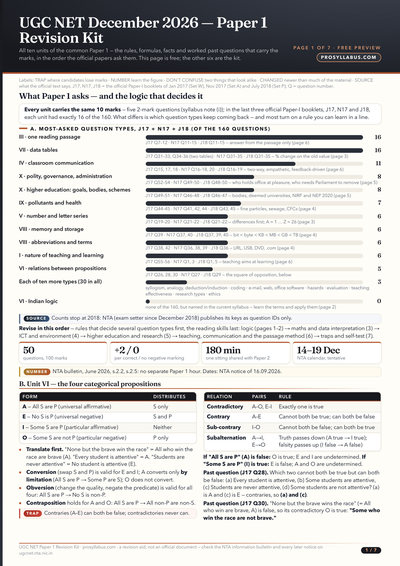
The 12 cases and answer explanations remain available here without a login. The separate seven-page UGC NET Paper I revision kit condenses research alongside higher education on page 5 and covers the other common Paper I units. It is a fast review aid after you can justify the choices above; it is not a substitute for full Paper II subject preparation, an official question bank or a membership.
Preview the actual Paper I revision kit
Read this full workshop for free, then inspect the kit’s first page and current contents before deciding whether a compact revision aid fits your study plan. Quiz and membership access are separate offerings.
See the first-page previewA separate Teaching Aptitude Unit I workshop handles classroom levels, methods and evaluation. The Paper I syllabus and booklet audit places Unit II alongside the other nine units. Use those pages when the error belongs to another unit; this page stays focused on Research Aptitude decisions.
Research Aptitude questions answered
How many Research Aptitude questions are in UGC NET Paper I?
The official UGC Paper I syllabus note says five questions of two marks are set from each module, including Unit II Research Aptitude. The June 2026 NTA bulletin gives 50 Paper I questions and 100 marks overall.
Which research methods does the official Unit II syllabus name?
Experimental, descriptive, historical, qualitative and quantitative methods. The syllabus also names research approaches, steps, writing and references, ICT and ethics.
Is a survey always descriptive?
A survey can describe a current condition, but the method label depends on the question and design. The example in this guide estimates current library access; it does not test a causal intervention.
Can a correlation prove that a programme worked?
Not by itself. Other factors may affect both the programme exposure and the outcome. A causal claim requires a suitable design and explicit treatment of alternatives.
Is quantitative research the same as experimental research?
No. Quantitative describes numeric evidence or analysis; experimental describes an intervention and comparison design. A study can be both.
Are the 12 cases official UGC NET previous-year questions?
No. They are original ProSyllabus study cases derived from the official Unit II headings. Use official papers and current notices for exam primary material.
Does the seven-page kit include Paper II or quiz membership?
No. It is a Paper I revision kit covering the ten common units. Paper II and quiz or membership access are separate.
Sources
- official — UGC NET Bureau — current syllabus index; General Paper, code 00
- official — UGC NET Bureau — General Paper on Teaching and Research Aptitude, Paper I English syllabus PDF
- official — NTA — UGC NET June 2026 information bulletin: Paper I/II pattern, duration and marking
official = a document published by the conducting body. reported = a news or coaching site we could not check against an original. Where sources disagree this page says so rather than picking one.
More in this series
- UGC NET cut-offs by subject and category, every cycle since 2023
- UGC NET JRF vs Assistant Professor vs PhD only
- UGC NET pattern, marking, percentile and normalised marks
- UGC NET previous papers and official answer keys
- UGC NET December 2026 dates and every past cycle's timeline
- Teaching Aptitude: worked classroom decisions
- UGC NET Paper 1 syllabus unit-wise, with weightage counted
- UGC NET notice board — alerts and updates
- UGC NET exam day: time management and CBT
- UGC NET syllabus and a study plan
- CSIR NET: JRF vs Assistant Professor