Checked 25 September 2026. From the SMLE Applicant Guide (September 2025) and the SMLE Blueprint 2026. SCFHS notes that each section may vary by ±5%; the format changed in March 2023, so check that any guide you use is dated after it.
The Saudi Medical Licensure Examination (SMLE) is the exam a doctor sits to practise in Saudi Arabia or to enter Saudi postgraduate training. Its format was cut down in March 2023, and much of what is written about it still describes the old one. This guide is built from the Saudi Commission for Health Specialties' (SCFHS) own documents: the applicant guide of September 2025 and the 2026 blueprint.
Where other pages get this wrong
The SMLE is 200 questions in two blocks — not 300 questions in six hours — and 560 is not "68%".
Commonly published instead: "300 MCQs, 6 hours, 3 sections" and "pass mark 68% (560/800)".
SCFHS changed the SMLE from March 2023 to 200 multiple-choice questions in two blocks of 100, each 120 minutes, with one 30-minute break; Prometric gives the seat time as 4 hours 30 minutes. The pass mark is 560 "on the reporting scale of 200–800" — a scaled score. Dividing 560 by 800 is meaningless (the scale starts at 200), and SCFHS publishes no percentage equivalent.
SMLE Applicant Guide (Sep 2025); SMLE Blueprint 2026.
The format
| Item | SMLE (from March 2023) |
|---|---|
| Questions | 200 MCQs, four options, one best answer; up to 20 (10%) pilot questions that do not count |
| Blocks | Two blocks of 100 questions, 120 minutes each |
| Break | One scheduled 30-minute break; overrunning it eats into the next block |
| Seat time | 4 hours 30 minutes (Prometric) |
| Question types | Recall, and scenarios testing interpretation, analysis, decision-making and problem-solving |
| Pass score | 560 on the 200–800 reporting scale |
| Results | Within 2–6 weeks of the end of the testing window; a statement of results and a feedback report |
| Delivery | Prometric, at SCFHS-approved centres in Saudi Arabia and internationally |
| Feature | Before March 2023 | From March 2023 |
|---|---|---|
| Questions | 300 | 200 |
| Blocks | 3 × 100, 120 min each | 2 × 100, 120 min each |
| Breaks | Two breaks sharing a 45-minute pool | One, 30 minutes |
| Pass score | 560 (scaled) | 560 (scaled) — unchanged |
| Blueprint | 30/25/25/20 | 30/25/25/20 — unchanged |
At 120 minutes for 100 questions you have 72 seconds a question, and because up to a tenth of the questions are unscored pilot items that look like the rest, every question should be treated as if it counts.
The blueprint
SMLE Blueprint 2026. Question counts are our arithmetic on 200 items; each discipline may vary by ±5%.
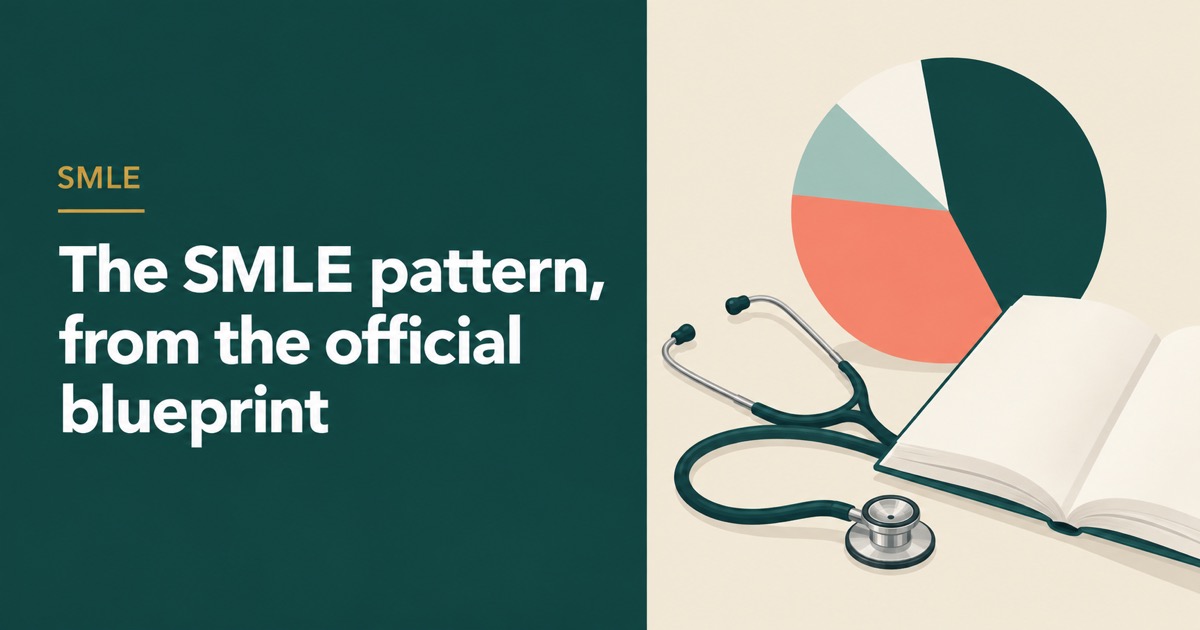
Medicine is the largest section at 30%, but obstetrics–gynaecology and paediatrics together are half the exam — a weight many doctors whose recent work has been in adult medicine underestimate. Surgery is the smallest at 20%. A fifth area, Patient Safety, Preventive Medicine and Ethics, appears in the content outline without a percentage of its own; its questions sit inside the four weights.
| Discipline | Sub-areas in the outline |
|---|---|
| Medicine (30%) | Cardiology, pulmonary, GI and hepatology, nephrology, endocrine, rheumatology, haematology, infectious diseases, neurology, oncology, critical care, geriatrics, psychiatry |
| OB/GYN (25%) | General obstetrics, general gynaecology, subspecialties including legal and ethical topics |
| Pediatrics (25%) | General and ambulatory paediatrics (immunisation, development), CNS, cardiovascular, respiratory, GI, infectious diseases, nephrology, acute care, haematology-oncology, neonatology, endocrinology, genetics and metabolism, allergy and immunology |
| Surgery (20%) | Basic principles, general surgery, trauma and acute care, subspecialties (including ophthalmology topics such as red eye and ocular trauma) |
| Patient safety, preventive medicine, ethics | Communication, medication and transfusion safety, radiation safety, research ethics, epidemiology and biostatistics |
How the 560 pass score is set
The 560 is not a count of correct answers. SCFHS held a standard-setting exercise in April 2017, in which experts judged what a minimally competent new doctor should be able to answer; the pass score it recommended, 560 on the 200–800 reporting scale, has been applied since June 2017 and was reviewed and approved by SCFHS's Central Assessment Committee. Candidates who sat before June 2017 keep their results for the approved validity period.
A scaled score lets different versions of the exam be held to the same standard. Every window uses a different form, and forms are never exactly equal in difficulty; converting raw marks to the 200–800 scale through equating means a candidate who meets the standard passes whichever form they drew. The practical consequence is that nobody — including SCFHS — can tell you in advance how many of the 200 questions you must get right. Coaching sites that print a fixed number or percentage are guessing.
| What you receive | What it tells you |
|---|---|
| Statement of results | Your scaled score and whether it reaches 560 |
| Feedback report | How your performance compares with other test takers |
| When | Within 2–6 weeks of the end of the testing window, in the SCFHS portal |
From the SMLE blueprint 2026. A score above 560 is not wasted: for doctors applying to Saudi Board residency, the SMLE counts for 55% of the matching score, so a higher pass is worth more.
Using the blueprint to plan
Two numbers from the blueprint should shape any plan. First, a discipline's weight tells you how many questions to expect: about 60 in medicine, 50 each in OB/GYN and paediatrics and 40 in surgery. SCFHS says the distribution "may differ up to +/-5% in each category"; read as percentage points, that is up to ten questions either way (our reading). Second, the mastery level tells you how deep to go on each topic. Together they stop the most common error — spending weeks on rare medicine topics marked level 1 while paediatric level-3 topics like immunisation, croup and nephrotic syndrome go unrevised.
Mastery levels
| Level | What it means (Blueprint 2026) | Examples in the outline |
|---|---|---|
| 1 | Some understanding of the knowledge or skill | Brucellosis, MERS-CoV/COVID-19, malaria and dengue, lung mass; most ophthalmology topics |
| 2 | Good practical understanding; skills the candidate should have assisted in | Atrial fibrillation, GERD, AKI, CKD, rheumatoid arthritis, Kawasaki disease |
| 3 | Core knowledge to demonstrate; skills to perform independently | Coronary artery disease, heart failure, asthma, COPD, pulmonary embolism, thyroid disease, diabetes and its acute complications, iron-deficiency anaemia, sickle cell disease, pneumonia, TB, immunisation, croup, nephrotic syndrome |
The mastery levels are the most useful thing in the blueprint for planning: a level-3 topic is one you are expected to know in depth. The outline also shows a Saudi emphasis — brucellosis, MERS-CoV, sickle cell disease and haemoglobinopathies all appear — which a doctor trained elsewhere may not have met in the same detail.
Each question is classified two more ways
Beyond discipline, the blueprint tags items by dimension of care (health promotion and illness prevention, acute, chronic, psychosocial) and by physician activity (assessment and diagnosis, management, communication), with no percentages for either. Items are also mapped to the SaudiMEDs framework, which includes outcomes on following Saudi health-system regulations and applying Islamic, legal and ethical principles.
The official reference list
| Discipline | References (Blueprint 2026) |
|---|---|
| Medicine | Toronto Notes; Davidson's; Harrison's; Kumar & Clark |
| OB/GYN | Hacker & Moore's Essentials; Current Diagnosis & Treatment OB/GYN; Gynaecology by Ten Teachers; Llewellyn-Jones Fundamentals |
| Pediatrics | Bernstein & Shelov, Pediatrics for Medical Students; Nelson Essentials; Lissauer, Illustrated Textbook of Paediatrics |
| Surgery | Cameron, Current Surgical Therapy; Bailey & Love; Mont Reid Surgical Handbook |
| Safety, prevention, ethics | WHO Patient Safety Curriculum Guide; Jekel's Epidemiology; USPSTF Guide to Clinical Preventive Services; SCFHS Professionalism and Ethics Handbook for Residents |
SCFHS says the list is a study aid only, implies no endorsement, and that questions are not necessarily taken from these books.
On the day
Rules from the guide
- Centres open at 7:30 a.m. Arriving more than 30 minutes late, or not arriving, means you are not admitted and it counts as an attempt unless SCFHS accepts a documented reason.
- ID: an unexpired passport — or, for a test in Saudi Arabia, a national or residence ID — whose name matches the scheduling permit exactly.
- The block clock keeps running if you leave the room; an over-long break is taken from the next block.
- Laminated boards and markers are provided for working.
SMLE Applicant Guide (Sep 2025) and Blueprint 2026.
Practise it, don't just read it
Half the SMLE is OB/GYN and paediatrics; topic quizzes show quickly whether your preparation reflects that.
The ProSyllabus SMLE library has topic quizzes for Internal Medicine (cardiology and respiratory; endocrine, renal and gastroenterology), General Surgery and Trauma, Pediatrics, Obstetrics and Gynaecology, Infectious Disease and Microbiology, Emergency Medicine and Critical Care and Community Medicine, Ethics and Saudi Health Practice. Each question comes with an explanation.
How many questions are in the SMLE?
200 single-best-answer multiple-choice questions in two blocks of 100, each 120 minutes, with a 30-minute break. Up to 20 are unscored pilot questions.
What is the SMLE passing score?
560 on the SMLE's 200–800 reporting scale, a scaled score approved by SCFHS's Central Assessment Committee. SCFHS publishes no percentage equivalent.
Is 560 in the SMLE equal to 70%?
No. 560 is a point on a scale that starts at 200 and is set by equating across exam forms; it is not a percentage of 800 or of the questions.
What is the SMLE blueprint?
Medicine 30%, obstetrics and gynaecology 25%, paediatrics 25% and surgery 20%, each allowed to vary by up to 5 percentage points, with patient safety, preventive medicine and ethics built into the content.
How long is the SMLE exam?
Two 120-minute blocks and a 30-minute break: Prometric gives the total seat time as 4 hours 30 minutes since March 2023.
Is there negative marking in the SMLE?
SCFHS's guide and blueprint do not mention negative marking.
Which books are recommended for the SMLE?
SCFHS lists Toronto Notes, Davidson's, Harrison's and Kumar & Clark for medicine; Hacker & Moore, Ten Teachers and others for OB/GYN; Nelson Essentials and Lissauer for paediatrics; Bailey & Love and Cameron for surgery; and WHO and USPSTF material for safety and prevention.
When did the SMLE change to 200 questions?
From March 2023. Before that it was 300 questions in three blocks over about six hours; the pass score and blueprint did not change.
Sources
- official — SCFHS — SMLE Applicant Guide (Sep 2025)
- official — SCFHS — SMLE Blueprint 2026
- official — SCFHS — SMLE guide, Dec 2022 (format change note)
- official — SCFHS — SMLE 2022 guide (300-question format)
- official — Prometric — SCFHS
- official — SCFHS — Saudi Board matching 2025
official = a document published by the conducting body. reported = a news or coaching site we could not check against an original. Where sources disagree this page says so rather than picking one.