Updates as of September 22, 2026
The SCFHS applicant guide sets the SMLE at 200 multiple-choice questions, including up to 20 unscored pilot items, in two blocks of 100 with 120 minutes each and one 30-minute break. Each question has four options and the paper mixes recall with scenario items testing interpretation, analysis and reasoning. Testing runs across 11 windows a year at SCFHS-approved Prometric centres in the Kingdom and abroad.
SCFHS SMLE Applicant GuideScores are reported on a 200 to 800 scale and the passing score is 560, a standard established in June 2017 and still stated in the current guide. Candidates receive a statement of results plus a performance feedback report comparing their profile across content areas. Results are announced within two to six weeks after the testing window closes.
SCFHS SMLE Applicant GuidePrometric records that from 1 March 2023 the seat time for the SMLE, SPLE and SDLE was set at four hours and thirty minutes. Widely circulated consultancy figures of 300 questions across six hours are not supported by the SCFHS guide, which gives 200 questions in two 120-minute blocks.
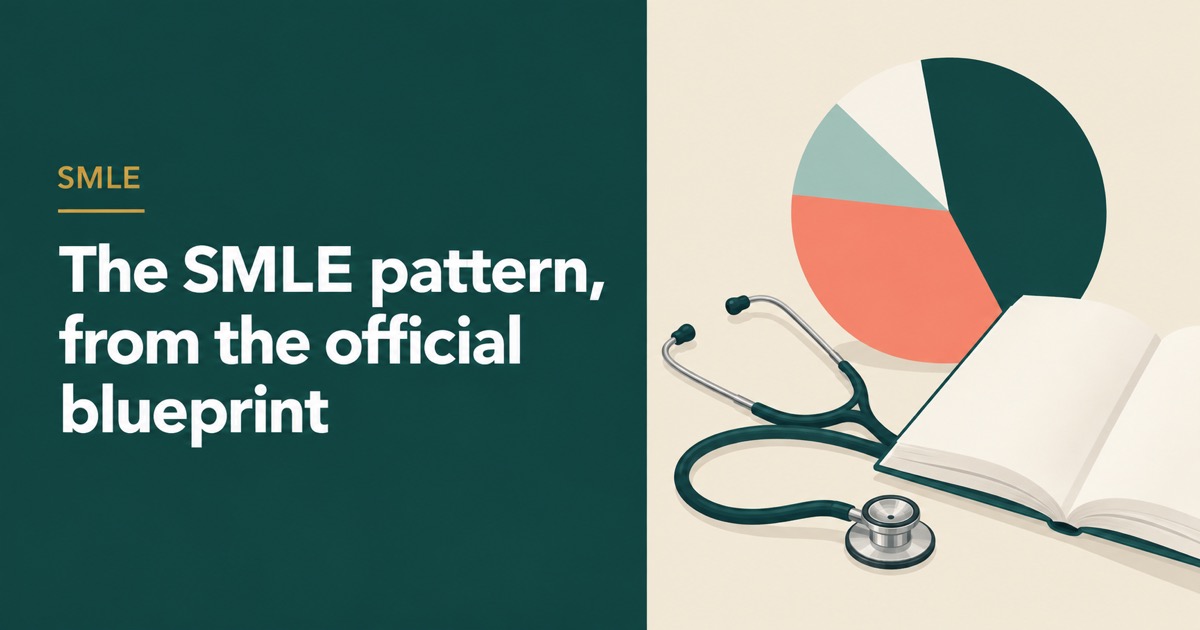
Prometric SCFHSThe blueprint weights medicine at 30 per cent, obstetrics and gynaecology at 25 per cent, paediatrics at 25 per cent and surgery at 20 per cent, with the guide allowing variation of up to five percentage points per category. Eligibility requires an accredited MBBS or MD, or being within one year of graduation.
SCFHS SMLE Applicant GuideAttempt rules are unusual in allowing testing after a pass. The guide permits up to four attempts a year to reach the passing score, a further two attempts after passing to improve a score, and one additional attempt each year thereafter for residency competitiveness, with rules applying for two years after graduation where a candidate has not passed.
SCFHS SMLE Applicant GuideSMLE at a glance
| Item | Detail | Source basis |
|---|---|---|
| Questions | 200 MCQs with four options, including up to 20 unscored pilot items | SCFHS SMLE guide |
| Structure | Two blocks of 100 questions, 120 minutes each, one 30-minute break | SCFHS SMLE guide |
| Seat time | 4 hours 30 minutes since 1 March 2023 | Prometric SCFHS |
| Scoring | 200 to 800 scale, pass score 560 set in June 2017 | SCFHS SMLE guide |
| Blueprint | Medicine 30, obstetrics and gynaecology 25, paediatrics 25, surgery 20 (per cent, plus or minus 5) | SCFHS SMLE guide |
| Windows | 11 testing windows a year at SCFHS-approved Prometric centres | SCFHS SMLE guide |
Applications are made electronically and a scheduling permit with an eligibility period is issued before a Prometric seat can be taken. Results are not instant: the guide gives two to six weeks after the window closes, and the candidate receives a performance feedback report alongside the statement of results.
Source: SCFHS SMLE Applicant Guide · Prometric SCFHS
Dates and windows
| What | When | Status |
|---|---|---|
| Exam sitting | Rolling — book on demand inside one of 11 annual testing windows once the scheduling permit is issued | Rolling |
| Seat time in force | 4 hours 30 minutes, effective 1 March 2023 | Confirmed |
| Pass score in force | 560 on the 200 to 800 scale, established June 2017 | Confirmed |
| Booking cut-off | At least 2 working days before the chosen date | Confirmed |
| Free reschedule or cancellation | 30 or more days before the date; USD 50 inside that; full fee forfeited within 15 days | Confirmed |
| Result announcement | 2 to 6 weeks after the testing window closes | Confirmed |
| Annual attempt allowance | Up to 4 attempts a year to pass; 2 further attempts after passing to improve a score | Confirmed |
| Post-graduation rule period | Applies for 2 years after graduation where the candidate has not yet passed | Confirmed |
SCFHS operates windows rather than single national sitting dates, and the exact opening and closing dates of the 11 windows are published in the applicant portal rather than in the guide. Confirm your own window boundaries against the scheduling permit, not against a third-party calendar.
What this means for your preparation
The single most common misunderstanding about the SMLE is the size of the paper. Consultancy pages still describe 300 questions over six hours with 45-minute breaks; the SCFHS applicant guide describes 200 questions in two 120-minute blocks with one 30-minute break, and Prometric fixes the appointment at four and a half hours. Preparing to the wrong length distorts pacing practice and, worse, the assumed conversion from practice percentages to the 560 cut score.
Four disciplines, and surgery is the smallest
The blueprint gives medicine 30 per cent, obstetrics and gynaecology 25 per cent, paediatrics 25 per cent and surgery 20 per cent, each with up to five percentage points of variation. On a 200-question paper that is roughly 60 medicine items against 40 surgery items, with obstetrics and gynaecology plus paediatrics together accounting for half the paper. Graduates from rotations weighted towards surgical exposure routinely under-prepare obstetrics and paediatrics, which jointly carry two and a half times the weight of surgery. The variation clause matters too: a five-point swing is ten questions, enough to move a borderline candidate either side of the line, so no discipline can safely be treated as optional.
560 is a scaled score, not seventy per cent
The passing score of 560 sits on a 200 to 800 reporting scale and was established in June 2017 through standard setting. Consultancy pages that render it as seventy per cent are dividing 560 by 800, which is not how the scale works: 200 is the floor of the scale, not zero. Up to 20 of the 200 questions are unscored pilot items, so the scored denominator is not fixed either. The useful discipline is to track practice performance as a trend rather than against an imagined raw threshold, and to read the performance feedback report after any failed attempt, since it compares the candidate across content areas and points directly at the weakest band.
Use the attempts-after-passing rule deliberately
The SMLE is unusual in allowing candidates who have already passed to sit again. The guide permits two further attempts after a pass to improve the score, plus one additional attempt each year thereafter, explicitly framed around residency competitiveness. That makes the score a matching currency, not merely a licence gate. Candidates aiming at competitive residency programmes should plan the first sitting for a realistic pass rather than a maximal score, then treat a second sitting as a considered decision with a revision plan attached. Candidates who only need the licence should stop at the pass and spend the time on the registration file instead.
Pace for 72 seconds a question
Two blocks of 100 questions at 120 minutes each gives 72 seconds per item. The paper deliberately mixes straightforward recall with scenario items demanding interpretation, analysis and reasoning, and the scenario items cannot be answered in 72 seconds. The arithmetic only closes if recall items are answered in half the average and the saved time is banked for the vignettes. The practical drill is full-length timed blocks rather than untimed question banks, with a flagging habit that prevents any single vignette absorbing four or five minutes. Since there is one 30-minute break between blocks and none within them, stamina across a single two-hour stretch is the thing to train.
Windows and permits, not a single national date
SCFHS runs 11 testing windows a year, issues a scheduling permit with an eligibility period, and only then can a Prometric seat be booked, with at least two working days notice. Results follow two to six weeks after the window closes, not after the individual sitting, so a late booking inside a window does not delay the result but an early one does not accelerate it either. Anyone whose internship completion, residency application or employment start depends on a result should count backwards from the window close date rather than from their own test date, and should hold the seat rather than reschedule, given the USD 50 charge inside 30 days and total forfeiture within 15.
Common questions
How many questions is the SMLE and how long does it last?
The SCFHS applicant guide specifies 200 multiple-choice questions with four options each, including up to 20 unscored pilot items, delivered as two blocks of 100 questions with 120 minutes for each and a single 30-minute break. Prometric sets the appointment length at four hours and thirty minutes, effective from 1 March 2023. Consultancy pages describing 300 questions across six hours contradict the official guide and should not be used for pacing practice.
What is the SMLE passing score?
560 on a reporting scale that runs from 200 to 800, a standard established in June 2017 and restated in the current SCFHS applicant guide. It is a scaled score produced by standard setting, not a percentage, so dividing 560 by 800 to get seventy per cent misrepresents it. Alongside the statement of results, SCFHS issues a performance feedback report that compares the candidate's performance across the blueprint content areas, which is the most useful document for planning a retake.
What is the SMLE blueprint?
Four content areas. Medicine carries 30 per cent, obstetrics and gynaecology 25 per cent, paediatrics 25 per cent and surgery 20 per cent. SCFHS states the distribution may vary by up to five percentage points in either direction for each category, which on a 200-question paper is about ten questions. Question style spans direct recall and scenario-based items that require interpretation, analysis and reasoning rather than simple factual retrieval.
Who is eligible to sit the SMLE?
The applicant guide requires an accredited MBBS or MD degree, or that the candidate is within one year of graduation. Applications are submitted electronically and SCFHS issues a scheduling permit with a defined eligibility period before a Prometric booking can be made. The guide also notes that its attempt rules apply for two years after graduation where a candidate has not yet reached the passing score, so final-year students should note the clock starts at graduation.
How many times can I sit the exam?
Up to four attempts within a year to achieve the passing score. After passing, two additional attempts are allowed to improve the score, and one further attempt each year after that, which the guide frames as supporting residency competitiveness. Separately, the Prometric SCFHS FAQ describes a general three-attempt limit across SCFHS titles with eligibility reactivation after two failures, so confirm which regime your scheduling permit names before planning a sequence of sittings.
When will I get my result?
Within two to six weeks after the close of the testing window in which you sat, not two to six weeks after your individual test date. SCFHS runs 11 windows a year and results are released against the window rather than the sitting. Prometric separately states that SCFHS results are posted to the commission's electronic portal within seven to ten working days for some titles and two to six weeks for licensure titles. Plan any deadline that depends on the result from the window close date.