Checked 24 October 2026. NVS’s JNVST 2027 Class VI prospectus controls the format, marking, test medium and qualifying marks. The passages and exercises here are original ProSyllabus teaching material, not official questions or predictions. Recheck the prospectus and admit card if NVS changes instructions.
The 2027 Navodaya Language Test is a reading test. The NVS Class VI prospectus says that it has four passages followed by five questions each: 20 questions, 25 marks and a suggested 30 minutes. Its specimen passage asks for a stated fact, word meaning and a conclusion. That is a better practice target than a page of isolated article, tense or preposition blanks. This workshop gives a way to read, locate evidence, reject attractive wrong choices and move through all four passages on time. The short passages below are written for this page. They let a child practise the method without pretending to be a past NVS paper.
NVS JNVST 2027 prospectus, composition and Language Test sections.
What the prospectus actually says about Language
The Language Test is Section 3 of the single two-hour booklet. NVS describes its purpose as assessing reading comprehension, and specifically says to read each passage carefully before answering the five questions that follow. Each question has four choices, only one correct. A correct answer receives 1.25 marks; there is no negative marking. NVS gives a minimum qualifying mark of 7 for Language. Six correct answers yield 7.5 marks and clear that numerical floor; five yield 6.25 and do not. Qualifying is necessary, but it is not a selection guarantee or a sensible final practice target.
| Official item | 2027 value | What to practise |
|---|---|---|
| Language material | Four reading passages, five questions each | Read a whole passage, then justify each choice from its words. |
| Questions and marks | 20 questions, 25 marks | One answer among four options; 1.25 marks for each correct answer. |
| Suggested time | 30 minutes within a two-hour paper | About seven minutes per passage, leaving a short transfer check. |
| Marking and minimum | No negative marking; 7 Language marks minimum | Attempt every question; treat six correct as the floor, not a target. |
NVS does not announce a separate grammar or essay section in this Language Test. Its sample includes vocabulary questions, but those words are tied to a passage. A child can strengthen vocabulary by reading, yet an invented “grammar-only paper” should not be presented as the official pattern. The sample passage is an example of possible question styles, not a promise that every real passage will contain one synonym, one antonym and three facts.
The five jobs a reader may have to do
Start with the question’s job, not with the first familiar word in an option. A correct answer can be a direct detail, a meaning inferred from nearby words, or a sensible conclusion. The prospectus sample about forests shows these jobs, including an opposite word and a consequence of losing forests. Our categories below are study labels for that specimen; NVS has not published a five-type quota.
| Reading job | Question signal | Check before marking |
|---|---|---|
| Find a stated fact | Who, what, where, when or which? | Point to the sentence that says it. |
| Work out a word in context | Meaning, opposite, similar or not similar | Read the whole sentence and test each choice in it. |
| Join two clues | Why, how or what follows? | Name both clues; avoid adding a fact the passage never supplied. |
| Choose the main idea | Best title or mainly about | Does the answer cover the whole passage rather than one detail? |
| Reject an unsupported claim | Which cannot be concluded? | Do not confuse a generally true claim with a text-supported one. |
A 30-minute four-passage routine
The paper’s 30 minutes for Language is a suggested allocation, not a separate clock that automatically stops after half an hour. NVS lets candidates adjust time within the two-hour test. Begin practice with accuracy; use the pace below only after a child can explain answers. Seven minutes per passage uses 28 minutes, leaving two minutes to check question numbers and OMR circles. If one passage is unusually hard, move to the next instead of spending half the section on it.
Our practice allocation, not an NVS prescribed time limit per passage.
| Step | Action | Time guide |
|---|---|---|
| At the start of a passage | Read the first and final sentence, then the whole text. Ask: who acts, what changes, and why? | About 1–2 minutes |
| On each question | Locate the supporting line; compare all four options; mark one answer. | About 1 minute each |
| If a word is unfamiliar | Use nearby clues and remove choices that do not fit the sentence. | Do not get stuck beyond the passage budget |
| After four passages | Check every answer number against the OMR row and fill any blank. | About 2 minutes |
A parent can model this routine on paper. After each answer, ask the child to put a finger under the supporting words. For a direct fact, the evidence should be one sentence. For an inference, it may be two sentences. If there is no text evidence, pause before marking: the answer may be relying on what the child already knows about the world. That knowledge can help interpret a passage, but cannot replace what this particular passage says.
Original reading drill 1: a stated detail
The village library
Every Saturday, Leela helped at the small library beside the village market. She put returned books on a low shelf so younger children could reach them. During the rainy weeks, she moved a basket of books away from the window because drops came through a gap. Her brother painted a sign that said, “Please return books on Saturday.” They counted the books together before closing.
Try this: Why did Leela move the basket away from the window? Find the exact phrase that answers it before opening the explanation.
Show the answer and the evidence
Rain drops came through a gap by the window, so the books might get wet. The supporting words are “drops came through a gap.” The library being near the market is a true detail, but it does not explain the move. This is an original worked comprehension example, not an official multiple-choice item.
Notice the word “because” in the passage. Such linking words can save time, but a child still has to check what the link connects. It connects the basket move to water entering through the window, not to the library opening day. After the child answers, change the question to “On which day did Leela help?” and let them underline “Every Saturday.” One short passage can train two different reading jobs without pretending to cover the whole exam.
Original reading drill 2: a word and its setting
The seed tray
A class planted beans in four small pots. The teacher asked the children to keep the soil damp, not flooded. Mina touched the soil each morning. When it felt dry, she added a little water. After several days, thin green shoots appeared. The class placed the pots where they received daylight and wrote down how the shoots changed.
Try this: In this passage, what does “damp, not flooded” tell you about how much water the soil needs? Explain the answer in your own words.
Show the reasoning
The soil should be slightly wet, but not covered or soaked with water. The contrast “not flooded” rules out “as much water as possible”; Mina’s action “a little water” supports the meaning. A word question is often solved by its neighbours, even when the word is unfamiliar in isolation.
For another question from the same passage, ask what the children recorded: how the shoots changed. Do not answer that they recorded the amount of rainfall; the passage says nothing about rain. A child who gets the factual question right but struggles to explain “damp” needs context practice, not a long unrelated grammar chapter. Ask them to replace the word in the sentence with their own simple phrase and see whether it still makes sense.
- Marks booster + cheatsheet: most-asked concepts in 2 lines each
- 12 traps JNVST has tested
- Worked questions from the 2026 paper
- Five Mental Ability figure types, solved
- Four Language passages, 20 questions
- Arithmetic rules, decimals to data
Original reading drill 3: an inference with two clues
The walking route
On the way to school, Arun and his aunt crossed a narrow bridge. One morning, they saw workers repairing its wooden side rail. A board asked walkers to use the wider road for two days. Arun and his aunt took that road, even though it was longer. On the third morning, the board was gone and the rail was firm. They crossed the bridge again.
Try this: Why was taking the longer road a sensible choice on the first morning? Name both clues from the passage.
Show the two clues
Workers were repairing the bridge rail, and the board asked walkers to use the wider road for two days. Together these clues explain the detour. The story does not say that the bridge collapsed or that a bus took them, so do not add either claim.
Inference means joining what the text gives you. It does not mean inventing a dramatic event that could have happened. Have the child draw two small boxes labelled “repair” and “use wider road”; the conclusion sits beneath them. This method is useful when an option includes a plausible reason that is unsupported. The passage might be about a bridge, a farm, a family or an animal; the reasoning step stays the same.
Original reading drill 4: main idea and a tempting detail
A shared garden
The children at a community centre wanted flowers near the entrance. They first cleared litter from a small patch of ground. A neighbour brought seeds, another lent a watering can, and the children took turns checking the soil. Some seeds grew slowly, so they kept caring for the patch. By the end of the month, several flowers had opened. Visitors stopped to look at the garden, but the children were proudest that everyone had helped.
Try this: Choose a short title for the whole passage. Then name one real detail that would be too narrow to serve as its title.
Show one defensible answer
“Working together on a garden” covers the whole passage. “A borrowed watering can” is a real detail, but it covers only one sentence. More than one child-written title may be reasonable; ask whether the proposed title fits the start, middle and end.
This fourth drill deliberately has an open answer. A parent can check the child’s reason before returning to four-option practice. In the real test, NVS uses four choices and one correct answer; an open rehearsal is only a teaching method. It reveals whether a child understands the complete story or remembers one vivid object. The last sentence often signals what matters most, but do not teach a rule that the answer is always there.
- Marks booster + cheatsheet: most-asked concepts in 2 lines each
- 12 traps JNVST has tested
- Worked questions from the 2026 paper
- Five Mental Ability figure types, solved
- Four Language passages, 20 questions
- Arithmetic rules, decimals to data
How to practise in the chosen test medium
The NVS prospectus lists available test languages by State or Union Territory. The child gets a booklet in the medium chosen in the online application, and the prospectus says that medium cannot be changed later. A family should practise reading in the chosen medium, using age-appropriate stories and informational paragraphs. These English examples teach a method, but they do not replace practice in Hindi or another chosen language. A parent who is more comfortable in the local language can ask the same four questions aloud: What happened? Where is the proof? What does the word mean here? What can we conclude?
On test day, NVS asks candidates to confirm that the booklet is in the chosen medium and that the booklet and OMR sheet carry the same number. Raise any mismatch with the invigilator before the test starts. Use a blue or black ballpoint pen for the OMR. Fill one circle cleanly; the prospectus says that corrections to a darkened circle, erasures and correction fluid are not allowed. This small administrative check belongs in a reading workshop because a correct thought marked on the wrong row does not earn the mark.
| Common slip | Repair prompt |
|---|---|
| Choosing an option because it is true in real life | “Which sentence in this passage proves it?” |
| Treating a synonym as correct in every context | “Put the word back into this sentence. Does it still fit?” |
| Reading only the first line and guessing the ending | “What changed in the middle and at the end?” |
| Spending too long on one passage | “Can you find a clue quickly? If not, move and return.” |
| Marking the next OMR row by accident | “Say the question number before filling the circle.” |
A seven-day passage practice board
Use one short passage per day at first. Let the child explain a wrong answer without scolding; it shows which step needs repair. Move to four passages in a single sitting only when the child can support answers with words from the page. The tracker below saves ticks in this browser only. It does not ask for a child’s name or transmit a score. A paper notebook works just as well.
| Day | Reading task | Evidence check |
|---|---|---|
| 1–2 | One passage per day: find who, where and what changed. | Underline the line for two factual answers. |
| 3 | One passage: work out two words from nearby clues. | Explain why one tempting meaning does not fit. |
| 4 | One passage: join two clues for one inference. | Say both clues aloud; reject an invented event. |
| 5 | Two passages in about 15 minutes. | Check five answers after each passage, not only the score. |
| 6 | Four fresh passages in about 30 minutes. | Leave two minutes to review question numbers and OMR transfer. |
| 7 | Redo only the reading job that caused most misses. | Try a new passage to see if the method transfers. |
Four-passage reading board
Tick a skill after the child demonstrates it on a fresh passage. The ticks remain only on this device.
0 of 9 done
Ticks are saved only in this browser on this device.
Where the revision kit fits
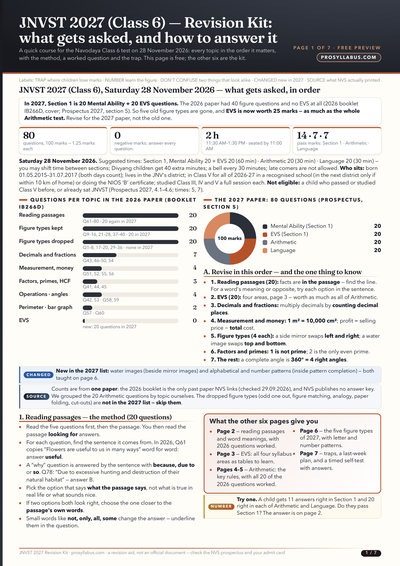
This page teaches the reading method openly. The separate JNVST Class VI revision kit is a compact seven-page final review for the 2027 paper. Its Language page condenses the four-passage approach, while other pages cover the new EVS part, Arithmetic and Mental Ability. Preview the live contents and price before buying. The kit is not the NVS paper, and buying it does not include quiz or membership access. We do not use an unverified quiz bank as the answer source for this workshop.
Take the method into the last revision week
Keep the four free reading drills for practice. If a seven-page summary would help your family review Language beside EVS, Arithmetic and figures, inspect the kit preview and current price.
Preview the JNVST 2027 revision kitThe full 2027 syllabus map covers all four test parts. Our separate EVS workshop explains its different one-passage format, while the figure workshop and Arithmetic workshop handle the other skills. Keep this Language page for reading comprehension rather than repeating the syllabus page.
Questions parents ask
Frequently asked questions
How many passages are in the JNVST 2027 Class VI Language Test?
The NVS prospectus says four passages, each followed by five questions, making 20 Language questions.
Is the JNVST Language Test only grammar questions?
No. NVS calls it a reading-comprehension test. Its specimen includes vocabulary tied to a passage, but it does not prescribe a separate grammar section.
How much time and how many marks are allotted to Language?
The prospectus assigns 30 suggested minutes and 25 marks to 20 Language questions within the two-hour paper.
Is there negative marking for wrong Language answers?
No. NVS awards 1.25 marks for a correct answer and says there is no negative marking.
What is the minimum qualifying Language mark?
NVS prints 7 marks. Six correct answers make 7.5 marks, but this numerical floor is not an admission cutoff or a suitable practice target.
Are the passages on this page official or previous-year questions?
No. These are original ProSyllabus reading drills. The official 2027 prospectus, linked below, has its own specimen passage and questions.
Should a child practise in English if the selected test medium is different?
The reading method transfers, but regular passage practice should be in the medium selected on the NVS application. NVS says the booklet medium cannot be changed after selection.
Sources
official = a document published by the conducting body. reported = a news or coaching site we could not check against an original. Where sources disagree this page says so rather than picking one.
More in this series
- JNVST 2027 dates: test, admit card, result
- JNVST 2027 exam pattern and qualifying marks
- JNVST 2027 syllabus, section by section
- JNVST 2027 eligibility: age, Class V, district
- Navodaya rural quota and reservation
- Navodaya seats, schools, fees and migration
- 2027 Mental Ability: 15 worked figures
- 2027 Arithmetic: scope and worked questions
- 2027 EVS: format and worked questions
- JNVST Class 6 notice board — official updates