Checked 25 September 2026. From the NVS prospectuses for JNVST 2027 and JNVST 2026. The 2026 previous-year paper on the NVS portal follows the old pattern.
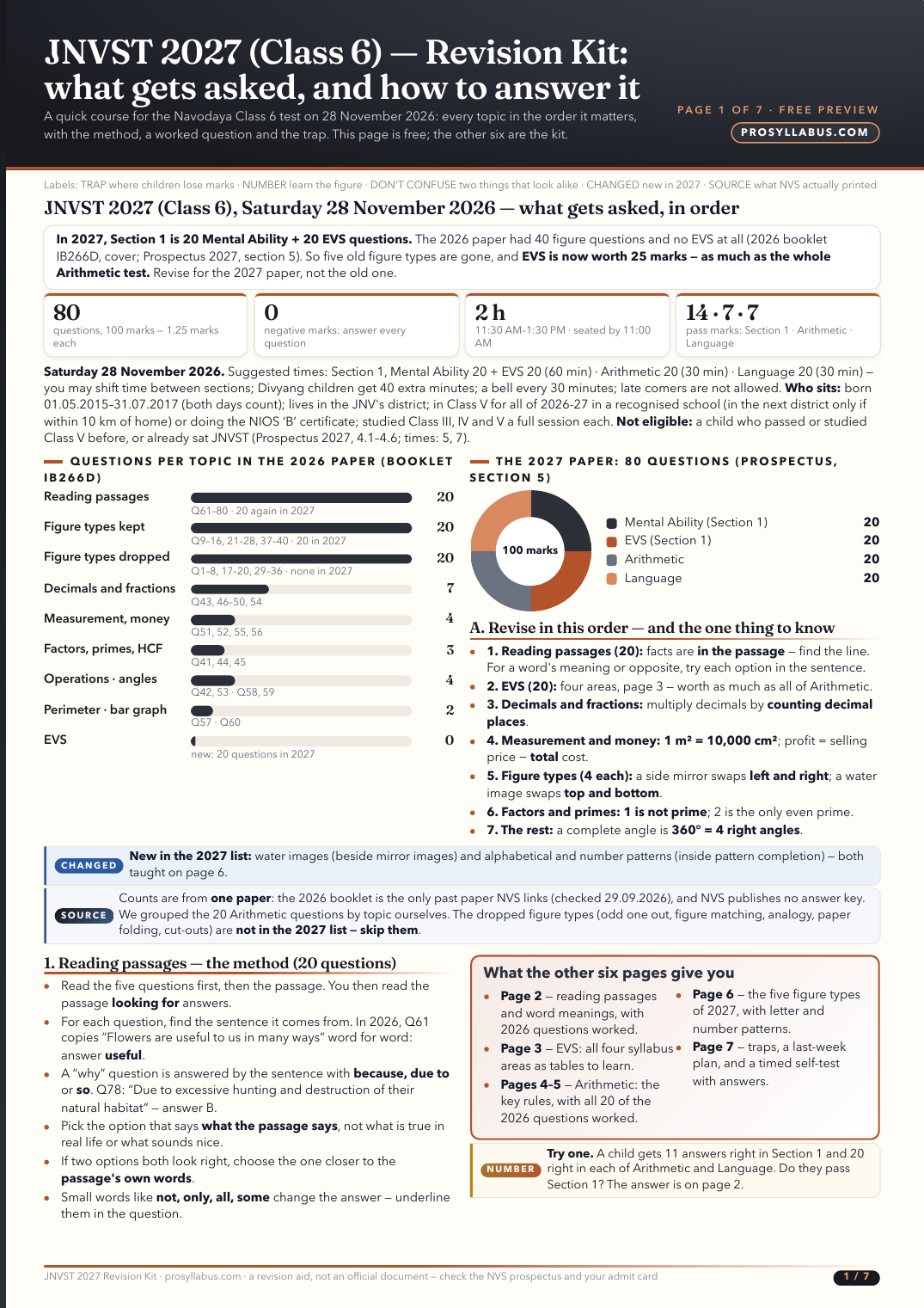
The Navodaya selection test is still 80 questions for 100 marks in two hours — but what is inside the first section changed for JNVST 2027. Until 2026 the Mental Ability Test filled Section 1 on its own with 40 figure questions. From 2027, Section 1 is 20 Mental Ability questions and 20 Environmental Studies (EVS) questions, 25 marks each. Many pages, and most practice books printed before mid-2026, still describe the old paper. This guide gives the 2027 pattern from the NVS prospectus, the minimum marks a child must reach in each section, and what those minimums mean in correct answers.
NVS prospectus JNVST 2027.
Where other pages get this wrong
In JNVST 2027, Section 1 has 20 Mental Ability and 20 EVS questions; Arithmetic and Language carry 25 marks each.
Commonly published instead: “Mental Ability Test 40 questions, 50 marks”, “Arithmetic 30 marks, Language 20 marks”, and the ten-part Mental Ability test with odd-man-out, analogy and punched holes.
NVS prospectus for JNVST 2027, “Composition of the Selection Test”. The 40-question Mental Ability section and its ten parts are the JNVST 2026 pattern.
The JNVST 2027 paper
| Section | Questions | Marks | Suggested time |
|---|---|---|---|
| Mental Ability Test + Environmental Studies | 20 + 20 | 25 + 25 | 60 min |
| Arithmetic Test | 20 | 25 | 30 min |
| Language Test | 20 | 25 | 30 min |
| Total | 80 | 100 | 2 hours (11:30 AM–1:30 PM) |
NVS prospectus JNVST 2027. All questions are objective, four options with one correct, in one booklet. Divyang candidates get 40 minutes more.
NVS prospectuses 2026 and 2027. Mental Ability lost half its marks to EVS; the other sections are unchanged.
Marking: 1.25 a question, nothing taken away
Every correct answer earns 1.25 marks, and NVS states plainly: “No negative marking will be done.” A wrong answer and a blank answer both score zero, so there is never a reason to leave a circle empty — when a child cannot work out an answer, the best choice between the remaining options is still worth marking. What does cost marks is the OMR sheet itself. Only a blue or black ball-point pen may be used, “no change in the darkened circle is allowed”, and striking, whitener or erasing means the answer “will not be evaluated”. A child who changes their mind after darkening a circle has lost that question.
The minimum marks — in correct answers
NVS sets a qualifying minimum in each section: 14 marks in Mental Ability and EVS, 7 in Arithmetic and 7 in Language. A child who misses any one of them is out, whatever the total. Because each question is worth 1.25 marks, the minimums translate into a whole number of correct answers — and the numbers are higher than the marks suggest at first glance.
| Section | Minimum marks | Correct answers needed | Share of the section |
|---|---|---|---|
| Mental Ability + EVS | 14 of 50 | 12 of 40 (15 marks); 11 gives 13.75 | 28% |
| Arithmetic | 7 of 25 | 6 of 20 (7.5 marks); 5 gives 6.25 | 28% |
| Language | 7 of 25 | 6 of 20 (7.5 marks); 5 gives 6.25 | 28% |
Our arithmetic from the prospectus rules (minimum marks ÷ 1.25, rounded up). The 14-mark minimum applies to Mental Ability and EVS together; the prospectus does not set separate minimums for the two halves.
Clearing the minimums is necessary, not sufficient. Seats are filled on merit within each district, separately for rural and open seats and for each reserved category, and NVS does not publish a cut-off. A child should aim well above the minimums everywhere — the minimums only ensure that a very strong score in one section cannot carry a near-blank in another.
JNVST 2027 marks and qualifying check
Enter the number of correct answers in each part of a practice paper. Each correct answer is worth 1.25 marks and there is no negative marking.
NVS prospectus 2027: 80 questions, 100 marks; 1.25 marks per correct answer; no negative marking; minimum qualifying marks 14 in Mental Ability and EVS (together), 7 in Arithmetic and 7 in Language. Clearing the minimums does not mean selection — seats go on merit within each district, area and category, and NVS publishes no cut-off.
Time per question
The suggested times work out to the same pace in every section: 60 minutes for 40 questions in Section 1, 30 minutes for 20 in Arithmetic and 30 minutes for 20 in Language — 90 seconds a question throughout (our arithmetic). A bell rings every 30 minutes, which is a useful check: at the first bell the child should be about halfway through Section 1. The prospectus lets children adjust the time between sections themselves, but advises against spending longer on a section than suggested.
| Section | Questions | Pace | Where the time goes |
|---|---|---|---|
| Mental Ability | 20 | 90 s each | Pattern and figure questions — quick once the rule is spotted |
| EVS | 20 (15 MCQs + a 5-question passage) | 90 s each | Reading the passage; the MCQs are recall |
| Arithmetic | 20 | 90 s each | Working on rough paper for word problems |
| Language | 20 (four passages × 5) | 90 s each | Reading four passages carefully |
Section content from the NVS prospectus JNVST 2027; pace is our arithmetic from the suggested times.
What changed from 2026, item by item
| 2026 | 2027 | Item |
|---|---|---|
| Mental Ability, 40 Q / 50 marks | Mental Ability 20 Q + EVS 20 Q, 25 + 25 marks | Section 1 |
| Ten (odd-man out, figure matching, pattern completion, figure series, analogy, geometrical completion, mirror imaging, punched hole, space visualisation, embedded figure) | Five (pattern completion incl. alphabet and number patterns, figure series, geometrical completion, mirror and water imaging, embedded figure) | Mental Ability parts |
| 12, incl. decimals, fraction–decimal conversion, profit and loss | 9 — those three gone; directions and mapping added to angles | Arithmetic topics |
| 14 in Mental Ability | 14 in Mental Ability and EVS | First qualifying minimum |
| Higher Mental Ability marks | Higher Mental Ability and EVS marks | First tie-breaker |
| 80 Q, 100 marks, 2 h, 1.25 per answer, no negative marking | Same | Unchanged |
NVS prospectuses for JNVST 2026 and JNVST 2027. Our separate syllabus guide goes through each section in detail.
When two children score the same
If candidates tie on the total, NVS breaks the tie in this order in 2027: higher marks in Mental Ability and EVS; then higher marks in Arithmetic; then an ST candidate before an SC candidate; an SC candidate before General and OBC; an OBC candidate before General; a girl before a boy; and finally the younger child. The 2027 list jumps from item (b) to item (d). In 2026, item (c) was “more marks in Language”, and it is most likely a drafting slip rather than a decision to drop Language from the tie-break — we flag it rather than assert either way.
| Order | Tie-breaker (2027) |
|---|---|
| 1 | Higher Mental Ability + EVS marks |
| 2 | Higher Arithmetic marks |
| (c) | Missing from the 2027 list (2026: higher Language marks) |
| 3 | ST over SC; SC over General and OBC; OBC over General |
| 4 | Girl over boy |
| 5 | Younger candidate |
The language of the paper
The booklet comes in the language chosen in the application form, from the list for the child’s State — English and Hindi everywhere, plus regional languages such as Telugu, Marathi, Urdu, Oriya and Kannada in Andhra Pradesh, or eight languages in Karnataka and in Assam. The prospectus is firm: “change of language (medium of examination) is not possible”. The medium was one of the fields open in the correction window, which the NVS portal announced for 11 and 12 August 2026; it has now closed. Before the test starts, the child should check that the booklet is in the right language and that the booklet number matches the OMR sheet; either problem must be raised with the invigilator at once.
It is worth practising the answer sheet as well as the questions. Because marking is machine-only, NVS says there is no provision for re-evaluation, re-totalling or manual scrutiny, and it advises candidates “to be careful and mention exact booklet number/code on OMR sheet during the examination”. A child who has filled in a few practice OMR sheets — booklet number first, one firm circle per question, no second thoughts — loses nothing to the sheet on the day.
Practise it, don't just read it
With no negative marking and a 12-of-40 minimum in Section 1, the fastest gains come from mirror and water images, figure series and reading passages — question types a child can learn to solve reliably in a few weeks.
The ProSyllabus JNVST library has topic quizzes on mirror and water images, figure series, arithmetic and reading-comprehension passages — the first quiz is free.
What is the JNVST 2027 exam pattern?
80 objective questions for 100 marks in 2 hours: Mental Ability 20 + EVS 20, Arithmetic 20, Language 20.
Is EVS included in JNVST 2027?
Yes — 20 EVS questions for 25 marks in Section 1, new in 2027.
How many marks is each JNVST question?
1.25 marks for every correct answer.
Is there negative marking in the Navodaya exam?
No — a wrong answer scores zero, the same as a blank.
What are the JNVST qualifying marks?
14 in Mental Ability and EVS combined (one minimum for Section 1), 7 in Arithmetic and 7 in Language.
How many correct answers are needed to qualify in JNVST?
At least 12 of 40 in Section 1 and 6 of 20 each in Arithmetic and Language (our arithmetic).
How many questions are in the Mental Ability section now?
20, in five parts, down from 40 in ten parts in 2026.
How long is the JNVST paper?
Two hours, 11:30 AM to 1:30 PM, with 40 extra minutes for Divyang candidates.
Can a child use a pencil on the JNVST OMR sheet?
No — only a blue or black ball-point pen.
Can a darkened circle be changed?
No — changed, struck or whitened answers are not evaluated.
What is the JNVST cut-off?
NVS publishes no cut-off; seats go on merit by district, area and category.
Is the JNVST 2026 question paper useful for 2027?
For Arithmetic and Language, yes; its Mental Ability section follows the old ten-part pattern and has no EVS.
Sources
- official — NVS — Prospectus cum Notification, JNVST 2027 (Class VI, session 2027-28)
- official — NVS — Prospectus, JNVST 2026 (session 2026-27)
- official — NVS admission portal, 9 Aug 2026 (Internet Archive capture): last date “extended up to 10.08.2026”, correction 11–12.08.2026
- official — NVS — Previous year question booklet 2026 (English; old pattern)
- official — NVS — Class VI admission portal
- reported — Careers360 — Navodaya JNVST Class 6 admission (reported; see corrections)
official = a document published by the conducting body. reported = a news or coaching site we could not check against an original. Where sources disagree this page says so rather than picking one.