Checked 3 October 2026. Based on the NVS JNVST 2027 prospectus. Practice drawings here are original illustrations, not official past-paper questions. Check NVS for later changes and the current admit card.
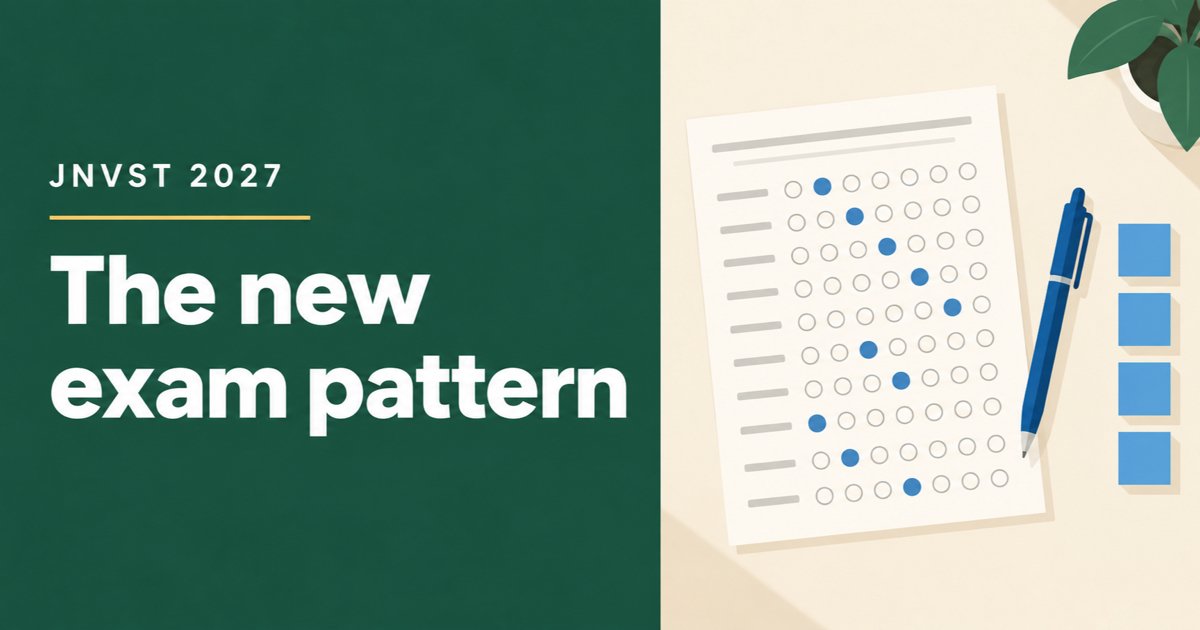
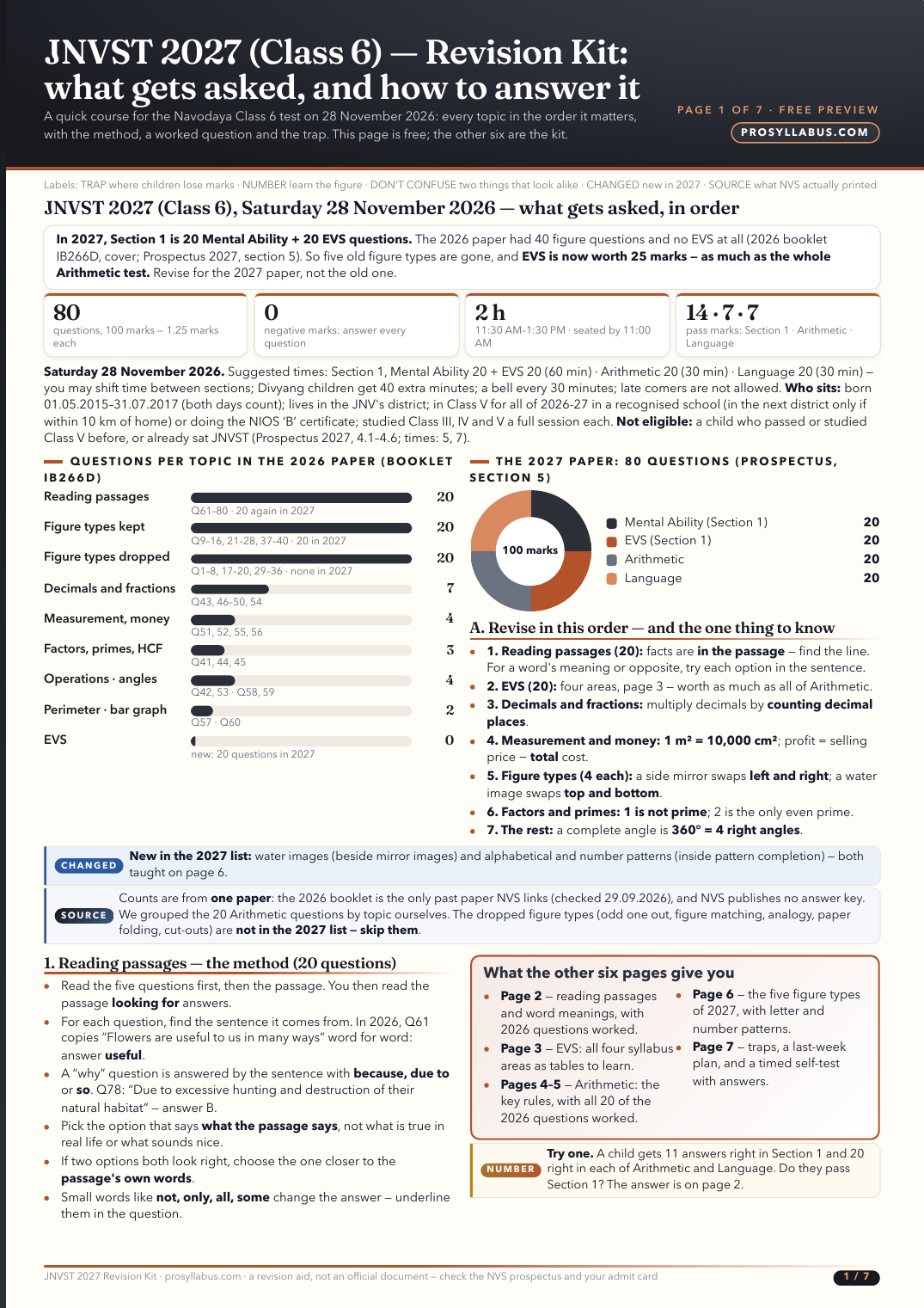
A Class V child searching for Navodaya Class 6 Mental Ability questions will find many 40-question MAT PDFs. Those are useful for general visual practice, but the official JNVST 2027 prospectus now gives 20 Mental Ability questions in five parts, alongside 20 new Environmental Studies questions in Section 1. The total paper remains 80 questions and 100 marks. This workshop teaches one original example for each of the five current visual parts, shows exactly how to explain an answer to a child, and gives a small practice log that does not confuse old and new paper formats.
NVS JNVST 2027 prospectus, composition and Nature of the Test sections. The date is 28 November 2026.
What changed for the 2027 paper
| Feature | JNVST 2026 prospectus | JNVST 2027 prospectus |
|---|---|---|
| Mental Ability | 40 questions, 50 marks; ten four-question parts | 20 questions, 25 marks; five parts described as four questions each |
| Environmental Studies | No separate EVS part in Section 1 | 20 questions, 25 marks; 15 individual MCQs and one five-question passage |
| Other sections | Arithmetic 20; Language 20 | Arithmetic 20; Language 20 |
| Whole paper | 80 questions, 100 marks, two hours | 80 questions, 100 marks, two hours |
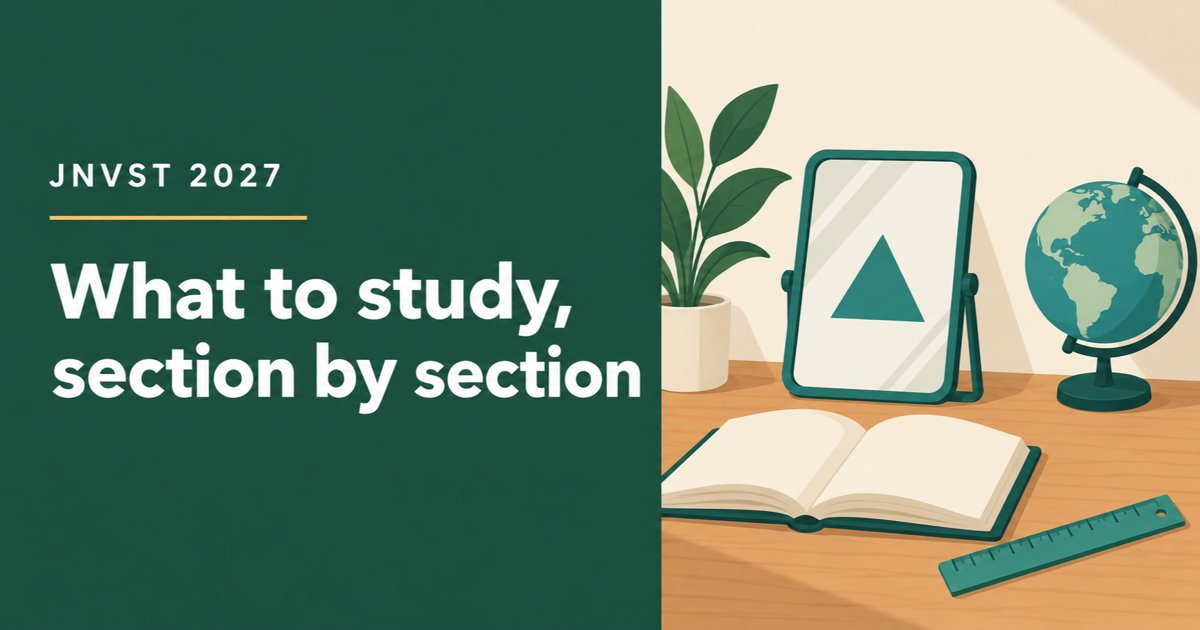
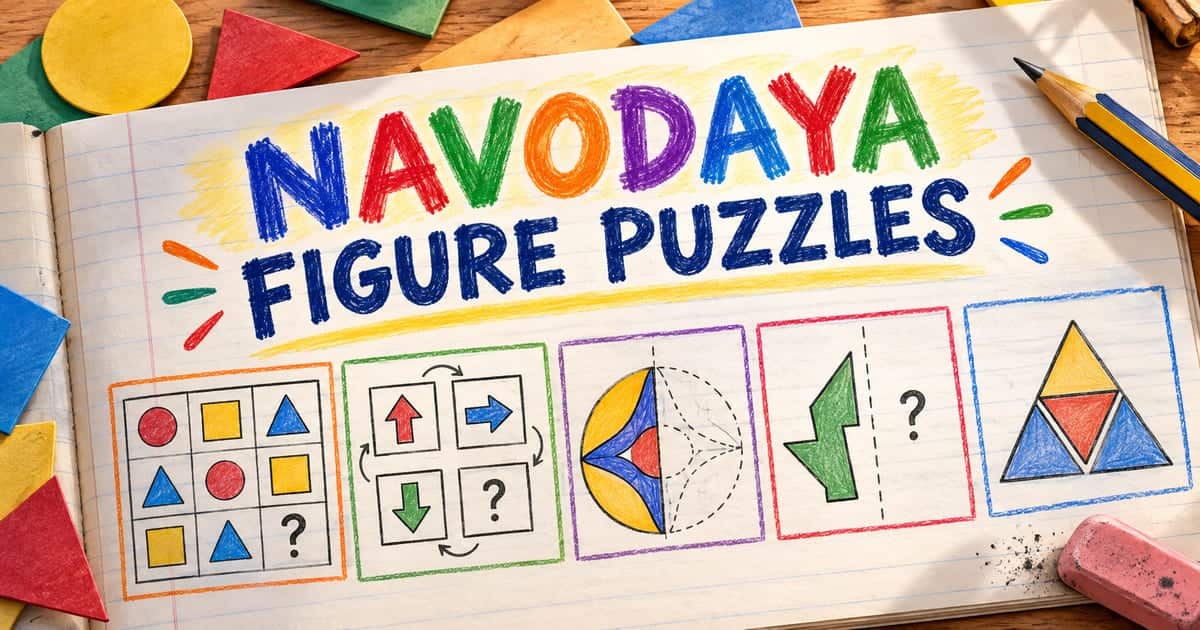
The NVS prospectus says MAT is a non-verbal test based on figures and diagrams. It names five parts: pattern completion (including alphabetical and number patterns), figure series completion, geometrical figure completion, mirror and water imaging, and embedded figures. Its printed example number ranges do not perfectly match the sentence “five parts having 4 questions each”: Part III says questions 09–11, while Part IV says 12–16. Treat the five families as the syllabus; do not make a 2027 per-family score forecast from those inconsistent ranges.
| Part | NVS name | Child’s question | Worked drawing below |
|---|---|---|---|
| I | Pattern completion | Which missing piece keeps the whole pattern? | A dot grid |
| II | Figure series completion | What changes from one picture to the next? | Quarter-turn arrows |
| III | Geometrical figure completion | Which piece completes the triangle, square or circle shape? | A diamond made from two triangles |
| IV | Mirror and water imaging | Which way does the picture face after reflection? | Asymmetric L by a vertical mirror |
| V | Embedded figure | Where is the small shape hidden in a busy drawing? | A triangle among crossing lines |
Five original figure puzzles, with the thinking made visible
These drawings are deliberately simpler than a full exam question. They teach the operation first: compare rows and columns, test a repeated change, close an outside boundary, reflect at the line, or trace an embedded shape. After a child can explain the operation, use a fresh NVS sample or a correctly labelled 2027 practice paper. Do not present these examples as past-year questions or as a prediction of what NVS will print.
1. Pattern completion
A missing tile must keep the same row and column rule. First compare left to right, then top to bottom.
| Worked answer | Error to watch | Next fresh test |
|---|---|---|
| D. Each top-row dot is near the top, each bottom-row dot is near the bottom. Each left-column dot is near the left, each right-column dot near the right. Both rules meet in the lower-right corner. | Choosing a piece because it looks similar without testing both directions. | Change the dot to a short line and repeat both row and column checks. |
2. Figure series
Test one change at a time: direction, number, shading or position. Keep the rule that works through all three given figures.
| Worked answer | Error to watch | Next fresh test |
|---|---|---|
| B. The arrow turns 90 degrees clockwise each time: up → right → down → left. Its colour and size do not change, so do not add a second rule. | Inventing a new rule for the last pair only. | Use a shape that changes colour as well as direction; test which change repeats. |
3. Geometrical completion
Picture the whole shape before you compare pieces. Trace the outside boundary and notice any interior line that must continue.
| Worked answer | Error to watch | Next fresh test |
|---|---|---|
| A. The missing half must reach a point on the right and return to the middle top and bottom. B is missing an edge; C puts the point on the wrong side. Rotate only if a real question permits rotation. | A piece fills the gap but breaks the outer boundary or internal line. | Use half a circle and trace its outside curve before looking at pieces. |
4. Mirror and water imaging
A vertical mirror swaps left and right. A horizontal water line swaps top and bottom. Marks nearest the reflection line stay nearest it.
| Worked answer | Error to watch | Next fresh test |
|---|---|---|
| The green L. Its upright remains upright, but the foot now points left. For water imaging, use a horizontal line and check top versus bottom instead. | Rotating a shape through 180 degrees instead of reflecting it. | Move the reflection line below the figure and test a water image. |
5. Embedded figure
Look for the target edges inside a busy figure. The target may have extra lines crossing it; preserve its exact shape and orientation.
| Worked answer | Error to watch | Next fresh test |
|---|---|---|
| The green outline. It is the same upward-pointing triangle as the target. Ignore extra lines in the larger drawing; the three target edges are still continuous. | Choosing a near-match with a broken edge or a triangle that faces the wrong way. | Hide the same triangle in a different set of crossing lines. |
A child-friendly three-pass way to solve a figure
| Pass | Question to ask aloud | What to write in a log |
|---|---|---|
| 1. Say what stays | Which features do not change: size, number, colour, outline or direction? | “Same outline, dot moves” is more useful than “wrong again”. |
| 2. Say what moves | Does it shift, rotate, reflect, grow, or join another piece? | Name the operation, such as “quarter-turn clockwise”. |
| 3. Test every given figure | Does this one rule explain all the pictures, including the answer? | If not, cross out the rule and try one other feature. |
For a child, a five-word explanation is often a stronger sign of learning than a fast lucky choice. Ask “what moved?” and “how do you know?” before showing the options again. For mirror questions, put a finger on the mirror line and match features by distance from that line. For embedded figures, trace each target edge with a pencil in the air. If the child cannot find one edge, the apparent match is probably a near-miss. This process needs no advanced vocabulary.
The new Section 1 includes EVS; keep the two learning logs separate
| Section 1 part | Questions | Maximum marks | Practice output |
|---|---|---|---|
| Mental Ability | 20 | 25 | One sentence naming the visual rule for each miss |
| Environmental Studies | 20 | 25 | A dated fact/concept card and a five-question passage review |
| Mental Ability + EVS total | 40 | 50 | The official qualifying floor is 14 marks for the combined Section 1 |
NVS says EVS contains 15 MCQs plus one passage with five questions. Its areas are the natural world, the human body, science in daily life, and social surroundings. A child might get a figure rule wrong because of orientation, but an EVS answer wrong because of a misunderstood water-cycle word or a passage detail. Put these in separate logs even though NVS gives one combined Section 1 qualifying floor. This avoids a common mistake: treating the old 40-question MAT paper as if nothing changed except the date.
Score the whole practice paper without inventing a selection cutoff
| 2027 test section | Questions | Maximum marks | Suggested time | Official minimum |
|---|---|---|---|---|
| Mental Ability + EVS | 20 + 20 | 25 + 25 = 50 | 60 minutes | 14 marks in combined section |
| Arithmetic | 20 | 25 | 30 minutes | 7 marks |
| Language | 20 | 25 | 30 minutes | 7 marks |
| Total | 80 | 100 | 2 hours | Each section floor must be met |
Read one 80-question practice paper correctly
Enter correct answers out of 20 in each part. The official 2027 prospectus awards 1.25 per correct answer and deducts nothing for a wrong answer. Its qualifying floors are 14 marks for Mental Ability + EVS together, 7 for Arithmetic and 7 for Language. This is a practice-paper check, not a selection prediction or an official result.
The 2027 pattern and qualifying-floor table above is the readable fallback for AMP and script-free pages. Your inputs remain in this browser.
Each correct answer earns 1.25 marks, and the prospectus says there is no negative marking. Eleven correct across MAT and EVS give 13.75 marks, just below the 14-mark Section 1 floor; twelve give 15 marks. In Arithmetic or Language, five correct give 6.25, below 7; six correct give 7.5. These are arithmetic thresholds for a practice paper under the published marking rule, not admission cutoffs. Selection also depends on district seats, category rules, other candidates, and NVS verification. The 14-mark requirement applies to MAT and EVS together in the current prospectus, not to MAT alone.
A seven-day figure practice loop for a Class V child
| Day | Short task | Evidence |
|---|---|---|
| 1 | One example from each of the five current figure families | Child names each rule without copying the answer. |
| 2 | Four pattern-completion and four series items | Record whether the error was row/column, direction, or an invented rule. |
| 3 | Four geometrical-completion and four mirror/water items | Trace boundaries and mark the reflection line. |
| 4 | Four embedded-figure items plus one mixed retest | All target edges traced; no near-match accepted. |
| 5 | One current-format 20-question MAT set; review wrong and guessed choices | Correct count and error family recorded. |
| 6 | One EVS five-question passage plus a fresh figure set | EVS reading errors kept separate from visual errors. |
| 7 | A full 80-question, two-hour paper if suitable; otherwise a smaller supervised sample | Child can explain the next repair without being told “just practise more”. |
These are examples of small sessions, not a timetable imposed by NVS. A child who needs more rest can spread the loop across two weeks. Avoid solving the same sheet repeatedly and counting memorised answers as progress. Switch shape, colour, position or reflection line for a fresh test. Stop a session when fatigue makes the child rush; a clear explanation on three unseen questions is better evidence than a long pile of guessed bubbles.
Five-family practice board
Tick only after the child explains an unseen example. This board stores ticks in this browser.
0 of 9 done
Ticks are saved only in this browser on this device.
Exam-day details that matter to a child practising figures
The JNVST 2027 prospectus schedules one sitting for summer- and winter-bound JNVs on Saturday 28 November 2026, from 11:30 a.m. to 1:30 p.m. It tells candidates to be seated by 11:00 a.m. The booklet language is the one chosen in the application and cannot be changed later. The test uses a separate OMR answer sheet, blue or black ball-point pen, one correct option among four, no pencil and no correction fluid. Practice filling the circle for the correct question number, not only solving the drawing. The instructions advise suggested times, but candidates may adjust the two-hour total. The current admit card and NVS notice control final logistics.
Older books can still supply visual exercises if their answer keys are good, but label them “extra practice” and do not let them redefine the 2027 section sizes. The official 2027 prospectus has sample figures for each part. This page’s five diagrams are independent examples designed to teach the rule; they do not duplicate those official figures. For the full current syllabus, including EVS, Arithmetic and Language, use our existing syllabus hub in the series below.
Keep the five figure rules close during revision
These worked puzzles, score check and board are free. The separate seven-page JNVST Class VI revision kit condenses the 2027 pattern, figure rules, EVS, arithmetic and language reminders. Preview its first page and check the current contents and price before buying. It is a separate digital product from quiz or membership access. ProSyllabus is independent of NVS.
Preview the JNVST Class VI revision kitHow many Mental Ability questions are in JNVST 2027 Class VI?
The NVS 2027 prospectus assigns 20 questions and 25 marks to Mental Ability. It adds 20 EVS questions and 25 marks in the same Section 1. Older 40-question MAT patterns belong to earlier years.
What are the five 2027 Mental Ability figure types?
Pattern completion, figure series completion, geometrical figure completion, mirror and water imaging, and embedded figures. The NVS prospectus describes five parts; its example number ranges are not perfectly consistent with four questions per part.
Is there negative marking in the Navodaya Class VI selection test?
No. The JNVST 2027 prospectus awards 1.25 marks for each correct answer and says there is no negative marking.
Is the 14-mark minimum for Mental Ability alone?
No. In the JNVST 2027 prospectus it is the minimum for the combined Mental Ability and EVS section. Arithmetic and Language each have a 7-mark minimum.
Are these diagrams official previous-year questions?
No. All five drawings on this page are original teaching examples. The NVS 2027 prospectus contains its own sample figures, linked in the Sources section.
When is JNVST 2027 Class VI held?
The NVS 2027 prospectus lists Saturday 28 November 2026 in a single phase for summer- and winter-bound JNVs, 11:30 a.m. to 1:30 p.m. Confirm the current admit card and notices.
Can a child practise from an old 40-question MAT book?
Yes, for extra visual practice, provided its answers are checked. Use the 2027 NVS prospectus for the current pattern: 20 MAT and 20 EVS questions, not 40 MAT questions.
Does buying the revision kit include quizzes or membership?
The kit is a separate digital product. Its offer page shows a free first-page preview and current contents and price.
Sources
- official — NVS JNVST 2027 Class VI prospectus: composition, figure parts, marking and schedule
- official — NVS JNVST 2026 Class VI prospectus: previous pattern comparison
official = a document published by the conducting body. reported = a news or coaching site we could not check against an original. Where sources disagree this page says so rather than picking one.