Checked 25 September 2026. From the NVS prospectus for JNVST 2027, compared with the JNVST 2026 prospectus. NVS may publish further sample questions on its website.
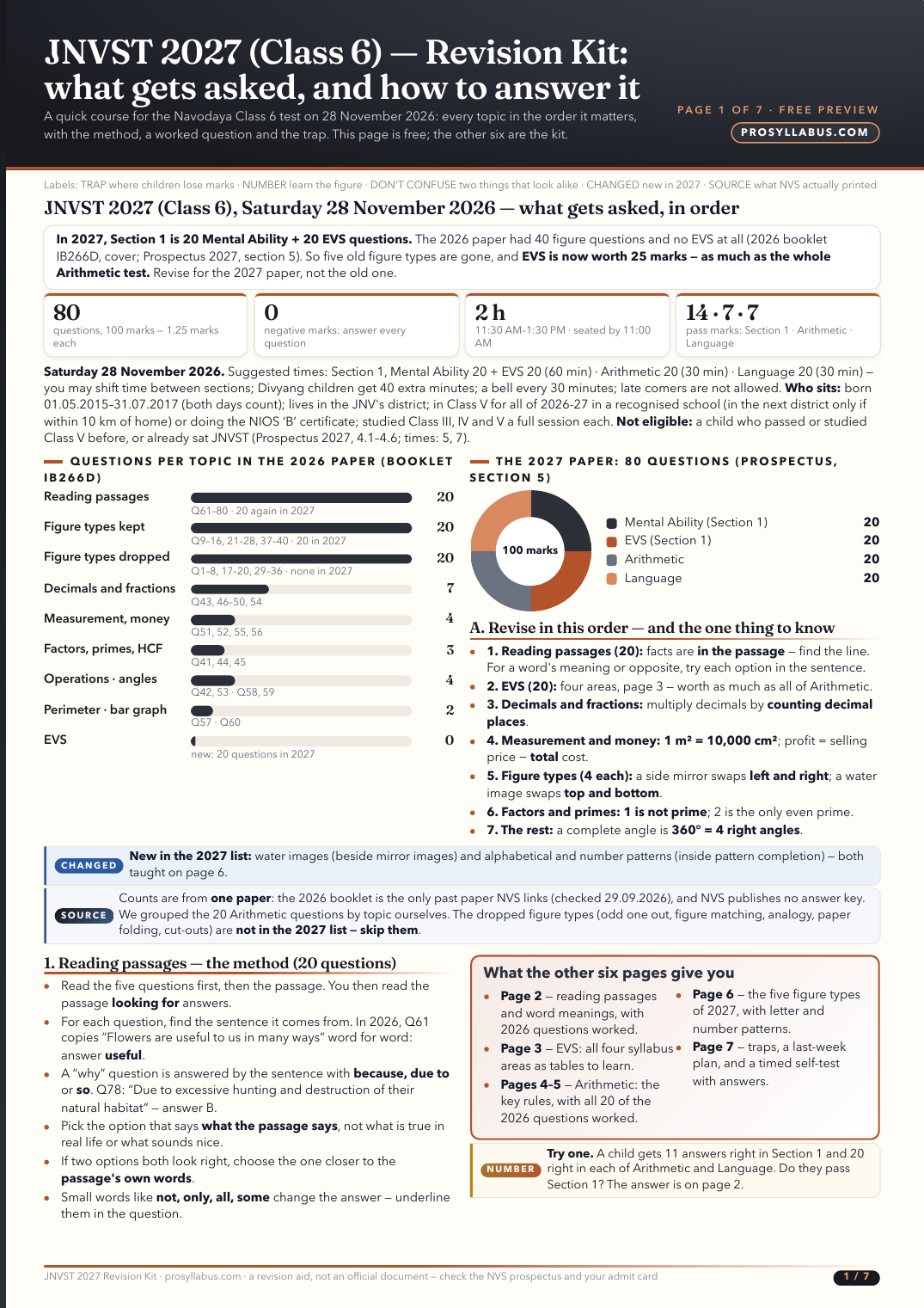
NVS does not publish a separate syllabus booklet for the Navodaya test: the syllabus is the “Nature of the test” section of the prospectus, with directions and a sample for each question type. For JNVST 2027 that section was rewritten. Mental Ability shrank from ten question types to five, a new Environmental Studies (EVS) part arrived with its own topic list, and three arithmetic topics were removed. This guide lays out the 2027 syllabus section by section, marks what is new and what was dropped, and suggests how a Class V child can cover it before 28 November 2026.
The sections are not equally new to a Class V child. Language and much of EVS draw on reading and general knowledge the child already uses at school; Arithmetic follows the Class III–V curriculum; Mental Ability is the one section with question types most children have never seen in class. That is why a few weeks of regular figure practice usually moves the score more than anything else — and why the syllabus below starts there.
NVS prospectus JNVST 2027.
Where other pages get this wrong
The 2027 Mental Ability test has five parts — pattern completion, figure series, geometrical figure completion, mirror and water imaging, and embedded figures — and arithmetic no longer includes decimals or profit and loss.
Commonly published instead: Ten Mental Ability types including odd-man out, figure matching, analogy, punched-hole patterns and space visualisation; a 12-topic arithmetic list with decimals and profit and loss.
Compare “Nature of the test” in the NVS prospectuses for JNVST 2026 and JNVST 2027.
Section 1a: Mental Ability — five question types
The Mental Ability Test is “a non-verbal test”: its questions “are based on figures and diagrams only”. The prospectus divides the 20 questions into five parts of four questions each and gives a worked example of each. Every one of them asks the child to spot a visual rule and apply it — none needs reading beyond the short direction at the start of the part.
| Part | Question type | What the child does |
|---|---|---|
| I | Pattern completion (including alphabetical and number patterns) | Finds the piece that completes a figure with a part missing |
| II | Figure series completion | Picks the fourth figure that continues a series of three |
| III | Geometrical figure completion (triangle, square, circle) | Finds the piece that completes the shape |
| IV | Mirror and water imaging | Picks the exact mirror image with the mirror held at a marked line (the printed direction describes only the mirror case) |
| V | Embedded figure | Finds the answer figure in which the problem figure is hidden |
NVS prospectus JNVST 2027. The printed question ranges (01–04, 05–08, 09–11, 12–16, 17–20) do not all contain four questions, although the text says “4 questions each” — treat each part as roughly four.
Dropped from the old test: odd-man out, figure matching, analogy, punched-hole (folding and unfolding) patterns and space visualisation. Practice books written for 2026 or earlier spend many pages on these; for 2027 that time is better spent on the five types above. Mirror and water images now share one part. The prospectus’s direction and sample describe only a mirror held at a line, but the title names water images too — the reflection of a figure in a horizontal line, as in still water, which turns it upside down — so a child should practise both.
As stated in the prospectus text (“five parts having 4 questions each”).
Section 1b: Environmental Studies — new for 2027
Questions 21 to 40 come from EVS: 15 multiple-choice questions and one passage followed by five questions. NVS describes EVS as interdisciplinary, “integrating basic concepts from Science, Social Science and Environmental Education”, and says its purpose is “to assess basic awareness of the candidates about their surroundings”. The prospectus lists four areas.
| Area | Topics named by NVS |
|---|---|
| The natural world | Transportation, rivers, mountains, plants and animals on land and in water, natural disasters, types of houses and shelters, the water cycle |
| The human body | Food and nutrients, hygiene and cleanliness, super senses, basic knowledge of internal systems (digestive, circulatory, respiratory) |
| Science in daily life | Food preservation, water and air pollution, conservation of water and soil |
| Social surroundings | Superlatives of India, States and capitals, national symbols, landscapes, festivals, seasons, forests, crops, clothes and fibres |
NVS prospectus JNVST 2027. The sample questions include the water cycle (evaporation), a police dog’s sense of smell, pickling mangoes, Holi as the festival of colours, and a passage about a lake in Jaisalmer.
The EVS topics are close to what most State Class III–V EVS textbooks cover, which is good news: a child who has read their own EVS books carefully already knows much of it. The areas that need deliberate revision are the fact-heavy lists — States and capitals, national symbols and the “superlatives of India” (longest river, highest peak and so on) — and the passage, which rewards careful reading exactly as the Language test does.
Section 2: Arithmetic — nine topics
The prospectus heading still says the 20 arithmetic questions are based on “12 topics”, but the 2027 list below it has nine. NVS adds that “emphasis will be more on testing of understanding and application of the concepts”, so expect short word problems rather than bare sums.
| 2026 | 2027 | |
|---|---|---|
| Number system (incl. ascending/descending, nearest, number names) | In | In |
| Four operations on whole numbers | In | In |
| Factors and multiples | In | In |
| Fractions (like-fraction +/−, multiplication) | In | In |
| Decimals and operations on them | In | Dropped |
| Fraction ↔ decimal conversion | In | Dropped |
| Measurement (length, mass, capacity, time, money, unit conversion) | In | In |
| Simplification of numerical expressions | In | In |
| Profit and loss (no percentage) | In | Dropped |
| Perimeter and area | In | In |
| Angles (incl. directions and mapping in 2027) | In | In |
| Data analysis (2026: bar diagram, graph, line chart; 2027: bar diagram, table, pictograph) | In | In |
Green = in the syllabus; blank = not listed.
NVS prospectuses for JNVST 2026 and 2027. Data analysis stays, but the 2026 “graph and line chart” became “table and pictograph” in 2027.
| Topic (2027) | Scope as printed |
|---|---|
| Number system | Including ascending, descending, nearest, 10/100/1000, number names and value |
| Four operations | Four fundamental operations on whole numbers |
| Factors and multiples | Factors and multiples including their properties |
| Fractions | Addition and subtraction of like fractions, and multiplication; unlike fractions and division of fractions not included |
| Measurement | Length, mass, capacity, time, money and unit conversion |
| Simplification | Simplification of numerical expressions |
| Perimeter and area | Perimeter of a polygon; area of a square, a rectangle and a triangle (as part of a rectangle) |
| Angles | Types of angles and simple applications, including directions and mapping |
| Data analysis | Bar diagram, table and pictograph |
NVS prospectus JNVST 2027, Section 2. One of its two worked examples prints the options “5, 4, 5, 16” — a misprint; the intended answer is 4.
Section 3: Language — four reading passages
The Language test assesses “reading comprehension” only: four passages, each followed by five questions. The sample passage in the prospectus is about forests, and its questions show the range to expect — a fact stated in the passage, the opposite of a word (“preservation”), which word is not a synonym of “wise”, and what follows from the passage. There is no separate grammar or essay section. Children who read short stories and non-fiction every day, and answer a few questions about each one, are preparing for this test directly.
| Specimen question | What it asks |
|---|---|
| 1 | A fact stated in the passage (“to preserve the ecosystem, existence of … is essential”) |
| 2 | The opposite of a word from the passage (“preservation”) |
| 3 | Which word is not a synonym of a passage word (“wise”) |
| 4 | Applying the passage to a situation (why carpenters depend on forests) |
| 5 | A consequence the passage implies (animals homeless if forests are destroyed) |
The five question types of the specimen passage in the NVS prospectus JNVST 2027 — a practice checklist for every passage a child reads.
Tracking what is covered
JNVST 2027 syllabus tracker
Tick a topic once your child can do timed questions on it without help.
0 of 22 done
Ticks are saved only in this browser on this device.
A word on the previous-year paper: NVS has put a 2026 question booklet (English) on the admission portal. Its Arithmetic and Language sections are good practice. Its Mental Ability section follows the old ten-part pattern and has no EVS, so use it for timing only, and skip the question types dropped in 2027.
Practise it, don't just read it
The ProSyllabus quizzes on mirror and water images and on reading-comprehension passages match 2027 question types directly; our arithmetic quizzes on decimals and on profit and loss cover topics no longer in the syllabus, so skip those.
The ProSyllabus JNVST library has topic quizzes on mirror and water images, figure series, arithmetic and reading-comprehension passages — the first quiz is free.
What is the JNVST 2027 syllabus?
Five Mental Ability question types, four EVS areas, nine arithmetic topics and four reading passages, as set out in the NVS prospectus.
Which Mental Ability topics are in JNVST 2027?
Pattern completion, figure series, geometrical figure completion, mirror and water images, and embedded figures.
Is analogy in the Navodaya exam 2027?
No — analogy, odd-man out, figure matching, punched holes and space visualisation were dropped.
What is in the JNVST EVS syllabus?
The natural world, the human body, science in daily life and social surroundings.
How many EVS questions are there?
20 — 15 multiple-choice questions and a passage with 5 questions.
Are decimals in the JNVST 2027 arithmetic syllabus?
No — decimals, fraction–decimal conversion and profit and loss were removed.
How many arithmetic topics are in JNVST 2027?
Nine, although the prospectus heading still says 12.
What does the JNVST Language test contain?
Four reading passages, each followed by five questions.
Is there grammar in the Navodaya Language test?
Not as a separate section; vocabulary questions come from the passages.
Where can I get the official JNVST sample questions?
In the NVS prospectus for JNVST 2027, and a 2026 previous-year booklet on the admission portal.
Is the JNVST syllabus based on the Class 5 textbooks?
NVS does not name textbooks; the EVS and arithmetic topics are at the Class III–V level.
Sources
- official — NVS — Prospectus cum Notification, JNVST 2027 (Class VI, session 2027-28)
- official — NVS — Prospectus, JNVST 2026 (session 2026-27)
- official — NVS — Previous year question booklet 2026 (English; old pattern)
- official — NVS — Class VI admission portal
official = a document published by the conducting body. reported = a news or coaching site we could not check against an original. Where sources disagree this page says so rather than picking one.