The Voice of the Rain
Class 11 English · Hornbill – Poems · Chapter 3
Visual story
Watch as storyTap a card to open it full-screen — swipe through like a story.
159 members in the CBSE community
View all










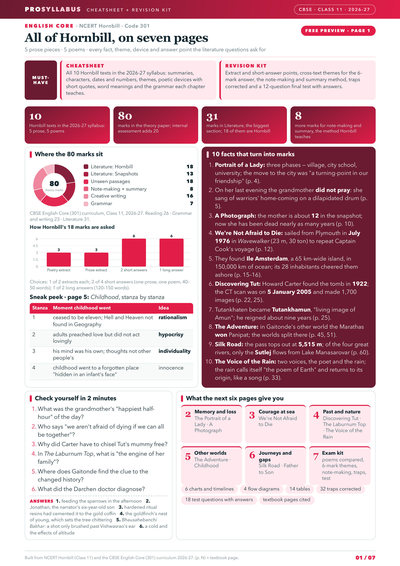
CBSE Class 11 · English Core
All 10 Hornbill texts: 5 prose, 5 poems- Marks booster + cheatsheet: key concepts in 2 lines each, common traps
- 8 marks: note-making and summary
- 5 poems compared, cross-text themes
- Common traps, corrected
- Poetic devices with short quotes
- Grammar each chapter teaches
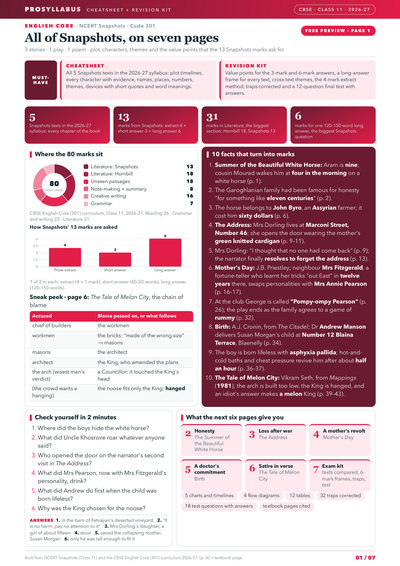
CBSE Class 11 · English Core
All 5 Snapshots texts for the 13 marks- Marks booster + cheatsheet: key concepts in 2 lines each, common traps
- 4-, 3- and 6-mark answers: how to write them
- Plot timeline for every text
- Common traps, corrected
- Every character, with evidence
- Cross-text themes, side by side
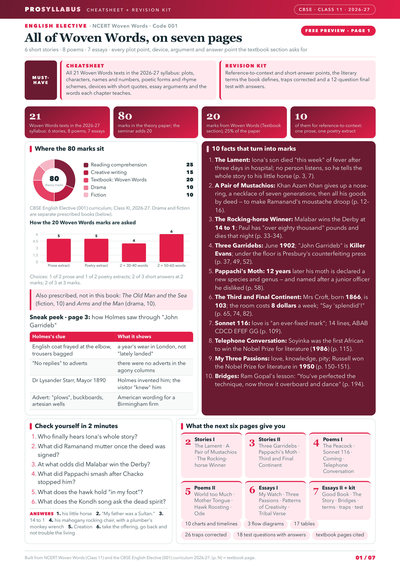
CBSE Class 11 · English Elective
6 stories, 8 poems, 7 essays of Woven Words- Marks booster + cheatsheet: key concepts in 2 lines each, common traps
- Poetic forms and rhyme schemes
- Devices with short quotes
- Common traps, corrected
- Essay arguments, essay by essay
- Words each chapter teaches
CBSE Class 11 · English Core
Hornbill + Snapshots: texts, themes, answers- 10 Hornbill texts: 5 prose, 5 poems
- 5 Snapshots texts for the 13 marks
- 8 marks: note-making and summary
- 4-, 3- and 6-mark answers: how to write them
- Poetic devices with short quotes
- Traps + 12-question test in both kits
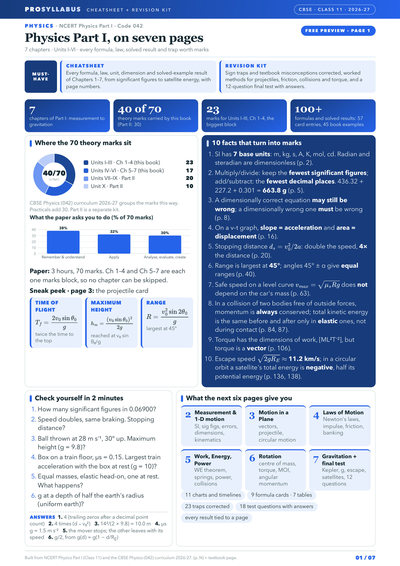
CBSE Class 11 · Physics, Chemistry, Maths + English
7 Class 11 PCM kits: marks, block by block- Maths: 25 marks in Unit II, the biggest block
- Physics: 23-mark block holds Ch 1–4
- Chemistry Part I: 45 of 70 theory marks
- Chemistry Part II: 11 marks in organic basics
- English: 10 Hornbill texts, 5 Snapshots texts
- 12 or 14 test questions close every kit
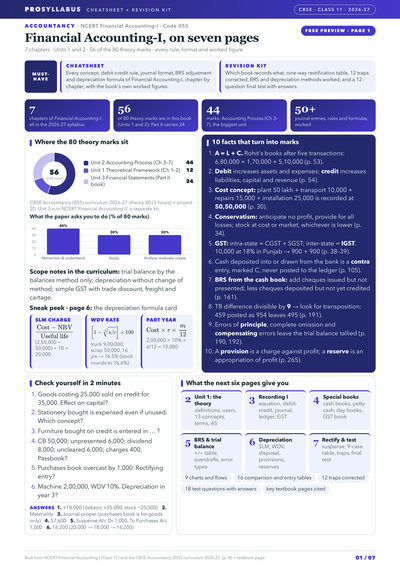
CBSE Class 11 · Accountancy, Business Studies, Economics + English
7 Class 11 Commerce kits: marks by unit- Accountancy I: 56 of the 80 theory marks
- Accountancy: 44 marks in Unit 2, the biggest
- Statistics: 25 marks in Unit 3, the biggest
- Microeconomics: 14 marks each, Units 5 and 6
- Business Studies: 11 chapters, merits, limits
- English: 10 Hornbill texts, 5 Snapshots texts
CBSE Class 11 · Physics, Chemistry, Biology + English
7 Class 11 PCB kits: marks, unit by unit- Biology: 18 marks in Unit V, the biggest unit
- Biology: 19 chapters, with traps corrected
- Physics: 23-mark block holds Ch 1–4
- Chemistry Part I: 45 of 70 theory marks
- Chemistry Part II: 11 marks in organic basics
- English: 10 Hornbill texts, 5 Snapshots texts
The story in short
Walt Whitman's poem is a brief dialogue between the poet and the rain, which is personified and given a voice. The poet asks the soft-falling shower who it is, and, strange to tell, the rain answers — its reply being given as if translated. The rain calls itself "the Poem of Earth," describing how it rises eternal and impalpable out of the land and the bottomless sea, ascends to heaven, where it is vaguely formed and "altogether changed, and yet the same," and then descends to wash the droughts, tiny particles and dust-layers of the globe. It explains that without this rain, all that lies in the earth would remain mere seeds, latent and unborn; by day and night the rain gives back life to its own origin and makes the earth pure and beautiful. This describes the natural water cycle of evaporation, condensation and precipitation, which the poet links with science. The closing lines, set in brackets, draw a parallel between rain and song (or poetry): a song too issues from its birthplace, wanders out into the world whether noticed or not, and duly returns with love to its source. The poem thus celebrates rain as a life-giving, selfless, eternal force and likens the cyclic journey of rain to the journey of art.