Discovering Tut: the Saga Continues
Class 11 English · Hornbill · Chapter 3
Visual story
Watch as storyTap a card to open it full-screen — swipe through like a story.
163 members in the CBSE community
View all









CBSE Class 11 · English Core
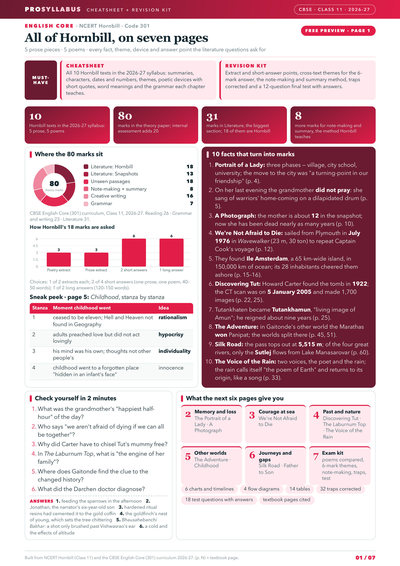
All 10 Hornbill texts: 5 prose, 5 poems- Marks booster + cheatsheet: key concepts in 2 lines each, common traps
- 8 marks: note-making and summary
- 5 poems compared, cross-text themes
- Common traps, corrected
- Poetic devices with short quotes
- Grammar each chapter teaches
CBSE Class 11 · English Core
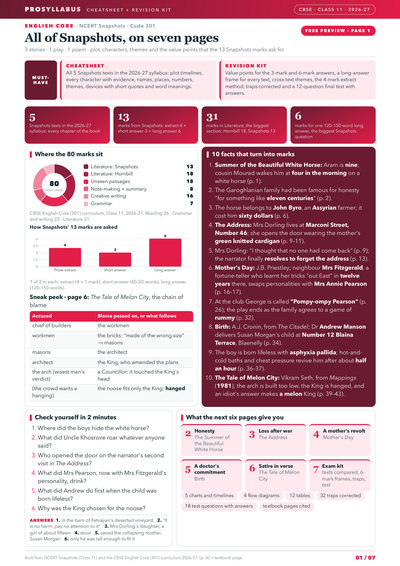
All 5 Snapshots texts for the 13 marks- Marks booster + cheatsheet: key concepts in 2 lines each, common traps
- 4-, 3- and 6-mark answers: how to write them
- Plot timeline for every text
- Common traps, corrected
- Every character, with evidence
- Cross-text themes, side by side
The story in short
A.R. Williams's National Geographic article describes how modern science continues to investigate the mummy of the boy pharaoh Tutankhamun, who died in his late teens over 3,300 years ago. Discovered in 1922 by Howard Carter in the Valley of the Kings, Tut's tomb held the richest royal collection ever found, but Carter's rough handling damaged the mummy: to free it from hardened resins and remove the gold adornments, his men severed the body at major joints. The article explains that archaeology has since shifted from treasure-hunting to studying the details of life and death using medical technology. On 5 January 2005 the mummy was taken from its tomb for a CT scan, creating 1,700 cross-sectional X-ray images to probe how Tut died and how old he was. The piece sketches Tut's dynasty: his father or grandfather Amenhotep III, the "wacky" Akhenaten who promoted worship of the sun-disk Aten and attacked the god Amun, the brief ruler Smenkhkare, and finally Tut, who restored the old ways and reigned about nine years. The scan is interrupted by a malfunction jokingly blamed on the "curse of the pharaoh," but is completed. The article blends history, archaeology, mystery and the power of modern forensic science to question the past.