Neural Control and Coordination
Class 11 Biology · Biology · Chapter 18
163 members in the CBSE community
View all









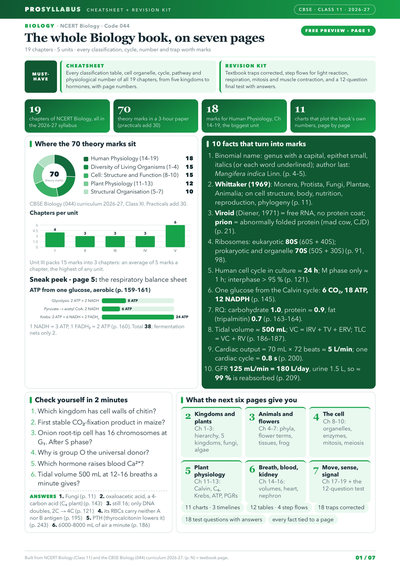
CBSE Class 11 · Biology
19 chapters: every table, cycle and pathway- Marks booster + cheatsheet: key concepts in 2 lines each, common traps
- 18 marks: Unit V, breathing to hormones
- 15 marks each: Units I and III
- Common traps, corrected
- Five kingdoms classification table
- Physiological numbers, with page numbers
Summary
This chapter explains how the neural system coordinates and integrates the activities of the body. Coordination is the process by which organs work together, achieved jointly by the neural system, which gives rapid point-to-point control, and the endocrine system, which gives chemical integration through hormones. The human neural system is divided into the central neural system (brain and spinal cord) and the peripheral neural system, whose afferent fibres carry impulses to the central system and efferent fibres carry them away; the peripheral system includes the somatic and autonomic (sympathetic and parasympathetic) divisions. The neuron, the structural and functional unit, has a cell body, dendrites and an axon, which may be myelinated or non-myelinated. Neurons are excitable because their membranes are polarised, maintained by the sodium-potassium pump giving a resting potential; a stimulus causes sodium influx and depolarisation, generating an action potential or nerve impulse that travels along the axon. Impulses pass between neurons at synapses, mostly chemical synapses using neurotransmitters released across the synaptic cleft. The brain, protected by the skull and meninges, has three parts: the forebrain (cerebrum, thalamus, hypothalamus and limbic system), the midbrain, and the hindbrain (pons, cerebellum and medulla oblongata), each controlling specific functions of the body.