
Checked 13 October 2026. Format, rules and fee from SIRI’s pages on danskogproever.dk and BEK nr 1687/2025, read 12–13 October 2026. 2027 dates from SIRI’s Prøvedatoer 2027 PDF. The 2027 fee is not published: SIRI announced the 2026 fee on 15 October 2025. University requirements from each university’s own page, read 13 October 2026. Pass rates from the ministry’s activity report for 2025.
Studieproven in one paragraph
Studieprøven — often typed “Studieproven”, in full Studieprøven i dansk som andetsprog — is the Danish state test at level C1 for adults who learned Danish as a second language. It closes module 6 of Danish Education 3 (Danskuddannelse 3), and it is the test Danish universities name when a Danish-taught programme asks an applicant with a foreign school-leaving exam to document Danish. It is run by SIRI, the Danish Agency for International Recruitment and Integration, and held twice a year at about ten language centres [official]. This page is the whole test in English, with a link to the guide that goes deeper on each point.
Sources: SIRI’s Studieprøven pages, BEK 1687/2025 and Prøvedatoer 2027.
The test at a glance
| Part | What you do | Time | Aids | Grade |
|---|---|---|---|---|
| Reading comprehension (læseforståelse), delprøve 1 | Find facts fast in about 25 pages of text on one theme; 15 short answers | 25 minutes | None | One reading grade for the four tasks together |
| Reading, delprøve 2A, 2B and 3 | Put 5 removed passages back; 5 multiple-choice questions; choose 10 missing words | 65 minutes | None | Same reading grade |
| Written production (skriftlig fremstilling) | One task chosen from three: describe facts in a chart or table, explain, assess, and argue a position, in at least 400 words | 3 hours | Dictionaries that are not internet-based; a list of irregular verbs | One writing grade |
| Oral communication (mundtlig kommunikation) | A presentation of about 5 minutes on one of three prepared topics, drawn by lot, then about 15 minutes of questions | 30 minutes in all | Your own notes: one A4 page for each topic, by the sample task sheet | One oral grade |
The reading and writing tests are held on one day, the written day; the oral follows in a window some weeks later, on a day your test centre chooses. The full minute plan and the rules of the room are in the written exam guide; the draw, the timing and the notes rule are in the oral exam guide. Listening is not a separate paper: it is tested inside the oral, where you must understand the examiner’s questions.
Studieprøven lytteforståelse: is there a listening test?
No. If you come from IELTS or TOEFL you may look for a Studieprøven listening paper to practise on, and there is none to find. The regulation says the written part consists of reading comprehension and written production, and the oral part of oral communication “hvori lytteforståelse indgår” — in which listening comprehension is included (BEK 1687/2025 bilag 1 pt 4.4) [official]. SIRI’s page for candidates puts it in one sentence: “Prøven i mundtlig kommunikation dækker også lytteforståelse.” There are three grades, and none of them is for listening alone.
| What you might expect | What Studieprøven has instead |
|---|---|
| A recording with questions to answer | None in the official descriptions we read. The only spoken Danish you must understand is the examiner’s (and the censor’s supplementary questions), live, in the oral |
| A listening grade | None. Understanding the examiner is one line on the assessor sheet for the oral and counts towards the oral grade |
| Listening practice tests | SIRI publishes a video of a passed oral on its Studieprøven page. Watch the examiner’s questions, not only the candidate’s answers |
| A rule on asking for repetition | SIRI says you may ask to have an unclear question made more precise. The description of the grade 7 allows for very complex questions being repeated; at 02, questions often need repeating and rephrasing |
So the listening you need is the listening of a discussion: the official goals expect you to follow the examiner’s questions, including their premises and counter-arguments, and to answer the question that was actually asked. For practice, we suggest a partner who speaks at a natural pace (our advice). What the assessors look for, and the Danish for asking an examiner to clarify, are in the oral exam guide.
How it is graded, and what a pass is
Each part gets a grade on the Danish 7-point scale: 12, 10, 7, 4, 02, 00 or -3. You pass Studieprøven when each of the three grades is at least 02 and reading and writing are passed in the same term [official: BEK 1687/2025 §48 stk. 3]. There is no average that decides: a 12 in the oral does not carry a 00 in reading. If one part fails, you resit that part — the written part means reading and writing together — and a passed oral is carried over. The combinations, the half fee for a resit and the complaint deadline are in the pass rule guide.
| Grade | Name on the scale | Passed? |
|---|---|---|
| 12 | Fremragende (excellent) | Yes |
| 10 | Fortrinlig (very good) | Yes |
| 7 | God (good) | Yes |
| 4 | Jævn (fair) | Yes |
| 02 | Tilstrækkelig (adequate) | Yes: the pass mark |
| 00 | Utilstrækkelig (inadequate) | No |
| -3 | Ringe (unacceptable) | No |
Writing and the oral are judged by trained censors against written descriptions of the grades 12, 7 and 02. The short version: what counts most is whether you can do four things in Danish — convey facts, explain, assess, and argue a position — and your grammar and vocabulary are judged by how well they serve that. Subject knowledge is not graded. The examples guide prints the descriptions in English, and the essay guide shows a weaker and a stronger text read against them. Reading is marked by points; how many points give which grade is set after each sitting and not published.
Who needs Studieprøven, and who does not
| Your goal | Is Studieprøven the test? | Read |
|---|---|---|
| A Danish-taught bachelor or master’s programme | Yes, at the universities that accept it in place of Dansk A. Most ask for 02 in each part; medicine and a few other programmes ask for 7 or 10 | <a href="/hub/studieproven-karakter-optagelse-university-grade-requirements" style="color:#255a45;font-weight:600">University requirements</a> |
| An English-taught programme | No. Studieprøven documents Danish; a programme taught in English sets an English requirement instead | The programme’s admission page |
| Danish citizenship | It is accepted with at least 02 in every part, but the standard test is Prøve i Dansk 3, one level lower | <a href="/hub/studieproven-vs-prove-i-dansk-3-which-to-take" style="color:#255a45;font-weight:600">Studieprøven or PD3</a> |
| Permanent residence | It is on the list of tests at or above Prøve i Dansk 3, with at least 02 in every part | <a href="/hub/studieproven-vs-prove-i-dansk-3-which-to-take" style="color:#255a45;font-weight:600">Studieprøven or PD3</a> |
| Authorisation as a doctor, nurse or dentist trained outside the EU/EEA | The authority asks for Prøve i Dansk 3 with set grades as a rule and lists Studieprøven among the qualifications that exempt you | <a href="/hub/studieproven-vs-prove-i-dansk-3-which-to-take" style="color:#255a45;font-weight:600">Studieprøven or PD3</a> |
For university there is one more condition to know from the start. Copenhagen (bachelor), Aarhus and Aalborg accept Studieprøven as Danish A only together with proof that you passed your mother tongue at the highest level in your school-leaving exam. That is a document from home, not a Danish test, and it is worth finding before you register.
Dates: winter 2026 and both sittings of 2027
- Cheatsheet + revision sheet: key concepts in 2 lines each
- All 7 parts: time, aids, marking
- 400-word text: plan for 4 points
- 1 model text of about 414 words
- 5-minute presentation frame
- 20 connectors, 14 grammar points
| Sitting | Registration deadline | Written day (reading + writing) | Oral window | Source |
|---|---|---|---|---|
| Winter 2026 | 31 August 2026 (passed) | Monday 9 November 2026 | 2–15 December 2026 | SIRI dates page |
| Summer 2027 | 1 March 2027 | Monday 10 May 2027 | 14–25 June 2027 | SIRI, Prøvedatoer 2027 (PDF) |
| Winter 2027 | 30 August 2027 | Monday 8 November 2027 | 6–17 December 2027 | SIRI, Prøvedatoer 2027 (PDF) |
The test is held in a summer term and a winter term. Registration closes about ten weeks before the written day and goes through a language centre that holds the test, not through SIRI. For winter 2026 the deadline has passed; a centre may still admit a late candidate in special cases, but it can refuse. SIRI’s dates page prints the winter 2026 oral window of 2–15 December under the Studieprøven heading while naming “Prøve i Dansk 1” in the sentence, which we read as a slip [official: SIRI dates page and Prøvedatoer 2027].
Your Studieprøven timeline, with dates
Pick a sitting and your situation. The tool lays out the dates SIRI has published and counts the two that run from them.
Registration deadlines, written days and oral windows are SIRI’s (dates page and Prøvedatoer 2027, read 13 October 2026). For winter 2026 the dates page prints the 2–15 December window under the Studieprøven heading but names “Prøve i Dansk 1” in the sentence. The 8-week and five-working-day counts are our arithmetic. Your choices are not stored.
The timeline needs scripts. Without them, use the dates table above: the registration deadline, the written day and the oral window are the three fixed points, and everything else is counted from them.
Fee and registration
If you are a student on Danish Education 3, module 6, your school registers you and the test is free. Everyone else is a self-studier (selvstuderende) and pays a national fee: in 2026 it is 987 kr for the written part and 987 kr for the oral part, 1,974 kr in all [official: SIRI]. The regulation’s own figure is 1,888 kr at 2025 level, indexed every 1 January, so the two figures are the base and the 2026 price [official: BEK 1687/2025 §12]. The 2027 fee had not been published when we checked; SIRI announced the 2026 fee on 15 October 2025. You bring valid photo ID on the day, and a driving licence is not accepted. Centres, the ID list, refunds and what happens if you miss the deadline are in the self-study guide.
That guide also has the number that should shape your plan. In 2025, among those who completed all parts, 84.5% of course students passed and 56.6% of self-studiers [official: ministry activity report 2025]. The test is the same; the difference is preparation for a format that course students have practised and self-studiers often meet for the first time on the day.
How to prepare, in the order that works
| Step | Do this | Why | Guide |
|---|---|---|---|
| 1 | Check your level honestly | In plain terms (our gloss, not SIRI’s), C1 means you can read a long newspaper feature without a dictionary and write an argued text. If that is far off, Prøve i Dansk 3 (B2) may be the right first test | <a href="/hub/studieproven-vs-prove-i-dansk-3-which-to-take" style="color:#255a45;font-weight:600">Studieprøven or PD3</a> |
| 2 | Fix the grade you need | 02 and 7 are different targets with different descriptions | <a href="/hub/studieproven-karakter-optagelse-university-grade-requirements" style="color:#255a45;font-weight:600">University requirements</a> |
| 3 | Learn the format on tasks that are not the official sample | SIRI publishes one sample of each part. Keep it for a timed run | <a href="/hub/studieproven-eksempler-example-tasks-each-part" style="color:#255a45;font-weight:600">Examples for each part</a> |
| 4 | Learn what a good text looks like | Writing is where a fixed four-point structure most rewards practice | <a href="/hub/studieproven-skriftlig-fremstilling-eksempel-model-texts-graded" style="color:#255a45;font-weight:600">Two model texts, graded</a> |
| 5 | Follow a dated plan and repair your grammar | Eight weeks counted back from the written day, then the oral | <a href="/hub/studieproven-forberedelse-self-study-plan-c1-grammar-drills" style="color:#255a45;font-weight:600">Self-study plan and drills</a> |
| 6 | Sit SIRI’s sample on the clock | The only official measure you have before the day | <a href="/hub/studieproven-written-exam-reading-and-400-word-task" style="color:#255a45;font-weight:600">The written exam</a> |
| 7 | Prepare all three oral topics when they arrive | One is drawn by lot; you cannot choose | <a href="/hub/studieproven-oral-exam-three-topics-presentation" style="color:#255a45;font-weight:600">The oral exam</a> |
How long it takes depends on where you start, and we found no official number of study hours for Studieprøven. What SIRI does say is how the test is meant to be met: as the end of module 6, after a course. If you study alone, the two things a course would have given you are the fixed task formats and someone who reads your texts. The first you can get from these guides and the official sample. The second you have to arrange: a teacher, a Danish-speaking friend or a study partner who will mark the same six lines a censor marks.
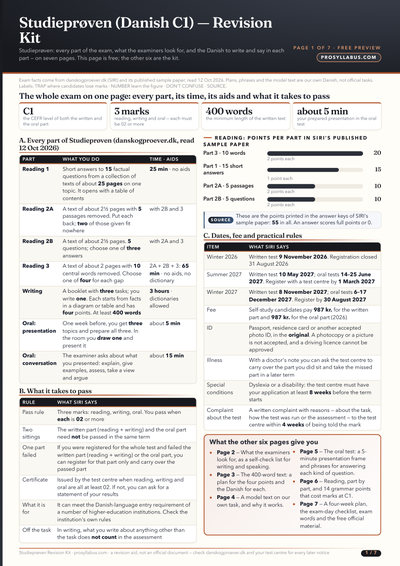
The same exam on seven printable pages
This page is the map. The kit is what you print and work from.
The Studieprøven revision kit is a seven-page PDF in English with the Danish you need: the whole exam on one page, what SIRI says is assessed turned into a self-check list, a plan and the Danish for each of the four points of the 400-word text, a full model text on a task of our own, the 30 minutes of the oral with a frame for the 5-minute presentation and phrases for each kind of question, reading part by part with 14 grammar points, and a four-week plan. Its exam facts come from danskogproever.dk; its model texts are our own, never official tasks. Page 1 is free to read in full before you decide.
Danish words you will meet
| Danish | English | Where you meet it |
|---|---|---|
| læseforståelse | reading comprehension | The first part of the written day; four tasks, one grade |
| skriftlig fremstilling | written production | The 400-word text |
| mundtlig kommunikation | oral communication | The 30-minute oral |
| delprøve | sub-test | Delprøve 1, 2A, 2B and 3 of the reading test |
| prøvetermin | test term | Summer (May–June) or winter (November–December) |
| tilmeldingsfrist | registration deadline | About ten weeks before the written day |
| selvstuderende | self-studier | A candidate who is not on module 6 and pays the fee |
| sprogcenter | language centre | Where you register and sit the test |
| eksaminator / censor | examiner / external assessor | The two people in the oral; censors also mark the written text |
| oplæg | presentation | The first 5 minutes of the oral |
| stikord | key words | The list under each oral topic; ideas, not a checklist |
| karakter | grade | One for each of the three parts |
| bestået / ikke bestået | passed / not passed | On your result |
| prøvebevis | test certificate | What you send to the university when all three parts are passed |
| Dansk A | Danish at upper-secondary A level | What Danish-taught programmes ask for and Studieprøven stands in for |
| modersmål på højeste niveau | mother tongue at the highest level | The second condition at KU (bachelor), AU and AAU |
Six misunderstandings worth clearing up
| People assume | What the sources say |
|---|---|
| It is like IELTS: any test centre, any month | Two sittings a year, about ten centres, registration about ten weeks ahead |
| A good average is a pass | Each of the three parts needs 02; no average decides the pass |
| There is a listening paper | There is none. Listening is assessed in the oral |
| You can use a dictionary throughout | Only in written production. Reading allows no aids |
| You need to know the topics well | Censors are told not to weigh your knowledge, only your language |
| Passing is enough for any programme | Some programmes ask for 7 or 10 in each part, and some universities add the mother-tongue condition |
Frequently asked questions
What is Studieprøven?
Studieprøven is the Danish state test in Danish as a second language at level C1, used mainly for admission to Danish-taught higher education.
Is the test available in English?
No. Every task and every instruction is in Danish. Only guides like this one are in English.
How many parts does it have?
Three graded parts: reading comprehension, written production and oral communication.
What is the pass mark?
At least 02 in each of the three parts, with reading and writing passed in the same term.
When is the next Studieprøven?
Written days are 9 November 2026 (registration closed), 10 May 2027 (deadline 1 March 2027) and 8 November 2027 (deadline 30 August 2027).
How much does it cost?
1,974 kr for a self-studier in 2026. It is free for students on Danish Education 3, module 6. The 2027 fee is not published yet.
Can I take it outside Denmark?
SIRI’s list of centres that hold Studieprøven names centres in Denmark only. We found no test centre abroad.
Is there a listening test (lytteforståelse) in Studieprøven?
Not as a separate paper, and there is no listening grade. The regulation says listening comprehension is included in oral communication, where you must understand the examiner’s questions.
Is Studieprøven harder than Prøve i Dansk 3?
It is one level higher, C1 against B2, and it needs a pass in every part rather than an average.
How long is the result valid?
SIRI says it depends on what you use the certificate for and tells you to check where you will use it. The university pages we read state no period for Studieprøven.
More in this series
- The pass rule: 02 in all three parts, reading and writing in one term (checker)
- The written day: reading strategies, a practice text and a reading clock; the 400-word essay (word planner)
- The oral: three topics, one drawn by lot, 5 + 15 minutes; ten example topics, two outlines, timer and self-check
- Self-study: the 1,974 kr fee, deadlines, the ~10 test centres, pass rates (calculators)
- Studieprøven or PD3: which test for university, citizenship, residence and STPS (chooser)
- Examples: one original task for each part, with what the censors look for
- The essay: two model texts on one task, with the grade each would get and why
- University: the Studieprøven grades six Danish universities ask for (checker)
- Preparation: an eight-week plan, a C1 grammar checklist and 20 drills
- Studieprøven notice board — official updates
Sources
- official — SIRI — Om Studieprøven og krav til at bestå (for candidates)
- official — SIRI — Om Studieprøven (SP): indhold og niveau (the page for language centres: focus and task type of each part)
- official — SIRI — Tilmeldingsfrister og prøvedatoer (2026 dates, 2026 fees, 2027 notice)
- official — SIRI — Prøvedatoer 2027 (PDF, 1 page)
- official — SIRI news — fees for tests in 2026 published (15.10.2025)
- official — BEK nr 1687 af 16/12/2025 — tests in Danish education for adult foreigners, with bilag 1–3 (retsinformation.dk)
- official — SIRI — Bedømmelsesvejledning, Studieprøven, mundtlig kommunikation, May 2024 (PDF, 22 pages; Wayback capture of 12 Sep 2025 — the file is no longer on danskogproever.dk)
- official — BEK nr 1759 af 30/12/2024 — the 7-point grading scale for the Danish tests (retsinformation.dk)
- official — SIRI — Om prøverne (the four tests and the rights each is linked to)
- official — SIRI — Tilmelding til prøve (ID, resits, the SP part-only rule, certificate)
- official — UIM activity report 2025, published July 2026 (Integrationsbarometer, PDF)
- official — SIRI — Sprogcentre (the providers, marked by the tests they hold)
- official — University of Copenhagen — Dansk A og danskkvalifikationer (Studieprøven grades and the mother-tongue condition)
- official — Aarhus University — Language requirements for bachelor’s programmes (page revised 26.06.2026)
- official — Aalborg University — Udenlandsk og international eksamen (bachelor): krav om Dansk A
- official — Cirkulæreskrivelse om naturalisation nr. 9461, §24 and bilag 3.a (retsinformation.dk)
- official — Nyidanmark — Prøver på tilsvarende eller højere niveau end Prøve i Dansk 3 (names Studieprøven)
- official — Styrelsen for Patientsikkerhed — language test for doctors trained outside the EU/EEA
official = a document published by the conducting body. reported = a news or coaching site we could not check against an original. Where sources disagree this page says so rather than picking one.