
Checked 13 October 2026. Dates from SIRI’s dates page and Prøvedatoer 2027, read 13 October 2026. What is assessed is from SIRI’s Studieprøven pages and its assessment guides (October 2022 and May 2024, archived copies). The plan, the hour split, the choice of grammar points and all 60 drill sentences are ours: we found no syllabus, grammar list or recommended number of study hours for Studieprøven on SIRI’s pages.
Studieprøven forberedelse: what you are actually preparing
Preparing for Studieprøven on your own is preparing for three different performances. Reading is a speed and accuracy test with no aids. Writing is one argued text of at least 400 words, built on four fixed points. The oral is a short presentation and a discussion with an examiner. A plan that only says “read more Danish” prepares none of them, and the numbers show what that costs: in 2025, 56.6% of self-studiers who completed all parts passed, against 84.5% of course students [official: ministry activity report 2025; the fee, the centres and the registration steps are in the self-study guide].
This page gives you three things: a plan in eight weeks counted back from the written day, a checklist of the grammar that most often separates a C1 text from a B2 one, and 20 correction drills to test yourself on it. One warning belongs at the top. We found no syllabus and no grammar list for Studieprøven on SIRI’s pages. They describe skills — reading fast and reading carefully, conveying, explaining, assessing and arguing — and its censors judge language by how well it serves those skills. The plan and the choice of grammar points below are therefore ours, built from those descriptions and from what goes wrong in candidates’ texts.
What SIRI says is assessed, and what that means for a plan
| Part | What SIRI says it tests | So practise | Our share of weekly hours |
|---|---|---|---|
| Reading, delprøve 1 | Reading fast to find specific, factual information in large amounts of text | Searching, not reading: table of contents, one search word per question, short answers | 30% for all reading |
| Reading, delprøve 2A and 2B | Careful reading: the main points of the whole text and of each passage | Following an argument: linking words, pronouns that point backwards, what each paragraph does | |
| Reading, delprøve 3 | Careful reading at single points and the exact meaning of words and expressions | Fixed pairings of verb or noun with preposition; near-synonyms | |
| Written production | Conveying facts, explaining, assessing, and taking a position with arguments, in a coherent text | One paragraph type at a time, then whole texts by hand on the clock | 45% |
| Oral communication | A prepared presentation and a discussion in which you describe, explain, assess and argue | Five-minute talks from key words, recorded; answering follow-up questions aloud | 25% before the written day, all of it after |
The middle column is from SIRI’s Studieprøven pages. The shares are ours. Writing gets most because it is where a fixed structure rewards practice most and where self-studiers have had least feedback; move ten points towards the part you trust least.
The weighting inside writing and the oral is not ours to choose. SIRI’s assessment guides tell censors that the “pragmatic” skill — doing the four language acts — is weighed most, and that grammar, vocabulary and coherence “kan ikke i sig selv begrunde en karakter”, cannot justify a grade on their own [official: assessment guides, archived copies]. Grammar practice is therefore a means: it is worth your hours only for the patterns that stop a reader following your argument. The examples guide prints the full descriptions.
The eight weeks, counted back from the written day
| Week | Weeks before the written day | Focus | What to do |
|---|---|---|---|
| 1 | 8 | Baseline | Sit SIRI’s sample reading test on the clock (25 minutes, then 65), mark it with the keys. Write SIRI’s sample task “Forbrug” in three hours by hand. Record a 5-minute talk on one topic of the sample oral sheet. |
| 2 | 7 | Search reading | Delprøve 1 method: table of contents first, one search word per question, short answers. Practise on any long report with a table of contents: 15 facts in 25 minutes. |
| 3 | 6 | Writing: points 1 and 2 | Three charts or tables from dst.dk. For each, 80–100 words of description and 100 words of causes, every cause hedged and reasoned. |
| 4 | 5 | Writing: points 3 and 4 | For the same three charts, an assessment with one counter-consideration, then a position on a statement of your own: at least a quarter of the text. |
| 5 | 4 | Careful reading and grammar | One long newspaper feature a day: mark every linking word and every pronoun that points backwards. Do the 20 drills on this page and hunt the same patterns in your own texts. |
| 6 | 3 | One full written run | Reading 25 + 65 minutes, a break, then three hours of writing by hand with the dictionary you will bring. Check the text with the tool in the essay guide. |
| 7 | 2 | Repair | Rewrite your weakest text. List your five most frequent errors and read every new text once for each of them. A second timed text. |
| 8 | 1 | Rest and logistics | No new material. Check your ID, the room, the start time and your dictionaries. Sleep. |
Three choices in that plan need a reason. The baseline comes first, even though it uses up SIRI’s published sample (the only one we found): without it you plan blind, and the sample can be sat again in week 6 as a timing run even if you remember the answers. If you would rather keep it, take your baseline from the mini set in the examples guide. Writing is split by point, because points 1–2 (describe, explain) and points 3–4 (assess, argue) fail for different reasons; the essay guide shows both. And the oral waits: the three topics reach you only about a week before the oral window, which opens three to five weeks after the written day, so those weeks belong to the oral alone.
Build your eight-week self-study plan
Pick your sitting, the hours you can give each week and the part you trust least. The plan counts back from the written day and then switches to the oral.
Dates are SIRI’s (dates page and the Prøvedatoer 2027 PDF, read 13 October 2026). The weekly content and the hour split are ours, not an official syllabus: we found none on SIRI’s pages. Your choices are not stored.
The plan builder needs scripts. Without them, take your written day from the dates below and count the eight weeks back yourself with the table above.
| Sitting | Registration deadline | Written day (reading + writing) | Oral window | Source |
|---|---|---|---|---|
| Winter 2026 | 31 August 2026 (passed) | Monday 9 November 2026 | 2–15 December 2026 | SIRI dates page |
| Summer 2027 | 1 March 2027 | Monday 10 May 2027 | 14–25 June 2027 | SIRI, Prøvedatoer 2027 (PDF) |
| Winter 2027 | 30 August 2027 | Monday 8 November 2027 | 6–17 December 2027 | SIRI, Prøvedatoer 2027 (PDF) |
A week that fits beside a job
| Day | Time | Session | Output |
|---|---|---|---|
| Monday | 45–60 minutes | Reading: one timed task (search reading or one long text) | Score, and the two questions you got wrong, explained |
| Tuesday | 45–60 minutes | Writing: one paragraph type, twice, on two different charts | Two paragraphs of 80–120 words |
| Wednesday | 45–60 minutes | Grammar: one group from the checklist; then correct Tuesday’s paragraphs for that group only | Your own error list, one line longer |
| Thursday | 45–60 minutes | Oral: a 5-minute talk from key words, recorded; listen once | Three things to change |
| Friday | 45–60 minutes | Reading: a long feature article; mark linking words and what each paragraph does | A five-line summary in Danish |
| Weekend | 2–3 hours | Writing: one full text of at least 400 words by hand, with a paper dictionary | A text checked with the tool in the essay guide |
That is about seven hours; the builder above scales it. The pattern is ours. What matters is that every session ends in something you can look at again: a score, a paragraph, a recording.
The C1 grammar checklist: six groups (our choice)
These are the six groups the 20 drills cover. The choice is ours; we found no official list. Each is a pattern a censor meets in almost every paragraph of an argued text, which is why errors in them are the ones that “bother the reading”. The examples are our own sentences.
| Group | The rule in one line | A correct example (ours) | Drills |
|---|---|---|---|
| 1. Word order in long sentences | Main clause: the finite verb is second, whatever stands first. Subordinate clause: ikke, aldrig, også, ofte and similar adverbs stand before the finite verb | Selvom priserne er steget, køber de fleste stadig økologisk, fordi de ikke vil gå på kompromis med kvaliteten. | 1–4 |
| 2. Passive and formal subject | s-passive tends to describe rules and what is generally done; blive-passive tends to describe single events; der as formal subject when the real subject is indefinite and comes later | Der bruges hvert år store beløb på forskning, og sidste år blev der oprettet tre nye centre. | 5–7 |
| 3. Linking words | Conjunctions (fordi, selvom, mens) start a subordinate clause; adverbs (derfor, desuden, imidlertid, derimod) take a place in a main clause and pull the verb before the subject when they come first | Lønnen er høj. Alligevel vælger mange unge faget fra, mens andre aldrig har hørt om det. | 8–11 |
| 4. Relative clauses | der only as subject; som as subject or object; hvis for whose; hvilket for a whole clause; the preposition goes to the end with som | De kommuner, som regeringen har givet støtte til, har fået flere borgere i arbejde, hvilket har overrasket mange. | 12–14 |
| 5. Prepositions with abstract nouns | Learn the pair, not the word: en stigning i, et fald på 5 procent, årsag til, betydning for, indflydelse på, interesse for, behov for, mangel på | Faldet i antallet af ansøgere har stor betydning for de små uddannelser. | 15–17 |
| 6. Probability, condition and opinion | Hedge causes (formentlig, sandsynligvis, kan skyldes); unreal conditions with havde … ville have; opinion phrases (efter min mening, jeg mener, at …) with the verb in the right place | Udviklingen kan formentlig forklares med, at flere har fået adgang til internettet. | 18–20 |
Group 1 deserves the most time. In the weaker model text of the essay guide, five of the six marked errors are word order: the verb in the wrong place after a fronted phrase, or ikke after the verb in a subordinate clause. They are the commonest errors in texts by speakers of English and of many other languages, and the easiest to remove, because the rule has no exceptions that matter in a formal text.
20 correction drills
20 correction drills at C1: pick the correct sentence
Each item shows one sentence three ways. Two contain an error of the kind named in the heading; one is correct standard Danish. Choose, then check: every item answers with the rule in English.
All 60 sentences are written for this page. The answers are also printed in the tables below, so the page works without scripts. Nothing you choose is stored.
- Cheatsheet + revision sheet: key concepts in 2 lines each
- All 7 parts: time, aids, marking
- 400-word text: plan for 4 points
- 1 model text of about 414 words
- 5-minute presentation frame
- 20 connectors, 14 grammar points
The drill needs scripts. The same 20 items are printed below with the correct sentence, the two wrong versions used in the drill and the rule, so the page also works on paper.
Drills 1–7: word order, passive and formal subject
| # | Correct sentence | English | Wrong versions in the drill | Rule |
|---|---|---|---|---|
| 1 | Det skyldes, at mange unge ikke længere har råd til at bo i byen. | This is because many young people can no longer afford to live in the city. | Det skyldes, at mange unge har ikke længere råd til at bo i byen. / Det skyldes, at har mange unge ikke længere råd til at bo i byen. | In a subordinate clause every sentence adverbial, here ikke længere, stands between the subject and the finite verb. |
| 2 | Selvom ledigheden er faldet, er der stadig mange, som ikke kan finde arbejde. | Although unemployment has fallen, there are still many who cannot find work. | Selvom ledigheden er faldet, der er stadig mange, som ikke kan finde arbejde. / Selvom ledigheden er faldet, stadig der er mange, som ikke kan finde arbejde. | A whole subordinate clause in first place counts as one element, so the main clause must start with its verb: er der. |
| 3 | Jeg mener, at staten ikke bør betale for alle uddannelser. | I think that the state should not pay for all education. | Jeg mener, at staten bør ikke betale for alle uddannelser. / Jeg mener, at staten bør betale ikke for alle uddannelser. | After at the clause is subordinate: ikke comes before the finite verb bør. Main-clause order after at is heard in speech but is out of place in a formal text. |
| 4 | Ikke alene belaster biltrafikken miljøet, men den skaber også støj i byerne. | Not only does car traffic burden the environment, but it also creates noise in the cities. | Ikke alene biltrafikken belaster miljøet, men den skaber også støj i byerne. / Ikke alene belaster biltrafikken miljøet, men den også skaber støj i byerne. | Ikke alene fills the first place, so the verb comes second (belaster biltrafikken). After men a new main clause begins: the subject den is first, the verb skaber second, and også follows the verb. |
| 5 | Problemet kan kun løses, hvis alle lande samarbejder. | The problem can only be solved if all countries cooperate. | Problemet kan kun blive løses, hvis alle lande samarbejder. / Problemet kan kun løser, hvis alle lande samarbejder. | After a modal verb use either the s-passive infinitive (løses) or blive + participle (blive løst), never both at once. |
| 6 | I de seneste år er der blevet bygget mange nye boliger. | In recent years many new homes have been built. | I de seneste år er blevet der bygget mange nye boliger. / I de seneste år der er blevet bygget mange nye boliger. | When an indefinite subject (mange nye boliger) stands after the verb, standard Danish normally uses the formal subject der, and with a fronted time phrase der comes right after the finite verb. |
| 7 | Man kan mindske udledningen ved at nedsætte farten på motorvejene. | Emissions can be reduced by lowering the speed on the motorways. | Man kan mindske udledningen ved nedsætte farten på motorvejene. / Man kan mindske udledningen ved at nedsættende farten på motorvejene. | English by + -ing is ved at + infinitive. Danish has no -ing form after a preposition. |
Drills 8–14: linking words and relative clauses
| # | Correct sentence | English | Wrong versions in the drill | Rule |
|---|---|---|---|---|
| 8 | Boligpriserne er steget, og derfor bliver mange unge boende hjemme. | House prices have risen, and so many young people go on living at home. | Boligpriserne er steget, derfor mange unge bliver boende hjemme. / Boligpriserne er steget, derfor at mange unge bliver boende hjemme. | Derfor is an adverb, not a conjunction: it takes the first place in its clause and the verb follows it. Join the clauses with og, or start a new sentence. |
| 9 | Da loven blev vedtaget i 2019, var der stor uenighed i Folketinget. | When the act was passed in 2019, there was great disagreement in Parliament. | Når loven blev vedtaget i 2019, var der stor uenighed i Folketinget. / Da loven blev vedtaget i 2019, der var stor uenighed i Folketinget. | A single event in the past takes da. Når is for the present, the future and repeated events. The main clause then starts with its verb. |
| 10 | Ordningen gavner hverken de studerende eller universiteterne. | The scheme benefits neither the students nor the universities. | Ordningen gavner ikke hverken de studerende eller universiteterne. / Ordningen gavner hverken de studerende og universiteterne. | Hverken … eller is already negative, so no ikke is added, and its partner is eller, not og. |
| 11 | Jo længere uddannelse man har, desto højere er lønnen som regel. | The longer the education you have, the higher the pay usually is. | Jo længere uddannelse man har, desto højere lønnen er som regel. / Jo længere uddannelse har man, desto højere er lønnen som regel. | The jo-part is a subordinate clause (subject before verb: man har); the desto-part is a main clause with the verb right after the comparative (desto højere er lønnen). |
| 12 | Antallet af cyklister er steget, hvilket har gjort byen roligere. | The number of cyclists has risen, which has made the city calmer. | Antallet af cyklister er steget, som har gjort byen roligere. / Antallet af cyklister er steget, hvilken har gjort byen roligere. | When which points back to the whole preceding clause and not to one noun, Danish uses hvilket. |
| 13 | Det gælder især de familier, hvis indkomst ligger under gennemsnittet. | This applies especially to the families whose income is below average. | Det gælder især de familier, hvem indkomst ligger under gennemsnittet. / Det gælder især de familier, som deres indkomst ligger under gennemsnittet. | English whose is hvis, for people and things alike. Som cannot be combined with deres. |
| 14 | Det er et problem, som politikerne længe har talt om. | It is a problem that the politicians have long talked about. | Det er et problem, der politikerne længe har talt om. / Det er et problem, om som politikerne længe har talt. | Der can only be the subject of the relative clause. Here the subject is politikerne, so som is needed, and the preposition om stays at the end. |
Drills 15–20: prepositions, probability, condition and opinion
| # | Correct sentence | English | Wrong versions in the drill | Rule |
|---|---|---|---|---|
| 15 | Stigningen i antallet af ældre stiller store krav til kommunerne. | The rise in the number of older people makes great demands on the municipalities. | Stigningen af antal af ældre stiller store krav til kommunerne. / Stigningen på antallet ældre stiller store krav til kommunerne. | En stigning i noget is a rise in something; en stigning på is followed by the size (på 5 procent). Antallet af takes a plural noun. |
| 16 | Sammenlignet med 2010 er forbruget næsten fordoblet. | Compared with 2010, consumption has almost doubled. | Sammenlignet til 2010 er forbruget næsten fordoblet. / Sammenlignet med 2010 forbruget er næsten fordoblet. | The preposition is med: sammenlignet med. The phrase fills the first place, so the verb er comes before the subject. |
| 17 | Uddannelse har stor betydning for den enkeltes muligheder på arbejdsmarkedet. | Education matters greatly for the individual’s chances on the labour market. | Uddannelse har stor betydning til den enkeltes muligheder på arbejdsmarkedet. / Uddannelse har stor betydning på den enkeltes muligheder på arbejdsmarkedet. | Fixed pairings to learn as units: betydning for, indflydelse på, årsag til. |
| 18 | Hvis kommunen havde handlet tidligere, ville problemet ikke være blevet så stort. | If the municipality had acted earlier, the problem would not have become so big. | Hvis kommunen havde handle tidligere, ville problemet ikke være blevet så stort. / Hvis kommunen havde handlet tidligere, problemet ville ikke være blevet så stort. | An unreal condition in the past: havde + past participle (handlet) in the hvis-clause; then ville + have/være + participle in the main clause, with the verb first. One wrong version uses an infinitive after havde; the other leaves the main clause without its verb in first place. |
| 19 | Udviklingen skyldes formentlig, at flere arbejder hjemme. | The development is probably due to more people working from home. | Udviklingen formentlig skyldes, at flere arbejder hjemme. / Formentlig udviklingen skyldes, at flere arbejder hjemme. | In a main clause the sentence adverbial comes after the finite verb. If formentlig is put first, the verb must follow it: Formentlig skyldes udviklingen … |
| 20 | Efter min mening bør reglerne ændres hurtigst muligt. | In my opinion the rules should be changed as soon as possible. | Efter min mening reglerne bør ændres hurtigst muligt. / Efter min mening, at reglerne bør ændres hurtigst muligt. | Efter min mening fills the first place of a main clause, so the finite verb bør comes before the subject reglerne. It is not followed by at: at belongs after a verb of opinion (Jeg mener, at reglerne bør ændres). |
The “wrong versions” columns are wrong on purpose. Read them only to see the error; copy the left-hand column.
From drill to text: how to use your score
A drill shows whether you know a rule when you are looking for it. The test asks whether you apply it in sentence 23 of a text written against the clock. So the score matters less than what you do next.
| Your drill result | What it tells you | Next step |
|---|---|---|
| 17–20 correct | You know the rules | Proofread your own 400-word text once per group, six passes. Count what you find. That number, not the drill score, is your level |
| 12–16 correct | One or two groups are unsure | Take the weakest group. Write ten sentences of your own with that pattern, on topics from your texts, and have them checked |
| Under 12 | Several groups are unsure | Start with group 1 only, for a week. Word order affects every sentence you write; the others can wait |
The bands are ours and have no connection with the grading of the test.
Then keep an error list. After every text, write down each corrected error in one line: the wrong form, the right form and the group. After four or five texts the list shows your own five patterns, which are never quite the same as anyone else’s, and the last pass over a text in the exam room is a pass for exactly those five. The dictionary you are allowed in written production helps with gender, plural and irregular forms; it does not help with word order, so that is the knowledge to carry in your head.
Material you can use for free
| Need | Use | Note |
|---|---|---|
| An official measure of your level | SIRI’s sample: the reading test with keys, the written task with a passed answer, the oral sheet and video | One of each. Free on danskogproever.dk |
| Charts and tables to describe | Statistics Denmark (dst.dk) publishes short news items with a chart | Our suggestion. Describe the chart before you read their text, then compare |
| Long informing and discussing texts | Feature and comment articles in Danish national newspapers; research news from universities | Our suggestion. Choose texts of two pages or more |
| Search-reading practice | Any long public report with a table of contents | Our suggestion. Have someone write 15 fact questions, or write them one week and answer them the next |
| Spoken Danish on society topics | Radio and podcast programmes that discuss current affairs | Our suggestion. Summarise one aloud in two minutes |
| Practice tasks in the test format | <a href="/hub/studieproven-eksempler-example-tasks-each-part" style="color:#255a45;font-weight:600">Our examples guide</a>: one original task per part | Ours, not official |
Only the first row is an official preparation resource. We found no course books or websites recommended on SIRI’s pages, and we name none.
The same exam on seven printable pages
A plan tells you when. The kit holds what to practise with.
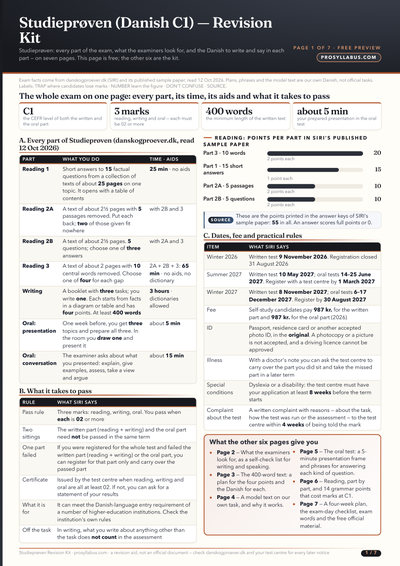
The Studieprøven revision kit is a seven-page PDF in English with the Danish you need: the whole exam on one page, what SIRI says is assessed turned into a self-check list, a plan and the Danish for each of the four points of the 400-word text, a full model text on a task of our own, the 30 minutes of the oral with a frame for the 5-minute presentation and phrases for each kind of question, reading part by part with 14 grammar points, and a four-week plan. Its exam facts come from danskogproever.dk; its model texts are our own, never official tasks. Page 1 is free to read in full before you decide.
The last week, and the weeks after the written day
In the last week, stop learning new things. Sit nothing longer than an hour, sleep, and settle the practical side: your photo ID (a driving licence is not accepted), the address, the start time your centre has given you, and the dictionaries you will bring — paper or offline, with no ready-made sentences in them. The rules of the room are in the written exam guide.
The day after the written test, the plan turns into oral preparation. Until the topics arrive, practise on SIRI’s sample sheet and the three topics in the examples guide: five minutes from key words, recorded, then the five kinds of question answered aloud. When your three topics arrive, about a week before the window by SIRI’s candidate page, give each about two days: the facts, some 25 topic words, a talk with an issue that invites discussion, and ten questions you would ask yourself. The oral guide has the timing and a preparation checklist. And if the result is for a university, check once more what it has to show: the grade your programme asks for.
Frequently asked questions
How long should I prepare for Studieprøven?
We found no official figure. Our plan uses eight weeks before the written day and the weeks between it and the oral, for someone already close to C1.
Is there an official syllabus or grammar list?
We found none on SIRI’s pages. They describe the skills that are tested, not a list of grammar or vocabulary.
How many hours a week do I need?
We found no official figure. The plan builder works with 4 to 15 hours and splits them 30/45/25 between reading, writing and the oral; the split is ours.
Does grammar decide my grade?
Not on its own. Censors judge grammar by how far it supports what you are saying; the four language acts weigh most.
Which grammar should I study first?
Word order: verb second in main clauses, and sentence adverbs such as ikke before the verb in subordinate clauses. It affects every sentence.
Can I pass as a self-studier?
Yes. In 2025, 56.6% of self-studiers who completed all parts passed, against 84.5% of course students.
When should I start preparing for the oral?
Practise speaking every week, but the three topics only arrive about a week before the oral window, after the written day.
Are the drills official test items?
No. All 60 sentences are written for this page. Studieprøven has no separate grammar test.
Should I use SIRI’s sample at the start or the end?
We use it at the start as a baseline and again later as a timing run. If you prefer to save it, use our mini set as the baseline.
When is the registration deadline for summer 2027?
1 March 2027, for the written day on 10 May 2027.
More in this series
- The pass rule: 02 in all three parts, reading and writing in one term (checker)
- The written day: reading strategies, a practice text and a reading clock; the 400-word essay (word planner)
- The oral: three topics, one drawn by lot, 5 + 15 minutes; ten example topics, two outlines, timer and self-check
- Self-study: the 1,974 kr fee, deadlines, the ~10 test centres, pass rates (calculators)
- Studieprøven or PD3: which test for university, citizenship, residence and STPS (chooser)
- Examples: one original task for each part, with what the censors look for
- The essay: two model texts on one task, with the grade each would get and why
- University: the Studieprøven grades six Danish universities ask for (checker)
- The whole test in English: format, grades, dates, fee, and a dated timeline
- Studieprøven notice board — official updates
Sources
- official — SIRI — Om Studieprøven og krav til at bestå (for candidates)
- official — SIRI — Om Studieprøven (SP): indhold og niveau (the page for language centres: focus and task type of each part)
- official — SIRI — Bedømmelsesvejledning, Studieprøven, skriftlig fremstilling, October 2022 (PDF, 28 pages; Wayback capture of 12 Sep 2025 — the file is no longer on danskogproever.dk)
- official — SIRI — Bedømmelsesvejledning, Studieprøven, mundtlig kommunikation, May 2024 (PDF, 22 pages; Wayback capture of 12 Sep 2025 — the file is no longer on danskogproever.dk)
- official — SIRI — Tilmeldingsfrister og prøvedatoer (2026 dates, 2026 fees, 2027 notice)
- official — SIRI — Prøvedatoer 2027 (PDF, 1 page)
- official — UIM activity report 2025, published July 2026 (Integrationsbarometer, PDF)
- official — BEK nr 1687 af 16/12/2025 — tests in Danish education for adult foreigners, with bilag 1–3 (retsinformation.dk)
- official — SIRI sample — SP reading, delprøve 1 ("Grønland") (PDF)
- official — SIRI sample — SP written production task ("Opgave 3 Forbrug") (PDF)
- official — SIRI sample — SP oral communication task sheet (May–June 2020 topics) (PDF)
official = a document published by the conducting body. reported = a news or coaching site we could not check against an original. Where sources disagree this page says so rather than picking one.