Checked 29 September 2026. The syllabus is Board letter E(GP)2022/2/4 of 07.11.2022, in force from 01.01.2023, as printed in the 2025-26 Southern Railway notification. A new Board letter would replace it; check the annexure of your cycle's notification.
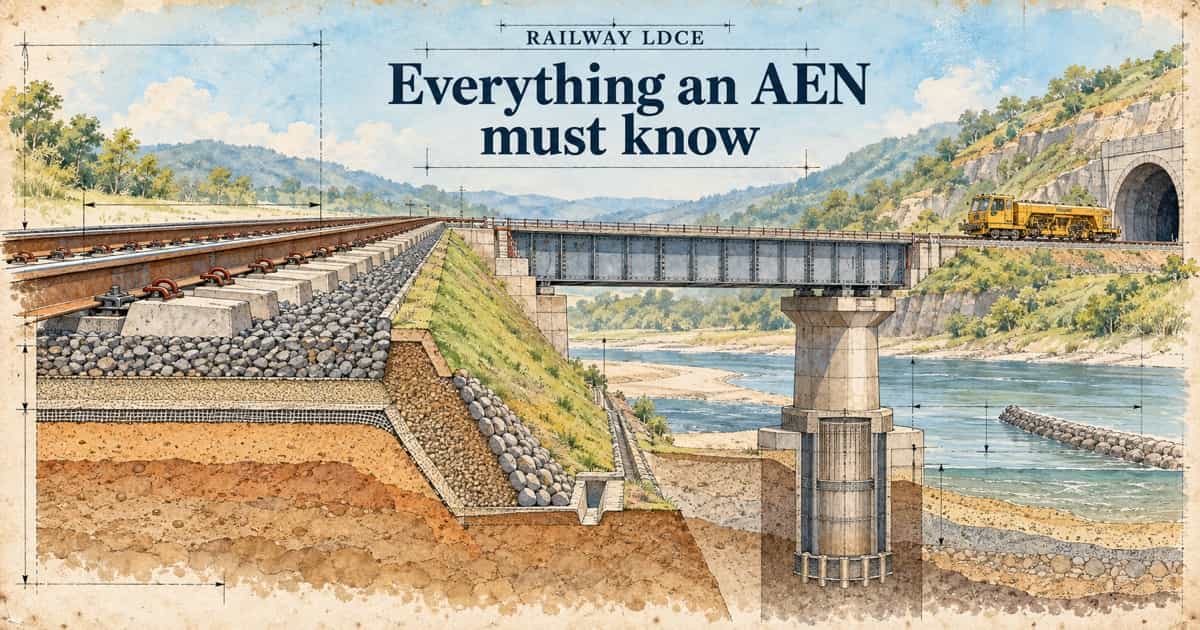
The AEN LDCE syllabus is not a list of textbook chapters. It is a map of an Assistant Engineer's working year — surveys and estimates, track and bridges, floods and tunnels, contracts and land — with the rules a Group B officer must apply. It comes from Board letter E(GP)2022/2/4 of 07.11.2022, applicable from 01.01.2023, and the 2025-26 Southern Railway notification prints the AEN version in full as Annexure A. This guide sets out every head, explains a naming clash that confuses almost everyone (two different things are called "Part A" and "Part B"), and turns the syllabus into a tracker.
ProSyllabus is an independent study site. We are not affiliated with Indian Railways, the Railway Board, RRB/Ajmer or any zonal railway. Every rule below is quoted or summarised from their published letters, and your zone's Personnel Department decides every application.
SR notification of 29.08.2025, para 6 and Annexure A.
Where other pages get this wrong
Only 80 of the 150 marks come from the professional subject. General knowledge with official language is 40, and establishment and financial rules are 30.
Commonly published instead: "The professional subject carries at least 100 of 150 marks" — IREM Vol I para 204.1, still on the Railway Board website, and repeated on pages that copy it.
That figure is not the LDCE pattern in force. The page on the Board's website prints para 204.1 as the written-test rule of the Group B selection procedure (150 marks, at least 100 on the professional subject), and it may not show later amendments. The centralised CBT pattern of 80, 40 and 30 marks — 175 questions, answer 150, qualifying 90 — was set by Board letter E(GP)2022/2/4 of 28.06.2022 (reported) and already used for the AEN CBT of 20.11.2022, whose official paper has 175 questions; the revised syllabus of 07.11.2022 then applied from 01.01.2023. The 2025-26 notification and RRB/Ajmer's instructions print the same 80 marks for the professional subject. Seventy marks — nearly half the paper — are GK, official language and rules. Candidates who prepare only civil engineering are preparing for a paper that no longer exists.
Two different "Part A / Part B"s — read this first
RRB/Ajmer's instructions name the three sections of the paper Part-A (professional subject), Part-B (general knowledge with official language) and Part-C (establishment and financial rules). The syllabus annexure, separately, splits the professional subject itself into (A) Civil Engineering (General) and (B) Civil Engineering (Railways). So "Part B" means GK in the paper and railway engineering in the syllabus. In this guide we say paper section or syllabus part every time.
| Paper section (RRB/Ajmer) | Questions | Marks | Syllabus behind it |
|---|---|---|---|
| Part-A: Professional subject | 85, answer 80 | 80 | Syllabus part (A) Civil Engineering (General), 5 heads + syllabus part (B) Civil Engineering (Railways), 13 heads |
| Part-B: GK including official language | 55, answer 40 (15 optional on official language policy and rules) | 40 | No GK syllabus is printed in the AEN annexure |
| Part-C: Establishment and financial rules | 35, answer 30 | 30 | Establishment Rules, 11 heads + Financial Rules, 17 heads (common to all Group B posts) |
Official marks; percentages ours.
Syllabus part (A): Civil Engineering (General)
| Head | What the annexure lists (condensed) |
|---|---|
| 1. Surveying | Chain, compass, levelling and theodolite surveys; simple circular curves; setting out buildings, culverts and railway centre lines, with GPS; auto level, total station, DGPS, LIDAR |
| 2. Strength of materials, structural design and drawings | Bending moment and shear force, influence lines, columns; RCC by working stress and limit state methods, IRS Concrete Bridge Code; steel connections, tension and compression members, plate girders, IRS Steel Bridge Code |
| 3. Construction materials | Stone, sand, timber, bricks, cement, lime, paints, glass, tiles; concrete mix design, placing, compaction, durability |
| 4. Foundation and construction engineering | Soil classification and properties, compaction, consolidation, shear strength, earth pressure, slope stability; open, well and pile foundations, bearing capacity, settlement |
| 5. Hydrology and hydraulics | Open channel and pipe flow; rainfall and run-off, flood discharge; bridge waterway, scour, afflux, clearance; design discharge under para 4.3.4 of the Substructure Code — RDSO report RBF-16 below 25 sq km, synthetic unit hydrograph from 25 to 2,500 sq km |
Condensed from Annexure A of the Southern Railway notification. The annexure's wording is authoritative; we shortened lists, not scope.
Two lines in syllabus part (A) are pure railway practice dressed as general engineering. Design discharge is to be estimated under para 4.3.4 of the Substructure Code: RDSO report RBF-16 for catchments below 25 sq km, and the flood estimation reports (synthetic unit hydrograph) from 25 to 2,500 sq km. And the RCC and steel design topics name the IRS Concrete Bridge Code and IRS Steel Bridge Code, not only the IS codes most engineers learnt in college.
Syllabus part (B): Civil Engineering (Railways)
| Head | What the annexure lists (condensed) |
|---|---|
| 1. Railway surveys and construction | Engineering Code provisions: classes of survey, alignment, ruling gradient, grade compensation, curves, hill surveys, catch sidings; survey reports for RECT, PECT and FLS; project estimates |
| 2. Railway track | Track structure, rails, sleepers, ballast, formation; duties of ADEN, SSE/JE and track staff; maintenance; AT and flash-butt welding, SWR, LWR, USFD; curves and points and crossings; tolerances and monitoring; Schedule of Dimensions; CRS sanction; renewals; engineering restrictions; level crossings; trollies and lorries; Track Management System; G&SR; accidents and monsoon precautions |
| 3. Maintenance of bridges | Substructure, arches, RCC/PSC and steel girders, HSFG bolts, painting, bearings; inspection by grade, bridge inspection register, Numerical Rating System, Unique, Condition and Overall Rating Numbers |
| 4. Rehabilitation of bridges | Reasons and priority, speed restrictions, regirdering, strengthening foundations and substructure, replacing non-standard girders and pipe culverts |
| 5. Rivers and floods | River behaviour, danger levels, bridge watchmen, monsoon inspection and reserves, flood records, river training works: guide bunds, spurs, marginal and closure bunds |
| 6. Tunnels and deep cuttings | Inspection and records, ventilation, leakage; vulnerable cuttings, boulder drops, guarding |
| 7. Buildings and structures | Inspection and maintenance, building registers, waterproofing, standard measurement registers, dismantling, retrofitting |
| 8. Sanitation, water supply and sewerage | Drinking-water standards and treatment, distribution, pumps, storage tanks; rainwater harvesting; water audit; sewer design and treatment; sanitation committees |
| 9. Land | Acquisition and relinquishment, land plans and records, leasing and licensing, encroachment; the Land Acquisition Act and the RFCTLARR Act 2013 |
| 10. Plans and estimates | Drawing practice, RDSO and CE's plans, completion drawings; types of estimate, rates, deposit works, urgency certificate |
| 11. Contracts and execution | Schedule of rates, tenders and tender committees, contract conditions, measurement books, bills, variations, PVC, basics of arbitration; bar charts, critical path networks, PERT |
| 12. Track machines | Duties and inspection schedules; tamping with 3-point and 4-point lining, design mode, dynamic track stabiliser; ballast cleaning machines; track relaying and TRT; rail grinding; block planning; G&SR for machines; CPOH and ZMD workshops |
| 13. Miscellaneous | Engineering plant, explosives and blasting, engineering stores, law and order on railway land |
Condensed from Annexure A. Head 2 alone has sixteen sub-heads, (a) to (p), and head 12 has nine, (a) to (i).
Heads 2 and 12 are the heaviest in the annexure: track has sixteen sub-heads and track machines nine, down to corrections in 4-point lining, target versines for 3-point lining, and the functions of CPOH and zonal machine depots. The land head prints "Land Acquisition Act. 1989" — the Land Acquisition Act is of 1894, and it was replaced by the Right to Fair Compensation and Transparency in Land Acquisition, Rehabilitation and Resettlement Act, 2013, which the same line also names. We read "1989" as a typing or scanning error in the notification; study both Acts as they apply to railway land.
| Syllabus area | Where we would read it (our suggestion, not in the syllabus) |
|---|---|
| Track, curves, points and crossings, tolerances, renewals, USFD, welding | Indian Railways Permanent Way Manual and the relevant RDSO guidelines |
| Bridge inspection, rating numbers, rehabilitation, floods | Indian Railways Bridge Manual; Substructure Code for design discharge |
| Buildings, water supply, sanitation, land | Indian Railways Works Manual; the two land Acts |
| Surveys, estimates, contracts, execution, stores | Indian Railways Code for the Engineering Department (the syllabus cites "Engineering code provisions") |
| Signals, block working, temporary single line, machines on the line | General and Subsidiary Rules (G&SR), named in the syllabus |
| Tamping, DTS, BCM, TRT, RGM, depots | Indian Railways Track Machines Manual |
| Structural design | IRS Concrete Bridge Code and IRS Steel Bridge Code, named in the syllabus |
The annexure itself names the G&SR, the Engineering Code, the Substructure Code (para 4.3.4), RDSO report RBF-16 and the flood estimation reports, the IRS Concrete Bridge Code, the IRS Steel Bridge Code and the Schedule of Dimensions. The manuals are our suggestion of where the listed topics are written down; use the current corrected editions your division uses.
Paper section C: Establishment and Financial Rules
These two lists are common to the Group B papers of every department, so they are the one part of the paper where an AEN candidate studies exactly what an APO or AFA candidate studies. Thirty marks come from 35 questions, and you may leave any five.
| No. | Establishment Rules head (condensed) |
|---|---|
| 1 | Organisation of the Personnel Department |
| 2 | Recruitment and training, including APARs |
| 3 | Conditions of service: seniority, lien, transfers, promotion, leave, pass, HOER, pay rules |
| 4 | Manpower planning; creation and surrender of posts |
| 5 | Railway Servants (Discipline and Appeal) Rules, 1968 |
| 6 | Railway Services (Conduct) Rules, 1966 |
| 7 | Retirement benefits, pension, gratuity, NPS |
| 8 | Staff welfare, SBF, grievance redress |
| 9 | Industrial relations: ID Act 1947, Industrial Relations Code 2020, Trade Unions Act 1926, PNM, JCM |
| 10 | Factories Act 1948, Workmen's Compensation Act 1923, labour enforcement, RTI |
| 11 | IT in railways: e-office, HRMS, IPAS and other applications |
| No. | Financial Rules head (condensed) |
|---|---|
| 1 | Parliamentary control, public accountability, canons of financial propriety |
| 2 | Railway budget: terms, types, cycle, demands for grants, reviews |
| 3 | Allocation rules, classification and control of expenditure, financial results |
| 4 | Works programme, financial justification, estimates, capital budget, reappropriation |
| 5 | Stores expenditure, purchase, inventory control, ABC analysis |
| 6 | Financial and cost control in workshops and sheds |
| 7 | Tenders and contracts for works and stores; M&P programme and RSP |
| 8 | Audit objections and draft paras |
| 9 | Delegation of powers |
| 10 | Losses, frauds and embezzlements |
| 11 | General Financial Rules |
| 12 | Government e-Marketplace (GeM) |
| 13 | Classification of railway revenue |
| 14 | IT with reference to railway applications |
| 15 | Taxation: GST and income tax |
| 16 | Organisation of the CGA and the C&AG |
| 17 | Any other topic felt necessary from time to time |
Condensed from the "Syllabus for Establishment Rules" and "Syllabus for Financial Rules" in Annexure A. Head 17 of the financial list is open-ended by design.
Paper section B: general knowledge and official language
The AEN annexure prints no GK syllabus. What is fixed is the structure: 55 questions, of which 15 are optional questions on official language policy and rules, and you answer any 40. Our reading of that arithmetic: the 15 official-language questions sit inside the 55, so you can answer all 40 from the other 40 GK questions and skip official language entirely, or use official-language questions to replace GK questions you would rather not risk. Official language questions reward a small, closed body of rules; general knowledge is open-ended. Many candidates will find the closed set the safer marks.
| Section | Set | Answer | You may leave (ours) | Share you may leave (ours) |
|---|---|---|---|---|
| Professional | 85 | 80 | 5 | 6% |
| GK incl. official language | 55 | 40 | 15 | 27% |
| Establishment and financial rules | 35 | 30 | 5 | 14% |
Set and answer counts are official; the rest is our arithmetic. The screen shows one question at a time and questions can be answered in any order (RRB/Ajmer).
Tick off the syllabus
AEN LDCE syllabus tracker
The 46 heads of the official annexure (5 + 13 + 11 + 17), in its order, plus two study items for paper section B that are not annexure heads. Tick one when you have revised it and solved questions on it.
0 of 48 done
Ticks are saved only in this browser on this device.
How to weigh your time across the syllabus
The marks split gives a first cut: roughly half your hours to civil engineering, a quarter to GK and official language, a fifth to rules. Inside the professional subject, the annexure gives no per-head weight, so let your own gaps decide. A field engineer who has spent years on P.Way will be strong in syllabus part (B) head 2 and weak in hydrology or steel design; a works or bridge engineer the reverse. The previous papers are the best check of what gets asked; see the papers guide in this series for the three official papers with final keys.
A practical order (our suggestion)
- Rules first, early. Thirty marks from a defined list of heads, the same for every department — though financial head 17 is open-ended ("any other topic felt necessary from time to time"), and labour law has moved: the syllabus names both the Industrial Disputes Act 1947 and the Industrial Relations Code 2020, and the four labour codes are reported to have come into force on 21.11.2025. Read the current law, not an old guide. Start rules in the first week and revisit weekly.
- Then the railway heads you do not work on. Syllabus part (B) is where your daily job gives you an edge in some heads and none in others.
- Then the college heads. Surveying, strength of materials, soil mechanics and hydraulics are numerical and fade fastest; solve, do not just read. Calculators are not allowed in the exam hall.
- Official language as a closed set. Fifteen optional questions from a limited body of rules can steady section B.
- General knowledge last and light. It is the least predictable 25 to 40 marks.
Our suggestion. The syllabus prescribes content, not an order.
What is the syllabus for the railway AEN LDCE?
Board letter E(GP)2022/2/4 of 07.11.2022, in force from 01.01.2023: civil engineering general (5 heads) and civil engineering railways (13 heads) for the professional part, 11 establishment rule heads and 17 financial rule heads. The 2025-26 notification prints it as Annexure A.
How many marks does the professional subject carry?
80 of 150, from 85 questions of which you answer 80. The "at least 100 marks" printed at IREM para 204.1 on the Board's website is not the LDCE pattern in force.
Is there a GK syllabus?
None is printed in the AEN annexure. The structure is fixed: 55 questions including 15 optional questions on official language policy and rules, answer any 40.
Can I skip the official language questions?
Yes, by our reading of the pattern. They are 15 optional questions inside the 55 of section B, and you answer any 40, so you can answer 40 GK questions instead.
Are establishment and financial rules the same for all Group B posts?
Yes. The annexure prints them as the syllabus for promotion to Group B posts by 70% selection and 30% LDCE, not an AEN-specific list.
Which codes and manuals are named in the syllabus?
The Engineering Code, the Substructure Code (para 4.3.4), RDSO report RBF-16, the IRS Concrete Bridge Code, the IRS Steel Bridge Code, the Schedule of Dimensions and the G&SR. Other manuals are our suggestion, not the syllabus.
Are calculators allowed?
No. RRB/Ajmer's 2026 instructions bar calculators from the centre and list an attempt to use the calculator on the exam PC among the grounds for debarment, so practise numerical questions by hand.
Sources
- official — Southern Railway — 30% LDCE for AEN notification No. P(G)532/I/AEN/30% LDCE/CCBT 2025-2026 dated 29.08.2025, with Annexure A (syllabus)
- official — North Eastern Railway — AEN 30% LDCE notification dated 19.12.2025 (Hindi), with Board letter E(GP)2022/2/4 dated 07.11.2022 (syllabus)
- official — RRB/Ajmer letter No. GBS/RRB/CBT/2025-26/30%/LDCE dated 14.05.2026 — CBT protocol and instructions to candidates (enclosed on the ECoR site)
- official — Railway Board — IREM Vol I, Chapter II (Group B promotion; parts superseded)
- official — NAIR — AEN question paper, CBT of 20.11.2022
- reported — staffnews.in — Board letter E(GP)2022/2/4 dated 28.06.2022, centralised CBT for Group B (reported)
official = a document published by the conducting body. reported = a news or coaching site we could not check against an original. Where sources disagree this page says so rather than picking one.