Checked 30 September 2026. Syllabus and pattern from DoP letter X-8/2/2022-SPN-II dated 18.04.2023, as enclosed in the Odisha 2026 notification (official). The pattern itself dates from 1989 and has not changed; the syllabus applies to exams held after 18.04.2023. Check each circle notification for a newer letter.
The PO & RMS Accountant Examination is the departmental test that decides which Postal and Sorting Assistants may work the accounts branch of a post office or RMS unit. It is small, circle-run and rarely written about well, and its syllabus is unusual: both papers are open-book, and two-thirds of every paper is practical work. You are not being asked to remember rules. You are being asked to find the right rule fast and then work a sum correctly with it.
The syllabus now in force is the Directorate's letter X-8/2/2022-SPN-II dated 18.04.2023. It replaced the syllabus of 17.01.1990 and restated the pattern of 10.11.1989 unchanged, and it applies to every exam held after the letter was issued. Circles reprint it in their notifications, so the text below is taken from the copy enclosed with Odisha's notification of 08.09.2026 for the exam on 1 November 2026.
DoP letter X-8/2/2022-SPN-II dated 18.04.2023.
The pattern in one paragraph
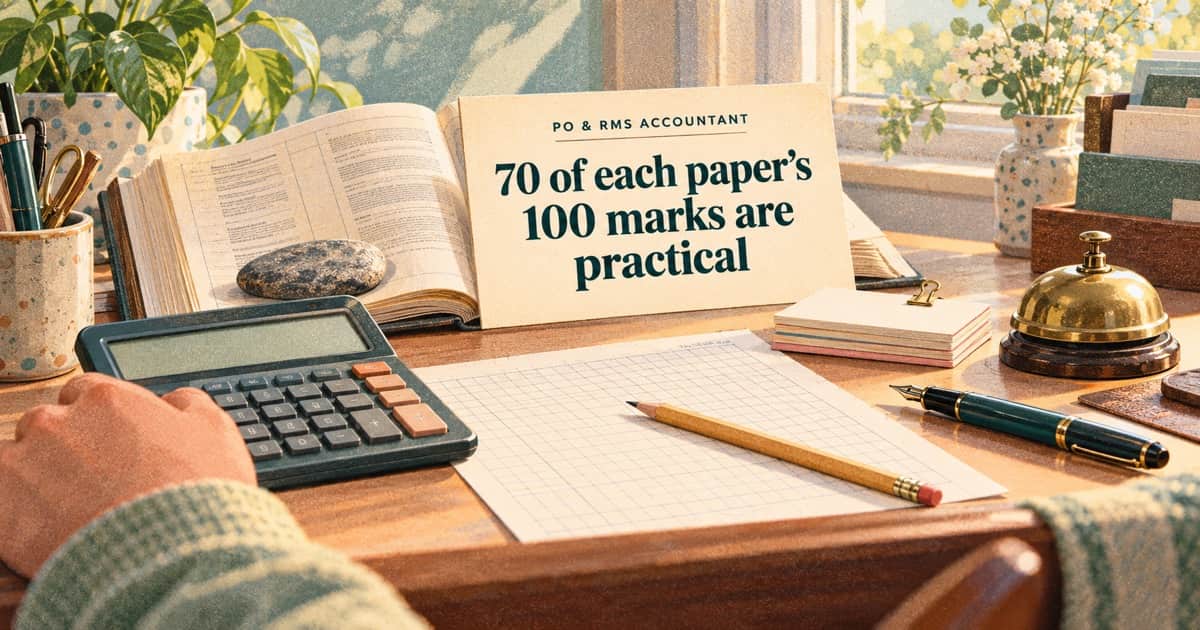
There are two papers of 100 marks each, and books are allowed in both. Each paper mixes theoretical and practical questions in the proportion of one-third theory to two-thirds practical: 30 marks of theory and 70 of practical work. Both portions contain some compulsory questions. Odisha schedules Paper I from 10:00 to 13:00 and Paper II from 14:00 to 17:00 on the same Sunday, which is the usual shape of the day. The qualifying standard and the 60% exemption are covered in the guide on marks and chances; this page is about what you study.
Paper I: service rules and allowances
| Part | Item | What it governs |
|---|---|---|
| I | Fundamental Rules 1 to 56 | Pay, increments, fixation on promotion, officiating and the core definitions |
| I | Supplementary Rules 1 to 203 | Travelling allowance, including transfer TA and the definition of family |
| I | CCS (Joining Time) Rules 1979 | Joining time on transfer |
| I | CCS (Leave) Rules 1972 | EL and HPL accounts, commuted leave, encashment |
| I | CCS (Pension) Rules 1972, and the New Pension Scheme rules | Qualifying service, pension, family pension, gratuity, commutation |
| I | GPF (Central Services) Rules 1960 | Subscriptions, withdrawals and yearly interest |
| II | Dearness allowance | DA rates and their use in retirement sums |
| II | House rent allowance | HRA by city class |
| II | City compensatory allowance | CCA |
| II | Children education allowance | CEA and hostel subsidy |
| II | Service rules for Gramin Dak Sevaks, Sections III, VI, VII, IX and XI | GDS engagement, leave, discharge and termination |
Paper I is the paper of calculation. In the Tamil Nadu paper of 10.09.2023, the one circle paper whose full worked key is published, a single question on one retiring official asked for the last pay, qualifying service, pension, family pension, gratuity, commutation and leave encashment, worth 25 marks with its second part. Another asked for a year of GPF interest (15 marks), another for pay fixation on promotion under both options (15 marks). The practical-questions guide works each of them step by step.
Paper II: financial handbooks, the Postal Manual and procurement
| Part | Item | What it governs |
|---|---|---|
| I | Financial Handbook (FHB) Volumes I and II | Pay bills, recoveries, attachment of pay, last pay certificates, security deposits, pension payment orders |
| I | Postal Manual Volume II, chapters IV, V, VII, VIII, IX, X and XII | Administrative approval, expenditure sanction, estimates and the office procedure behind them |
| I | Schedule of financial powers of the Department of Posts | Who may sanction what, and up to what limit |
| I | Core System Integration manual in the SAP environment for Finance and Accounts, and the HR payroll manual | SAP transactions for accounts and for employee records |
| II | Postal Manual Volume VI, Parts I, II, VII, XII, XVI and XVII | Accounts rules of the post office |
| II | Postal Manual Volume VI Part II, relating to MOS, IPOS and BPOS | The money-order and related accounting systems the letter names |
| II | Overtime allowance, medical reimbursement, CGHS, HBA, LTC and the Group Insurance Scheme | Claims an Accountant checks every week |
| II | Procurement of goods and services: GFR and the Handbook on GeM | Bid security, buy-back, purchase on GeM |
Two printing quirks are worth knowing. The letter writes CGHS out as "Central Government Health Insurance Scheme", and it calls the SAP payroll book the "HR pay role management Manual". Neither changes what you study. The Tamil Nadu 2023 Paper II shows how these items are asked: ten one-mark objective questions whose keyed answers include Government e-Marketplace, Rs 25,000, CPMG/PMG, the SAP transaction zfi_pos_bal, one year and Rs 5,000; then descriptive questions on overtime limits (6 hours on working days, 8 on Sundays and holidays), on the retrenchment register (FHB I Rule 85), attachment of pay (FHB I Rule 174), the last pay certificate (FHB I Rules 181-182), bid security (GFR 170), buy-back (GFR 176), a CGHS package-rate claim, HBA admissibility, a Group Insurance calculation and SAP HR transactions.
Where other pages get this wrong
The syllabus letter is X-8/2/2022-SPN-II dated 18.04.2023.
Commonly published instead: Odisha's notifications of 02.04.2025 and 08.09.2026 cite it as "X-8/28/2022-SPN-II", and Delhi's 2026 result memo as "X-8/2022-SPN-II".
The enclosed letter itself, and the PwBD letter of 28.04.2026 issued on the same file, carry X-8/2/2022-SPN-II. The content the circles reprint is identical, so no one is studying a different syllabus; quote the correct number if you write to your division.
Which rules are new since 1990
The 2023 letter says the syllabus was changed "due to various change of rules and procedure" to meet present-day requirements. Reading the lists, the additions a candidate who prepared from old material would miss are clear: the New Pension Scheme rules beside the 1972 pension rules; the Gramin Dak Sevak service rules; the SAP (Core System Integration) manuals for accounts and payroll; and procurement under the GFR and the Handbook on GeM. The 1990 syllabus text is not reprinted by any circle, so we cannot list line by line what was removed; the safe course is to prepare only from the 2023 list. One official consequence is recorded: the Directorate told Maharashtra on 16.10.2023 that exemptions earned under the old syllabus remain valid "to the extent as per pattern", because the pattern did not change.
Carrying books: what the rules allow and what they do not say
The letter says only that both papers are "with books". It does not list permitted editions, and it does not say whether annotated guides or handwritten notes are allowed. Circle notifications we read do not add a list either. So take the rule books the syllabus names, in their current government editions, and ask your division before the day if you intend to take anything else. Because the exam is open-book, speed of lookup decides marks: index tabs on FR 22 (pay fixation), the CCS (Pension) rules on qualifying service, gratuity and commutation, the leave rules on encashment, the GPF rules on interest, and SR 116 with its government orders (transfer TA) are the difference between finishing and not finishing.
Tab your books: a checklist from the 2023 syllabus
Tick each book or chapter once you have tabbed it and worked at least one practical from it. The list follows the letter of 18.04.2023 item by item.
0 of 27 done
Ticks are saved only in this browser on this device.
How to split your preparation
Because each paper is 30 marks of theory and 70 of practicals, the question to ask of every rule is "what sum can they set on this?". For Paper I the answer is obvious: pension, gratuity, commutation, encashment, GPF interest, pay fixation, transfer TA, leave accounts. For Paper II it is less obvious but just as real: an HBA admissibility calculation, a CGHS package claim, a Group Insurance payout, an overtime claim, an interest table on an advance, a bid security. Practise one of each until you can do it from the book in the time a 3-hour paper allows, then read the theory around it.
The Gramin Dak Sevak rules are the easiest marks on Paper I because they are short and the questions are factual: in 2023 each of five GDS items was worth 2 marks, on maternity leave, emergency leave, the ex gratia while put off duty, voluntary discharge and termination. Do not skip them because they seem out of place in an accounts exam.
Where this exam sits among postal departmental exams
The PO & RMS Accountant exam is taken by PAs and SAs who already passed the entry exam described in our PA/SA LDCE guide. It does not change your seniority or your cadre. Since 11.02.2025 it also no longer leads to a separate LSG or HSG Accountant line; the guide on the 2025 merger explains what passing now does for you.
What is the syllabus of the PO & RMS Accountant exam?
Paper I covers FR 1-56, SR 1-203, the CCS Joining Time, Leave and Pension rules with the NPS rules, the GPF rules, DA, HRA, CCA, CEA and the GDS service rules. Paper II covers FHB Volumes I and II, Postal Manual Vol II and Vol VI parts, the schedule of financial powers, the SAP finance and payroll manuals, OTA, medical, CGHS, HBA, LTC, Group Insurance, and GFR procurement with the GeM handbook.
Which letter prescribes the current syllabus?
DoP letter X-8/2/2022-SPN-II dated 18.04.2023. It applies to exams held after that date.
Are books allowed in the PO & RMS Accountant exam?
Yes. Both papers are with books. The letter does not list permitted editions, so check with your division before taking anything beyond the rule books.
How long is each paper?
Three hours and 100 marks each.
What is the theory and practical split?
One-third theory and two-thirds practical: 30 marks of theory and 70 of practical questions in each paper, with some compulsory questions in both portions.
Did the exam pattern change in 2023?
No. The 2023 letter changed the syllabus; the two-paper pattern of 1989 was restated unchanged.
Do exemptions from the old syllabus still count?
Yes. The Directorate told Maharashtra on 16.10.2023 that exemptions earned under the old syllabus remain valid to the extent of the pattern.
Is SAP in the syllabus?
Yes. Paper II Part I includes the Core System Integration manual in the SAP environment for Finance and Accounts and the HR payroll manual. The Tamil Nadu 2023 paper asked SAP transaction codes.
Is the Savings Bank manual in the syllabus?
Not as such. The 2023 lists name Postal Manual Vol VI parts and FHB, not the Savings Bank manual or SB orders.
Are GDS rules really in an accounts exam?
Yes, Sections III, VI, VII, IX and XI of the GDS service rules are in Paper I Part II. The 2023 Tamil Nadu paper had five two-mark GDS items.
More in this series
- Qualifying marks, exemption and chances
- Eligibility and the token vacancy
- Practicals: pension, GPF, pay fixation
- Results circle by circle
- After the 2025 merger
- India Post PO & RMS Accountant: alerts and updates
- PA/SA LDCE eligibility: Category A, Category B and the GDS route
- IP LDCE: pattern, syllabus and exam dates
- PS Group B LDCE eligibility: IP line and clerical line
Sources
- official — Department of Posts — X-8/2/2022-SPN-II dated 18.04.2023, revised pattern and syllabus of the PO & RMS Accountant Examination (as enclosed in Odisha Circle notification RE/30-8/2026)
- official — Odisha Circle — RE/30-8/2026 dated 08.09.2026, PO & RMS Accountant Examination on 01.11.2026, with application form, proforma and tentative vacancies (Annexures I-IV)
- official — Odisha Circle — RE/30-8/2024 dated 02.04.2025, PO & RMS Accountant Examination for vacancy years 2024 and 2025 on 11.05.2025
- official — Rajasthan Circle — notice Rectt/2-5/2025 dated 19.11.2025 (exam 30.12.2025), enclosing PM Vol IV Rules 273-275 and Directorate letters of 19.02.2019, 16.10.2023, 26.06.2024 and 11.02.2025
- official — Tamil Nadu Circle — final answer key, PO & RMS Accountant Examination held 10.09.2023, Papers I and II
- official — Delhi Circle — Rectt/R-2/PO & RMS Acctt/Exam/2025 (May 2026), final result for vacancy year 2025, exam held 22.03.2026
official = a document published by the conducting body. reported = a news or coaching site we could not check against an original. Where sources disagree this page says so rather than picking one.