If you are preparing for Inspector Posts from a syllabus that lists four papers, you are preparing for an exam that no longer exists. The Department of Posts superseded the old pattern letter (No. 7-14/2011-SPN-II dated 06.04.2021) with a new one, No. 7-14/2011-SPN-II dated 22.08.2025, and directed that it applies to every examination held after that date. LDCE IP 2026 — notified by F. No. DE-12/5/2026-DE-DOP dated 14.08.2026 and being held on 26 and 27 September 2026 — is run on the new pattern.
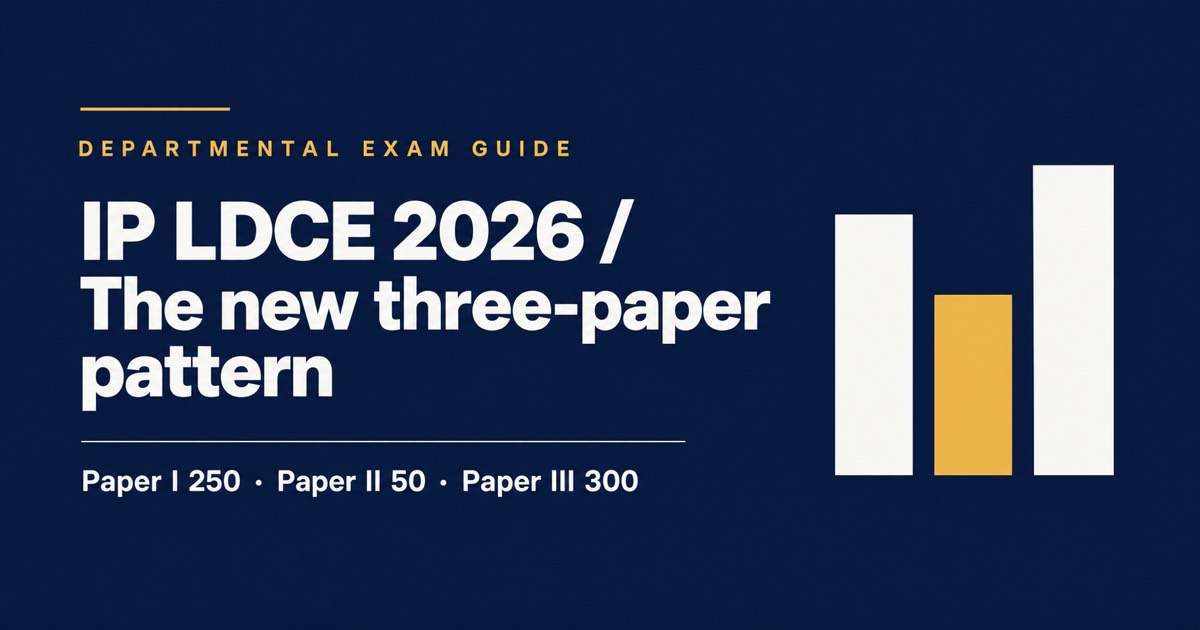
There are now three papers instead of four, 600 marks instead of 400, and one of the three is written rather than multiple choice. The savings-scheme rules, the Post Office Act 2023 and the Post Office Rules and Regulations 2024 are named in the syllabus by title. Several things the old syllabus asked for are gone.
What changed, in one table
| Item | Old pattern (06.04.2021) | Current pattern (22.08.2025) |
|---|---|---|
| Number of papers | Four | Three |
| Total marks | 400 | 600 |
| Written / descriptive paper | Within the papers | Paper-II only — noting, drafting, charge sheet |
| Governing statute | Indian Post Office Act, 1898 | The Post Office Act, 2023 |
| Savings schemes | POSB manuals | The nine notified 2019 scheme rules, by name |
| Newly named topics | — | DIGIPIN, PNOP, Dak Ghar Niryat Kendras, BNSS 2023, CCS (Pension) Rules 2021, GDS (Conduct & Engagement) Rules 2020, PMLA, Consumer Protection Act 2019 |
The exam pattern
| Paper | Type | Marks | Duration |
|---|---|---|---|
| Paper-I | 125 MCQs × 2 marks | 250 | 2 hours 30 minutes |
| Paper-II | Noting (15) + Drafting (15) + Draft charge sheet (20) — written | 50 | 1 hour |
| Paper-III | 150 MCQs × 2 marks | 300 | 3 hours |
| Total | 275 MCQs + one written paper | 600 | 6 hours 30 minutes over two days |
Papers I and III are objective, two marks a question. Paper-II is the only paper you write out by hand, and at 50 marks it is small — but it is also the paper almost nobody practises, which makes it the cheapest marks on the table. The examination is conducted without the aid of books.
Qualifying marks
| Category | In each paper | Overall average |
|---|---|---|
| General / UR / OBC | 40% | 45% |
| SC / ST / PwBD | 33% | 38% |
Both conditions have to hold: the per-paper floor in every paper, and the overall average. Clearing Papers I and III comfortably does not rescue a Paper-II below the floor, which is the other reason to spend time on the written paper.
Exam dates and timings
| Date | Paper | Time | Marks |
|---|---|---|---|
| 26 September 2026 | Paper-I | 11:00 — 13:30 | 250 |
| 26 September 2026 | Paper-II | 15:00 — 16:00 | 50 |
| 27 September 2026 | Paper-III | 10:00 — 13:00 | 300 |
Paper-I — 26 September 2026, 11:00 IST
Counting down to the first paper. Dates from the DoP notification F. No. DE-12/5/2026-DE-DOP dated 14.08.2026.
Paper-II the same afternoon at 15:00; Paper-III on 27 September at 10:00. Always confirm against your own Circle's notice and your admit card.
Applications ran from 21 August 2026 to 15 September 2026 — the original 5 September deadline was extended by F. No. DE-12/5/2026-DE-DOP dated 03.09.2026, which also moved verification to 16 September and corrections to 17 September. Exam centre allotment was fixed for 19 September and admit cards were made available from 22 September. The exam dates themselves were not changed. Centres are at Circle Headquarters across the 23 postal circles.
Vacancies and eligibility
| Field | Detail |
|---|---|
| Vacancy year | 1 January 2026 to 31 December 2026 |
| Quota | 66.66% departmental quota for the Inspector Posts cadre |
| Tentative vacancies | 27 — UR 21, SC 4, ST 2, plus 1 backlog PwBD |
| Qualifying service | Eight years of regular qualifying service as on 01.01.2026 |
| Age limit | Not exceeding 45 years as on 01.01.2026; five years relaxation for SC/ST |
| Eligible cadres | HSG-II, Postmaster Grade-II, Stenographer Grade-I, LSG, Postmaster Grade-I, PA/SA, Stenographer Grade-II |
The notification states that the vacancies are tentative and likely to increase, and that they are treated at the all-India level with a common merit list.
Paper-I syllabus (250 marks)
Acts
- The Post Office Act, 2023
- Government Savings Promotion Act, 1873
- Prevention of Money Laundering Act, 2002 and its amendments
- Consumer Protection Act, 2019
- Information Technology Act, 2000
Rules and the nine notified savings schemes
- Post Office Rules, 2024 and Post Office Regulations, 2024
- Government Savings Promotion General Rules
- Post Office Savings Account Scheme, 2019
- National Savings Recurring Deposit Scheme, 2019
- National Savings Time Deposit Scheme, 2019
- National Savings Monthly Income Account Scheme, 2019
- Senior Citizens’ Savings Scheme, 2019
- National Savings Certificate (VIII Issue) Scheme, 2019
- Kisan Vikas Patra Scheme, 2019
- Public Provident Fund Scheme, 2019
- Sukanya Samriddhi Account Scheme, 2019
Interest rates are notified quarterly and are therefore not a stable exam fact — learn the rules of each scheme (who may open it, tenure, deposit limits, premature closure, nomination, transfer), not this quarter’s rate.
Savings Bank, insurance and IT
- POSB Manual Volumes I, II and III
- POSB (CBS) Manual corrected up to 31 December 2021, and subsequent SB Orders
- Post Office Life Insurance Rules, 2011 and amendments; the SANKALAN compilation; PLI-CIS
- APT Knowledge (IT 2.0) and working knowledge of Core Banking Solutions
- India Post Payments Bank (IPPB) — a standalone syllabus item, not a footnote
Manuals, mails and guides
- Book of BO Rules
- Postal Manual Volumes II, III, IV, V, VI (Parts I, II and III), VII and VIII
- Mail operations and money remittances
- Post Office Guide Part I and Part II; inland and foreign post guidelines
- Preservation and disposal of postal records
- The Annual Report and the Book of Information of the Department of Posts
New and important postal topics
- Digital Postal Index Number (DIGIPIN)
- Mail Network Optimization Project (MNOP)
- Parcel Network Optimization Project (PNOP)
- Centralised delivery of postal articles
- Dak Ghar Niryat Kendras (DNKs)
- Directorate guidelines on consolidation of products
- Jansuraksha schemes and the guidelines on them
This block is where the 2025 revision put most of its new ground, and it is the block competitor syllabus pages are most likely to be missing.
Conduct and engagement rules (in Paper-I, not Paper-III)
- CCS (Conduct) Rules, 1964
- CCS (Classification, Control and Appeal) Rules, 1965
- CCS (Temporary Service) Rules, 1965
- GDS (Conduct and Engagement) Rules, 2020 and related orders
Worth noting where these sit: Conduct and CCA are Paper-I items, while the POSH Act is a Paper-III item. The charge sheet you draft in Paper-II is a CCA Rule 14 document.
Paper-II syllabus (50 marks, written)
| Component | Marks | What is asked |
|---|---|---|
| Noting | 15 | A note of about 200 words on a given topic |
| Drafting | 15 | A communication of about 200 words on a given topic |
| Draft Charge Sheet | 20 | A draft major penalty charge sheet |
The charge sheet is the single largest component of Paper-II and the most mechanical: it is a memorandum under Rule 14 of the CCS (CCA) Rules, 1965 with a Statement of Articles of Charge, a Statement of Imputations of Misconduct or Misbehaviour, a list of documents and a list of witnesses. Get the structure right and the marks follow. There is a separate guide on this paper below.
Paper-III syllabus (300 marks)
Constitution of India
- Preamble, Fundamental Rights, Directive Principles, Fundamental Duties
- Articles 124 to 147 — the Union Judiciary
- Articles 214 to 232 — the High Courts
- Article 311 — dismissal, removal and reduction in rank of civil servants
- Articles 338, 338A and 338B — the Commissions for SCs, STs and Backward Classes
The article ranges are specific and narrow. Article 311 is the one to know cold — it is the constitutional backing for the whole CCA disciplinary structure you draft in Paper-II.
Acts and administrative procedure
- Bharatiya Nagarik Suraksha Sanhita, 2023 — Sections 1, 2 and 84 only
- Central Administrative Tribunal Act, 1985
- Revenue Recovery Act, 1890
- Prevention of Corruption Act, 1988
- Right to Information Act, 2005 and the RTI Rules, 2012
- Sexual Harassment of Women at Workplace (Prevention, Prohibition and Redressal) Act, 2013
Financial rules and procurement
- General Financial Rules, 2017 — Chapters 2 and 6 only
- Manuals for Procurement of Goods, of Works, and of Consultancy and Other Services
- Schedule of Financial Powers
- Postal Financial Handbook Volumes I and II
Pension, provident fund and retirement benefits
- General Provident Fund (Central Services) Rules, 1960
- CCS (Pension) Rules, 2021 and amendments
- CCS (Commutation of Pension) Rules, 1981
- National Pension System and the related CCS Rules
- Service Discharge Benefit Scheme, 2010
CCS (Pension) Rules 2021 replaced the 1972 rules. A 2021-rule question answered from a 1972-rule note is a very easy mark to lose.
Establishment and general ability
- Fundamental Rules and Supplementary Rules (FR & SR)
- Casual labourers and related DoP&T instructions
- APAR maintenance instructions
- Welfare measures for departmental employees and GDS
- English language; General Knowledge and current affairs (economy, polity, sports, culture, science)
- Reasoning, intelligence, mental aptitude, quantitative aptitude
- Interpersonal skills and ethics
The moving cutoff nobody tells you about
The syllabus scopes itself in time: circulars, orders and guidelines issued up to 31 December of the year preceding the exam year are part of the syllabus, and the latest Annual Report and Book of Information published on the Department of Posts website apply. For a 2026 exam that means anything issued up to 31 December 2025. An SB Order from March 2026 is outside the syllabus; one from November 2025 is inside it.
Sample questions from the topics above
These three are from our IP LDCE question bank. Every question in it carries an independent pass from two separate AI auditors, and items that could not be verified against a published source — small-savings interest rates, DA-linked figures, which Postal Manual volume covers which subject — were dropped rather than guessed.
A postal circle in the Department of Posts is headed by an officer of which designation?
- A. Chief Postmaster General
- B. Superintendent of Post Offices
- C. Director of Postal Services
- D. Senior Postmaster
Answer: Chief Postmaster General
Each postal circle is headed by a Chief Postmaster General. A Superintendent of Post Offices heads a postal division, a Director of Postal Services assists the circle head at the regional level, and a Senior Postmaster heads a large head post office.
Which unit of the Department of Posts is a postal division, the field unit that an Inspector of Posts is attached to, headed by?
- A. Superintendent of Post Offices
- B. Chief Postmaster General
- C. Postmaster General of the region
- D. Director General of Postal Services
Answer: Superintendent of Post Offices
A postal division, the basic field administrative unit, is headed by a Superintendent or Senior Superintendent of Post Offices, and Inspectors of Posts work under that officer. The other designations sit at region, circle or directorate level, above the division.
From the ProSyllabus IP LDCE question bank — 15 quizzes, 150 questions, each one passed independently by two auditors.
Article 311 of the Constitution protects a civil servant by providing that he shall not be:
- A. dismissed or removed by an authority subordinate to that which appointed him
- B. transferred out of his home state without consent
- C. placed under suspension in any circumstances
- D. required to retire before the age of sixty in any circumstances
Answer: dismissed or removed by an authority subordinate to that which appointed him
Article 311(1) forbids dismissal or removal by an authority subordinate to the appointing authority, and Article 311(2) requires an inquiry with a reasonable opportunity of being heard. Transfer, suspension and compulsory retirement are dealt with by service rules rather than by this constitutional protection.
From the ProSyllabus IP LDCE question bank — 15 quizzes, 150 questions, each one passed independently by two auditors.
How to use the last week
- Paper-II first, not last. It is 50 marks with a per-paper floor, and the charge sheet format is the only part of this exam you can learn to full marks in an evening.
- Read the Acts as Acts. The Post Office Act 2023 is short. Reading the actual sections beats reading a summary of a summary, and the audit of our own question bank found a widely-repeated error in circulating notes: it is the Director General, not the Central Government, who fixes charges by regulation under section 3(2)(b).
- Learn the nine scheme rules as a grid — who can open, minimum and maximum deposit, tenure, premature closure, nomination, transfer. Not the rates.
- Do not revise from a four-paper syllabus. If a set of notes has a "Paper-IV", it predates 22 August 2025.
- Know your article ranges. 124–147, 214–232, 311, 338/338A/338B. Reading the whole Constitution is a worse use of the last week than knowing those cold.
How many papers are there in IP LDCE 2026?
Three. Paper-I is 125 MCQs for 250 marks in 2 hours 30 minutes, Paper-II is a written paper of 50 marks in 1 hour, and Paper-III is 150 MCQs for 300 marks in 3 hours — 600 marks in total. The earlier four-paper pattern was superseded by DoP letter No. 7-14/2011-SPN-II dated 22 August 2025.
What are the IP LDCE 2026 exam dates?
Paper-I on 26 September 2026 from 11:00 to 13:30 and Paper-II the same day from 15:00 to 16:00; Paper-III on 27 September 2026 from 10:00 to 13:00. The dates were not changed when the application window was extended to 15 September 2026.
What are the qualifying marks for IP LDCE?
General candidates need 40% in each paper and a 45% overall average. SC, ST and PwBD candidates need 33% in each paper and a 38% overall average. Both conditions apply — the per-paper floor and the overall average.
Is there negative marking in IP LDCE 2026?
The pattern letter prescribes 125 and 150 multiple-choice questions at two marks each and does not prescribe a negative-marking deduction. Because a deduction would be stated on the question paper and in the instructions to candidates, confirm it on your own admit card and paper instructions rather than on any website.
How many vacancies are there in IP LDCE 2026?
27 tentative vacancies for vacancy year 2026 — 21 UR, 4 SC, 2 ST and 1 backlog PwBD — against the 66.66% departmental quota. The notification says the number is tentative and likely to increase.
Who is eligible for the Inspector Posts LDCE?
Officials with eight years of regular qualifying service as on 1 January 2026 and not more than 45 years of age on that date, with five years relaxation for SC and ST officials. Eligible cadres include HSG-II, Postmaster Grade-II, Stenographer Grade-I, LSG, Postmaster Grade-I, PA/SA and Stenographer Grade-II.
Is the Post Office Act 2023 part of the IP LDCE syllabus?
Yes — it is the first item listed under Acts in Paper-I, replacing the Indian Post Office Act, 1898 which it repealed. The Post Office Rules, 2024 and Post Office Regulations, 2024 made under it are also named in Paper-I.
How far back do circulars and SB Orders count?
Up to 31 December of the year preceding the exam year — so 31 December 2025 for the 2026 exam. The latest Annual Report and Book of Information on the Department of Posts website also apply.
Where this came from
Pattern, marks and qualifying marks: DoP pattern letter No. 7-14/2011-SPN-II dated 22.08.2025, which supersedes No. 7-14/2011-SPN-II dated 06.04.2021. Dates, vacancies and eligibility: the LDCE IP 2026 notification F. No. DE-12/5/2026-DE-DOP dated 14.08.2026, as revised by F. No. DE-12/5/2026-DE-DOP dated 03.09.2026. The paper-wise topic lists are transcribed from public reproductions of the pattern letter — the Department does not publish the syllabus as text on indiapost.gov.in — so check your Circle's own notice and the letter itself before relying on a single line. Where our reading and a circulating note disagreed, we have said so on the page rather than picked the convenient version.
The rest of the India Post series
- IP LDCE Paper II — noting, drafting and the major-penalty charge sheet
- IP LDCE previous year question papers and answer keys
- India Post PA/SA LDCE (LGO) — syllabus, pattern, DEST and the merit rule
- GDS to MTS, Postman and Mail Guard — syllabus and pattern
- The Post Office Act, 2023 — summary and MCQs
- CCS (Conduct) Rules, 1964 — notes and MCQs
- CCS (CCA) Rules, 1965 — penalties, procedure and MCQs
- The POSH Act, 2013 — notes and MCQs
- DIGIPIN explained — India Post’s digital address code
- India Post Payments Bank (IPPB) for departmental exams
Practice: IP LDCE quizzes · syllabus · previous papers · PA/SA/MTS