Checked 26 September 2026. From the CET Cell’s “Document on Normalization” (MHT-CET Result Processing Methodology — the same file for 2024, 2025 and 2026), the 2026 brochure and the CAP 2026-27 brochure (tie-breaks).
MHT CET runs in dozens of sessions, each with its own question paper, so the CET Cell does not publish marks. It publishes a percentile worked out inside each session. The method is set out in a seven-page “Document on Normalization” that has not changed since 2024: the 2025 and 2026 files have the same MD5 checksum, and the 2024 file’s text matches apart from whitespace (our check, 26 September 2026). This guide walks through the formula, what it does and does not do, and why it produces so many “100 percentile” results.
CET Cell “Document on Normalization”; CAP brochure 2026-27.
Where other pages get this wrong
The CET Cell computes percentiles within each session from raw marks; in 2026 it computed them separately for each attempt and used the better total.
Commonly published instead: “The State Cell will use the normalisation method across both attempts.”
MHT-CET 2026 brochure p. 15 and the Document on Normalization: no cross-attempt or cross-session equating step is described.
The formula
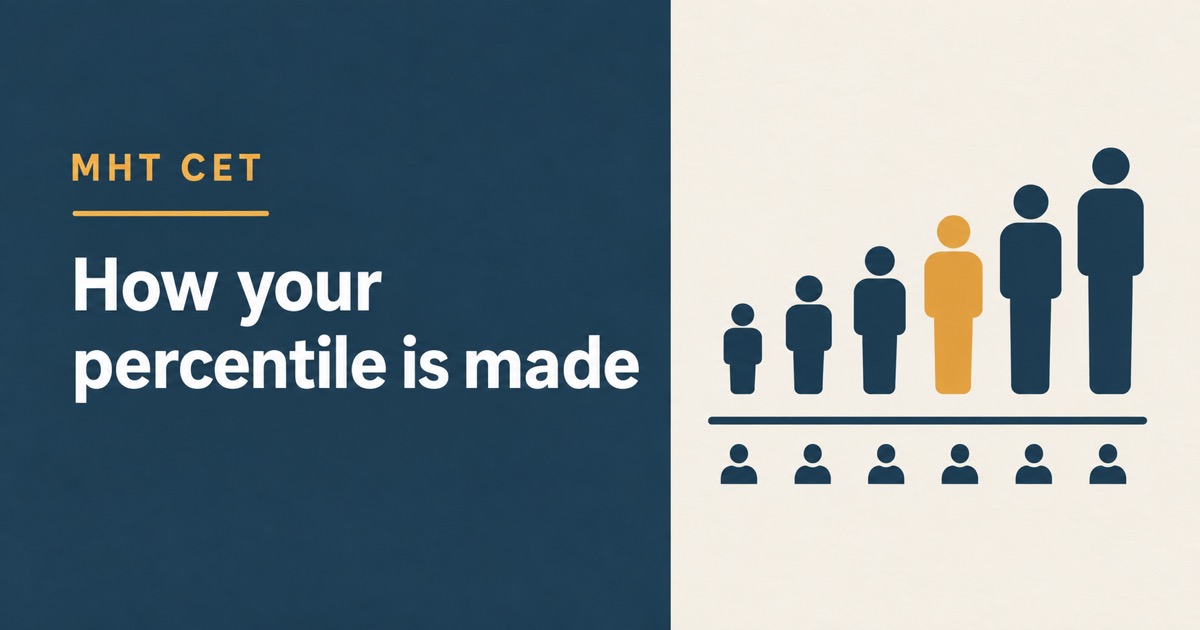
The document defines the percentile as the percentage of candidates in the session who scored equal to or below a candidate. In the CET Cell’s own form:
| Term | Meaning |
|---|---|
| Percentile | 100 × (candidates who appeared in the session with a raw score equal to or below yours) ÷ (total candidates who appeared in the session) |
| Where it applies | Separately to the total and to each subject — Mathematics, Physics, Chemistry (and Biology, and the PCB total) |
| Precision | 7 decimal places, “to avoid bunching effect and reduce ties” |
| Top of each session | “The highest raw score in each paper … will be the 100 Percentile” |
| Total vs subjects | The total percentile is computed from the total raw score; it “shall NOT be an aggregate or average” of subject percentiles |
| Combining sessions | Session percentiles are merged and “shall be called the CET scores” |
CET Cell, Document on Normalization (MHT-CET 2026 Result Processing Methodology), pp. 1–4 and 7; the formula is printed as an image on pp. 1 and 4.
The CET Cell’s percentile formula, worked
“Document on Normalization” (CET Cell; the same file for 2024, 2025 and 2026): Percentile = 100 × (candidates appeared in the session with raw score equal to or below the candidate) ÷ (total candidates in the session), to 7 decimal places, separately for the total and for each subject. The highest raw score in each session is 100. Session sizes are not published — the numbers here are yours to try.
A worked example with the formula: in a session of 30,000 candidates, a candidate with 29,700 people at or below their raw score (including themselves) gets 100 × 29,700 ÷ 30,000 = 99.0000000. Nothing about marks survives into that number — two candidates with the same raw marks in different sessions can have different percentiles, and the CET Cell treats that as the point: it assumes candidates are spread randomly across roughly equal sessions, so a candidate’s standing in their own session is a fair measure.
Why so many 100-percentile candidates?
Because every session has a top scorer, and the top scorer of every session gets exactly 100 — as does anyone tied with them. More sessions therefore mean more 100s, whatever the papers were like. The CET Cell’s own counts show it.
| Sitting | Sessions | At 100 percentile |
|---|---|---|
| 2024 PCM | Not published | 20 |
| 2024 PCB | Not published | 17 |
| 2025 PCM | Not published | 22 |
| 2025 PCB | Not published | 14 |
| 2026 PCM 1st | 16 | 26 |
| 2026 PCM 2nd | 11 | 12 |
| 2026 PCB 1st | 11 | 11 |
| 2026 PCB 2nd | 4 | 4 |
CET Cell press notes and result notices 2024–2026 (100-percentile counts; 2024 counted from the press note’s rows — our count). The 2024 public notice of 24.06.2024 lists 100-percentile candidates session by session, including two in one PCB session.
In 2026 the PCB second attempt had four sessions and exactly four 100-percentile candidates; the PCB first attempt had eleven and eleven. The PCM numbers run above the session count because of ties at the top. None of this says anything about how hard a paper was — it is the formula doing what it says.
What the percentile is not
| It is not | Why |
|---|---|
| A percentage of marks | 99 percentile means 1% of your session scored higher, not that you scored 99% of the marks |
| An All India Rank | CAP ranks Maharashtra candidates by a State General Merit Number; All-India seats go on JEE (Main) |
| Derived from a published marks table | The CET Cell publishes no marks-to-percentile table; answer keys are shown to candidates for objections, not as a public marks table |
| An average of subject percentiles | The total is ranked on total raw marks |
| Equated between attempts | Each 2026 attempt was ranked on its own; the better total was kept |
Document on Normalization; MHT-CET 2026 brochure pp. 7, 15; CAP cut-off list legends. Any marks-versus-percentile table online is an estimate, not a CET Cell figure.
What the method assumes, and what that means for you
The document states its aim plainly: candidates should be “neither benefitted nor disadvantaged due to the difficulty level” of the session they happened to sit. It gets there by assumption rather than by adjusting marks — it takes candidates to be allocated randomly across sessions of roughly equal size, so that every session holds a similar spread of ability. If that holds, being in the top 1% of your session means the same thing as being in the top 1% of any other, whatever each paper was like.
Two consequences are worth knowing. First, the bottom of the scale depends on session size: the lowest scorer in a session of 30,000 gets a much smaller percentile than the lowest scorer in a session of 3,000, because far fewer people are at or below them in proportion. The document notes this itself. Second, a hard paper does not hurt you by itself — if your session found it hard, your rivals did too, and your percentile reflects your rank among them, not the marks. What does hurt is losing easy marks your session-mates took, which is why accuracy on the straightforward Class 12 questions matters more than chasing the hardest ones. And with no negative marking, a guess on an unanswered question can only move you up.
Ties: the order the CAP merit list uses
| Step | Tie broken by |
|---|---|
| 1 | Higher marks or score in Mathematics at CET |
| 2 | Higher marks or score in Physics at CET |
| 3 | Higher marks or score in Chemistry at CET |
| 4 | HSC percentage in Physics, Chemistry and Mathematics together |
| 5 | HSC Mathematics percentage |
| 6 | HSC Physics percentage |
| 7 | HSC aggregate percentage |
CAP Information Brochure 2026-27, printed pp. 60–61, clauses (a)–(g), for B.E./B.Tech — quoted: “higher marks or score in Mathematics at CET”, and so on. The 2026 final merit list prints the Mathematics, Physics and Chemistry percentiles beside the total. Other courses (pharmacy, for instance) have their own rules.
The seven decimals do most of the work — ties on the total percentile are rare — but when two candidates share a total percentile, the brochure’s “marks or score” in each subject decides who is ahead, starting with Mathematics. That makes the Mathematics section, already worth 100 of the 200 marks, doubly important for PCM candidates.
A caution about the document’s own examples
The Document on Normalization ends with worked tables. They are illustrations, and they do not all follow the formula: the same percentile, 99.9119718, is shown for sessions of 2,249 and 2,216 candidates, which the formula cannot produce. Use the rule on pages 1 and 4, not the example numbers.
Our arithmetic from the CET Cell formula; session sizes are illustrative — the CET Cell does not publish them.
| Session size (illustrative) | Candidates at or below you for 99 percentile | Candidates above you |
|---|---|---|
| 10,000 | 9,900 | 100 |
| 30,000 | 29,700 | 300 |
Our arithmetic.
Practise it, don't just read it
The percentile rewards being ahead of your own session, and no marks are lost for wrong answers. The MHT CET quizzes help raise raw scores in the high-weight Class 12 chapters.
The ProSyllabus MHT CET library has topic quizzes on laws of motion, rotational dynamics, current electricity, electrochemistry, chemical kinetics, equilibrium, organic basics, quadratic equations and complex numbers, and calculus — the first quiz is free.
How is MHT CET percentile calculated?
100 × candidates in your session with a raw score equal to or below yours ÷ candidates in the session, to 7 decimals.
Why do so many students get 100 percentile in MHT CET?
Every session’s top scorer gets exactly 100, so more sessions produce more 100s.
Is MHT CET percentile the same as percentage?
No — it is your standing within your session, not a share of marks.
Does MHT CET give an All India Rank?
No — CAP uses a Maharashtra State General Merit Number; All-India seats use JEE (Main).
Is there normalisation between MHT CET attempts?
No equating step is described; each attempt is ranked on its own and the better total is used.
How are ties broken in MHT CET merit?
Mathematics, then Physics, then Chemistry, then HSC marks.
Does the CET Cell publish a marks vs percentile table?
No.
Has the MHT CET normalisation method changed?
No — the 2024, 2025 and 2026 documents are the same.
Is total percentile the average of subject percentiles?
No — it is computed from the total raw score.
Can two students with the same marks have different percentiles?
Yes, if they sat different sessions.
More in this series
- MHT CET two attempts: 2026 explained, 2027 outlook
- MHT CET: use your merit number, not your percentile
- MHT CET cut-off: COEP, VJTI, SPIT, PICT, WCE and 120 courses
- MHT CET CAP rounds: freeze, betterment, seat codes and fee
- MHT CET eligibility: Types A–E, the 45% rule, PCB branches
- MHT CET pattern and syllabus: 90 + 90 minutes, Class 11 chapters
- MHT CET notice board — official updates
Sources
- official — State CET Cell — “Document on Normalization”: MHT-CET 2026 Result Processing Methodology
- official — State CET Cell — MHT-CET 2026 Information Brochure (updated 11.04.2026)
- official — CET Cell — Information Brochure for UG & PG Technical Courses 2026-27 (02.07.2026)
- official — State CET Cell — Press note, PCM 1st attempt result 2026 (16.06.2026)
- official — State CET Cell — Press note, PCM 2nd attempt result 2026 (19.06.2026)
- official — State CET Cell — PCB 1st attempt result notification 2026 (09.06.2026)
- official — State CET Cell — Press note, PCB 2nd attempt result 2026 (18.06.2026)
- official — State CET Cell — PCM 2025 result notification (16.06.2025)
- official — State CET Cell — PCB 2025 result notification (17.06.2025)
- official — State CET Cell — Press note MHT-CET 2024 (16.06.2024)
- reported — Collegedunia — MHT CET marks vs rank (reported; see corrections)
official = a document published by the conducting body. reported = a news or coaching site we could not check against an original. Where sources disagree this page says so rather than picking one.