Checked 26 September 2026. From the MHT-CET 2026 Information Brochure (pattern, timing, medium) and the CET Cell’s syllabus document for CETs under Technical Education 2026-27; 2025 brochure for comparison. Unchanged from 2025 to 2026; no 2027 document had been published on 26 September 2026.
MHT CET is a two-block, 180-minute computer-based test with no negative marking, set on the Maharashtra state-board syllabus. The question, marks and timing structure did not change between 2025 and 2026 — what changed was the number of attempts, the centres and the Mathematics-medium clause (all covered below) — so the structure is the safest thing to plan 2027 preparation around. This guide sets out the pattern, the exact Class 11 chapters that are in scope, how the clock works, and the medium rules, from the CET Cell’s own documents.
MHT-CET 2026 Information Brochure; syllabus document 2026-27.
Where other pages get this wrong
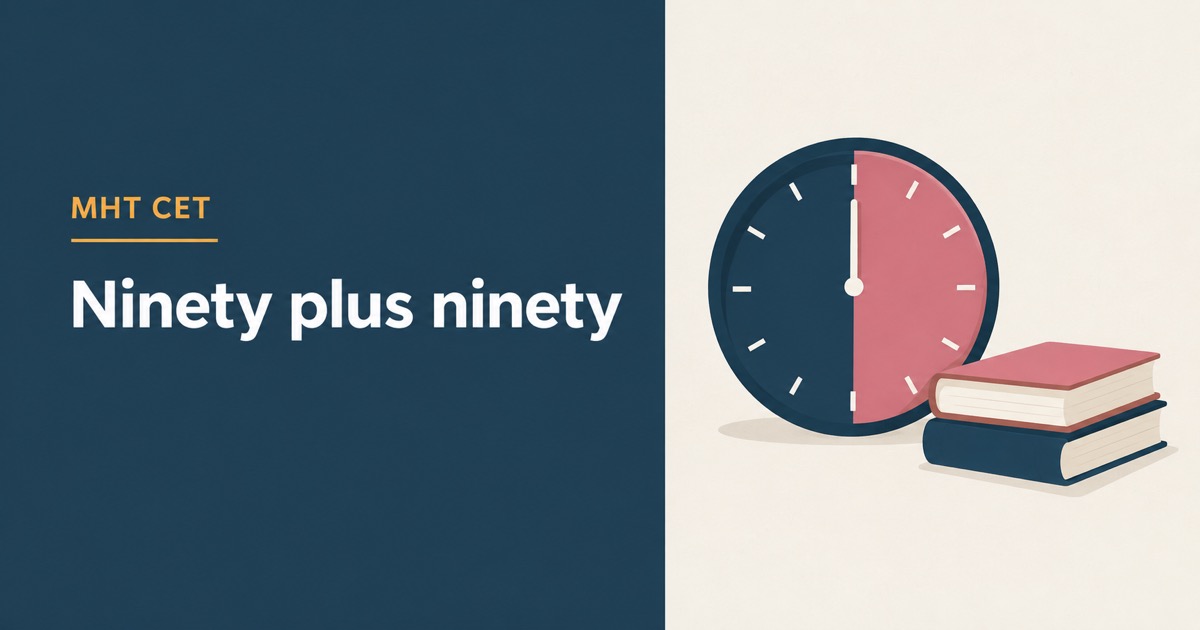
MHT CET lasts 180 minutes: Physics and Chemistry together in the first 90 minutes (auto-submitted), then Mathematics or Biology in the next 90.
Commonly published instead: Careers360’s 2027 page: a “2 Hours and 45 Minutes” exam with Mathematics, Physics and Chemistry as three separate 90-minute papers.
MHT-CET 2026 Information Brochure (examination pattern and timing).
The paper, subject by subject
| Subject | Questions (Class 11 + Class 12) | Marks each | Marks | Block |
|---|---|---|---|---|
| Physics | 50 (10 + 40) | 1 | 50 | First 90 minutes |
| Chemistry | 50 (10 + 40) | 1 | 50 | First 90 minutes |
| Mathematics (PCM) | 50 (10 + 40) | 2 | 100 | Second 90 minutes |
| Biology (PCB) | 100 (20 + 80) | 1 | 100 | Second 90 minutes |
Syllabus document for CETs under Technical Education 2026-27 and MHT-CET 2026 Information Brochure: online computer-based test, multiple choice with four options and one correct answer, no negative marking. PCM = 150 questions and PCB = 200 questions, each for 200 marks (our sum).
From the table above: approximately 20% Class 11 and 80% Class 12 in every subject.
Three things follow from the table. Mathematics carries half of a PCM candidate’s marks from one-third of the questions, because each is worth two. Biology is half of a PCB paper by questions and marks. And because there is no negative marking, an unanswered question is simply a lost mark — there is no reason to leave anything blank when the clock runs out. The official description of the level is that Mathematics, Physics and Chemistry questions are “at par with” JEE (Main), Biology “at par with” NEET, and the questions are “mainly application based”.
How the clock works
| Block | PCM | PCB | Average per question (our arithmetic) |
|---|---|---|---|
| Minutes 1–90 | Physics + Chemistry, 100 questions | Physics + Chemistry, 100 questions | 54 seconds |
| Minutes 91–180 | Mathematics, 50 questions | Biology, 100 questions | Maths 108 seconds; Biology 54 seconds |
MHT-CET 2026 Information Brochure: the first block is submitted automatically at 90 minutes and the second block then opens; time cannot be carried from one block to the other. Averages are 90 minutes divided by the number of questions (ours).
The two blocks are sealed from each other. Time left over in Physics and Chemistry does not carry into Mathematics, and you cannot go back to Chemistry once the second block has opened. The brochure describes the first 90 minutes as one Physics-and-Chemistry block with no subject-wise time limit inside it, so the split within those 90 minutes is yours to plan (check how navigation works in the official mock test) — the tool below turns a result into a raw score. Compensatory time is 20 minutes per hour — 30 minutes on a 90-minute block — for candidates granted a scribe or extra time, and only for the disability categories the brochure’s table marks as eligible; not every category gets it.
Raw score out of 200 (no negative marking)
MHT-CET pattern (brochure and syllabus document 2026): PCM = Physics 50 × 1 + Chemistry 50 × 1 + Mathematics 50 × 2; PCB = Physics 50 × 1 + Chemistry 50 × 1 + Biology 100 × 1; no negative marking. Raw marks are converted to a session percentile — the CET Cell publishes no marks-to-percentile table, so this tool stops at marks.
The syllabus: Maharashtra State Board, not NCERT
The syllabus document is explicit: questions are based on the “Syllabus of State Council Of Educational Research And Training, Maharashtra” — the whole Class 12 syllabus plus a listed set of Class 11 chapters. NCERT is not mentioned in any MHT CET document. For students from the state board this is their own textbook; for CBSE students it means checking the few places where the Maharashtra syllabus orders or covers topics differently. The CET Cell does not reproduce the Class 12 syllabus (“since XII standard whole syllabus is to be covered”), publishes no chapter-wise weightage beyond the 20:80 split, and lists no deleted Class 12 chapters.
| Subject | Class 11 chapters in scope (2026, same as 2025) |
|---|---|
| Physics | Vectors; Error Analysis; Motion in a plane; Laws of Motion; Gravitation; Thermal properties of matter; Sound; Optics; Electrostatics; Semiconductors |
| Chemistry | Some Basic Concepts of Chemistry; Structure of Atom; Chemical Bonding; Redox Reactions; Elements of Group 1 and 2; States of Matter (Gaseous and Liquids); Adsorption and Colloids (Surface Chemistry); Hydrocarbons; Basic Principles of Organic Chemistry; Chemistry in Everyday Life |
| Mathematics | Trigonometry II; Straight Line; Circle; Probability; Complex Numbers; Permutations and Combinations; Functions; Limits; Continuity; Conic Section |
| Biology | Biomolecules; Respiration and Energy Transfer; Human Nutrition; Excretion and Osmoregulation |
Syllabus of CETs under Technical Education, A.Y. 2026-27 (and the 2025 brochure, identical list). Class 12: the whole SCERT Maharashtra syllabus.
The Class 11 list is short on purpose: ten chapters each for Physics, Chemistry and Mathematics, and four for Biology, supply the 10 (or 20) Class 11 questions per subject. Everything else in Class 11 is out of scope, so a Class 11 revision plan should start from this table rather than from the full textbook. The Class 12 book, by contrast, is in scope whole and supplies 80% of the paper — which is where most preparation time should go.
Medium and centres
| 2025 | 2026 | Question |
|---|---|---|
| English / Marathi / Urdu | English / Marathi / Urdu (English version final in case of doubt) | Languages for Physics, Chemistry, Biology |
| “Mathematics paper shall be only in English” | Not stated separately — the clause on Mathematics was dropped; another clause says PCM questions “will be available in English/Urdu/Marathi” | Language for Mathematics |
| Maharashtra plus centres in other states’ capitals | “Across the state Maharashtra only” | Where the exam is held |
MHT-CET 2025 and 2026 Information Brochures. Whether Mathematics was actually offered in Marathi or Urdu in 2026 is not stated explicitly in any document we found — check the 2027 brochure.
If you plan to take Mathematics in Marathi or Urdu, do not assume either way: the 2025 brochure said English only, and the 2026 brochure neither repeats that sentence nor says Mathematics is available in other media, while a separate clause lists all three languages for “PCM” questions. The 2027 brochure will be the document to read. For out-of-state candidates, note that 2026 moved every centre inside Maharashtra, where 2025 also had centres in the capitals of Bihar, Chhattisgarh, Delhi-NCR, Gujarat, Jharkhand, Karnataka, Telangana, Madhya Pradesh, Rajasthan and Uttar Pradesh.
Planning around the pattern
Three plain choices fall out of the official pattern (our reading, not CET Cell advice). Spend most hours on the Class 12 book, which is 80% of every subject. For PCM, treat Mathematics as half the exam, since its 50 questions carry 100 marks and it is also the first tie-breaker in the CAP merit list (CAP Information Brochure 2026-27, not the exam brochure). And practise the first 90-minute block as one unit — 100 Physics and Chemistry questions at about 54 seconds each — because the split between those two subjects is the only timing decision you control.
What the percentile does to all this
Your raw score out of 200 is converted to a percentile within your session: the share of candidates in your session who scored at or below you. There is no official marks-to-percentile table, so no raw score can be promised a percentile in advance — it depends on who sat in your session and how hard its paper was. The percentile guide in this series has the CET Cell’s formula; the merit-number guide shows why 2026 percentiles are not comparable with 2025’s.
Practise it, don't just read it
Four-fifths of every MHT CET paper comes from Class 12. The MHT CET quizzes cover those Physics, Chemistry and Mathematics chapters.
The ProSyllabus MHT CET library has topic quizzes on laws of motion, rotational dynamics, current electricity, electrochemistry, chemical kinetics, equilibrium, organic basics, quadratic equations and complex numbers, and calculus — the first quiz is free.
What is the MHT CET exam pattern?
PCM 150 questions or PCB 200 questions, 200 marks, 180 minutes in two 90-minute blocks, no negative marking.
Is there negative marking in MHT CET?
No.
How many marks is each Mathematics question?
Two; Physics, Chemistry and Biology questions carry one mark each.
How much of MHT CET is from Class 11?
About 20% — 10 questions each in Physics, Chemistry and Mathematics and 20 in Biology, from listed chapters only.
Which Class 11 chapters are in MHT CET Maths?
Trigonometry II, Straight Line, Circle, Probability, Complex Numbers, Permutations and Combinations, Functions, Limits, Continuity, Conic Section.
Is the MHT CET syllabus NCERT?
No — it is the Maharashtra SCERT (state board) syllabus.
Is MHT CET 2 hours 45 minutes long?
No, 180 minutes: Physics and Chemistry for 90, then Mathematics or Biology for 90.
Can I use leftover Physics time for Maths?
No, the first block is auto-submitted at 90 minutes.
Is MHT CET Maths available in Marathi?
The 2025 brochure said English only; the 2026 brochure is not explicit — check the 2027 brochure.
More in this series
- MHT CET two attempts: 2026 explained, 2027 outlook
- How MHT CET percentile is calculated
- MHT CET: use your merit number, not your percentile
- MHT CET cut-off: COEP, VJTI, SPIT, PICT, WCE and 120 courses
- MHT CET CAP rounds: freeze, betterment, seat codes and fee
- MHT CET eligibility: Types A–E, the 45% rule, PCB branches
- MHT CET notice board — official updates
Sources
- official — State CET Cell — MHT-CET 2026 Information Brochure (updated 11.04.2026)
- official — State CET Cell — Syllabus of CETs under Technical Education, A.Y. 2026-27
- official — State CET Cell — Revised Information Brochure MHT-CET 2025
- official — CET Cell — Information Brochure for UG & PG Technical Courses 2026-27 (02.07.2026)
- official — State CET Cell — “Document on Normalization”: MHT-CET 2026 Result Processing Methodology
- reported — Careers360 — MHT CET 2027 exam date (reported; see corrections)
official = a document published by the conducting body. reported = a news or coaching site we could not check against an original. Where sources disagree this page says so rather than picking one.