Checked 15 October 2026. UHR’s pages re-read on 15 October 2026. The questions are our own, written from Sverige i fokus (1st edition, corrected version 2026-08-10). UHR has published five example questions and no past paper; the number of questions, the time and the pass mark of the real test are not announced. If UHR issues a new edition of the guide, facts and page numbers here can change.
What real medborgarskapsprov frågor look like
UHR has told candidates very little about the questions themselves. The test is in Swedish, it is written on paper, and it “består av flervalsfrågor med fyra svarsalternativ, där ett svar är rätt” — multiple-choice questions with four options, one correct [official: UHR]. It has published five example questions and nothing else. There is no past paper, because the only sitting so far, in August 2026, was a trial test whose questions have not been released.
| Fact | Status | Source |
|---|---|---|
| Language | Swedish only | UHR, Frågor och svar |
| Question type | Multiple choice, four options, one correct | UHR |
| Number of questions, test time | Not announced for the next sitting | UHR |
| Pass mark | August 2026 trial: set after the test. Later sittings: not announced | UHR, Frågor och svar |
| Minus points for a wrong answer | None. UHR’s tip: “Våga gissa! Det finns inga minuspoäng.” | UHR, Provdagen |
| Official example questions | Five, on UHR’s pages; no past paper | UHR |
| What the test is based on | Sverige i fokus, corrected version 2026-08-10 | Sverige i fokus, p.4; UHR |
| Questions on this page | 30 of our own, from Sverige i fokus, with the page for every answer | Ours |
Checked on 15 October 2026 against UHR’s pages on medborgarskapsprovet. The August 2026 results had not been published and UHR had released no questions from that test.
Sammanfattning på svenska
- Här finns 30 egna övningsfrågor på svenska. Varje fråga har fyra svarsalternativ och ett rätt svar, som på det riktiga provet. Till varje svar finns en förklaring och sidan i Sverige i fokus där svaret står.
- Frågorna är inte UHR:s frågor. UHR har publicerat fem exempelfrågor och inga gamla prov. UHR står inte bakom övningsprov som andra personer eller företag har gjort.
- Frågorna är ordnade efter de 13 kapitlen i Sverige i fokus. En tabell längre ner visar vilka kapitel som hör till de elva kunskapsområdena i förordningen (2026:451). Den kopplingen är vår egen bedömning.
- Antal frågor, provtid och gräns för godkänt på nästa prov har inte meddelats.
- Det finns inga minuspoäng. Svara därför på alla frågor.
- Kontrollerat 15 oktober 2026.
Those five examples are worth studying for their shape, and you should read them on UHR’s own page rather than in a copy. We do not reproduce them here. What they show:
| UHR example | Area of the guide | What kind of question it is |
|---|---|---|
| 1 | Labour market (kapitel 8, where the public sector is defined; its welfare services are kapitel 9) | The main task of something: a definition question |
| 2 | How Sweden is governed (kapitel 3) | A title or a name: one-word answers |
| 3 | The country Sweden (kapitel 1) | A resource with a long-standing role in the economy |
| 4 | Sweden and the world (kapitel 11) | History fixed by a year and a duration |
| 5 | Law and justice (kapitel 5) | A short everyday situation: choose the option that best describes how a right works |
Two things stand out. Four of the five ask for a plain fact that is one sentence in the study guide. The fifth describes a person doing something and asks which statement fits; that type cannot be answered by matching a word, only by understanding the rule. The thirty questions below are all of the first kind, plain facts and definitions from the guide; for the scenario kind, practise on UHR’s own example 5. The mapping of UHR’s examples to chapters is ours.
Where other pages get this wrong
No one outside UHR has the real questions.
Commonly published instead: pages and apps that present their question bank as “the real medborgarskapsprov questions” or as questions “from the August 2026 test”.
UHR writes that practice tests made by other people or companies exist online, that it does not stand behind them, and that their quality has not been checked by UHR or any other authority [official: UHR]. Judge any practice set, including this one, by whether each answer can be found in Sverige i fokus.
How these 30 questions were written
- Each fact is a sentence in Sverige i fokus, corrected version of 10 August 2026. The page is given with every answer so that you can check it.
- Questions are in Swedish, because the test is. The English line under each one is our translation and will not be on the paper.
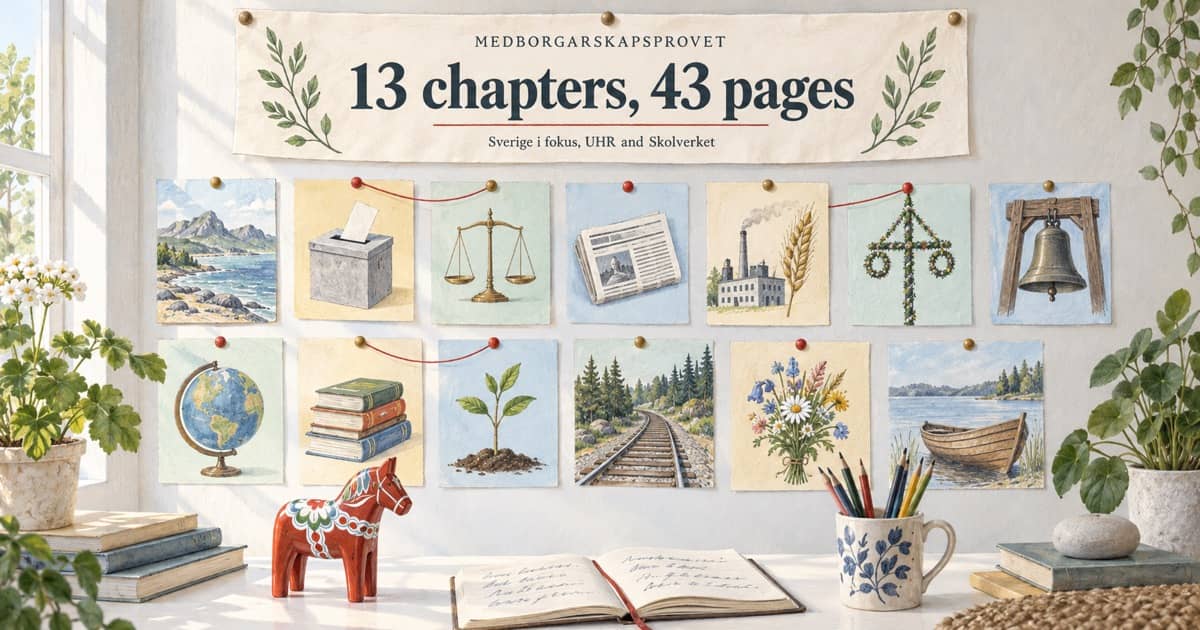
- They are grouped by the guide’s 13 chapters: three each for the longest chapters, two for the others.
- Wrong options are taken from the same chapter where possible, so that the choice is between things the guide actually mentions.
- None repeats the ten questions of the mini test, the questions in our quiz library, the revision kit’s self-test or UHR’s five examples.
Our own questions. They have not been seen or approved by UHR.
A spread across all 13 chapters. It is not a forecast of the real paper: with no past paper published, nobody can say how UHR weights the chapters.
Themes of the test and where to read them
The ordinance on the test lists, “till exempel”, eleven areas that basic knowledge of Swedish society is to cover (förordning (2026:451) 2 §) [official: förordning (2026:451)]. The left column gives them word for word in Swedish. The middle column names the chapters of Sverige i fokus under their official titles, as UHR lists them on its study-material page, where each chapter also has its own audio file. Matching areas to chapters is our reading: neither text prints it. The right column shows which of the thirty questions below come from those chapters.
| Area in the ordinance (2 §) | Chapter of Sverige i fokus (official title, pages) | Questions on this page from those chapters |
|---|---|---|
| 1. historiska händelser som har format Sverige | 10. Sveriges moderna historia (pp.32–38); 11. Sverige och omvärlden (pp.39–41) | 22, 23, 24, 25, 26 |
| 2. traditioners betydelse för det svenska samhället | 13. Traditioner och högtider (pp.45–47) | 29, 30 |
| 3. den svenska välfärdsstaten | 9. Välfärdssamhället (pp.30–31) | 20, 21 |
| 4. arbetsmarknad, arbetsliv och privatekonomi | 8. Arbetsmarknad och privatekonomi (pp.27–29) | 18, 19 |
| 5. klimatet och miljöns betydelse för det svenska samhället | 1. Landet Sverige (pp.5–9) | 1, 2, 3 |
| 6. Sveriges demokratiska statsskick, grundlagarna och det svenska rättssystemet | 2. Sveriges demokratiska system (pp.10–11); 3. Så här styrs Sverige (pp.12–13); 4. Politiska val och partier (pp.14–15); 5. Lag och rätt (pp.16–19) | 4, 5, 6, 7, 8, 9, 10, 11, 12 |
| 7. fri- och rättigheter inklusive jämlikhet, jämställdhet och barnets rättigheter | 7. Mänskliga rättigheter (pp.22–26) | 15, 16, 17 |
| 8. världsreligioner, livsåskådningar och religionsfrihetens betydelse för det svenska samhället | 12. En sekulär stat och ett mångreligiöst land (pp.42–44) | 27, 28 |
| 9. mediernas roll i det svenska samhället | 6. Mediernas roll (pp.20–21) | 13, 14 |
| 10. Sveriges geografiska och geopolitiska förutsättningar | 1. Landet Sverige (pp.5–9); 11. Sverige och omvärlden (pp.39–41) | 1, 2, 3, 25, 26 |
| 11. övergripande kunskap om EU och andra viktiga internationella samarbeten | 11. Sverige och omvärlden (pp.39–41) | 25, 26 |
A question from a chapter is not always about the area beside it: kapitel 1 covers both the climate and Sweden’s geography, and kapitel 11 both history and international cooperation. Use the table to see which chapters to read for an area, not as a key to the paper. With no past paper published, nobody outside UHR knows how many questions each area gets.
30 frågor med svar
30 practice questions, grouped by chapter
Answer in order or jump to the chapter you have just read. Press Check my answers to see your score for each chapter and the reason for every answer.
Kapitel 1: Landet Sverige — The country Sweden, pp.5–9
1. Vilka är Sveriges två största öar?
Which are Sweden’s two largest islands?
2. Ett av Sveriges klimatpolitiska mål är att utsläppen av växthusgaser ska vara så nära noll som möjligt. Vilket år gäller målet?
One of Sweden’s climate policy goals is that greenhouse gas emissions should be as close to zero as possible. Which year does the goal apply to?
3. Ungefär hur stor andel av Sveriges befolkning bor i städer?
Roughly what share of Sweden’s population lives in towns and cities?
Kapitel 2: Sveriges demokratiska system — Sweden’s democratic system, pp.10–11
4. Varför ska valen vara hemliga?
Why must elections be secret?
5. Vad betyder integration?
What does integration mean?
Kapitel 3: Så här styrs Sverige — How Sweden is governed, pp.12–13
6. Vilken myndighet fattar beslut när en person söker föräldrapenning?
Which authority decides when a person applies for parental benefit?
7. Vem väljer ministrarna i regeringen?
Who chooses the ministers in the government?
Kapitel 4: Politiska val och partier — Elections and parties, pp.14–15
8. Vad betyder proportionella val?
What do proportional elections mean?
9. Vad handlade den folkomröstning om som Sverige höll år 2003?
What was the referendum that Sweden held in 2003 about?
Kapitel 5: Lag och rätt — Law and justice, pp.16–19
10. Vad ger allemansrätten alla möjlighet att göra?
What does the right of public access let everyone do?
11. Vilka dömer tillsammans med domaren i tingsrätten?
Who judge together with the judge in the district court?
12. Vilken myndighet avgör om en person som misstänks för brott ska ställas inför domstol?
Which authority decides whether a person suspected of a crime is to be brought before a court?
Kapitel 6: Mediernas roll — The role of the media, pp.20–21
13. Hur finansieras public service-företagen SR, SVT och UR?
How are the public service companies SR, SVT and UR financed?
14. Vad innebär det att vara källkritisk?
What does it mean to be critical of sources?
Kapitel 7: Mänskliga rättigheter — Human rights, pp.22–26
15. Vilket år presenterade FN förklaringen om de mänskliga rättigheterna?
In which year did the UN present the declaration of human rights?
16. Vad heter samernas folkvalda parlament?
What is the Sami people’s elected parliament called?
17. Vad kallas det när någon begår ett brott mot personer för att de tillhör en viss grupp?
What is it called when someone commits a crime against people because they belong to a certain group?
Kapitel 8: Arbetsmarknad och privatekonomi — Labour market and personal finances, pp.27–29
18. Ungefär hur stor andel av alla som jobbar i Sverige arbetar inom den privata sektorn?
Roughly what share of everyone working in Sweden works in the private sector?
19. Vad är A-kassan?
What is the A-kassa?
Kapitel 9: Välfärdssamhället — The welfare society, pp.30–31
20. Vad är moms?
What is moms?
21. Vem ska enligt svensk lag erbjuda äldre personer stöd och hjälp?
Who must, under Swedish law, offer older people support and help?
Kapitel 10: Sveriges moderna historia — Sweden’s modern history, pp.32–38
22. Ungefär hur många svenskar utvandrade till USA mellan 1850 och 1920?
Roughly how many Swedes emigrated to the USA between 1850 and 1920?
23. Vem formulerade idén om folkhemmet år 1928?
Who formulated the idea of the “people’s home” in 1928?
24. Vad innebar du-reformen på 1960-talet?
What did the “du reform” of the 1960s mean?
Kapitel 11: Sverige och omvärlden — Sweden and the world, pp.39–41
25. Inom EU kan människor studera, flytta, arbeta och sälja varor fritt mellan länderna. Vad kallas det?
Within the EU people can study, move, work and sell goods freely between the countries. What is that called?
26. Vilka omfattas av totalförsvarsplikten?
Who is covered by the total defence duty?
Kapitel 12: En sekulär stat och ett mångreligiöst land — A secular state and a country of many religions, pp.42–44
27. Vad innebär det att Sverige är en sekulär stat?
What does it mean that Sweden is a secular state?
28. Vilket år kom religionsfrihetslagen, som gjorde det möjligt att helt fritt välja religion eller att inte tillhöra någon religion alls?
In which year did the Freedom of Religion Act come, which made it possible to choose religion freely or to belong to no religion at all?
Kapitel 13: Traditioner och högtider — Traditions and holidays, pp.45–47
29. Vad firas internationellt den första maj?
What is celebrated internationally on the first of May?
30. Vad betyder ordet advent?
What does the word advent mean?
These are our own questions, written from the official study guide. They are not UHR’s questions and UHR has not checked them. Nothing is sent anywhere: the grading runs in your browser.
Answers and reasons
The full key as a table, for printing or for a page without the grader. Cover the right-hand columns and say the answer aloud first.
| # | Correct answer | Why | Where in Sverige i fokus |
|---|---|---|---|
| 1 | A. Gotland och Öland (Gotland and Öland) | Gotland and Öland, in the Baltic Sea. Vänern and Vättern are lakes, Kiruna and Malmberget mining towns, Skagerrak and Kattegatt seas on the west coast. | Kapitel 1, p.5 |
| 2 | B. 2045 | The guide gives 2045, and explains it as not emitting more than nature can absorb. | Kapitel 1, p.9 |
| 3 | D. 85 procent (85 per cent) | About 85 per cent. (70 per cent is a different figure in the guide: the share of the workforce in the private sector.) | Kapitel 1, p.7 |
| 4 | C. För att ingen ska behöva avslöja hur de röstar (so that nobody has to reveal how they vote) | A secret ballot means nobody has to reveal how they voted, so everyone can vote without threat or pressure. | Kapitel 2, p.10 |
| 5 | B. Att människor med olika bakgrund och ekonomi lever närmare varandra och känner sig delaktiga i samhället (that people with different backgrounds and means live closer to each other and feel part of society) | Option A is the guide’s description of segregation, the opposite term on the same page. | Kapitel 2, p.11 |
| 6 | D. Försäkringskassan (the Social Insurance Agency) | The guide uses exactly this example for how the government governs through state authorities. | Kapitel 3, p.13 |
| 7 | A. Statsministern (the prime minister) | The prime minister, once given the task of forming a government, chooses the ministers. | Kapitel 3, p.12 |
| 8 | C. Att partierna får platser utifrån den andel röster de fått (that parties get seats according to the share of votes they received) | Seats follow the share of votes: the guide’s example is twenty per cent of the votes giving twenty per cent of the seats. | Kapitel 4, p.15 |
| 9 | D. Valutan euro (the euro currency) | The people voted no to replacing the krona with the euro, and Sweden kept the krona. | Kapitel 4, p.14 |
| 10 | B. Att vara i naturen oavsett vem som äger marken (be in nature whoever owns the land) | Everyone may be in nature whoever owns the land, but responsibly: gardens, farmers’ fields and protected plants are off limits. | Kapitel 5, p.17 |
| 11 | C. Nämndemän (lay judges) | Lay judges (nämndemän), who represent the public and are appointed by the political parties. | Kapitel 5, p.19 |
| 12 | B. Åklagarmyndigheten (the Prosecution Authority) | The Prosecution Authority. Kriminalvården runs prisons, Brottsoffermyndigheten supports victims, Kronofogdemyndigheten sees that debts are paid. | Kapitel 5, p.17 |
| 13 | D. Genom en avgift som tas ut via skatten (by a fee collected through tax) | They may not earn money from advertising; they are financed by a fee collected through tax. | Kapitel 6, p.21 |
| 14 | A. Att ifrågasätta och kontrollera om det man läser, ser eller hör är korrekt (to question and check whether what you read, see or hear is correct) | Source criticism is checking and examining information, because not everything published is correct. | Kapitel 6, p.21 |
| 15 | C. 1948 | 1948; it has 30 articles. 1945 is the end of the Second World War and the year the UN was created, 1995 the year Sweden joined the EU. | Kapitel 7, p.22 |
| 16 | B. Sametinget (the Sami Parliament) | Sametinget. Sápmi is the land area across Sweden, Norway, Finland and Russia, not the parliament. | Kapitel 7, p.25 |
| 17 | D. Hatbrott (a hate crime) | A hate crime; the offender gets a stricter punishment if the crime has a hate motive. | Kapitel 7, p.26 |
| 18 | C. 70 procent (70 per cent) | Around 70 per cent in the private sector and about 30 per cent in the public sector. | Kapitel 8, p.27 |
| 19 | A. En ekonomisk förening som betalar ut pengar till arbetslösa medlemmar (an economic association that pays money to unemployed members) | The unemployment insurance fund: an economic association paying benefit to unemployed members who have worked enough hours and are actively seeking work. | Kapitel 8, p.29 |
| 20 | B. En skatt som man betalar när man köper varor och tjänster (a tax you pay when you buy goods and services) | Moms (mervärdesskatt) is value added tax on goods and services. Tax on wages is inkomstskatt. | Kapitel 9, p.30 |
| 21 | D. Kommunerna (the municipalities) | Elderly care is a municipal responsibility; the regions are responsible for health care. | Kapitel 9, p.31 |
| 22 | B. Över en miljon (more than one million) | More than one million, because Sweden was still poor and many found it hard to get work. | Kapitel 10, p.32 |
| 23 | C. Per Albin Hansson | Per Albin Hansson, leader of the Social Democrats. Raoul Wallenberg was the diplomat who gave Jews protective passports during the Second World War. | Kapitel 10, p.35 |
| 24 | A. Att människor började säga ”du” till varandra i stället för att använda titlar eller ”ni” (that people began to say “du” to each other instead of using titles or “ni”) | People began to address each other with the informal “du”, which the guide links to a more equal society. | Kapitel 10, p.37 |
| 25 | D. De fyra friheterna (the four freedoms) | The four freedoms. The other three terms are Swedish concepts from other chapters of the guide. | Kapitel 11, p.39 |
| 26 | C. Alla som bor i Sverige och är mellan 16 och 70 år (everyone who lives in Sweden and is between 16 and 70) | Everyone living in Sweden aged 16 to 70 may have to help defend the country. Conscription (värnplikt), for men and women who have turned 18, is a different rule on the next page. | Kapitel 11, p.40 |
| 27 | B. Att staten är religiöst neutral (that the state is religiously neutral) | The state is religiously neutral: it neither takes the side of nor discriminates against any religion. | Kapitel 12, p.42 |
| 28 | C. 1951 | 1951. In 1860 Swedes could leave the Church of Sweden only for another Christian community; in 2000 the state and the Church of Sweden were separated. | Kapitel 12, p.42 |
| 29 | A. Arbetarnas dag (workers’ day) | Workers’ day; in Sweden it is also a public holiday marked by the labour movement’s demonstrations. | Kapitel 13, p.46 |
| 30 | D. Ankomst (arrival) | Advent means arrival; it falls on the four Sundays before Christmas Day and was traditionally a time of preparation. | Kapitel 13, p.47 |
The Swedish that decides these questions
In most of the thirty, one word carries the question. If the word is unknown, the fact behind it does not help. These are the terms the questions above turn on, each as the guide writes it. The English is our translation.
| Swedish term | English | Chapter |
|---|---|---|
| hemliga val | secret elections | 2 |
| integration / segregation | integration / segregation | 2 |
| föräldrapenning | parental benefit | 3 |
| proportionella val | proportional elections | 4 |
| folkomröstning | referendum | 4 |
| allemansrätten | the right of public access to nature | 5 |
| nämndemän | lay judges | 5 |
| Åklagarmyndigheten | the Prosecution Authority | 5 |
| källkritisk | critical of sources | 6 |
| hatbrott | hate crime | 7 |
| Sametinget | the Sami Parliament | 7 |
| A-kassan (arbetslöshetskassan) | unemployment insurance fund | 8 |
| moms (mervärdesskatt) | value added tax | 9 |
| äldreomsorg | care of the elderly | 9 |
| folkhemmet | the “people’s home” | 10 |
| de fyra friheterna | the four freedoms (EU) | 11 |
| totalförsvarsplikt | total defence duty | 11 |
| sekulär stat | secular state | 12 |
| valborgsmässoafton, advent | Walpurgis Eve, Advent | 13 |
Three traps built into the options
1. Two numbers from the same book
The guide gives about 85 per cent for the share of the population living in towns and about 70 per cent for the share of the workforce in the private sector. Questions 3 and 18 each offer the other figure as a wrong option. Years work the same way: 1945, 1948, 1951, 1979 and 1995 all appear in the guide for different things, and a question about one of them can list the others as wrong options.
2. The neighbouring term
Question 5 asks for integration and offers the guide’s description of segregation. Question 26 asks about totalförsvarsplikt, which covers everyone living in Sweden aged 16 to 70, and offers a rule that sounds like värnplikt, conscription, which covers men and women who have turned 18. The terms sit on the same or the next page of the guide, which is exactly why they are easy to swap.
3. Which level of government
Question 21 depends on knowing that elderly care belongs to the municipalities while health care belongs to the regions. The guide spends a whole chapter on who is responsible for what, and a question only needs to change one word to test it.
How to use a practice set without fooling yourself
- Do the set once before reading the chapter. The chapters where you score worst are where your reading time should go.
- After checking, open the guide at the page given for every wrong answer and read the paragraph, not only the sentence.
- Wait a few days before repeating the set. A second attempt straight after seeing the answers measures memory of the answers, not knowledge.
- Hide the English lines on the second attempt: the real paper has none.
If the format and the rules of the day are what you came for, they are in what is decided and what is not; the ten questions there are different from these thirty. For the chapters themselves, the topic map lists every sub-heading of the guide.
Practise it, don't just read it
Twelve more questions in Swedish, on the two chapters about democracy and government, are on the exam page.
One Swedish practice quiz is live on the exam page today: 12 questions on democracy and how Sweden is governed, four options each, with the reason for every answer. None of its questions is repeated on this page.
Preview the medborgarskapsprovet revision kit
After a practice set, most people want the facts in one place rather than spread over 48 pages. The kit puts the whole official guide, Sverige i fokus, on seven pages in English, with the Swedish word you will meet on the paper beside each fact and the guide’s page number after it. Page 1 is free to read in full on the kit page, where you can also see the contents of the other six pages before deciding.
What we could not find
- Any real question from the August 2026 test. UHR has released none.
- A list of the hardest or most-missed topics. UHR has published no results or statistics per question or per area, so this page does not rank topics by difficulty.
- How many questions each chapter or area gets on the real paper.
- The number of questions, the test time and the pass mark for the next sitting.
Checked on 15 October 2026 on UHR’s pages.
Frequently asked questions
Are these the real medborgarskapsprov questions?
No. They are our own questions written from the official study guide. UHR has released five example questions and no past paper, and it does not stand behind any practice test made by others.
How many options does each real question have?
Four, with one correct answer. That is stated on UHR’s pages.
Are the real questions in Swedish only?
Yes. UHR states that the test can only be taken in Swedish. The English lines on this page are our translations to help you check your understanding.
Where do the answers come from?
From Sverige i fokus, UHR’s study material, in the corrected version of 10 August 2026. Each answer in the key gives the chapter and page.
How many do I need right to pass the real test?
Nobody outside UHR knows. No pass mark has been published; the pass limit for the August 2026 trial test is being set after the test.
Which chapters have the most questions in the real test?
Unknown. No past paper exists, so the split on this page is simply even coverage of the 13 chapters.
Where can I see UHR’s own example questions?
On UHR’s pages about medborgarskapsprovet, under “Exempel på provfrågor”. There are five.
Is guessing penalised?
No. UHR’s tips say there are no minus points, so an unanswered question can only lose you a mark.
Do these questions overlap with your quiz or revision kit?
No. They were written so that none repeats the quiz on the exam page, the kit’s self-test or the mini test in the format guide.
More in this series
- Medborgarskapsprovet: what is decided, what is not, and a 10-question mini test
- Språkkravet: the Swedish level required and how to check which proof you hold
- Svenskt medborgarskap krav: the six requirements and what the test covers (checklist)
- Samhällskunskap for the test: all 13 chapters on one page, with a revision tracker
- Swedish citizenship test in English: a guide for expats, with a 10-question mini test
- Svensk medborgarskap test: a 2-week study plan, day by day, with a tracker
- Medborgarskapsprov undantag: who must take the test, who is exempt, with a checker
- Medborgarskapsprov svåra frågor: rights, democracy, history, 15 worked questions
- Medborgarskapsprov vs SFI and samhällsorientering: what is different, what to study
Sources
- official — UHR and Skolverket — Sverige i fokus. Utbildningsmaterial till medborgarskapsprov, 1st edition 2026, corrected version 2026-08-10 (PDF)
- official — UHR — Utbildningsmaterial om det svenska samhället, with the two corrections of 10 August 2026 and the 14 audio files (updated 12 August 2026)
- official — UHR — Om medborgarskapsprovet (page last updated 17 August 2026; read 13 October 2026)
- official — UHR — Frågor och svar om medborgarskapsprovet (read 13 October 2026)
- official — UHR — Provdagen: call-up letter, valid ID, what you may bring, tips (updated 17 August 2026)
- official — Förordning (2026:451) om medborgarskapsprov, amended up to SFS 2026:1194 (riksdagen.se)
official = a document published by the conducting body. reported = a news or coaching site we could not check against an original. Where sources disagree this page says so rather than picking one.