Checked 13 October 2026. From lag (2001:82) 11–13 c §§ as amended to SFS 2026:1689, Migrationsverket’s page and its news of 30 September 2026, and UHR’s final report page of 2 October 2026. The Swedish-language test has no confirmed start: the Act says 1 October 2027 or an earlier day the government decides, UHR has recommended a later start, and the government has not yet decided. Expect this page to change when it does.
Språkkravet in plain words
Since 6 June 2026, a person who applies for Swedish citizenship must have “visat tillräckliga kunskaper i svenska och om det svenska samhället” — shown sufficient knowledge of Swedish and of Swedish society (lag (2001:82) 11 § first paragraph 6) [official]. The two halves are separate. This page is about the first: the Swedish language. The second, knowledge of society, is shown either with a school grade in samhällskunskap or with the civics test, medborgarskapsprovet i samhällskunskap.
Three facts decide almost every case, and the rest of the page expands them:
- There is no Swedish-language citizenship test yet. Today Swedish is shown with a grade or with an existing test such as Tisus.
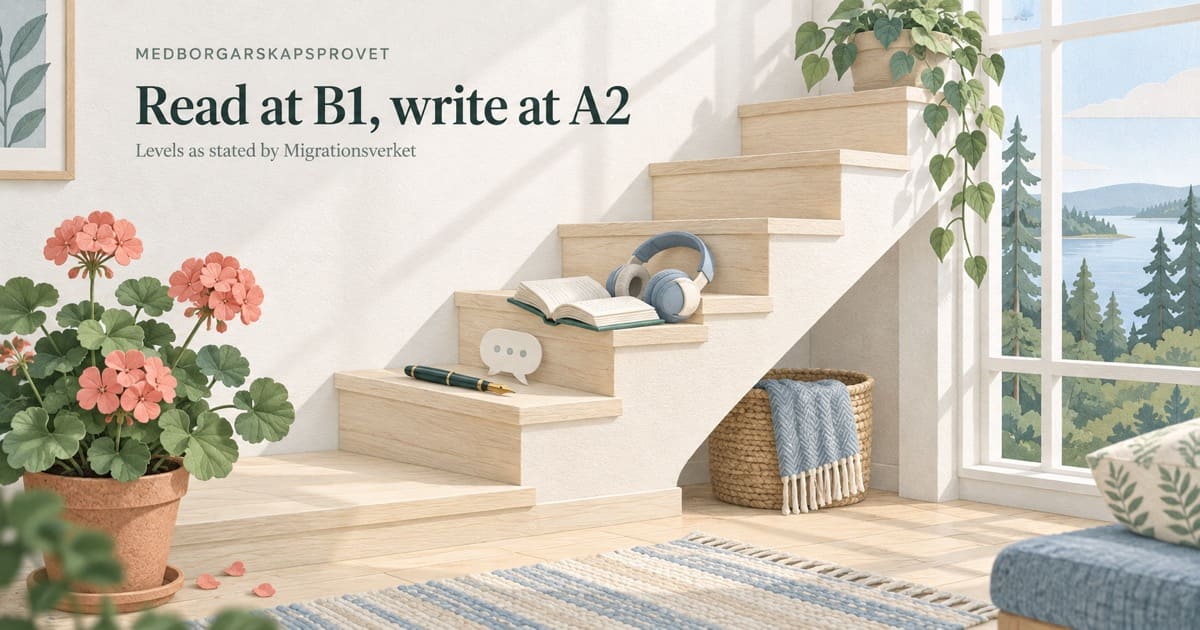
- The level: Migrationsverket states B1 for reading and listening and A2 for speaking and writing. The Act uses the words “functional level” and “basic level”, in the versions of 13 § that describe the future Swedish test; the version in force today points to the list of proofs instead.
- The civics test is itself in Swedish, and only in Swedish. So a reader of Swedish is needed for both halves of the requirement.
Official: lag (2001:82) 13–13 b §§; Migrationsverket; UHR. Read 13 October 2026.
Which level of Swedish? Two official wordings
Two official texts describe the level, in different words. We print both and do not treat one as a translation of the other.
| Skill | Migrationsverket (CEFR level) | The Act, 13 § in its future versions |
|---|---|---|
| Reading comprehension | B1 | “läs- och hörförståelse på funktionell nivå” — functional level |
| Listening comprehension | B1 | functional level |
| Speaking | A2 | Only in the last of the future versions: “muntlig och skriftlig färdighet på grundläggande nivå” — basic level |
| Writing | A2 | Only in the last of the future versions: basic level |
Migrationsverket writes that language proficiency “will be assessed at different levels” under the Common European Framework of Reference (CEFR; in Swedish GERS) [official: Migrationsverket]. So the requirement is deliberately uneven: you must understand more than you must produce.
What B1 and A2 mean
The Council of Europe’s global scale describes the levels. In short, and in our paraphrase: at B1 a person understands the main points of clear standard language on familiar matters met at work, in school and in free time. At A2 a person can handle simple, routine exchanges of information on familiar matters and describe their background and immediate surroundings in simple terms. B1 is the lower of the two “independent user” levels; A2 is the upper of the two “basic user” levels.
Levels: Council of Europe, CEFR global scale. Which level applies to which skill: Migrationsverket. Bar lengths only show the order of the levels.
How Swedish is shown today
Until the test exists, the Act lists the accepted proofs in 13 a §. Migrationsverket’s page gives the same list in plainer words. Any one of them is enough.
| Proof | Paragraph | Note |
|---|---|---|
| Pass grade in Swedish or Swedish as a second language from the final year of compulsory school (or the equivalent, including adapted and special school) | 13 a § 1 a | Migrationsverket: year 9; years 9–10 of special school |
| Pass grade in Swedish or Swedish as a second language from upper secondary school, adapted upper secondary school or folk high school at upper secondary level | 13 a § 1 b | — |
| Pass grade in Swedish or Swedish as a second language from municipal adult education | 13 a § 1 c | Komvux |
| Pass grade in Swedish from the final year of a school form equal to compulsory or upper secondary school in another Nordic country | 13 a § 1 d | — |
| Pass grade in the highest course of municipal adult education in Swedish for immigrants (SFI), or equivalent | 13 a § 2 | Only the highest course counts |
| Pass on a test that universities and university colleges use for the Swedish needed for higher studies | 13 a § 3 a | Migrationsverket names Tisus |
| Pass on another Swedish test that shows functional-level Swedish with a high degree of certainty | 13 a § 3 b | Migrationsverket: “such as Swedex”, during the transition period |
Two practical points. First, UHR does not run Swedex or Tisus: its FAQ says Folkuniversitetet is responsible for Swedex and Stockholm University for Tisus, so questions about dates and fees for those go there [official: UHR]. Second, Migrationsverket’s page names Swedex as an example but does not say which Swedex level it accepts. We found no official text that does, so we do not state one; ask Migrationsverket before you book.
Where other pages get this wrong
You cannot sit a Swedish-language citizenship test today, and the requirement still applies.
Commonly published instead: that the language requirement “has been postponed”, or that applicants must wait for the new test before they can show Swedish.
Migrationsverket’s notice of 30 September 2026 says the recommendation to postpone the test “does not mean that the requirement to have knowledge of Swedish will be removed”, and lists the grades and tests that show Swedish in the meantime [official: Migrationsverket]. Only the test is delayed, not the requirement.
Check which proof you hold
Språkkravet: check which proof you already hold
Pick your age group and tick every certificate you can actually show. The answer names the paragraph of the Citizenship Act it rests on.
What I can show
A self-check against the text of lag (2001:82) and Migrationsverket’s page, not a decision. Migrationsverket decides what it accepts in your case; ask it before paying for a test.
The tool only sorts what you tick into the paragraphs of the Act. The same logic as a table:
| If you can show | Then |
|---|---|
| A grade or test from the list above | You hold a listed proof. Keep the certificate; Migrationsverket asks for documents when it needs them. |
| A pass grade in Danish or Norwegian from the final year of a Nordic school | The Swedish requirement does not apply to you (13 b §). |
| Only a test such as Swedex | A listed proof today (13 a § 3 b), but that point is absent from the Act’s final version. Confirm with Migrationsverket. |
| Nothing yet, age 16 to 66 | Choose a route: the highest SFI course, Swedish at Komvux, Tisus, or another accepted test. |
| Nothing, and you are under 16 or have turned 67 | The knowledge requirement does not apply. |
Who does not have to show Swedish
| Group | Rule | Source |
|---|---|---|
| Under 16 | A child must show the knowledge only “om barnet har fyllt sexton år”. | Act, 12 § first paragraph 5 |
| 67 or older | The requirement does not apply to a person who has turned 67. Migrationsverket states the range as 16 to 66. | Act, 11 § second paragraph; Migrationsverket |
| Pass grade in Danish or Norwegian from a Nordic school | The Swedish requirement does not apply. | Act, 13 b § |
| Disability or other personal circumstances | May be naturalised without showing the knowledge if it cannot reasonably be asked. | Act, 11 c § fourth paragraph |
| Stateless persons born in Sweden who are under 21 | Exempt from the knowledge requirements. | Migrationsverket |
| Nordic citizens, in one of two wordings | Swedish page: Nordic citizens who have made a notification (anmälan) of Swedish citizenship are exempt from the knowledge requirements. English page: Nordic citizens who “have applied” are exempt. The two do not say the same thing. | Migrationsverket, two wordings |
The last row is a real difference between the two language versions of the same page. A notification and an application are different procedures in the Act, so if you are a Nordic citizen, read the Swedish page or ask Migrationsverket which one your case is.
The Swedish test: three steps in the Act, and a delay
The Act already contains the future. 13 § exists in three versions: the one that applies now, one that enters into force on 1 October 2027 or an earlier day the government decides, and one that enters into force on a day the government decides [official: lag (2001:82)].
| Step | What 13 § says | Start in the Act |
|---|---|---|
| 1 — now | Swedish is shown by the proofs in 13 a §. Knowledge of society is shown by a passed civics test, or a grade (13 c §). | In force since 6 June 2026 |
| 2 | A Swedish test is added that tests reading and listening comprehension at functional level. The 13 a § proofs remain as alternatives. | 1 October 2027, or earlier if the government decides |
| 3 | The Swedish test also covers speaking and writing at basic level. In this version 13 a § no longer lists “another test” (today’s 3 b). | A day the government decides |
Against that timetable stands UHR’s final report on introducing the test, published with a summary on UHR’s site (page updated 2 October 2026) [official: UHR]. Its conclusions, as UHR summarises them:
What UHR told the government
- The conditions for introducing step two by 1 October 2027 are lacking: Stockholm University does not see a way to deliver a fully developed, quality-assured test by then.
- UHR recommends that step two be introduced in the autumn of 2029, as a digital test from the start.
- Step three, speaking and writing, is judged possible in 2030 at the earliest; recruiting enough qualified assessors is a central difficulty.
- For a time the Swedish part and the civics part would be taken in different ways and on different occasions: Swedish digitally, civics on paper.
These are UHR’s recommendations, not decisions. Migrationsverket (30 September 2026): the government will consider the recommendation and decide when the test can be introduced.
What this means for planning is our reading, not an official statement: if you need to show Swedish in the next couple of years, the realistic routes are the ones that exist now. Waiting for the new test is waiting for a date nobody has set.
The Swedish you need for the civics test
Even with a perfect grade in Swedish from Komvux, the civics test has to be read. The Act says the civics test “ska utformas på svenska på funktionell nivå” — is to be written in Swedish at functional level (13 § third paragraph) — and UHR confirms it cannot be taken in any other language [official]. UHR’s five example questions are the best public sample of that Swedish. These are words taken from those five questions, with our translations; if several are unfamiliar, vocabulary is the first thing to work on.
| Word in UHR’s example questions | English (our translation) |
|---|---|
| den offentliga sektorn | the public sector |
| främsta uppgift | main task |
| välfärdstjänster | welfare services |
| stifta lagar | to make (enact) laws |
| statschef | head of state |
| talman / landshövding / statsminister | speaker / county governor / prime minister |
| naturresurs | natural resource |
| betydelse | importance |
| inlägg på sociala medier | a post on social media |
| yttrandefriheten | freedom of expression |
| bryter mot lagen | breaks the law |
| be om tillstånd | ask for permission |
A quick reading check that costs nothing: try the 10-question mini test with the English lines covered. Then the 30 practice questions show which chapters’ vocabulary you still lack.
Preview the medborgarskapsprovet revision kit
If your Swedish is at the stage where facts go in faster in English, the kit pairs each fact with its Swedish term. The kit puts the whole official guide, Sverige i fokus, on seven pages in English, with the Swedish word you will meet on the paper beside each fact and the guide’s page number after it. Page 1 is free to read in full on the kit page, where you can also see the contents of the other six pages before deciding.
Frequently asked questions
What level of Swedish is required for Swedish citizenship?
Migrationsverket states B1 for reading and listening and A2 for speaking and writing, under the CEFR. The Act describes the future test as functional level for reading and listening and basic level for speaking and writing.
Is there a Swedish language test for citizenship now?
No. UHR has only held the civics test. The Swedish test will be introduced later, and UHR has recommended postponing it; the government has not decided.
How can I show my Swedish today?
With one of the proofs in 13 a § of the Citizenship Act: a pass grade in Swedish or Swedish as a second language from school, Komvux or a Nordic school, a pass in the highest SFI course, Tisus, or another test that shows functional-level Swedish.
Does SFI count?
A pass grade in the highest course of SFI counts. Lower courses are not listed.
Is Swedex accepted?
Migrationsverket names Swedex as an example of another test accepted during the transition period. Its page does not state a level, so confirm with Migrationsverket.
Has the language requirement been postponed?
No. Migrationsverket states that postponing the test does not remove the requirement to have knowledge of Swedish.
From what age does the requirement apply?
From 16 until the day you turn 67. Migrationsverket states the range as 16 to 66.
I have a school grade in Danish or Norwegian. Do I need to show Swedish?
No, if it is a pass grade from the final year of compulsory or upper secondary school in another Nordic country. 13 b § exempts you from the Swedish requirement.
When will the Swedish test start?
The Act says 1 October 2027 or earlier for reading and listening. UHR’s report recommends autumn 2029 instead, and 2030 at the earliest for speaking and writing. Nothing is decided.
Is the civics test available in English?
No. It is written in Swedish at functional level and can only be taken in Swedish.
Who runs Tisus and Swedex?
Not UHR. Stockholm University is responsible for Tisus and Folkuniversitetet for Swedex.
More in this series
- Medborgarskapsprovet: what is decided, what is not, and a 10-question mini test
- Medborgarskapsprov frågor: 30 practice questions with answers, by chapter
- Svenskt medborgarskap krav: the six requirements and what the test covers (checklist)
- Samhällskunskap for the test: all 13 chapters on one page, with a revision tracker
- Swedish citizenship test in English: a guide for expats, with a 10-question mini test
- Svensk medborgarskap test: a 2-week study plan, day by day, with a tracker
- Medborgarskapsprov undantag: who must take the test, who is exempt, with a checker
- Medborgarskapsprov svåra frågor: rights, democracy, history, 15 worked questions
- Medborgarskapsprov vs SFI and samhällsorientering: what is different, what to study
Sources
- official — Lag (2001:82) om svenskt medborgarskap, amended up to SFS 2026:1689: 11–13 e §§ (riksdagen.se)
- official — Migrationsverket — Citizenship for adults: requirements, knowledge of Swedish and Swedish society, maintenance, orderly life, fee (read 13 October 2026)
- official — Migrationsverket — Medborgarskap för vuxna (the Swedish version of the same page)
- official — Migrationsverket news, 30 September 2026 — The Swedish language test for citizenship may be postponed
- official — UHR — Slutredovisning om införandet av medborgarskapsprov: the Swedish-language parts (page updated 2 October 2026)
- official — UHR — Frågor och svar om medborgarskapsprovet (read 13 October 2026)
- official — UHR — Om medborgarskapsprovet (page last updated 17 August 2026; read 13 October 2026)
- official — Council of Europe — CEFR global scale (Table 1): what A2 and B1 mean
- official — Förordning (2026:451) om medborgarskapsprov, amended up to SFS 2026:1194 (riksdagen.se)
official = a document published by the conducting body. reported = a news or coaching site we could not check against an original. Where sources disagree this page says so rather than picking one.