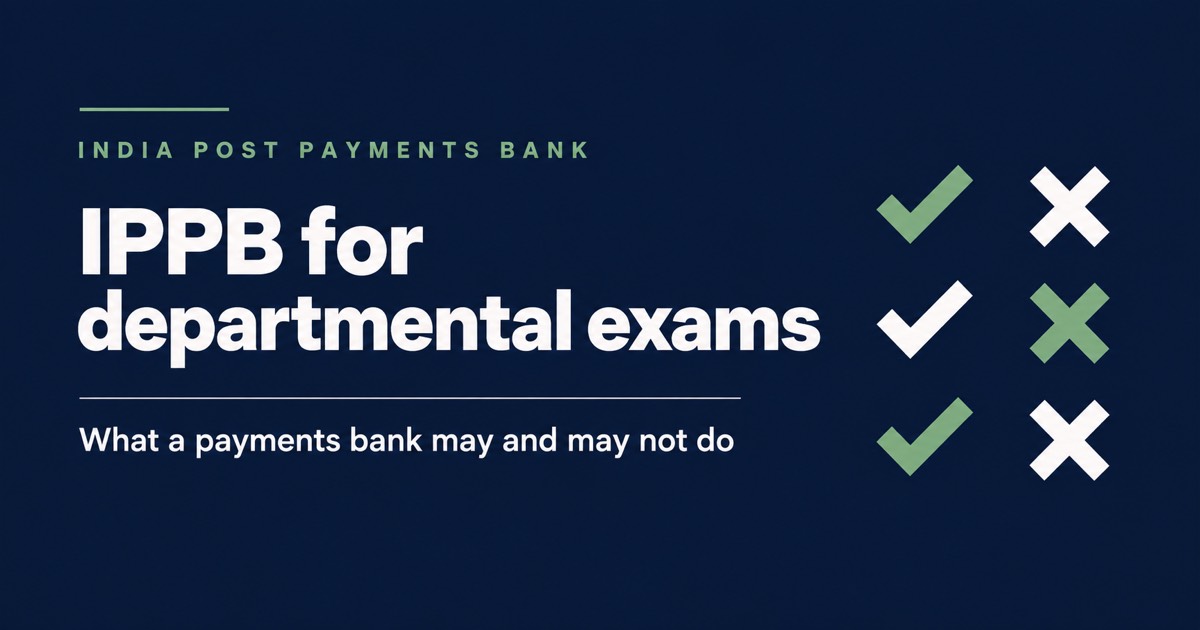
India Post Payments Bank is a standalone item in the Inspector Posts LDCE Paper-I syllabus — not a line inside a list of products — and it also sits in the PA/SA departmental syllabus under products and services. The questions asked about it are almost always about the <em>category</em>: what a payments bank is allowed to do, and what it is not.
The facts that get asked
| Item | Detail |
|---|---|
| Launched | 1 September 2018, nationally |
| Ownership | 100% equity held by the Government of India |
| Sits under | The Department of Posts, Ministry of Communications |
| Category | A payments bank, licensed by the Reserve Bank of India — not a scheduled commercial bank |
| Reach | Built on the post office network and delivered through postmen and Gramin Dak Sevaks |
What a payments bank may and may not do
| Activity | Permitted |
|---|---|
| Accept demand deposits — savings and current accounts | Yes, up to the per-customer end-of-day balance limit the RBI prescribes |
| Lend — any loan or advance | No |
| Issue credit cards | No |
| Issue debit cards | Yes |
| Accept fixed or recurring deposits of its own | No |
| Remittances, money transfer, bill and utility payments | Yes |
| Direct Benefit Transfer and Aadhaar-enabled payment services | Yes |
| Distribute third-party products such as insurance and mutual funds | Yes, as a distributor |
The lending bar is the point of the category
- A payments bank takes deposits and moves money; it does not take credit risk. That is the whole design, and it is why the model can be pushed out to every branch post office.
- So any exam option in which IPPB grants a loan, issues a credit card or runs its own term deposit is wrong.
- The per-customer deposit ceiling is set by the RBI for all payments banks and has been revised — it was raised from ₹1 lakh to ₹2 lakh in 2021. Because it is an RBI limit rather than a statutory one it can move again, so check the current figure before quoting it as a number.
IPPB and POSB are two different things
| IPPB | POSB (Post Office Savings Bank) | |
|---|---|---|
| What it is | A payments bank licensed by the RBI, a separate entity wholly owned by the Government | A savings service of the Department of Posts under the small-savings framework |
| Governing framework | RBI regulation as a payments bank | The Government Savings Promotion Act, 1873 and the schemes notified under it |
| Products | Savings and current accounts, payments, remittances, DBT, AePS | Savings Account, RD, TD, MIS, SCSS, NSC, KVP, PPF, Sukanya Samriddhi |
| Interest-bearing long-term deposits | No | Yes — that is what the notified schemes are |
| Doorstep service | Core to the model, through postmen and GDS | Counter-based, with some doorstep services |
For Paper-I this distinction is the high-value one, because the syllabus names both: IPPB as its own topic, and the POSB manuals and the nine notified 2019 scheme rules separately. A question that asks which of a list of products is an IPPB product is really asking whether you can tell the two apart.
The rest of the IT and modernisation block it sits in
- Core Banking Solution (CBS) — the platform that brought POSB accounts onto a single core, so an account can be operated from any CBS post office.
- CSI (Core System Integrator) — the ERP-style integration of the Department’s own back-office processes.
- Rural ICT / RICT — the handheld devices that put branch post offices online.
- DARPAN — the project connecting branch post offices to the CBS and PLI platforms.
- PLI-CIS — the customer information system for Postal Life Insurance.
- APT / IT 2.0 — the current generation of the Department’s IT programme, named in the syllabus as "APT Knowledge (IT 2.0)".
- DIGIPIN — the digital address code, covered in its own guide.
These acronyms are each other’s distractors. Knowing which one is the ERP, which is the handheld device and which is the branch-office connectivity project is most of the marks in this block.
Practice questions
India Post Payments Bank was launched nationally in which year?
- A. 2018
- B. 2015
- C. 2020
- D. 2013
Answer: 2018
IPPB was launched nationally in September 2018 after a pilot in early 2017. The Reserve Bank granted payments bank licences in 2015, but the licence year is not the launch year.
What is the equity holding of the Government of India in India Post Payments Bank?
- A. one hundred per cent
- B. fifty-one per cent
- C. seventy-four per cent
- D. twenty-six per cent
Answer: one hundred per cent
IPPB is wholly owned by the Government of India through the Department of Posts, with one hundred per cent equity. It has no private shareholding, so the partial holdings offered are incorrect.
Which activity is a payments bank such as IPPB prohibited from undertaking?
- A. granting loans on its own account
- B. accepting demand deposits from customers
- C. issuing debit cards to customers
- D. providing remittance and payment services
Answer: granting loans on its own account
A payments bank may accept deposits, issue debit cards and provide payment and remittance services, but it may not lend on its own account or issue credit cards. Lending is the defining restriction that separates a payments bank from a commercial bank.
IPPB accounts are distinguished from Post Office Savings Bank accounts principally because IPPB accounts:
- A. are held with a separately incorporated bank regulated by the Reserve Bank of India
- B. carry no interest at all
- C. can be opened only at head post offices
- D. are restricted to departmental employees
Answer: are held with a separately incorporated bank regulated by the Reserve Bank of India
IPPB is a separate corporate entity holding a payments bank licence from the Reserve Bank, whereas the Post Office Savings Bank is government business run by the Department itself under the small savings statute. IPPB accounts do bear interest, are opened widely including at the doorstep, and are open to the public.
From the ProSyllabus IP LDCE question bank — 15 quizzes, 150 questions, each one passed independently by two auditors.
When was India Post Payments Bank launched?
1 September 2018, launched nationally. It operates under the Department of Posts with 100% equity held by the Government of India.
Can IPPB give loans?
No. A payments bank may not lend or issue credit cards. It takes demand deposits and provides payments, remittance and distribution services, but it does not take credit risk — that restriction is the defining feature of the payments-bank category.
What is the maximum balance in an IPPB account?
A per-customer end-of-day balance limit set by the Reserve Bank for all payments banks. It was raised from ₹1 lakh to ₹2 lakh in 2021. Since it is an RBI-prescribed limit rather than a statutory one, confirm the current figure before quoting it.
What is the difference between IPPB and a Post Office Savings Bank account?
IPPB is a separate payments bank licensed by the RBI and wholly owned by the Government; POSB is a savings service of the Department of Posts under the Government Savings Promotion Act, 1873 and the schemes notified under it. POSB offers interest-bearing long-term deposits such as RD, TD, PPF and Sukanya Samriddhi; a payments bank cannot.
How does IPPB reach customers at home?
Through the post office network — postmen and Gramin Dak Sevaks providing doorstep banking, with Aadhaar-enabled payment services and Direct Benefit Transfer at the door. The reach of the existing network is what the model is built on.
Is IPPB in the IP LDCE syllabus?
Yes — India Post Payments Bank is named as a standalone topic in Paper-I of the pattern notified on 22 August 2025, alongside APT Knowledge (IT 2.0), Core Banking Solutions and PLI-CIS.
The rest of the India Post series
- IP LDCE 2026 — new 3-paper pattern, full syllabus and exam dates
- IP LDCE Paper II — noting, drafting and the major-penalty charge sheet
- IP LDCE previous year question papers and answer keys
- India Post PA/SA LDCE (LGO) — syllabus, pattern, DEST and the merit rule
- GDS to MTS, Postman and Mail Guard — syllabus and pattern
- The Post Office Act, 2023 — summary and MCQs
- CCS (Conduct) Rules, 1964 — notes and MCQs
- CCS (CCA) Rules, 1965 — penalties, procedure and MCQs
- The POSH Act, 2013 — notes and MCQs
- DIGIPIN explained — India Post’s digital address code
Practice: IP LDCE quizzes · syllabus · previous papers · PA/SA/MTS