Checked 2 October 2026. The three-paper scheme is from the Department of Posts 22 August 2025 revision and 24 September 2025 corrigendum, also carried in the 2026 sitting notice. The 2026 sitting was held on 26–27 September. A later exam date needs a new notice; under the standing syllabus rule, ordinary circulars and orders are scoped to 31 December of the preceding exam year unless the Department changes that rule. This guide uses no unverified past-paper frequency or countdown.
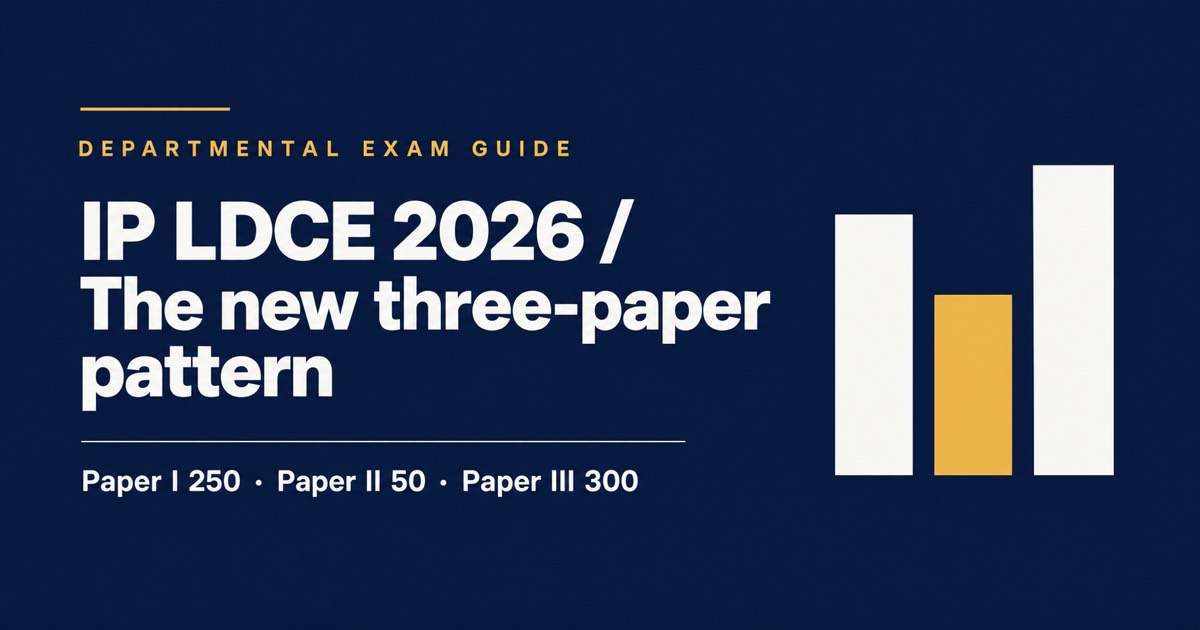
The Inspector Posts LDCE now has three papers, 600 marks and a separate qualifying floor in each paper. It is tempting to divide revision time 250:50:300 by marks. That undertrains Paper II, the written noting, drafting and charge-sheet paper. This page gives a repeatable method: map the current syllabus to ten topic families, classify your own mistakes, allocate 14 or 30 days, then retest. It serves a different purpose from the previous-paper and answer-key guide: download there, plan and repair here. The 2026 sitting has passed; confirm the next exam date and any amendment to the standing syllabus cutoff before the next cycle.
The first three values come from the current DoP scheme. Fourteen and 30 days are our editable planning horizons, not official schedules.
| Paper | Marks | Time | Format | Principal ground |
|---|---|---|---|---|
| Paper I | 250 | 2 h 30 min | 125 MCQs × 2 marks | Postal operations, savings, insurance, manuals, service rules |
| Paper II | 50 | 1 h | Written: noting 15 + drafting 15 + charge sheet 20 | Written office communication and major-penalty charge sheet |
| Paper III | 300 | 3 h | 150 MCQs × 2 marks | Constitution, legislation, pension, finance, establishment and aptitude |
These are paper marks, not hours to study. Paper II needs writing time despite its smaller bar.
The two qualification gates change your study order
The revised pattern sets both a minimum in each paper and an “overall average.” The Department’s exact wording is 40% in each paper, subject to an overall average of 45%, for General candidates; 33% in each paper, subject to an overall average of 38%, for SC, ST and PwBD candidates. Because the papers have unequal maxima (250, 50 and 300), do not silently replace “overall average” with a total-mark percentage or an unweighted mean of three paper percentages without an official calculation instruction. The per-paper floors are clear and remain separate. All three papers are compulsory and the examination is without the aid of books. The table translates only the individual-paper percentages into marks; a fractional result is a mathematical threshold, not a claim about rounding.
| Paper | Maximum marks | General 40% floor | SC/ST/PwBD 33% floor |
|---|---|---|---|
| Paper I | 250 | 100 | 82.5 |
| Paper II | 50 | 20 | 16.5 |
| Paper III | 300 | 120 | 99 |
For example, a General candidate scoring 125 in Paper I, 18 in Paper II and 150 in Paper III has 293 marks in all. Yet the 18/50 in Paper II is only 36%, below its separate 40% floor. Whatever method the Department uses for “overall average,” this candidate misses an explicit individual-paper condition. Repair the written paper first. This is a worked gate example, not a result forecast. Use the official result and instructions for the actual overall-average calculation.
Map the official syllabus to real revision outputs
The topic names and source item references below follow the DoP three-paper syllabus. The line-item count is our count of lettered or numbered syllabus entries; it is not an observed question count and should never be called exam weightage. We group adjacent topics only to make a usable work queue. Open the actual DoP letter or your Circle notification for precise exclusions: Postal Manual VI Part II and the Post Office Guide have important omitted sections, and the 24 September 2025 corrigendum corrected several document names.
| Paper | Revision family | Syllabus reference | First output to produce |
|---|---|---|---|
| I | Postal savings schemes and POSB/CBS | P-I items 1(b), 2(b–k), 10(a–b) | Build a scheme grid: entry, term, limits, closure, nomination; test changed rules |
| I | Postal manuals and Book of BO Rules | P-I item 4(a–k) | Locate each volume and named exclusions, then answer a manual-lookup prompt |
| I | Post Office Act, Guide, mail network | P-I items 1(a), 2(a), 6–9 | Map the 2023 Act and 2024 Rules to operational scenarios |
| I | PLI/RPLI, Jansuraksha, IPPB, IT and records | P-I items 3, 5, 11–14 | Compare product eligibility and distinguish insurance from payment-bank functions |
| I | CCS Conduct, CCA, Temporary Service and GDS rules | P-I items 15–18 | Identify the applicable rule and a Rule 14 charge-memo step |
| II | Noting, drafting and charge sheet | P-II items 1–3 | Write one timed 200-word note, one communication and one four-annexure charge memo |
| III | Constitution, Acts, RTI and PoSH | P-III items 1–6, 11 | Separate article/section recall from scenario application |
| III | Pension, GPF, NPS and service benefits | P-III items 8–10, 12, 17 | Create an applicable-rule selector before solving a benefits case |
| III | Financial rules, procurement and powers | P-III items 7, 13, 18, 20 | Locate the correct GFR chapter, procurement manual and power schedule |
| III | FR/SR, APAR, welfare and aptitude | P-III items 14–16, 19, 21–23 | Split static rule lookup from timed English, reasoning and quantitative sets |
We counted named line items in the official syllabus for planning. A single Constitution item can cover many articles, while several small-savings schemes each have their own line. Bar length is not expected marks.
Paper I has the largest postal-content inventory. The 2019 savings schemes, POSB manuals and CBS need a comparison table rather than a stack of isolated limits. The Post Office Act 2023, its 2024 Rules and Regulations, and postal network projects need an operational map: identify which source governs the scenario before recalling a number. For PLI, RPLI, Jansuraksha and IPPB, distinguish the product owner, eligibility and service function. A candidate who can say which document answers a question is less likely to be trapped by a plausible but wrong figure.
Paper III is broad in a different way. It names narrow constitutional article ranges, specific Acts, GPF and pension rules, NPS, procurement, financial powers, FR/SR, APAR, welfare and general ability. Sort these into three modes: exact-source lookup, scenario application and timed skill practice. A constitutional article or rule section needs accurate recall; a pension case needs the correct applicable scheme and dates; reasoning and quantitative aptitude improve through short timed sets and error review. Do not assume the latest current-affairs item is governed by the same cutoff as a circular or SB Order.
Paper II is a separate writing discipline
Paper II asks for approximately 200-word noting (15 marks), an approximately 200-word communication (15 marks), and a draft major-penalty charge sheet (20 marks). Its one-hour window makes writing speed and format visible. The Paper II drafting guide has the underlying components; use this page to schedule them. A useful three-session loop is: write a note from facts, redraft it after marking unsupported assumptions, then write a fresh communication for a different recipient. For the charge sheet, practise the memorandum and four annexures while keeping allegations separate from proof and avoiding a pre-decided penalty.
| Written task | One timed drill | What to diagnose |
|---|---|---|
| Noting · 15 marks | Set facts, issue, applicable rule, options and recommendation within about 200 words | Did you infer a fact or merely copy the incoming letter? |
| Drafting · 15 marks | Write a clear official communication to the specified addressee in about 200 words | Is the action, authority and deadline unambiguous? |
| Charge sheet · 20 marks | Outline memorandum, articles of charge, imputation statement, document list, witness list | Are charge, evidence and penalty kept distinct? |
Protect two or three short writing blocks each week even when Paper I and III mock scores are weak. Paper II is a small fraction of total marks, but the independent floor makes it a hard bottleneck. A candidate already consistently above its floor can reduce, not eliminate, writing practice. The allocator below enforces an example 15% minimum while Paper II is marked as needing revision; this is our planning policy, not an official requirement. A “secure for this study block” choice assigns zero hours in this particular block and never means the paper is optional in the exam. You can change the hour total and weakness flags after every mock.
Turn one wrong answer into the next revision task
After a mock or old-paper set, log the source and cause rather than only the score. Use four error classes: (1) wrong rule or outdated edition, (2) right source but wrong calculation or fact, (3) misread question or confusion between similar schemes, (4) time/format failure. The repair differs. An outdated-law error requires a current source and a replacement note. A calculation error requires a fresh numerical variant. A confusion error needs a comparison table. A format failure needs a timed redo. If the original key relies on a superseded statute, keep the old item as a method exercise but do not learn its old answer.
| Error class | Evidence to save | Next task |
|---|---|---|
| Outdated source | Old paper year, old rule, current DoP/Act source | Rewrite the rule reference and answer the scenario again |
| Calculation or fact | Intermediate step and where the result diverged | Work a new numerical case without seeing the solution |
| Confused pair | Two schemes, authorities or forms you mixed | Make a side-by-side comparison and self-test tomorrow |
| Time or format | Minutes spent, unfinished sentence or missing annexure | Repeat the output under a shorter timer |
The 2025 revision replaced the old four-paper pattern and changed named content. Older sets may still teach postal operations, service-rule reasoning and scheme mechanics, but a four-paper score is not a three-paper mock score. The 2026 exam was held under the three-paper scheme, so use any published 2026 paper and official key as the closest format check, provided you can verify the file, series and final-key status. Do not infer topic frequency from a single new-pattern sitting. Neither the Department site nor our working archive provides a complete, audited question-by-question set for a defensible “most repeated topics” chart.
A 14-day and 30-day sequence you can actually use
| Phase | What to do | Evidence of progress |
|---|---|---|
| Days 1–3 of 14 / 1–6 of 30 | Baseline across all three papers; write one Paper II piece; start a dated error ledger | A per-paper score and four-class error list |
| Days 4–9 of 14 / 7–21 of 30 | Repair high-cost rule and product confusions; one timed objective set and two written drills per week | Current-source citation, new variant and improved writing time |
| Days 10–12 of 14 / 22–27 of 30 | Full three-paper simulation using current pattern and separate floors | Paper floors plus overall result, not only total marks |
| Days 13–14 of 14 / 28–30 of 30 | Review unresolved errors, official notice, permitted scope and compact notes; no new broad source hunt | One-page “still wrong” list and checked rule editions |
Build a 14- or 30-day revision allocation
Enter a daily study budget, choose 14 or 30 days, and mark the areas causing repeated mistakes. The tool splits total hours using a transparent editorial weight: paper marks × syllabus item share within that paper × your weakness level. When marked as needing revision, Paper II receives a minimum 15% of hours because it has a separate qualifying floor and requires written practice. The item count is a syllabus-line count, not expected exam questions or official topic weightage.
Edit the weights as your mock error log changes. For an AMP or print view, use the paper and syllabus tables on this page as the static fallback.
IP LDCE REVISION KIT
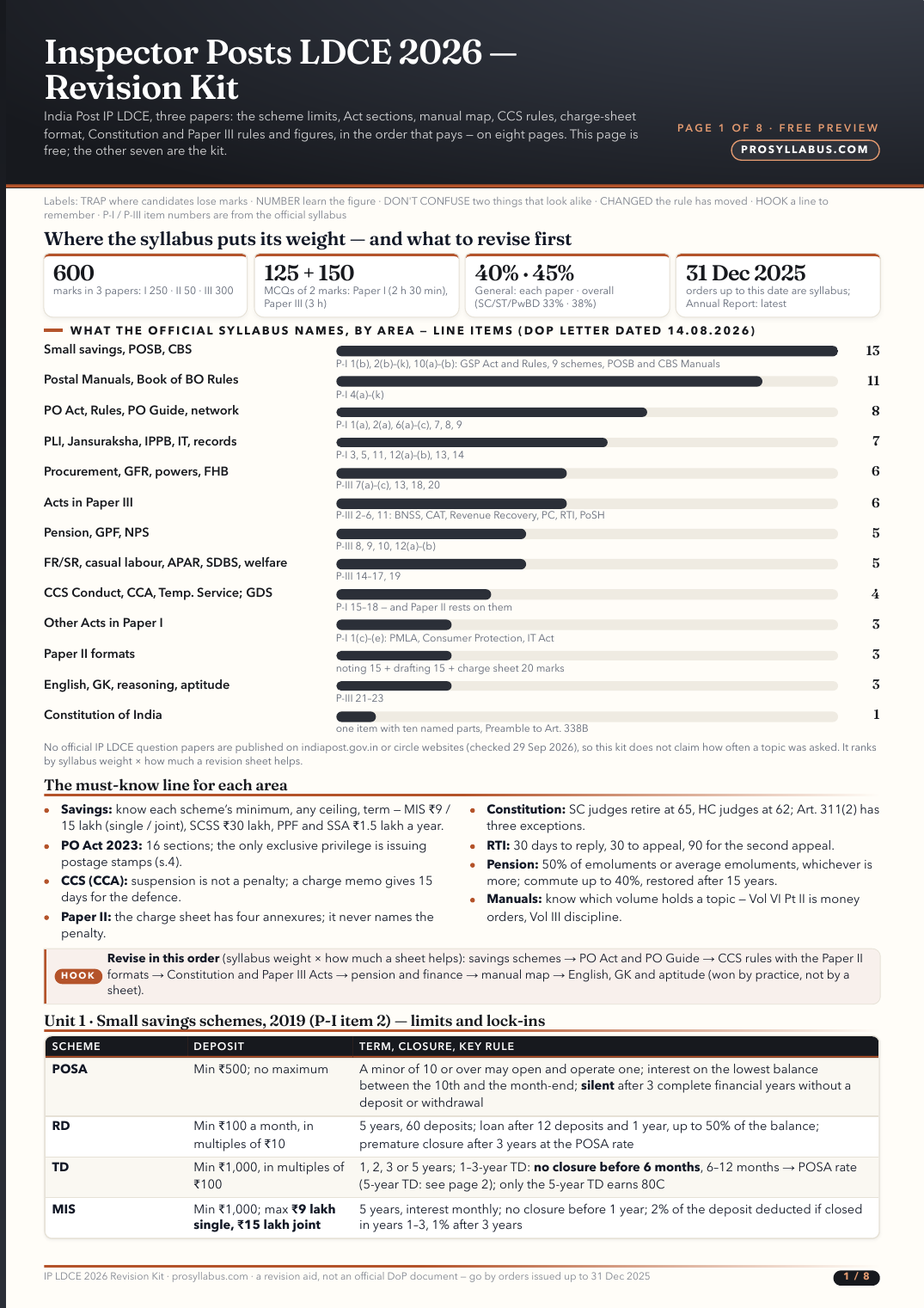
The free planner above sets your revision order. The separate eight-page kit condenses the official three-paper scheme, postal products, manual map, CCS rules, Paper II formats, Constitution and Paper III formulas. Its first page is a free preview, and the current offer page shows the price.
Preview the kit and price · Open the previous-paper guide
Independent ProSyllabus product, not a Department of Posts publication. Kit purchase is separate from quiz or membership access. The official syllabus and planning method on this page remain free.
A worked allocation shows why the tool uses your errors, not only marks. Suppose a candidate has 2 hours a day for 14 days and repeatedly misses savings-scheme eligibility and Paper II charge-sheet format, while Constitution and aptitude are steady. Start by marking savings and Paper II “repeated mistakes,” mark secure areas “secure for this study block,” and let the tool assign the 28 hours. After three sessions, if the charge-sheet format can be written accurately within the timer, lower Paper II to “needs revision” and move hours to the next unresolved error. Keep one complete three-paper simulation so that a narrow repair does not hide a new weakness elsewhere.
Mark outputs completed, not chapters merely read
Check a box after producing the stated work and recording what you got wrong. Your checklist remains in this browser.
0 of 11 done
Ticks are saved only in this browser on this device.
Source date and old-key traps before your next mock
The DoP syllabus includes circulars, orders and guidelines issued up to 31 December of the year before the exam year, while the latest Annual Report and Book of Information published on the DoP site are treated separately. For the 2026 sitting the ordinary cutoff was 31 December 2025. If the standing rule is unchanged, a 2027 sitting would use 31 December 2026 for ordinary circulars and orders; its exam date and any pattern change still need a fresh notice. The Post Office Act 2023 and 2024 subordinate rules replaced old statutory ground, and the 24 September 2025 corrigendum changed five syllabus names: Government Savings Promotion General Rules 2018, Post Office Life Insurance Rules 2011, GPF (CS) Rules 1960, amended financial powers and the latest Postal FHB volumes. Your error log should record the edition you used.
Use the working official Postal Circle copy of the revised-pattern annexure and the Circle recruitment directory below to verify a letter number, date and paper scheme. An unlabelled mirror may be convenient for reading, but compare it to the official copy and its corrigendum before putting it in a revision folder. The official 2026 provisional keys for Papers I and III were released from 29 September 2026; Paper II is written and has no objective key. Check the current Department or Circle notice for the feedback deadline and final-key status rather than treating a provisional key as final.
How should I divide study time across the three IP LDCE papers?
Start from the official 250/50/300-mark scheme, then adjust for separate per-paper qualification floors and your own repeated errors. Give Paper II regular timed writing even though it is only 50 marks. The editable 14/30-day allocator on this page is a planning aid, not official topic weightage.
Can a high overall score compensate for a weak Paper II?
No. The revised scheme requires a minimum in each paper and an overall average. For General candidates, the usual figures are 40% per paper and an overall average of 45%; for SC/ST/PwBD, 33% per paper and an overall average of 38%.
Are old four-paper IP LDCE question papers useful?
Yes, for topic-level practice after checking every changing rule against the current syllabus. They are not full-format mocks for the three-paper scheme that took effect after the 22 August 2025 letter.
Does the syllabus item-count chart show frequently asked questions?
No. It counts named official syllabus lines in our grouped work queue. It is neither a past-paper frequency chart nor expected marks. A broad single line can be harder than several narrow lines.
What belongs in a Paper II practice block?
Write and review a roughly 200-word note, a roughly 200-word official communication, and a draft major-penalty charge sheet. The official distribution is 15, 15 and 20 marks respectively.
What source cutoff applies to orders and circulars?
The scheme says 31 December of the year preceding the exam year, with a separate latest-published rule for the Annual Report and Book of Information. The 2026 exam therefore used 31 December 2025 for ordinary circulars. The standing formula continues unless amended; a later exam date needs its own notice.
Is the revision kit included with quiz or membership access?
This guide does not promise that. The separate eight-page IP LDCE kit has a free page-one preview and an offer page with its current price; kit purchase is separate from any quiz or membership entitlement.
Sources
- official — West Bengal Postal Circle recruitment directory, including IP LDCE circulars
- official — West Bengal Postal Circle IP LDCE 2025 notification with revised-pattern annexure
official = a document published by the conducting body. reported = a news or coaching site we could not check against an original. Where sources disagree this page says so rather than picking one.