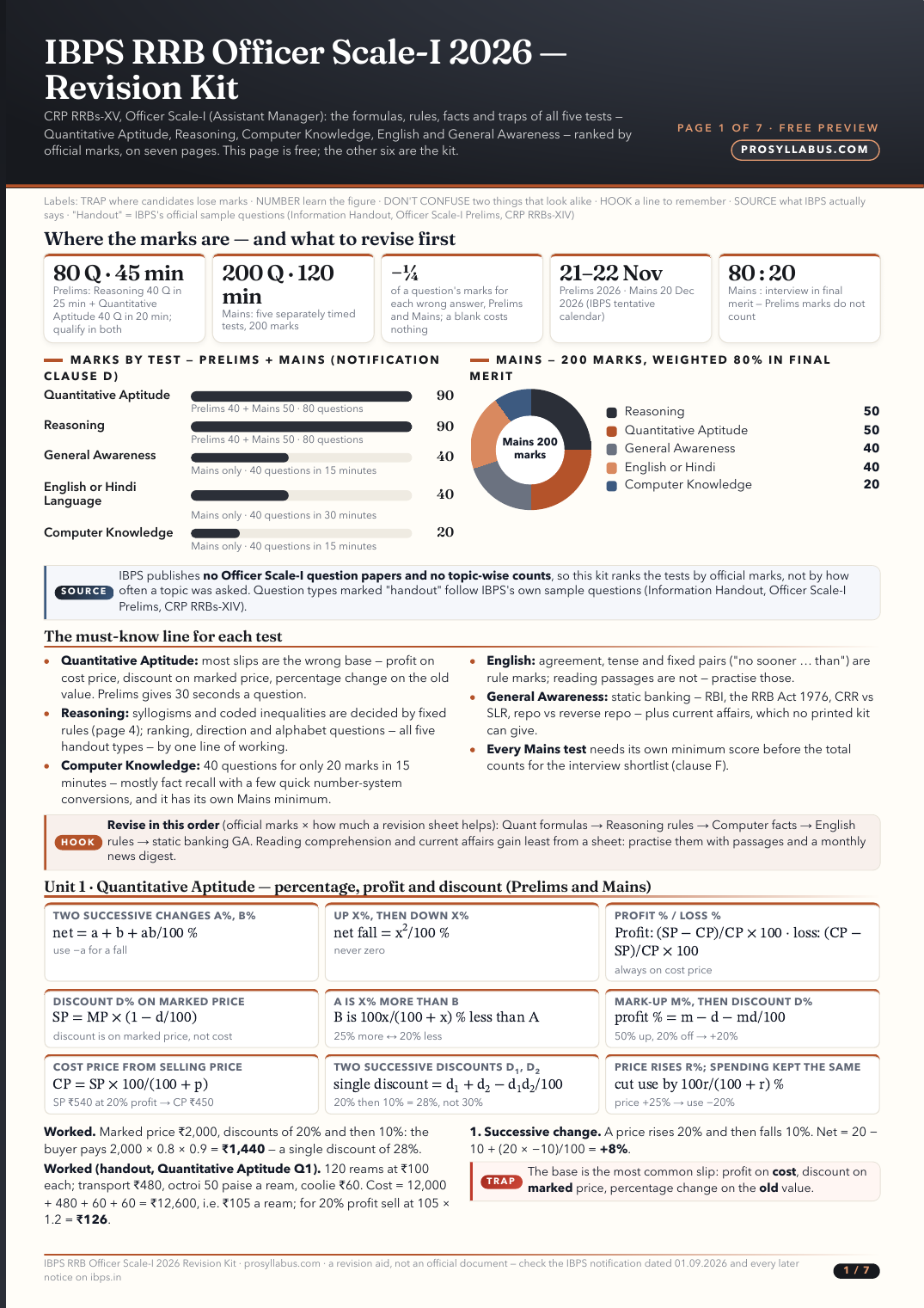

Checked 29 September 2026. Pattern, penalty, minimums and the 80:20 ratio from the CRP RRBs-XV notification (01.09.2026), unchanged from XIV. Average marks per question and the implied penalties are our arithmetic on an equal-marks assumption IBPS does not state; the final-score formula is our approximation. IBPS may change the structure.
The IBPS RRB Officer exam is one notification but three different tests. Scale I (Assistant Manager) has a qualifying prelims, a Main and an interview. Scale II (Manager, general banking or one of six specialist streams) and Scale III (Senior Manager) have a single online exam and an interview. All three share one rule that is easy to misread: the penalty for a wrong answer is one quarter of the marks assigned to that question, not a flat quarter mark. Because the Main tests have 40 questions each but different totals, the average question — and so the likely cost of a guess — differs from test to test. This guide lays out each pattern exactly as IBPS prints it, separates what IBPS states from our arithmetic, and explains how the final 80:20 score is built.
IBPS CRP RRBs-XV notification, 01.09.2026.
Scale I prelims: qualifying only
| Test | Questions | Marks | Time | Average marks per question (ours) | Penalty if marks are equal (ours) |
|---|---|---|---|---|---|
| Reasoning | 40 | 40 | 25 min | 1 | 0.25 |
| Quantitative Aptitude | 40 | 40 | 20 min | 1 | 0.25 |
| Total | 80 | 80 | 45 min | — | — |
Each test has its own time limit and its own cut-off: IBPS says candidates “have to qualify in both the tests by securing minimum cut-off marks”. There is no English or General Awareness section in the prelims, which is the biggest difference from the IBPS PO prelims. The prelims only decide who sits the Main; for Scale I, “marks obtained only in the online main examination will be considered for shortlisting for interview and final merit listing”.
Scale I Main: five tests, 40 questions each, different totals
| Test | Questions | Marks | Time | Average marks per question (ours) | Penalty if marks are equal (ours) |
|---|---|---|---|---|---|
| Reasoning | 40 | 50 | 30 min | 1.25 | 0.3125 |
| Computer Knowledge | 40 | 20 | 15 min | 0.5 | 0.125 |
| General Awareness | 40 | 40 | 15 min | 1 | 0.25 |
| English or Hindi Language | 40 | 40 | 30 min | 1 | 0.25 |
| Quantitative Aptitude | 40 | 50 | 30 min | 1.25 | 0.3125 |
| Total | 200 | 200 | 120 min | — | — |
Questions, marks and time are official. The last two columns are our arithmetic, not IBPS figures: the test total divided by 40, and one quarter of that. IBPS does not say that every question within a test carries the same marks — it gives each test’s total and says the penalty is a quarter of “the marks assigned to that question”. If marks are equal within a test, the columns are exact; if not, they are averages. The information handout issued with the call letter is the place to check. A candidate chooses either the English or the Hindi language test. Other tests are offered in English, Hindi and, depending on the state, one or more regional languages; if the English and translated versions differ, the English version prevails.
Our arithmetic from the official marks table, assuming equal marks within a test (IBPS does not state this): one quarter of the average question. A blank answer costs nothing.
The practical consequence, on that equal-marks assumption: an average question in Reasoning or Quantitative Aptitude is worth 2.5 times an average Computer Knowledge question (1.25 against 0.5 marks), and a wrong answer there costs 0.3125 marks against 0.125. What is certain from the official table alone is the total: each of those two tests carries 50 marks against Computer Knowledge’s 20. Both tests together are 100 of the 200 marks. Computer Knowledge gives 15 minutes for 40 questions but only 20 marks, so time spent there buys less. On a question with five options, a blind guess under a one-quarter penalty has an expected value of exactly zero (our arithmetic: one chance in five of gaining the mark, four in five of losing a quarter of it), so a guess pays on average only after you have eliminated at least one option.
Scale II and Scale III: one exam, no prelims
Scale II General Banking Officer and Scale III share the same pattern. The six Scale II specialist streams (IT, Chartered Accountant, Law, Treasury Manager, Marketing, Agriculture) take a longer paper with a Professional Knowledge test. For all of these the medium is Hindi or English, not the regional languages.
| Test | GBO and Scale III (Q / marks / min) | Specialist Scale II (Q / marks / min) |
|---|---|---|
| Reasoning | 40 / 50 / 30 | 40 / 40 / 30 |
| Computer Knowledge | 40 / 20 / 15 | 40 / 20 / 15 |
| Financial Awareness | 40 / 40 / 15 | 40 / 40 / 15 |
| English or Hindi Language | 40 / 40 / 30 | 40 / 20 / 30 |
| Quantitative Aptitude & Data Interpretation | 40 / 50 / 30 | 40 / 40 / 30 |
| Professional Knowledge | — | 40 / 40 / 30 |
| Total | 200 / 200 / 120 | 240 / 200 / 150 |
Official marks per test. Scale I Main tests General Awareness; Scale II and III test Financial Awareness instead.
Where other pages get this wrong
Financial Awareness is a Scale II and Scale III test. The Scale I Main tests General Awareness.
Commonly published instead: Syllabus pages, including the topic list on our own exam page, that put “Financial Awareness (officer scale)” among the Scale I tests.
The CRP RRBs-XV notification lists General Awareness (40 questions, 40 marks) for the Scale I Main and Financial Awareness only for Scale II and III. IBPS publishes test names and marks, not topic lists; any topic breakdown is a guide, not an official syllabus.
From online score to final merit
| Rule | What the notification says |
|---|---|
| Penalty | One quarter (0.25) of the marks assigned to a question for each wrong answer; no penalty for a blank. |
| Minimum per test | A minimum score in each test of the Main (Scale I) or single exam (Scale II, III), plus a high enough total. |
| Normalisation | Scores from different sessions normalised by the equipercentile method; taken to two decimals. |
| Interview shortlist | Up to three times the declared vacancies per category — per state for Scale I. |
| Main scores before interview | Not shared with shortlisted candidates until the interview process is complete. |
| Interview | 100 marks; minimum 40% (35% for SC, ST, OBC and PwBD). |
| Final weight | Online exam and interview in the ratio 80:20; for Scale I the Main, not the prelims. |
| Ties | The candidate senior in age (earlier date of birth) is placed higher. |
| Worked example (our approximation, not IBPS) | Main 120 of 200 and interview 55 of 100: 0.8 × 60 + 0.2 × 55 = 59 out of 100. |
IBPS gives the ratio but not the arithmetic. A common reading — and the one our calculator uses, labelled as an approximation — is to scale the Main (out of 200) to 100, weight it 80%, and add 20% of the interview score. On that reading a Main score of 120 and an interview of 55 give 0.8 × 60 + 0.2 × 55 = 59. Because the Main score is also normalised, the figure you calculate from your answer count will not match your scorecard exactly; use it to see how much an extra correct answer is worth, not to predict a rank.
Scale I Main net-score and 80:20 calculator
Enter how many questions you expect to get right and wrong in each Main test. The calculator is our approximation twice over: it assumes every question in a test carries the same marks (IBPS states each test’s total and the one-quarter penalty, not per-question marks), and IBPS states the 80:20 ratio but not the exact conversion. Your real Main score will also be normalised. Use it to compare strategies, not to predict a scorecard.
Assumed marks per question (test total ÷ 40, our arithmetic): Reasoning and Quantitative Aptitude 1.25, General Awareness and Language 1, Computer Knowledge 0.5. A wrong answer loses one quarter of a question’s marks; a blank loses nothing. The final figure only means anything if you clear the minimum in every Main test and the total needed for an interview call — cut-offs nobody knows in advance.
If you want a condensed, exam-week revision resource for the Scale I tests, ProSyllabus sells an IBPS RRB Officer Scale I revision kit; everything in this guide is free and stands on its own.
One more practical point for the Main: each test is separately timed, so time saved in Computer Knowledge cannot be carried into Quantitative Aptitude. Plan each section as its own sitting, and decide before the exam how many questions in each you will attempt, given each test’s marks and the one-quarter penalty rule.
Dates to plan around
The notification gives month windows: prelims in November or December 2026, the Main and the Scale II and III single exam between December 2026 and February 2027, interviews in January or February 2027. IBPS’s own tentative calendar, dated 16 January 2026, is more specific: Scale I prelims on 21 and 22 November 2026, and the Scale I Main together with the Scale II and III single exam on 20 December 2026. IBPS reserves the right to change these. In 2025 the same calendar slot moved: the Scale I prelims planned for July and August 2025 were rescheduled to 22 and 23 November 2025 in a revised calendar of 16 June 2025.
What is the negative marking in IBPS RRB PO?
One quarter of the marks assigned to the question for each wrong answer. No marks are deducted for a question left blank.
How many marks is each RRB PO Main question worth?
IBPS gives test totals, not per-question marks. Dividing each total by its 40 questions gives averages of 1.25 (Reasoning, Quantitative Aptitude), 1 (General Awareness, language) and 0.5 (Computer Knowledge) — our arithmetic, exact only if marks are equal within a test.
Is there English in the RRB PO prelims?
No. The Scale I prelims has only Reasoning and Quantitative Aptitude, 40 questions each.
Do RRB PO prelims marks count in the final result?
No. Only the Main and the interview count for Scale I.
What is the interview weightage in IBPS RRB Officer?
20%. The online exam carries 80%, and the interview has a minimum of 40% (35% for SC, ST, OBC and PwBD).
Is the RRB PO Main in regional languages?
The Scale I Main is offered in English, Hindi and, depending on the state, regional languages; the language test itself is English or Hindi.
How many questions are in the Scale II specialist exam?
240 questions for 200 marks in 150 minutes, including a 40-question Professional Knowledge test.
When is the IBPS RRB PO Main 2026?
IBPS’s tentative calendar gives 20 December 2026 for the Scale I Main and the Scale II and III single exam.
Sources
- official — IBPS — CRP RRBs-XV detailed notification (01.09.2026)
- official — IBPS — Tentative calendar 2026-27 (dated 16.01.2026)
- official — IBPS — Tentative calendar 2025-26 (15.01.2025)
- official — IBPS — Revised calendar 2025-26 (16.06.2025)
official = a document published by the conducting body. reported = a news or coaching site we could not check against an original. Where sources disagree this page says so rather than picking one.