Checked 2 October 2026. The IBPS 2026–27 calendar is tentative. Check the current call letter and information handout before each stage; IBPS may change the examination structure. No future cutoff is predicted here.
For IBPS RRB Officer Scale I candidates, the preliminary is only the first gate. It has two separately timed tests. The main examination adds Computer Knowledge, General Awareness and a chosen language test; its score later meets an interview score in an 80:20 final weight. A candidate who studies only the 45-minute preliminary may clear it yet enter the main without a working ledger for three new tests. A candidate who spends the whole week reading mains notes may overlook a weak preliminary section that has its own minimum. This guide gives each stage a separate decision and turns mock evidence into a compact revision queue. It is for Scale I, commonly searched as “RRB PO”, not the Office Assistant or Scale II/III route.
Pattern and tentative dates: IBPS CRP RRBs-XV notice and 2026–27 calendar.
Start with the selection route, not a generic timetable
| Stage | What IBPS says | Decision for revision |
|---|---|---|
| Preliminary | Reasoning and Quantitative Aptitude, 40 questions and 40 marks each; 25 and 20 minutes respectively. Minimum in each test. | Protect the weaker qualifying section; review two section scores, not merely the total. |
| Main examination | Five tests, 200 questions, 200 maximum marks, 120 minutes. Minimum marks in each test. | Build three new subject ledgers before the preliminary result; use mains mock section evidence. |
| Interview | 100 marks; minimum 40%, or 35% for SC/ST/OBC/PwBD. Main and interview carry 80:20 relative weight. | Prepare evidence about the RRB, local area and your own application; do not count prelims marks in final merit. |
IBPS shortlists Scale I candidates from the preliminary for the main examination. Based on main scores, it calls an adequate number for interview, approximately up to three times declared vacancies per state and category. The interview is not a replacement for the main examination. IBPS states relative weightage, but this guide deliberately does not translate a raw mains mark into an official final composite score: normalisation and the final score method are controlled by IBPS. A high mock number is not a future cutoff.
The 2026 dates are planning anchors
| Event | IBPS source | Planning consequence |
|---|---|---|
| Registration | Extension corrigendum to 27 September 2026 | Closed for this cycle; existing applicants can use this guide. |
| Scale I preliminary | 21 and 22 November 2026, tentative calendar | Use separate 25-minute and 20-minute retests now. |
| Scale I main | 20 December 2026, tentative calendar | A short interval follows the listed prelims dates; begin the three new subjects before results. |
| Interview | January/February 2027 window in detailed notification | Prepare a small evidence file after the main, then follow the call letter. |
The exact preliminary dates come from the IBPS tentative calendar, not from the detailed notification, which prints wider month windows. IBPS can revise the calendar or exam structure. Do not buy a timed mock solely because its landing page says “RRB PO 2026”: confirm its section locks and marking against the current IBPS information handout when available. A generic PO mock can look similar but still rehearse a different clock.
The 45-minute gate: two clocks, two minimums
| Preliminary test | Questions | Maximum marks | Time | What the log should say |
|---|---|---|---|---|
| Reasoning | 40 | 40 | 25 minutes | Set setup time, abandonment point, careless inference |
| Quantitative Aptitude | 40 | 40 | 20 minutes | Method choice, intermediate calculation and unit check |
In the preliminary, a correct answer earns one mark. A wrong answer loses one-quarter of the marks assigned to that question, so a one-mark question costs 0.25. A blank has no penalty. This makes a raw mock calculation straightforward but does not make the raw mark an official score: IBPS normalises across sessions and determines the qualifying minimums. The two sections have their own time and their own minimum. A stronger Quantitative Aptitude mark cannot retroactively qualify a weak Reasoning test, or vice versa.
Turn a prelims mock into a next action
Enter the two section counts. This computes raw corrected marks (+1 correct, −0.25 wrong) from the official preliminary marks rule. It cannot compute an IBPS normalised score, future sectional minimum, shortlist or selection probability. Your error cause is a human decision.
The tables above and below remain available in AMP or when scripts are disabled. Inputs stay in this browser.
Same mark, different repair
| 40-question section | Attempted | Correct | Wrong / blank | Raw corrected | Next experiment |
|---|---|---|---|---|---|
| Candidate A | 30 | 25 | 5 / 10 | 23.75 | Code the five wrong answers; redo fresh variants under the section clock. |
| Candidate B | 25 | 24 | 1 / 15 | 23.75 | Inspect first-pass selection and where the clock went; retest one alternate order. |
A and B have the same raw corrected mark. “Take another mock” ignores why. A may be sacrificing accuracy; B may have an expensive first-pass choice. For every wrong or blank item, write a four-letter cause code: K for knowledge, R for reading, E for execution, T for time. Add the question family and the minute at which you committed or abandoned it. The next practice block must test the cause with unseen questions. If the same family improves only after you remember yesterday’s solution, you have rehearsed an answer rather than repaired a method.
The main examination changes both the subject mix and the value of an error
| Main test | Questions | Maximum marks | Locked time | Maximum marks ÷ questions |
|---|---|---|---|---|
| Reasoning | 40 | 50 | 30 minutes | 1.25 |
| Computer Knowledge | 40 | 20 | 15 minutes | 0.50 |
| General Awareness | 40 | 40 | 15 minutes | 1.00 |
| English or Hindi Language | 40 | 40 | 30 minutes | 1.00 |
| Quantitative Aptitude | 40 | 50 | 30 minutes | 1.25 |
The final column is an arithmetic average from the official section maxima, useful for understanding why the five tests are not interchangeable. It is not a claim that every individual main question has the same mark. IBPS deducts one-quarter of the marks assigned to a wrong question. Check the marks shown in the actual test or handout before calculating a question-level penalty. The main also requires a minimum in each test. Do not sacrifice an entire 15-minute test simply because Reasoning and Quantitative Aptitude each have higher maximum marks.
IBPS CRP RRBs-XV main examination table. This shows maximum marks, not a recommendation to divide study hours in the same ratio.
Carry forward what a preliminary mock can actually teach
| Preliminary evidence | Main bridge |
|---|---|
| Reasoning set was started but abandoned after long setup | Rehearse a first-pass set screen under the 30-minute main clock; record setup minutes before solve minutes. |
| Arithmetic method correct, copy error in a table | Use a data interpretation set with explicit source-cell checks and units; accuracy may matter more than another formula card. |
| High raw total with one weak section | Keep the weak preliminary test first until both qualify in repeated mocks; add short mains retrieval sessions alongside it. |
| Both tests stable in fresh timed mocks | Shift marginal time to Computer, General Awareness and chosen language while maintaining one short two-test retest. |
These are candidate decisions, not topic-frequency claims. The notification specifies test names and section structures; it does not publish a guaranteed 2026 count for puzzles, DI or a “most important” computer subtopic. A topic earns extra time when your own scored and timed attempts show repeat errors. That is why the revision queue should be rebuilt after each new mock rather than copied from a generic 30-day schedule.
Build three new mains ledgers before the preliminary result
Computer Knowledge: recognise confusable concepts
Computer Knowledge is 40 questions for a maximum of 20 marks in 15 minutes. Start with one closed-book diagnostic. For each miss, write the concept, the tempting wrong option and a one-sentence distinction. Separate a stable concept, such as what a protocol does, from product versions or interface labels that can age. Read once, retrieve after a gap, then test with a fresh wording. A sheet that only copies definitions can feel complete while recall remains weak. A compact kit is useful only after your log identifies what must be retrieved.
General Awareness: preserve source and date
General Awareness has 40 questions, 40 maximum marks and 15 minutes. For each current claim, log the issuing body, publication date, source URL, unit, and the date you last recalled it without notes. Use official IBPS, RBI, NABARD, government and RRB materials as appropriate to the claim. Keep static rural-bank and banking concepts separate from current figures or schemes that can change. The IBPS notice does not set a guaranteed “last six months” boundary, so do not create one in your notes. If two sources disagree, prefer the current issuer and preserve the date of the older value for context.
English or Hindi: commit after a timed sample
The language choice appears in the Scale I main, not in its preliminary. Take one timed 30-minute sample in the language you intend to choose. Split mistakes into comprehension, grammar, usage and time. Do not assume that choosing English or Hindi in the main changes the separate local-language proficiency requirement for the state/RRB in your application. Check the eligibility guide and your own application state. A language choice based only on conversational comfort can hide reading speed under a 40-question clock.
| Ledger | Record | Repair proof |
|---|---|---|
| Computer | Concept, confusing neighbour, source, closed-book recall | Explain distinction and answer unseen item within the short section clock. |
| General Awareness | Claim, issuer, source link, publication date, unit, last recall | Say the current answer and why an older figure is stale. |
| English or Hindi | Comprehension/grammar/usage/time error plus passage or item | Fresh 30-minute language set with error category reduced. |
One week of blocks, chosen by evidence
A “block” here means 45 minutes, including its review. Ten blocks are an example for someone with that much time, not an IBPS rule. Count available blocks first. Protect one full 45-minute preliminary rehearsal and its review; use short retrieval blocks for the mains-only tests even if the preliminary is your immediate gate. After the preliminary sitting, do not wait idly for a result to start mains work. Until IBPS declares qualification, treat the main plan as contingent preparation rather than an assumption that you passed.
| Situation | First blocks | Mains maintenance | Proof before reallocating |
|---|---|---|---|
| One preliminary section repeatedly weak | Fresh section test, error coding, one repair method | One Computer concept block, one dated Awareness block, one language sample | A second unseen timed section improves the specific cause. |
| Both preliminary tests stable | One two-test mock and review | Five-test baseline, then two blocks for the largest mains error cause | An unseen main section retest under its own clock. |
| Preliminary sitting over, result pending | Five-test main mock with question-level mark review | Cycle Computer, Awareness and language while keeping Reasoning/Quant active | Error ledger improves on fresh main-level items. |
| Main sitting over; interview call pending | File RRB/state facts from current issuer and your own application details | Review your examples of decisions, service and customer handling | A concise answer cites a real example and is factually current. |
Do not schedule “mock every day” without review time. A full main mock is 120 minutes before analysis, and a very weak area may be more efficiently tested in a 15- or 30-minute section after a targeted repair. The right weekly question is not how many mocks you accumulated; it is which error moved from repeated to resolved on a fresh set. Keep the dates tentative, and use a printed table as a fallback if you do not use the tracker below.
A visible stage board
Tick an item only when the output exists. The board is saved in this browser, not sent to ProSyllabus.
0 of 11 done
Ticks are saved only in this browser on this device.
The interview is a third stage, with its own evidence
The Scale I interview is for candidates shortlisted after the main. It carries 100 marks; the minimum is 40% or 35% for SC/ST/OBC/PwBD. The official 80:20 online-exam-to-interview weight means the main remains central, while an interview below its own minimum is material. Prepare from the current notice and call letter, the RRB you applied to, its state and language, and the claims you made in your application. Keep a small evidence file: why this RRB and locality, one example of responsible decision-making, one example of explaining a financial concept clearly, and the documents the call letter requires. Do not memorise unsupported salary or vacancy claims as an interview answer.
No mock tool can infer an interview score or selection probability from your preliminary attempts. Interview dates are a window in the notice and depend on the later call. Likewise, a revision kit can speed retrieval of formulas and facts, but it cannot replace a real timed set or a truthful answer about your own work. Use the kit as a small layer after the error ledger has identified the holes.
Turn your error ledger into a compact revision layer
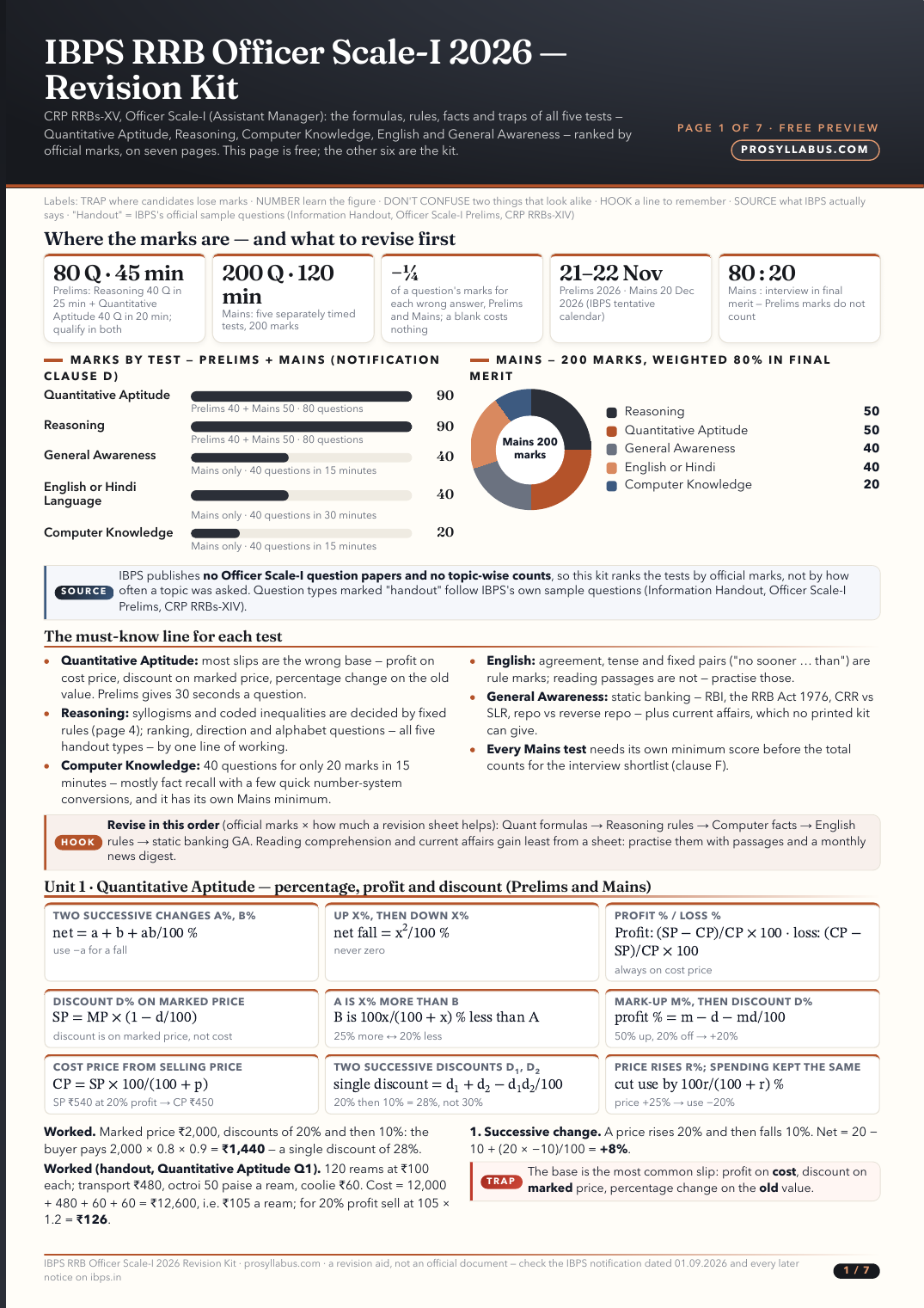
The stage map, diagnostic and board here are free. The separate seven-page Officer Scale I revision kit condenses Quant formulas, Reasoning rules, Computer facts, grammar and static banking points from prelims through interview. Preview its first page and check the current contents and price before buying. The kit is separate from quiz or membership access. ProSyllabus is independent of IBPS.
Preview the RRB Officer Scale I revision kitDo RRB Officer Scale I preliminary marks count in final merit?
No. The preliminary is a qualifying and shortlisting stage. The CRP RRBs-XV notice gives final relative weight to the main examination and interview at 80:20.
Are RRB PO preliminary Reasoning and Quant separately timed?
Yes. The XV notification gives Reasoning 25 minutes and Quantitative Aptitude 20 minutes, with 40 questions and 40 marks in each.
What are the five Scale I main tests?
Reasoning, Computer Knowledge, General Awareness, English or Hindi Language, and Quantitative Aptitude. Together they contain 200 questions, 200 maximum marks and 120 minutes.
Is there an interview for RRB Officer Scale I?
Yes. Scale I has a preliminary, a main and an interview. The interview is 100 marks and has a minimum of 40%, or 35% for SC/ST/OBC/PwBD.
Can a high overall preliminary mock total compensate for a weak section?
It cannot guarantee qualification. The notification requires candidates to qualify in both preliminary tests at IBPS-set minimums. Future numeric cutoffs are not known from the notice.
When are RRB Officer Scale I 2026 prelims and mains?
The tentative IBPS 2026–27 calendar lists prelims on 21 and 22 November 2026 and the Scale I main on 20 December 2026. Check later IBPS updates, call letters and handouts.
Should I begin main subjects before the preliminary result?
A small Computer, General Awareness and language ledger before the preliminary result protects the short planned interval to the main. Keep the separate preliminary qualifying tests as the immediate gate.
Does the kit include quizzes or membership?
The revision kit is a separate digital product. Its offer page provides a first-page preview and current contents and price; check it before deciding.
Sources
- official — IBPS CRP RRBs-XV detailed notification: Scale I pattern and selection rules
- official — IBPS tentative online examination calendar 2026–27
- official — IBPS CRP RRBs-XV notices and corrigenda
official = a document published by the conducting body. reported = a news or coaching site we could not check against an original. Where sources disagree this page says so rather than picking one.